Walk the Line vs. History: How Accurate Is the Johnny Cash Movie?
Walk the Line fact check: Joaquin Phoenix's Oscar-nominated portrayal of Johnny Cash. We examine the real story of Johnny and June Carter Cash in Mangold's 2005 biopic.
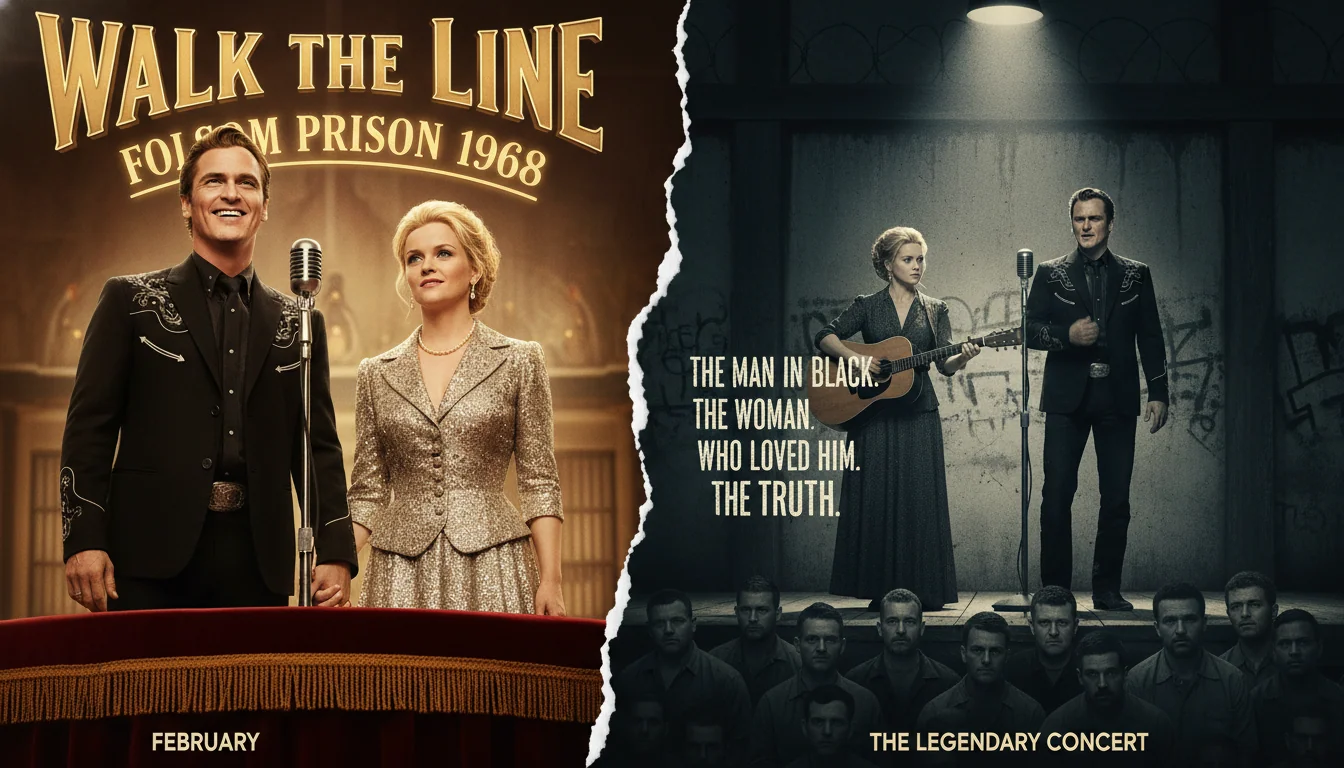
When Walk the Line opened in late 2005, it arrived with the unusual blessing of its subject. Johnny Cash had spent his last months working with director James Mangold and actor Joaquin Phoenix on the script before his death in September 2003. June Carter Cash had also been involved before her death four months earlier. The film that emerged is, by Hollywood biopic standards, unusually faithful to the source material, and unusually generous with the difficult parts.
It compresses the timeline. It softens some edges and sharpens others. It bends the chronology of certain songs. But the central arc, an Arkansas farm boy, an Air Force enlistment, a Sun Records audition, an amphetamine problem that nearly killed him, and a singing partner who would not let him die, is told as Cash himself told it.
So how close to the historical record does the film stay? Closer than most biopics. The major events, in their broad shapes, occurred substantially as the film depicts. The compressions and rearrangements that Mangold and Phoenix used to fit twenty years of life into 136 minutes do not distort the essential story, although they smooth over a great deal that was rough, complicated, and poorly behaved.
What Hollywood Got RIGHT
The Arkansas childhood
Johnny Cash, born J. R. Cash in Kingsland, Arkansas in 1932, grew up on a New Deal resettlement farm in Dyess, Arkansas, with six siblings. His older brother Jack, two years his senior, was deeply religious and intended to become a preacher. In May 1944, Jack was working at the school's agricultural shop when his clothing was caught in a power saw and he was nearly cut in half. He survived for a week, with the family at his bedside, and died at age 14. The film's depiction of Jack's death is detailed and substantially accurate.
The relationship between J. R. and his father, Ray Cash, was as cold and disapproving as the film suggests. Ray Cash blamed his surviving son for his brother's death, told him so, and reminded him of it for decades. The line in the film, "the wrong son died," was, by Cash's own account in his autobiographies, something his father effectively communicated, though never in those exact words.
Sun Records and the audition
In early 1955, Cash, then a recently discharged Air Force radio operator working as a door-to-door appliance salesman in Memphis, talked his way into the Sun Records office at 706 Union Avenue. The film's depiction of Sam Phillips waving him off as just another gospel hopeful, and Cash refusing to leave until Phillips heard him sing his own original songs, follows the story Cash told for the rest of his life. Phillips signed him in March 1955.
Cash's Tennessee Two, with Luther Perkins on guitar and Marshall Grant on bass, were exactly as the film shows them: limited musicians whose limitations created the boom-chicka-boom rhythm that became Cash's signature sound. Perkins, in particular, played because his fingers could not handle anything more elaborate, and the resulting sound was the foundation of every Cash hit through the 1960s.
The amphetamine years
Cash's addiction to amphetamines, particularly Dexedrine and Benzedrine, began in 1957 on tour and consumed roughly the next decade of his life. The film's depiction of his dependence, his erratic behavior, his collapses, his property destruction, and his hospital admissions is broadly accurate. Cash himself admitted in interviews and in his second autobiography to almost everything the film shows.
The film also shows him crashing his Cadillac, setting fire to a national forest (Los Padres National Forest, in 1965, by way of his truck's malfunctioning exhaust), being arrested in El Paso for smuggling pep pills across the Mexican border in his guitar case, and trashing dressing rooms with his band. All of these events occurred essentially as the film depicts them, with minor compression of dates.
The Folsom Prison shows
The film ends with Cash's January 13, 1968 performance at Folsom State Prison in California. This concert was real, the audience response was real, and the live recording released in May 1968 as At Folsom Prison became one of the most important albums of his career. Cash had been writing to prison wardens for over a decade requesting permission to perform, and Folsom was the first prison that finally agreed.
The film also captures, accurately, that Cash had never been to prison himself. He had spent a few nights in jail on charges related to his addictions, but he was not, despite the persistent myth, a former convict. Cash's empathy for inmates was based on family stories, religious conviction, and an outsider's identification, not on personal experience.
The proposal
The film's climactic proposal occurs at the end of the Folsom concert. The actual proposal happened on stage at the Gardens, an arena in London, Ontario, on February 22, 1968, six weeks after Folsom. Cash interrupted his set, asked June to marry him in front of seven thousand people, and refused to go on with the show until she said yes. She said yes. They married a week later in Franklin, Kentucky.
The film moves the proposal earlier and combines it with Folsom for dramatic compression. The substance of the moment, an on-stage proposal that put June in an impossible position and that she accepted, is correct.
What Hollywood Got WRONG
Cash's first marriage
The film treats Vivian Liberto, Cash's first wife, with sympathy that is not always evident in the writing. They married in 1954 after meeting at a roller-skating rink in San Antonio and had four daughters: Rosanne, Kathy, Cindy, and Tara. The marriage was difficult from the beginning. Cash was on the road, addicted, and emotionally unavailable for years.
Vivian's experience of the marriage was, by her own account in her 2007 memoir I Walked the Line, considerably worse than the film suggests. She has been described as feeling sidelined by both Cash's career and the way the Cash mythology was constructed in subsequent decades. The film does not malign her, but it gives June Carter most of the redemptive narrative space, while Vivian functions largely as a backstory wife who could not handle her husband's life.
June Carter's first marriages
June Carter had been married twice before she finally married Cash in 1968. Her first marriage was to country singer Carl Smith from 1952 to 1956, with whom she had a daughter, Carlene Carter, who herself became a successful country musician. Her second marriage was to police officer Edwin "Rip" Nix from 1957 to 1966, with whom she had a daughter, Rosie Nix Adams.
The film mentions that June has been married twice but spends almost no time on either of those marriages, the children from them, or the way June's own life was as complicated as Cash's. The dramatic compression here is real, and a more honest film might have shown June as the country music professional and twice-divorced single mother she actually was when Cash met her.
The Sun Records timing
The film compresses the early years at Sun Records. Cash recorded his first single, "Cry! Cry! Cry!", in 1955, but the chronology of "I Walk the Line," which the film treats as one of his earliest sessions, is moved earlier than its actual recording date in 1956. Similarly, his first concert with Elvis Presley and Carl Perkins is depicted slightly differently from the actual order of events.
These compressions are minor and standard for the genre. None of them affect the substance of the story.
June's role as caretaker
The film, faithfully, shows June stepping in to manage Cash's addictions, throw out his pills, and pull him out of the worst of his collapses. The actual dynamic was more complicated. June was herself a recovering pill user with her own struggles, and her role as Cash's caretaker came at significant cost to her own career, her own children, and her own equilibrium. The film celebrates her without quite acknowledging what the role demanded of her.
What the film captures even when it bends facts
Walk the Line gets one essential thing exactly right: the texture of what it felt like to be Johnny Cash in the 1960s. Joaquin Phoenix, who lost weight, learned to play guitar, and sang every Cash song himself, captured something close to the actual presence of the man. The voice is not perfect (no one's was) but the body language, the brooding, the controlled menace, the quiet self-loathing are all recognizable from the documentary footage and the home recordings.
The film also captures the texture of country music as a small, gossipy, intensely competitive professional world in the 1950s and 1960s. The tour buses, the stale dressing rooms, the package shows where six stars rotated through the same town, the pills passed around backstage, the pastors who tried to save them, are all rendered correctly.
Historical Accuracy Score: 8/10
Walk the Line is one of the more accurate musical biopics Hollywood has produced. The Arkansas childhood, the Air Force years, the Sun Records signing, the addiction, the affair with June, the Folsom concert, and the on-stage proposal are all rendered with care. The film bends the chronology of certain events and underweights both Vivian Liberto's experience and June Carter's pre-Cash life, but the major facts are preserved.
What the film gets most right: the texture of Cash's amphetamine years and Phoenix's recreation of his physical presence on stage.
What it gets most wrong: flattening Vivian Liberto's experience and skating past June Carter's two earlier marriages and her two daughters.
The bottom line is that Walk the Line is more faithful to its subject than almost any other musical biopic, partly because its subject was alive to shape it. If you want to understand the rise, fall, and second rise of Johnny Cash, the film will not lead you far astray, although you should also read Vivian Liberto's I Walked the Line to hear the side of the story the film does not quite tell.
For similar fact-checks of musical biopics, see our analyses of Bohemian Rhapsody and Elvis, two films that take similar liberties with their subjects' lives.
Quick Answers
Common questions about this topic
Is Walk the Line based on a true story?
Yes. The 2005 film, directed by James Mangold, is based on Johnny Cash's two autobiographies, Man in Black and Cash, and on extensive interviews with Cash himself before his death in September 2003. It traces his life from his Arkansas childhood through his rise at Sun Records, his addiction to amphetamines, and his courtship of June Carter, ending with the Folsom Prison concert in January 1968.
Did Joaquin Phoenix and Reese Witherspoon really sing in the film?
Yes. Both actors performed all of their own vocals and learned to play their instruments to a passable level. They trained for over six months under T-Bone Burnett. Witherspoon won the 2006 Best Actress Oscar for the role and the soundtrack went on to win two Grammy Awards.
Did Johnny Cash really propose to June Carter on stage?
Yes. Cash proposed to June during a concert in London, Ontario, on February 22, 1968. The film's depiction of the proposal, mid-show in front of a sold-out audience, is essentially accurate, although the songs surrounding it are slightly rearranged for cinematic flow.
Did Johnny Cash perform at Folsom Prison?
Yes. Cash performed two shows at Folsom State Prison on January 13, 1968. The recordings were combined into the live album At Folsom Prison, released in May 1968, which became one of the bestselling albums of his career and revived him commercially. The film ends with this concert.

Debate the Accuracy with the Real Figures
Ask the real people what Hollywood got wrong about their lives.
Chat with HistoryJoin the HistorIQly Club
Get smarter about the past.
Weekly stories, deep dives, and exclusive content straight to your inbox.