The Disappearance of Amelia Earhart: What Happened Over the Pacific?
In 1937, the most famous woman in aviation vanished over the Pacific Ocean. Nearly 90 years later, her fate remains one of history's most enduring mysteries.
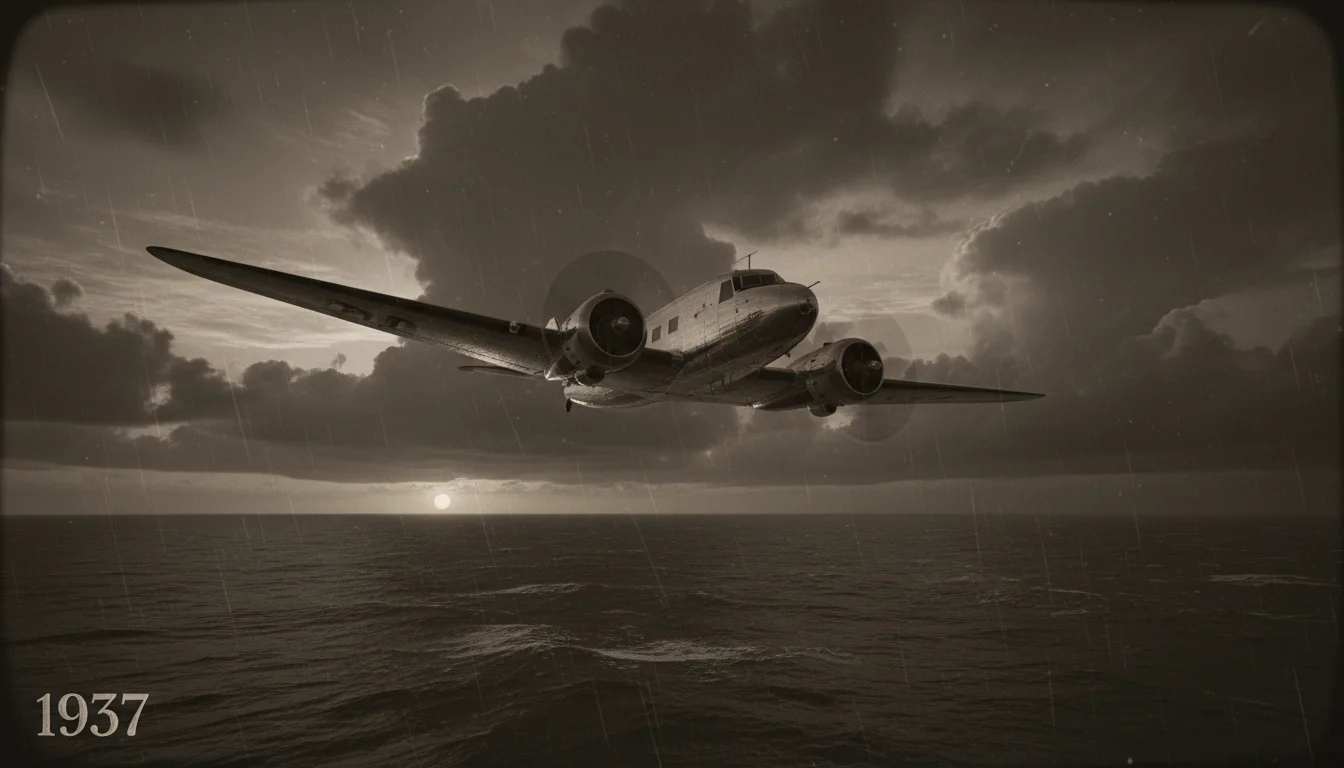
On the morning of July 2, 1937, a Lockheed Electra 10E lifted off from Lae, New Guinea, carrying two people toward a tiny speck of coral in the central Pacific. Amelia Earhart and her navigator Fred Noonan were attempting the longest and most dangerous leg of their around-the-world flight - 2,556 miles of open ocean to Howland Island, a flat strip of land barely two miles long and half a mile wide.
They never arrived.
What happened to Amelia Earhart has become perhaps the most famous disappearance in aviation history. Despite decades of investigation, millions of dollars in search expeditions, and advances in technology that the 1930s could never have imagined, the Pacific has refused to give up its secret.
The Flight That Changed Everything
By 1937, Earhart was already the most famous female pilot in the world. She had been the first woman to fly solo across the Atlantic in 1932, shattering records and expectations in equal measure. But it was her planned circumnavigation of the globe - following as close to the equatorial route as possible - that would be her crowning achievement.
The journey had begun on June 1 from Miami, Florida. Earhart and Noonan hopscotched across South America, Africa, South Asia, and Southeast Asia, covering roughly 22,000 miles in five weeks. By the time they reached Lae, only 7,000 miles remained. The hardest part, however, was still ahead.
The leg to Howland Island was a navigational nightmare. The island sits almost exactly on the equator, rising just six feet above sea level at its highest point. Finding it in the vast Pacific required precise celestial navigation - Noonan's specialty - and reliable radio communication with the U.S. Coast Guard cutter Itasca, stationed offshore to guide them in.
The Last Transmissions
Earhart took off from Lae at 10:00 AM local time on July 2. The Electra was loaded with 1,100 gallons of fuel, enough for roughly 20-21 hours of flight. The expected flight time was approximately 18 hours.
For most of the flight, there was radio silence. The Itasca's crew grew increasingly anxious as the hours ticked by with little contact. Then, at 7:42 AM (Itasca time), Earhart's voice crackled through: "We must be on you, but cannot see you. But gas is running low. Have been unable to reach you by radio."
At 8:43 AM came the final transmission: "We are on the line 157-337. We will repeat this message. We will repeat this on 6210 kilocycles. Wait."
Then nothing.
The "line 157-337" referred to a line of position - a celestial navigation fix running northwest to southeast through Howland Island. It meant Earhart believed she was somewhere along that line but didn't know if she was north or south of her target.
The Itasca immediately began a search. Within days, the U.S. Navy launched the most extensive air and sea search in history up to that point, covering 250,000 square miles of ocean. Battleships, aircraft carriers, destroyers, and dozens of planes scoured the Pacific for sixteen days.
They found nothing. Not a scrap of wreckage, not an oil slick, not a single piece of the gleaming silver Electra.
Theory One: Crashed and Sank
The simplest explanation is often the most likely. Earhart ran out of fuel, ditched in the Pacific, and the plane sank. The central Pacific is thousands of feet deep in most places. A small aircraft swallowed by those waters might never be found.
This theory is supported by the radio evidence. Earhart's transmissions indicated she was low on fuel and couldn't locate the island. If she overshot or drifted off course by even a small margin, she would have found nothing but empty ocean in every direction.
Modern analyses suggest that headwinds during the flight were stronger than forecast, which would have consumed more fuel than planned. Some researchers estimate Earhart may have had less than an hour of fuel remaining during her final transmission.
In January 2024, deep-sea exploration company Deep Sea Vision announced sonar imagery from the ocean floor near Howland Island that appeared to show an aircraft shape at a depth of roughly 16,000 feet. The image generated enormous excitement, though definitive identification remains pending as of this writing.
Theory Two: The Gardner Island Hypothesis
The International Group for Historic Aircraft Recovery (TIGHAR) has spent decades investigating an alternative theory: that Earhart and Noonan, unable to find Howland, turned south along their line of position and landed on Gardner Island (now Nikumaroro), an uninhabited coral atoll roughly 350 miles southeast of Howland.
The evidence is circumstantial but intriguing. In 1940, a British colonial officer exploring Nikumaroro found a partial human skeleton, a woman's shoe, a sextant box, and a Benedictine bottle near a campfire site on the island's southeast shore. A doctor at the time assessed the bones as belonging to a short, stocky European male, and the remains were subsequently lost.
However, in 1998, forensic anthropologists reanalyzed the original bone measurements using modern techniques. Their conclusion: the skeleton was more consistent with a tall woman of European descent - someone matching Earhart's build. A 2018 study using updated forensic methods strengthened this assessment.
TIGHAR expeditions have also recovered artifacts from the island including fragments of plexiglass consistent with an Electra's window, improvised tools, and remnants of American cosmetics from the 1930s. Radio distress calls were also reportedly received in the days after the disappearance, some with details consistent with a landing on a reef flat.
Critics note that Gardner Island had been visited by shipwreck survivors and other castaways over the years, and the artifacts could have other origins.
Theory Three: Captured by Japan
The most dramatic theory holds that Earhart and Noonan went down in the Japanese-held Marshall Islands, were captured, and either died in captivity or were executed as suspected spies.
This theory has persisted in part because of eyewitness testimonies from Marshall Islanders who claimed to have seen a Western woman and man brought ashore by the Japanese in 1937. A photograph discovered in the National Archives in 2017 appeared to show Earhart and Noonan on a dock in Jaluit Atoll, though this was later debunked when researchers found the photo had been published in a Japanese travel book in 1935 - two years before the disappearance.
While the conspiracy theory remains popular in some circles, most historians consider it unlikely. Japan had little strategic reason to capture and conceal two civilian aviators, and no credible documentary evidence from Japanese archives supports the claim.
Why It Still Matters
The Earhart mystery endures not just because of the missing plane, but because of what Amelia Earhart represented. In an era when women were expected to stay home, she flew across oceans. She was bold, charismatic, and unapologetically ambitious - and then she simply vanished.
The Pacific is unimaginably vast. Even today, with satellite technology and deep-sea submersibles, most of the ocean floor remains unmapped. Somewhere beneath those waves - or perhaps on a remote coral island - lie the answers to what happened on that July morning in 1937.
Fred Noonan, the brilliant navigator who shared Earhart's fate, often gets overlooked in the retelling. He was a former Pan American Airways navigator with more Pacific experience than almost anyone alive. Whatever went wrong, it wasn't for lack of skill.
Nearly nine decades later, new expeditions continue to launch. Sonar technology improves. AI-enhanced image analysis scours old photographs. The Pacific keeps its secrets well, but technology is patient, and the search has never truly stopped - much like the decades-long hunt to identify D.B. Cooper.
Amelia Earhart once wrote, "Please know that I am aware of the hazards. I want to do it because I want to do it." She knew the risks. She flew anyway. And the sky that gave her freedom ultimately claimed her, leaving behind a mystery that refuses to die.
Quick Answers
Common questions about this topic
What happened to Amelia Earhart?
On July 2, 1937, Earhart and navigator Fred Noonan took off from Lae, New Guinea, attempting to fly 2,556 miles across the Pacific to tiny Howland Island. They never arrived. Her final transmission came at 8:43 AM, then silence. Despite the largest sea and air search in history up to that point, covering 250,000 square miles, no wreckage was ever found.
What was Amelia Earhart's last transmission?
Her final confirmed transmission was: 'We are on the line 157-337. We will repeat this message. We will repeat this on 6210 kilocycles. Wait.' The 'line 157-337' was a celestial line of position running through Howland Island, meaning Earhart believed she was somewhere along that line but didn't know if she was north or south of her target.
Did Earhart crash and sink in the Pacific?
This is the leading theory. Radio evidence shows Earhart was low on fuel and couldn't locate the island. Modern analyses suggest headwinds were stronger than forecast, burning more fuel than planned. In January 2024, Deep Sea Vision announced sonar imagery near Howland Island showing what appeared to be an aircraft shape at roughly 16,000 feet depth, though definitive identification is still pending.
Is the Gardner Island (Nikumaroro) theory credible?
The theory that Earhart landed on Gardner Island - now Nikumaroro - has been investigated for decades by TIGHAR. A 1940 discovery on the island included a human skeleton, a woman's shoe, a sextant box, and a Benedictine bottle. 1998 and 2018 forensic reanalyses of the bone measurements suggested they were consistent with a tall woman of European descent matching Earhart's build.

Want to Interrogate the Suspects?
Chat with historical figures and uncover the truth behind history's greatest mysteries.
Start Your InvestigationJoin the HistorIQly Club
Get smarter about the past.
Weekly stories, deep dives, and exclusive content straight to your inbox.