The AK-47: How a Soviet Sergeant's Rifle Became the World's Weapon
Mikhail Kalashnikov's 1947 design is the most-produced firearm in history. The story of how the AK-47 escaped Soviet origins and ended up in 80 million hands worldwide.
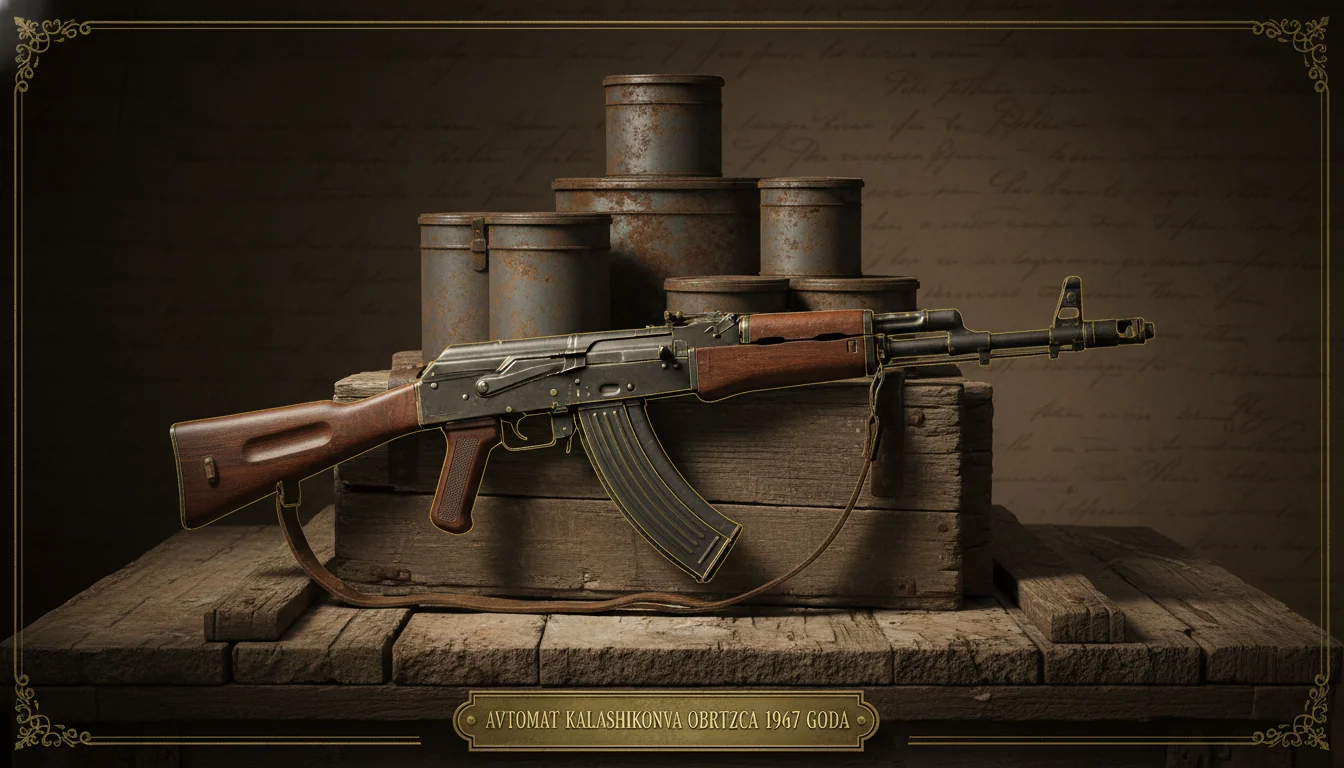
In 1947, a Soviet army sergeant named Mikhail Kalashnikov submitted a prototype assault rifle for trials at the Soviet small arms commission. Two years later, his design was adopted as the Avtomat Kalashnikova obraztsa 1947 goda, the Kalashnikov automatic rifle of 1947, universally known by its abbreviation AK-47. In the seventy-nine years since, that rifle and its direct descendants have been produced in larger numbers than any other firearm in human history. They have armed Soviet conscripts, African revolutionaries, Latin American guerrillas, Afghan mujahideen, and countless state and non-state combatants on every continent. The rifle is on the flag of Mozambique. It is on the coat of arms of Zimbabwe. It is in the possession of an estimated one in every eighty people on Earth.
A wartime education
The AK-47's design philosophy emerged from Soviet wartime experience. In the Second World War, Soviet infantry was issued a mix of bolt-action rifles, semi-automatic SVT-40s, submachine guns chambered in pistol-caliber 7.62x25, and the long-range Mosin-Nagant in 7.62x54R. The submachine guns were lethal at close range but useless past 200 meters. The full-power rifles were accurate at long range but slow-firing and clumsy in close-quarters fighting.
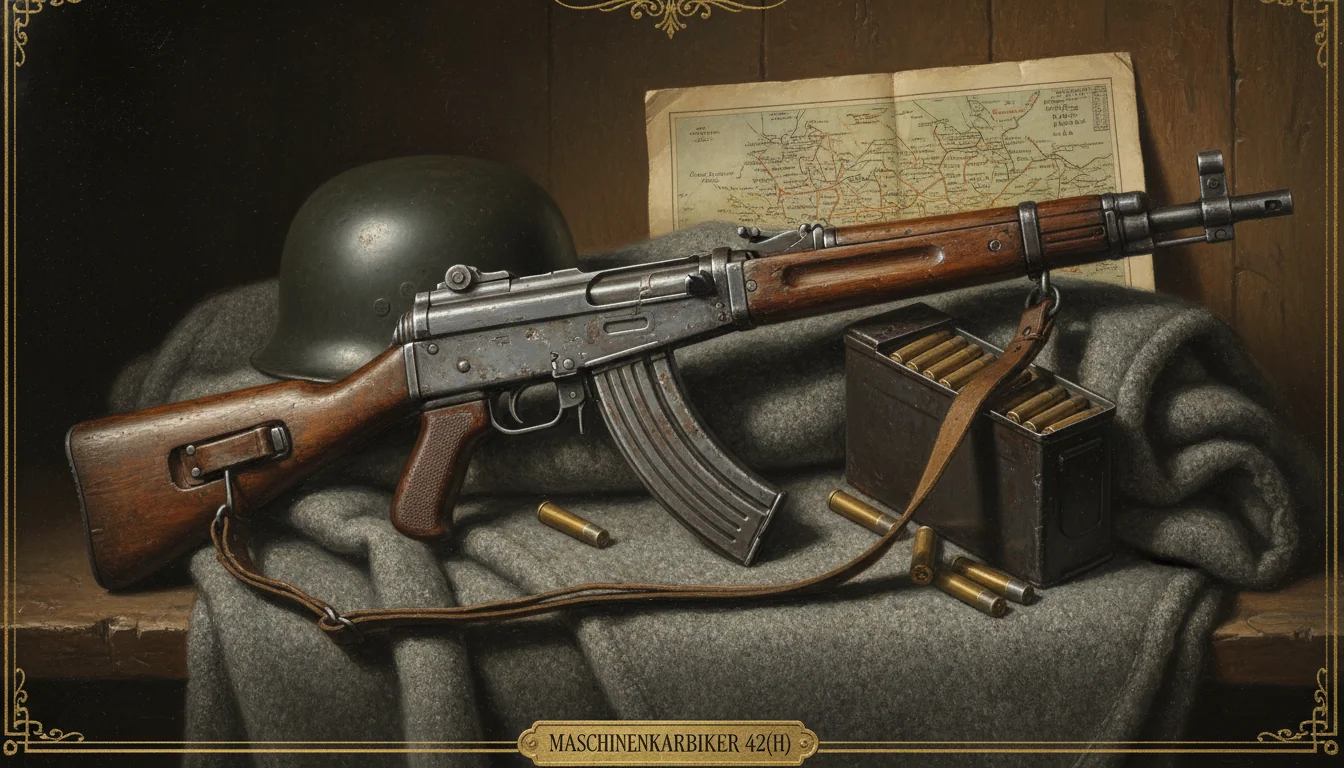
The Germans, facing the same problem, developed an intermediate cartridge and a rifle to fire it: the 7.92x33 Kurz round and the StG 44 assault rifle. Soviet examiners studied captured StG 44s and concluded that the future of infantry warfare lay with selective-fire weapons firing intermediate cartridges, optimized for the 200- to 400-meter ranges where most combat actually occurred.
The Soviet government issued a development specification for a new intermediate cartridge in 1943. The 7.62x39mm round was adopted in 1944. With the cartridge fixed, the next requirement was a rifle to fire it. Multiple designers competed: Sudayev, Bulkin, Dementiev, and Kalashnikov among them.
Mikhail Kalashnikov
Kalashnikov was born in 1919 in a peasant family in the southern Urals. He served as a tank crewman in the early phases of the Soviet-German war, was wounded at the Battle of Bryansk in October 1941, and during his hospital recovery began sketching designs for a submachine gun. After the war, the Soviet army assigned him to small-arms development at the Izhevsk arsenal.
Kalashnikov was not a trained engineer in the formal sense. He was a self-taught soldier-mechanic who worked closely with experienced design teams. The AK-47 was emphatically a team product, despite the singular name. Aleksandr Zaitsev, in particular, contributed substantially to the rifle's final form. Kalashnikov himself acknowledged the team contribution in his later memoirs, although the Soviet propaganda apparatus, then and later, preferred a single hero narrative.
The AK-47 prototype emerged in late 1946 and was selected for trials in 1947. After several iterations, the rifle was adopted by the Soviet army in 1949. Mass production began at the Izhmash plant in 1948-49 and ramped up steadily through the 1950s.
What made it work
The AK-47's mechanism is a long-stroke gas-operated piston with a rotating bolt. Gases tapped from the barrel push a piston attached to the bolt carrier rearward, the bolt carrier rotates the bolt to unlock, the case is extracted and ejected, and a return spring drives the bolt carrier forward to chamber the next round. This is not new technology; the Garand and the StG 44 used variations of the same principle. What was new was the implementation.
Kalashnikov's design used loose tolerances throughout the action, with generous clearances between moving parts. Machining was simplified to the level that Soviet factories could mass-produce the rifle without high-precision equipment. The trigger group was a stamped sheet metal assembly. The bolt carrier and bolt were robust forgings. The receiver, in the original AK-47, was milled from steel; in the later AKM (1959), it was stamped to reduce weight and cost.
The result was a weapon that could be made cheaply, in millions, and would function reliably under almost any battlefield condition. Soviet acceptance trials famously included tests in mud, sand, snow, and water, and the AK passed every one with rates of fire that approached its theoretical maximum. Western designers visiting captured AKs in the 1950s were initially dismissive of the loose machining and the apparent crudeness of the parts. Then they tried to make the rifle malfunction. They could not.
The Warsaw Pact and beyond
The Soviet Union did not patent the AK-47 internationally and did not enforce intellectual property restrictions on its Warsaw Pact allies. By the late 1950s, license-built versions of the AK were being produced in East Germany (MPi-K), Hungary (AMD-65), Romania (PM md. 63), Yugoslavia (Zastava M70), Bulgaria, Poland, and Czechoslovakia.
The Chinese acquired the design through Soviet aid in the 1950s and produced their own version, the Type 56, in vast numbers. After the Sino-Soviet split, Chinese production continued and the Type 56 became one of the most common weapons in the developing world. By the late 20th century, Chinese-made AKs were ubiquitous in conflicts from Vietnam to Africa to Latin America.
Egypt, Iraq, North Korea, Vietnam, and Pakistan all produced or assembled AK variants. Pakistani gun-shops in the Khyber region of the North-West Frontier turned out hand-made AK copies in cottage workshops, with quality ranging from indistinguishable from factory output to actively dangerous to fire.
By 1990, an estimated 50 million AK-pattern rifles had been produced worldwide. By 2020 the figure was somewhere between 75 and 100 million.
Cold War combat
The AK-47 was the standard rifle of the Soviet Army from 1949 until the 1970s. It saw its first major combat use in Hungary in 1956, was the standard rifle of North Vietnamese regulars during the Vietnam War, and became iconic in revolutionary movements through the 1960s and 70s.
In Vietnam, American soldiers issued the early M16 frequently picked up captured AK-47s because the M16's early teething problems made it less reliable than the rifle they were fighting. The contrast was instructive: the M16 was theoretically more accurate, lighter, and tactically superior, but the AK was the rifle that actually worked when you needed it to.
The Soviet experience in Afghanistan, from 1979 to 1989, saw both sides of the war using AK derivatives, with Soviet conscripts carrying the AK-74 in 5.45x39 and Afghan mujahideen carrying older AKM and AK-47 variants supplied by China, Egypt, and Pakistan. The two-rifle conflict illustrated how thoroughly the Kalashnikov design had spread on both sides of the Cold War.
Symbol and tool
The AK-47 has acquired more political and cultural symbolism than any other firearm. The image is on the flag of Mozambique (independence 1975), the coat of arms of Zimbabwe (independence 1980), the emblem of the Hezbollah movement, the iconography of countless revolutionary and insurgent groups, and the name of streets, neighborhoods, and even children. In Yemen and parts of Pakistan, the AK is so common that boys are routinely named "Kalash" after it.
The rifle's symbolic association with revolution and resistance is both deserved and exaggerated. It is genuinely the rifle of post-colonial wars, of Cold War proxy conflicts, and of asymmetric combat against state forces. It is also the rifle of state armies, paramilitary police, and uniformed soldiers in dozens of countries. The Kalashnikov is not exclusively a guerrilla weapon. It is simply the most common rifle in existence.
The long evolution
The basic AK-47 received only modest changes over its lifetime. The AKM, introduced in 1959, switched to a stamped sheet-metal receiver, reducing weight from 4.3 to 3.1 kilograms and simplifying production. The AK-74, adopted in 1974, switched to the smaller 5.45x39mm cartridge after Soviet examination of the U.S. M16's 5.56x45 round suggested that smaller, faster bullets were the future of infantry warfare. The 100-series, introduced in the 1990s, modernized stocks, sights, and accessories without altering the core mechanism.
The AK-12, adopted by the Russian army in the 2010s, is the most thoroughly redesigned variant, with modern furniture, modular accessories, and improved ergonomics. It is still recognizably a Kalashnikov, with the same long-stroke gas piston and rotating bolt that Mikhail Kalashnikov drew in 1946.
What Kalashnikov said
Mikhail Kalashnikov lived to 94, dying in 2013. In his final years he expressed mixed feelings about the rifle's worldwide use. In a 2012 letter to the Russian Orthodox Patriarch, made public after his death, he asked whether he was responsible for the deaths of the people his rifle had killed, and whether the church could provide spiritual comfort to a man who had built such a weapon. The Patriarch responded that a soldier doing his duty for his country bore no personal responsibility for what others did with his work.
That theological answer was perhaps the most that could be offered. The AK-47 has killed more people than any other firearm in history, by a margin that may never be matched. It was designed to be a battlefield rifle for Soviet infantry. It became, instead, the global tool of armed conflict in the second half of the 20th century and the first quarter of the 21st.
A weapon that defines an era
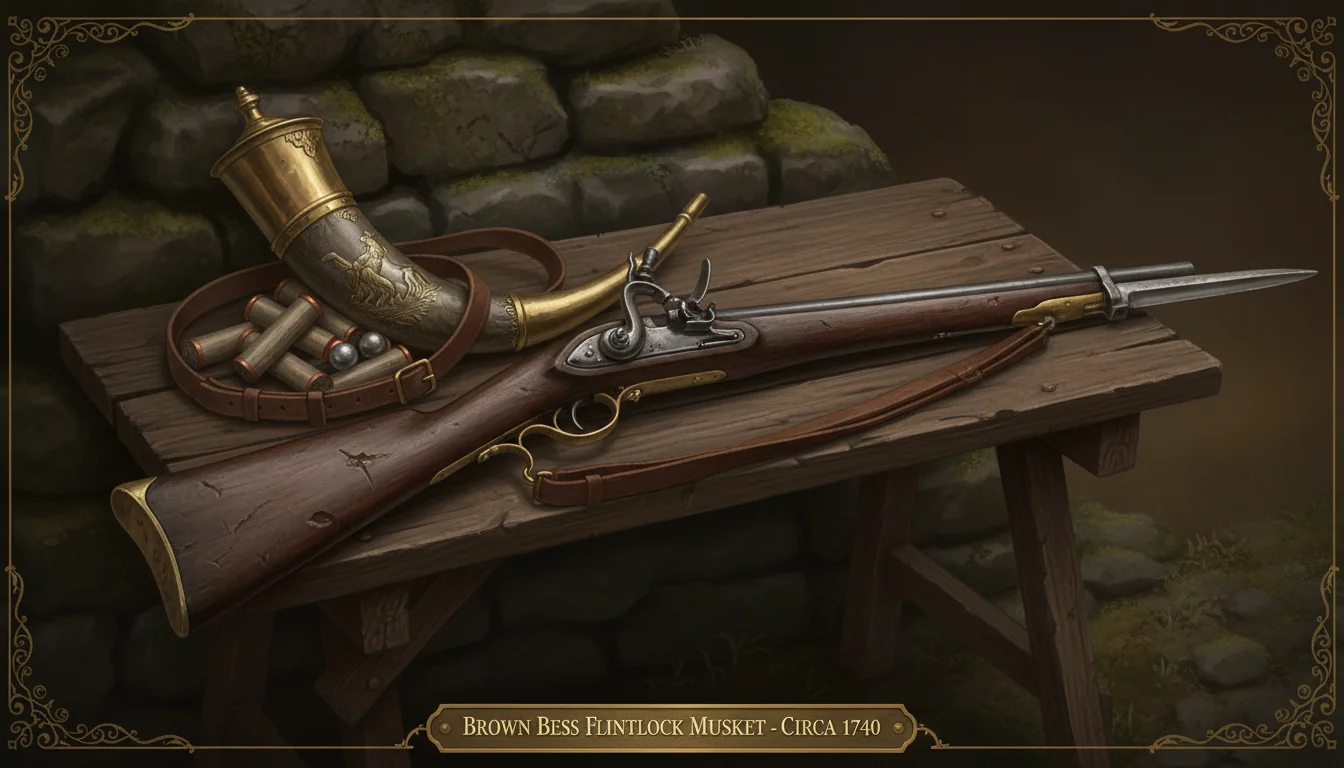
The AK-47 is the rifle of the modern world the way the Maxim was the rifle of 1914 or the Brown Bess was the rifle of 1800. It is the product of a specific industrial civilization (Soviet mass production), a specific tactical doctrine (combined-arms war at intermediate ranges), and a specific historical moment (the early Cold War). And like its predecessors, it has so dominated its category that the next weapon to displace it will have to do so in a world where AK-pattern rifles are still being made and used in the millions.
Whether that displacement comes from advances in personal weapon technology, from changes in the strategic balance, or simply from the ordinary obsolescence of an 80-year-old design, the Kalashnikov will be hard to retire. It is too cheap, too durable, and too embedded in too many supply chains and cultural imaginations to disappear. The AK-47, like the longbow and the gladius before it, is a weapon that outlasted its strict tactical utility because the world it created refuses to stop using it.
Quick Answers
Common questions about this topic
How many AK-47s have been produced?
Estimates range from 75 to 100 million Kalashnikov rifles of all variants worldwide, dwarfing any other firearm in history. The figure includes Soviet/Russian production, license-built copies in former Warsaw Pact states, and unlicensed copies made in China, Pakistan, Bulgaria, Egypt, and many other countries. Total small-arms production globally has been around 1 billion units, meaning the AK family represents close to a tenth of all firearms ever made.
Did Mikhail Kalashnikov get rich from the AK-47?
No. He worked as a Soviet state employee and received state honors but no royalties for decades. The Soviet Union did not pay royalties to inventors, and the design was widely copied without license worldwide. Late in his life he was made a Hero of the Russian Federation and received some commercial endorsements, but he never became wealthy by the standards of Western inventors. He died in 2013.
Why is the AK-47 so reliable?
The action is gas-operated with a long-stroke piston, generous internal clearances, and few precision-machined parts. This means dirt, sand, mud, and corrosion that would jam tighter-tolerance designs are simply pushed through the mechanism. The trade-off is that the AK is less accurate than a tighter weapon. For its intended use - infantry combat at typical engagement ranges - that trade-off is exactly right.
What is the difference between the AK-47, AKM, and AK-74?
The AK-47 is the original 1947 design, with a milled steel receiver. The AKM, introduced in 1959, uses a stamped steel receiver and is lighter. The AK-74, adopted in 1974, switches to the smaller 5.45x39mm cartridge. All three share the same basic mechanism. Most rifles called 'AK-47' in popular use today are actually AKMs or unlicensed derivatives.

Talk to the People Who Wielded These Weapons
Chat with the soldiers, smiths, and commanders whose lives were shaped by the weapons of their age.
Talk to a WarriorJoin the HistorIQly Club
Get smarter about the past.
Weekly stories, deep dives, and exclusive content straight to your inbox.