Arsenal: The M1 Garand, the Rifle That Won the War
The M1 Garand, Patton's greatest battle implement ever devised: how John Garand's semiautomatic rifle gave American infantry a decisive firepower edge in World War II.
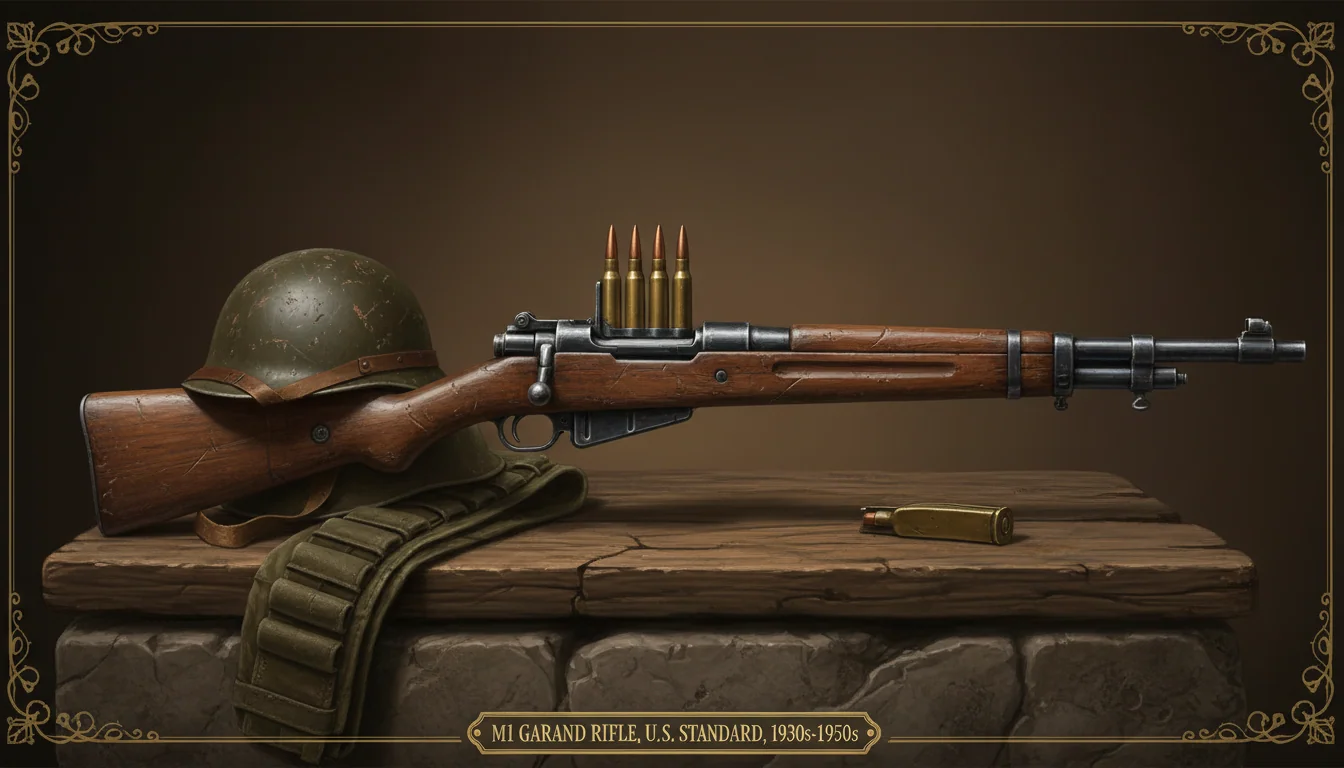
When General George S. Patton wrote in January 1945 that the M1 Garand was the greatest battle implement ever devised, he was not being rhetorical. The rifle had been in U.S. service for nine years. American infantrymen carrying it had walked into Tunisia, climbed Monte Cassino, waded ashore at Omaha Beach, fought through the Hurtgen Forest, and held the line at Bastogne. Wherever they had encountered German or Japanese soldiers carrying bolt-action rifles, the math had favored them. The M1 was the first standard-issue semiautomatic battle rifle in any major army, and for almost a decade no other power had a comparable answer.
This is the story of how a Canadian draftsman at Springfield Armory spent nearly twenty years engineering a rifle that nobody initially wanted, and how, when the Second World War arrived, that rifle quietly redefined what an infantry squad could do.
A long road to adoption
The U.S. Army entered the First World War in 1917 with the M1903 Springfield, a beautiful bolt-action rifle that fired the powerful .30-06 cartridge. Like every other major rifle of its generation, it was a product of the prewar consensus that infantry should fire deliberately, slowly, and at long range. After 1918, American Ordnance officers who had watched the war up close started asking a different question. What if every soldier had a rifle that fired as fast as he could pull the trigger?
Several designers attempted to answer that question. The most successful was John Cantius Garand, a French-Canadian immigrant who had taken U.S. citizenship in 1920 and joined the Springfield Armory in 1919. Garand was self-taught, methodical, and famously patient. He worked on a series of prototypes through the 1920s, first a primer-actuated design (in which the slight rearward thrust of the cartridge primer cycled the action), then, after testing exposed problems with that approach, a gas-operated design that tapped propellant gas from a port near the muzzle to drive the operating rod backward.
By 1932 the gas-operated rifle, designated T1E2, had defeated competing designs from John Pedersen and others in field trials. By January 1936 it was officially adopted as the U.S. Rifle, Caliber .30, M1. It would take another five years before production reached the volumes the Army needed, and the early years of mass production were plagued by reliability issues, particularly a problem with the gas cylinder near the front sight known as the seventh-round stoppage. By 1941, Springfield had redesigned the gas system and the rifle was ready for war.
The technology
The M1 Garand is, mechanically, a remarkable piece of engineering. It fires the .30-06 cartridge from an eight-round steel clip, an unusual design feature that made the rifle distinctive and that, in 1936, was almost the only way to combine a fully self-loading action with reliable feed. The clip is loaded into the open receiver from the top, the operating rod springs forward to chamber the first round, and after the eighth shot the clip is ejected upward with a clear metallic ping.
The famous ping is a small but persistent feature of M1 mythology. German and Japanese soldiers, the legend goes, learned to listen for it as a signal that an American rifleman was momentarily out of ammunition and could be rushed. The legend is real but exaggerated. In the chaos of an actual firefight, with multiple riflemen, machine guns, mortars, artillery, and the engine noise of vehicles, hearing one specific ping over twenty yards of broken ground was difficult. Veterans on both sides recall hearing it. Few recall acting on it.
The rifle's gas system is simple, durable, and forgiving of dirt. The trigger group is removable as a single unit for cleaning. The wooden stock and handguards are stout American walnut. The whole rifle weighs about 9.5 pounds, comparable to its bolt-action peers. Its sights, an aperture rear and a winged front blade, were genuinely the best combat sights of any rifle of the period. Most American riflemen could hit a man-sized target reliably out to 400 yards with no special training.
The squad transformed
It is hard to overstate what a self-loading rifle did to the rifle squad. A bolt-action rifleman in a German Schütze unit or a Japanese rifle squad fired three to five aimed rounds per minute under combat conditions. An American rifleman with the M1 could fire fifteen to twenty rounds per minute and reload in less than five seconds. Multiplied across a twelve-man squad, the imbalance was extreme.
It was not just rate of fire. It was sustained fire under stress. Bolt-action shooters in their first firefight tended to fumble the bolt under adrenaline; M1 shooters did not need to. They could focus on aim, on cover, on the man next to them. Squad fire-and-movement tactics, which all major armies were trying to perfect by 1939, fit the M1 the way it fit the hand. The Germans, who had adopted excellent doctrine, had to compensate with their MG34 and MG42 belt-fed machine guns, which fired at extraordinary rates and made up much of the firepower differential at the squad level. But for individual rifle exchanges, the Americans were ahead.
The war
The M1 first saw extensive combat with U.S. Marines on Guadalcanal in late 1942, although many Marines initially carried the older M1903 Springfield until M1 supplies caught up. By North Africa in early 1943, U.S. Army units were equipped almost entirely with the M1. From that point onward, every major American campaign of the Second World War was conducted with the Garand as the standard rifle.
Specific moments stand out:
- Tunisia, 1943. First sustained Army-level use against German troops, who reported in after-action analyses that American rifle squads were producing volumes of fire that they had not expected.
- Italy, 1943-1945. Italian terrain, with its ridgelines, terraces, and short engagement distances, suited the M1's strengths perfectly.
- Normandy, 1944. Photographs of the Omaha Beach landings show American soldiers wading ashore with M1s in olive-drab waterproof bags. Once the bocage country was reached inland, the rifle's high rate of accurate fire helped break a series of small, costly hedgerow assaults.
- Bastogne, 1944. During the German Ardennes counteroffensive, U.S. units of the 101st Airborne fought with M1s, M1 Carbines, and M1919 machine guns at very short ranges. The Garand's reliability in extreme cold, with frozen lubricants and snow-clogged actions, was widely praised.
- The Pacific, 1942-1945. From Tarawa to Iwo Jima to Okinawa, the M1 fought a different war: shorter ranges, denser cover, smaller targets, frequent night close-quarters action. It performed well, although the M1 Carbine was often preferred for jungle scouting because of its lighter weight.
The Korean encore
The Garand's second war is sometimes forgotten. From 1950 to 1953, U.S. and U.N. forces in Korea fought North Korean and Chinese armies still equipped largely with bolt-action Mosin-Nagant rifles and submachine guns. The firepower asymmetry that had been decisive in 1944 was decisive again. American riflemen at the Pusan Perimeter, at Inchon, at the Chosin Reservoir, fought with the same rifle their fathers had carried, and produced the same imbalance of effective fire.
What changed during Korea was the appearance of large numbers of Chinese troops carrying captured Soviet PPSh-41 submachine guns, which produced enormous volumes of close-range fire. At ranges under 75 yards, the PPSh frequently outshot the Garand. At every other distance, the Garand still dominated.
The end
By the early 1950s, the world's major militaries had begun adopting intermediate cartridges and select-fire rifles capable of automatic fire. The Soviets had the AK-47 by 1949. The Belgians had the FN FAL by 1953. The Germans, before their defeat, had pioneered the concept with the StG 44.
The U.S. Army's response was the M14, adopted in 1957. The M14 was, in essence, a modernized Garand. It used the same basic gas-operated, rotating-bolt action. It accepted a detachable 20-round magazine instead of an en-bloc clip, fired the new 7.62x51mm NATO cartridge, and could be fitted for select-fire (although in practice almost all M14s were issued in semiautomatic only, because the .30-caliber cartridge was nearly uncontrollable on full automatic from a 9-pound rifle). The M14 served as the U.S. standard rifle for less than a decade before being replaced by the M16, but its lineage was unmistakable. Underneath the new wood and steel, it was Garand's design.
The M1 Garand itself stayed in service. National Guard units carried it well into the 1960s. Reserve and ROTC units used it into the 1970s. Even today, the M1 is the official drill rifle of the U.S. Army's ceremonial units, including the Tomb of the Unknown Soldier guard at Arlington. More than 6 million M1s were produced between 1937 and 1957. Many of them have been sold to civilians through the Civilian Marksmanship Program, and a well-maintained Garand remains, almost ninety years after John Garand finalized the design, an excellent shooter.
Echoes
The Garand changed every army that fought against it. The Germans, having watched American rifle squads produce sustained fire that their bolt-action infantry could not match, accelerated the development of the StG 44, the world's first true assault rifle, in part to recover the firepower balance. The Soviets watched both, and Mikhail Kalashnikov synthesized the lessons in 1947. The trajectory from John Garand's first prototype in 1919 to Mikhail Kalashnikov's AK-47 in 1947 is, viewed at the right angle, a single argument: the era of the deliberate, slow-firing battle rifle was over, and the side with self-loading or fully automatic infantry weapons would dominate the rifle squad.
Garand himself never grew rich from his design. He worked at Springfield Armory until his retirement in 1953 on a federal salary that never reflected the historic importance of his rifle. He died in 1974, having spent most of his last years quietly puttering with engineering projects in his Massachusetts home. He was, by all accounts of the few colleagues who survived him, a modest man slightly bemused by the thought that he had given his adopted country one of the decisive weapons of the 20th century.
Patton, who was rarely modest about anything, was right. For a particular kind of war, fought between 1941 and 1953, the M1 Garand really was the greatest battle implement ever devised. It is a rare piece of military equipment that earns the praise of the man who used it most flamboyantly and the engineer who most quietly built it. The Garand earned both.
For comparisons with the rifles it faced and the one that succeeded it, see our entries on the Mauser K98 and the M16 rifle.
Quick Answers
Common questions about this topic
Who invented the M1 Garand?
John Cantius Garand, a Canadian-born engineer at the U.S. Army's Springfield Armory, designed the rifle. He worked on the project for nearly two decades, beginning in 1919, before the M1 was officially adopted in 1936. He never received royalties; the rifle was developed under government salary and the design belonged to the United States.
How many rounds did an M1 Garand hold?
Eight rounds of .30-06 Springfield ammunition, loaded via a steel en-bloc clip that was inserted into the receiver as a single unit. After the eighth round was fired, the empty clip was ejected upward with a distinctive metallic 'ping' that became one of the most recognizable battlefield sounds of the Second World War.
Was the M1 Garand really better than the K98?
In sustained fire, decisively. The bolt-action Mauser K98 was accurate and reliable but required the shooter to manipulate the bolt between every shot. A trained American rifleman could put eight aimed rounds downrange in roughly twelve to fifteen seconds. The German equivalent could manage three or four. Across a squad, that translated into a fundamental imbalance of firepower.
Why did the U.S. replace the M1 Garand?
By the mid-1950s, NATO had standardized the 7.62x51mm cartridge and the U.S. Army wanted a select-fire rifle with a detachable box magazine. The M14, adopted in 1957, was essentially a modernized Garand with these features. The M1 itself remained in National Guard and reserve service into the 1970s and is still used as a ceremonial drill rifle today.

Talk to the People Who Wielded These Weapons
Chat with the soldiers, smiths, and commanders whose lives were shaped by the weapons of their age.
Talk to a WarriorJoin the HistorIQly Club
Get smarter about the past.
Weekly stories, deep dives, and exclusive content straight to your inbox.