The Flintlock Musket: The Weapon That Wrote the Modern World
The flintlock musket armed two centuries of infantry warfare, from Marlborough to Napoleon. History, mechanics, and the legacy of the gun that built the modern world.
For two centuries, between roughly 1690 and 1840, the flintlock musket was the most important weapon in the world. It armed the redcoats at Blenheim, the grenadiers of Frederick the Great, the continentals at Saratoga, and the columns of Napoleon. It was the weapon that conquered colonies, defended frontiers, and decided the wars that produced the modern nation-state. Its tactics, drill manuals, and logistical infrastructure shaped European militaries down to the regiment, and many of those structures survive today even though the weapon itself disappeared in a single generation when something better came along.
From matchlock to flintlock
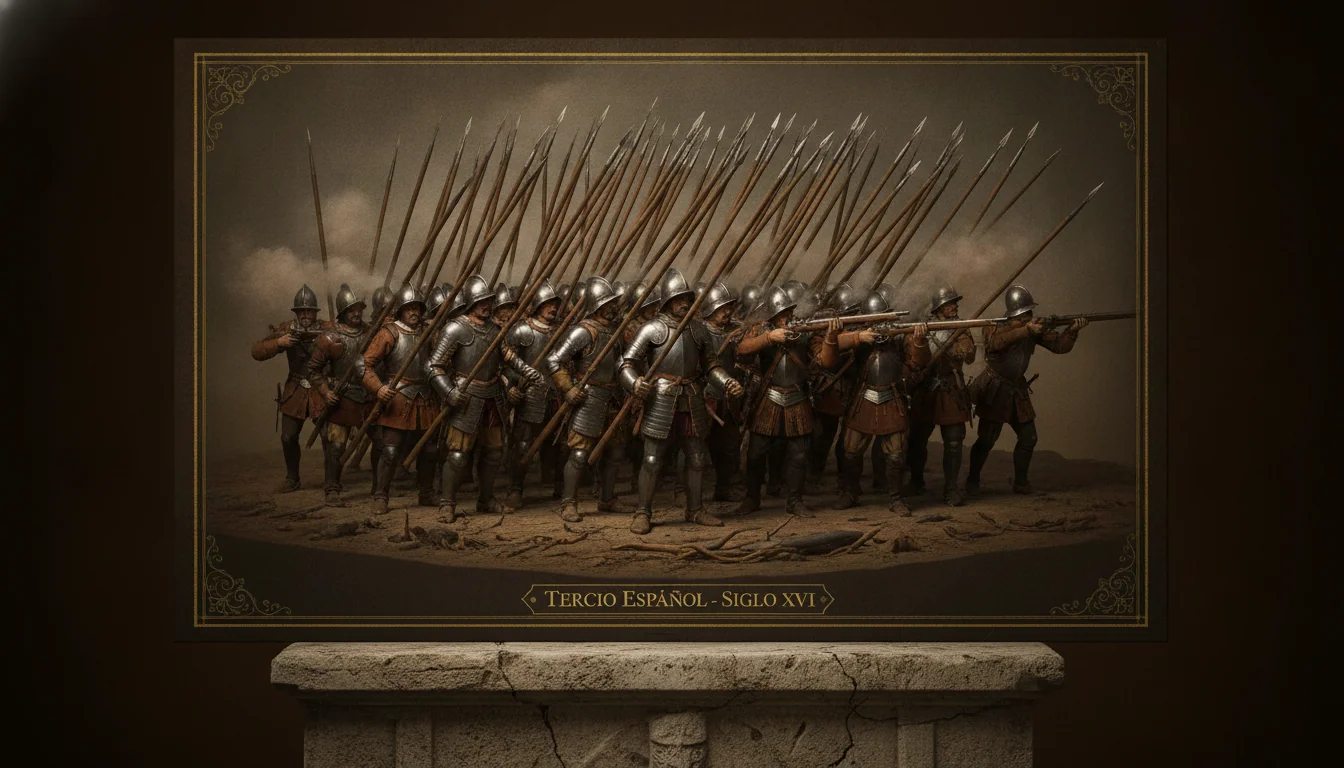
The flintlock did not appear suddenly. The history of the firing mechanism is a long sequence of incremental improvements over more than a century. The matchlock, dominant in the 16th century, used a slow-burning length of saltpetered cord called the match, which the soldier kept lit and brought to the priming pan with a serpentine arm when he pulled the trigger. It worked, but it had obvious problems: rain extinguished the match, the soldier had to handle a lit cord near gunpowder, and a regiment of matchlock men was visible at night by the dozens of glowing match-tips.
The wheellock, used in the 16th and 17th centuries, replaced the cord with a spring-driven steel wheel that struck a piece of pyrite to produce sparks. It was faster, weatherproof, and reliable, but expensive and delicate. Wheellock muskets were carried mostly by cavalry and aristocrats; ordinary infantry could not be issued them in numbers.
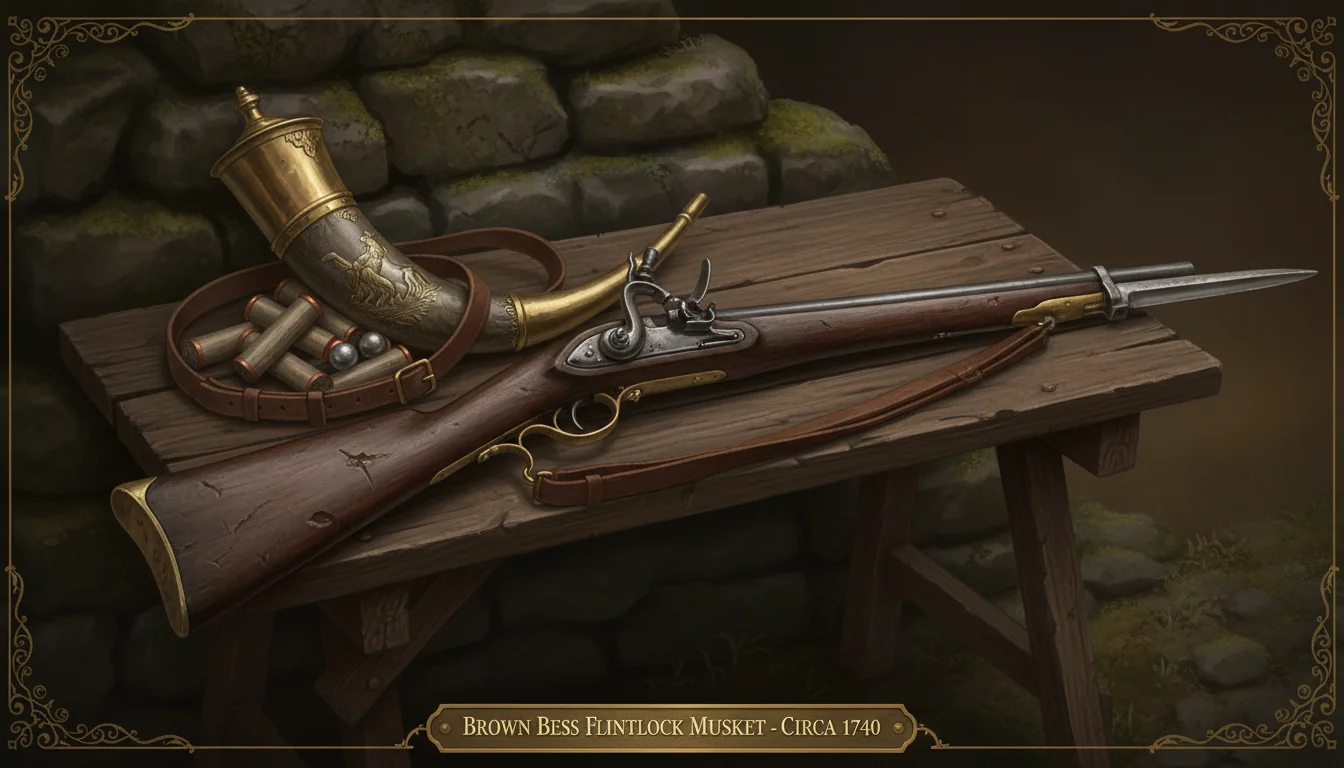
The snaphance, the dog-lock, and the miquelet were intermediate steps. By the late 17th century, the design that we now call the true flintlock, with a single integrated cock-and-frizzen mechanism and a half-cock safety, had emerged in France. The Charleville Model 1717 was the first major army issue. The British Brown Bess, introduced around 1722, was the standard issue for the British army through the Napoleonic Wars.
How a flintlock works
The action is almost mechanically poetic. The soldier pulls back the cock, which holds a piece of flint between two jaws. He primes the pan with a few grains of fine powder and closes the frizzen, a hinged steel cover that doubles as the striking surface. He pours the main powder charge down the barrel from a paper cartridge, drops in the lead ball, rams it home, and presents the weapon.
When the trigger is pulled, the cock falls forward, scraping the flint along the curved face of the frizzen. The friction throws sparks while simultaneously knocking the frizzen open, exposing the priming pan. The sparks ignite the priming powder, which flashes through a touch-hole in the side of the barrel and ignites the main charge. The ball is driven down the barrel and out the muzzle.
This sequence takes about a tenth of a second. There is a perceptible delay between trigger pull and discharge, called lock time, which adds to the inaccuracy of the weapon. A skilled marksman could compensate by following through on the aim. Most soldiers could not.
The line of battle
The flintlock musket made the linear battle possible. Throughout the 18th century, European infantry fought in long, thin lines, two or three ranks deep, designed to maximize the volume of fire from each soldier's musket. Tactics turned on the speed of reloading, the discipline of the volley, and the readiness to advance with the bayonet after a few exchanges of fire.
The Prussian army under Frederick the Great mastered this drill more thoroughly than anyone else. Frederick's infantry could fire five rounds per minute in short bursts and three rounds sustained, with the front rank kneeling and the rear ranks firing over their heads. The drill manuals of the period, including the British 1764 Manual Exercise, codified every motion of loading and presenting in a fixed sequence of perhaps thirty separate commands.
Battles unfolded as choreographed exchanges. Two lines closed to within 50 to 100 paces, opened a rolling fire by platoons or files, and either broke each other with sustained volleys or charged with the bayonet to decide the issue at the point.
Range, accuracy, and lethality
The flintlock musket was inaccurate. The ball was deliberately undersized to load quickly down a fouled barrel, which meant it bounced off the lands of the smoothbore and emerged at unpredictable angles. The lock time added another source of error. The huge cloud of smoke from black powder obscured the target after the first volley.
Tests by the Prussian army in 1810, against a target the size of an enemy formation 100 meters away, found that experienced troops hit it about 60 percent of the time. At 200 meters the rate dropped to about 25 percent. At 300 meters the musket was useful only for psychological effect.
But the lethality of a hit was extreme. The soft lead ball, typically about 18 mm in diameter and weighing 28 grams, deformed on impact and produced wounds far beyond what modern small-caliber rifles do. Bones were shattered, soft tissue was destroyed, and any hit to the torso was likely fatal in the medical conditions of the age. Even with the inaccuracy, a regiment of 600 muskets firing three rounds a minute could deliver enough hits to break the enemy line within minutes.
The Brown Bess and the Charleville
Two muskets dominated the 18th and early 19th centuries. The British Land Pattern Musket, universally known as the Brown Bess, was introduced around 1722 and went through several revisions before being replaced in the 1830s. Calibre was 19 mm, length about 1.5 meters, weight about 4.5 kg. The bayonet was a triangular socket type, 43 cm long.
The French Charleville series, named for the arsenal at Charleville-Mézières, ran from the 1717 model through the 1777 model that armed the French revolutionary and Napoleonic armies. Calibre was slightly smaller at 17.5 mm. Weight and length were similar.
Both designs were copied, modified, and licensed across Europe and the Americas. The American Continental Army of 1775 to 1783 used a mix of Brown Besses captured from the British, Charlevilles supplied by France, and a variety of locally made approximations.
Logistics and infrastructure
The flintlock musket reshaped military logistics. Armies needed steady supplies of black powder, lead, paper for cartridges, flints, and replacement parts. Major arsenals at Charleville, Liège, Suhl, and Birmingham produced muskets in the tens of thousands. The British Tower of London, the French Manufacture d'Armes de Saint-Étienne, and the Springfield Armory in Massachusetts were direct expressions of musket-era industrial policy.
Flints themselves became a strategic commodity. The best gun flints came from the chalk mines of Brandon in Suffolk, England. A single Brown Bess soldier needed a fresh flint every twenty to thirty rounds, which meant the British army went through millions of flints in a campaign. The flint trade between France and England continued even during wars because both sides needed Brandon flints.
Cartridges were prepared in advance, by companies of women working at the arsenals or by soldiers themselves on the eve of battle. A standard paper cartridge held the powder charge and ball in a single tube of waxed paper. The soldier bit off the end, primed the pan, poured the rest down the barrel, and rammed the empty paper as wadding.
Beyond Europe
The flintlock musket spread well beyond European armies. Mughal and Maratha armies in India, Qing forces in China, Tokugawa garrisons in Japan, and Ottoman janissaries all carried flintlocks of varying quality. African kingdoms along the West African coast bought hundreds of thousands of European flintlocks through the Atlantic trade, which was inseparably entangled with the slave trade. American Plains tribes integrated flintlocks into mounted warfare from the 18th century onward, modifying tactics that had previously turned on the bow.
The musket's social impact was as global as its physical reach. The structure of state power, of standing armies, of conscription and citizenship, of professional officer corps and standardized industrial production, all matured during the flintlock era. The political revolutions of the late 18th century, in America, France, and Latin America, were musket revolutions in their physical reality.
The end
The flintlock's end came suddenly, after two centuries of refinement, in the early 19th century. The percussion cap, invented in the 1820s by the Reverend Alexander Forsyth and developed industrially by several manufacturers in the 1830s, replaced flint and steel with a small copper cap of fulminate of mercury. The new mechanism was almost immune to weather, faster, and more reliable. Within twenty years, every major army had converted or replaced its flintlocks.
Then, in the 1850s, the rifled musket and the conical Minié ball arrived together. The Crimean War and the American Civil War were fought primarily with rifled percussion-cap muskets that doubled effective range and tripled accuracy. The smoothbore flintlock was suddenly an antique.
By 1870, the bolt-action rifle, the metallic cartridge, and the breechloader had displaced even the rifle-musket. The flintlock survived only in obsolete colonial garrisons, in private hunting and target shooting, and in the cabinets of museums and collectors. The specific story of the British version is covered in our Brown Bess musket deep dive, and the weapon attached to it in battle is traced in the bayonet's full evolution.
Legacy
The flintlock musket left two huge inheritances. The first is the modern infantry rifle, which is its direct mechanical descendant: a shoulder-fired weapon optimized for volume and discipline rather than individual marksmanship. The second is the institutional architecture of the modern military, with its drill, its arsenal system, its standardized training, and its mass production.
When historians describe the 18th century as the age of musket and bayonet, they are describing not just a weapon but a civilization. The flintlock was the dominant tool of two centuries of European, American, and global state-building. It is no longer used in war, but the world it built is still here.
Quick Answers
Common questions about this topic
How accurate was a flintlock musket?
At 100 meters, a trained soldier could expect to hit a man-sized target less than half the time. At 200 meters the chance dropped to roughly 10-20 percent. The musket was inaccurate by modern standards because it was a smoothbore, the ball was undersized to allow fast loading, and the mechanism added additional delay between trigger pull and discharge. Volume of fire mattered far more than individual aim.
How fast could a soldier fire a flintlock?
Well-drilled British infantry could fire 3-4 rounds per minute. Prussian soldiers under Frederick the Great were trained to maintain 4-5 rounds per minute in short bursts. Most other European troops fired 2-3 rounds per minute in sustained combat. Reload speed was the single most important infantry skill of the 18th century, and entire battles turned on it.
What is the difference between a flintlock and a matchlock?
A matchlock uses a slow-burning length of cord, kept lit by the soldier, which is brought to the priming pan to fire the gun. A flintlock uses a piece of flint clamped in the cock, which strikes a steel frizzen to produce sparks when the trigger is pulled. The flintlock is faster, safer in wet weather, and does not require carrying a lit cord around a powder magazine. It replaced the matchlock between roughly 1650 and 1720.
When did the flintlock become obsolete?
The percussion cap, introduced in the 1820s, made the flintlock mechanically obsolete almost overnight. By 1840 most European armies were converting their existing flintlock muskets to percussion locks. By 1860 the rifle-musket and conical bullet had displaced the smoothbore entirely. The flintlock had a roughly 200-year run as the dominant infantry weapon.

Talk to the People Who Wielded These Weapons
Chat with the soldiers, smiths, and commanders whose lives were shaped by the weapons of their age.
Talk to a WarriorJoin the HistorIQly Club
Get smarter about the past.
Weekly stories, deep dives, and exclusive content straight to your inbox.