Arsenal: The StG 44 Assault Rifle - The Weapon That Defined Modern Infantry Combat
The StG 44 assault rifle came too late to save the Reich, but its intermediate-cartridge design defined every military rifle built in the eight decades since.
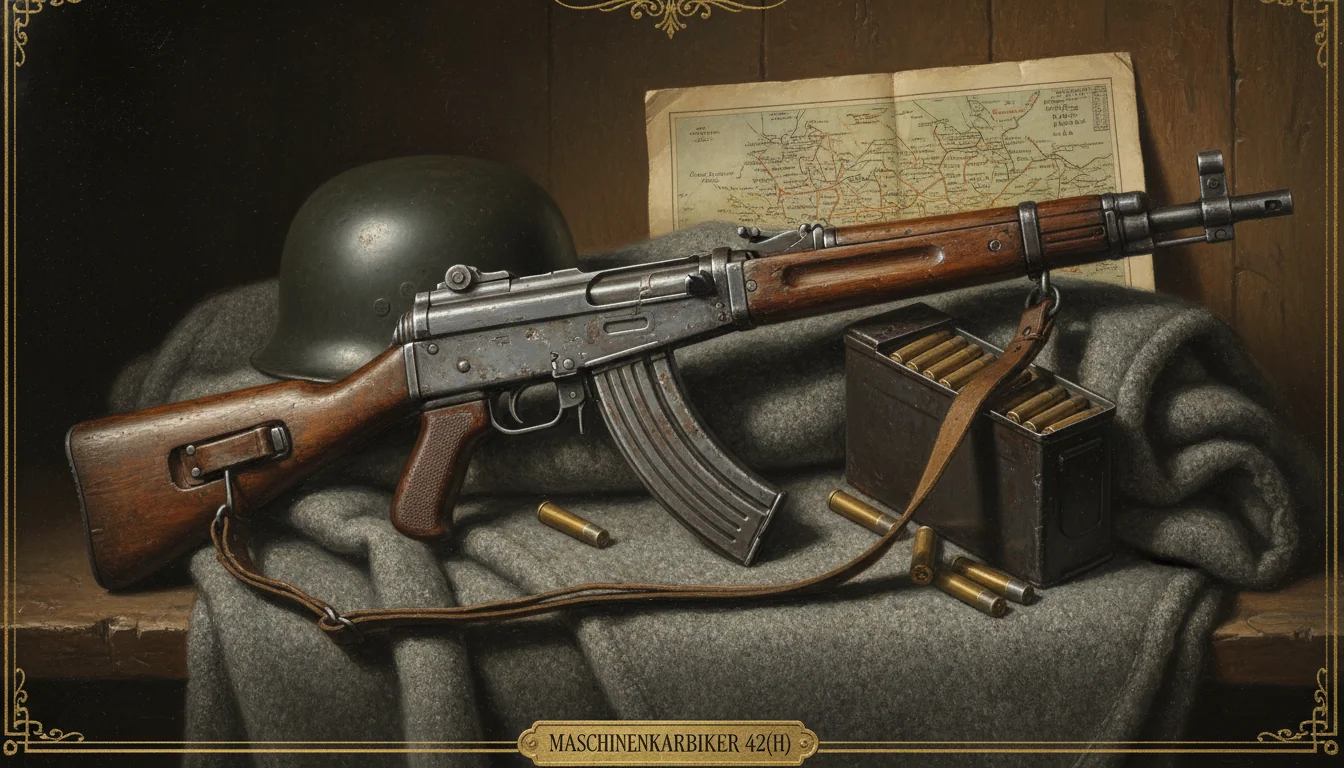
In the summer of 1944, German soldiers on the Eastern Front were writing letters home asking for a weapon that did not yet officially exist. They described it in practical terms: something that could be fired accurately at 300 meters, could deliver sustained automatic fire in a trench or a ruined building, and could be carried by a single infantryman without the weight penalty of a full-caliber machine gun. The generals had spent three years telling them such a weapon was unnecessary. The soldiers who had fought at Kursk and Kharkov and were now retreating across Ukraine knew otherwise.
The weapon they were describing was already in prototype. The High Command had been suppressing it. What happened next - a bureaucratic deception, a Fuhrer's reversal, and a manufacturing sprint that came two years too late - produced the most influential firearm design of the 20th century.
The problem it was designed to solve
Military small arms in 1939 were built around a contradiction that nobody in any major army had properly resolved. The standard infantry rifle of the era - the German Mauser K98k, the American M1 Garand, the British Lee-Enfield - fired a powerful full-caliber cartridge designed to be lethal at 800 meters or more. This made sense in an earlier era of open-field infantry combat where massed rifle fire across several hundred meters was a standard tactic. By the 1940s, most infantry combat was happening at ranges below 300 meters, in forests, cities, villages, and defensive positions where the long-range accuracy of the service rifle was entirely irrelevant.
The powerful cartridges were also heavy. A soldier could carry only so many of the full-caliber rounds, and the recoil made fully automatic fire impractical - the rifle climbed off target after the first shot. Armies had compensated by issuing submachine guns firing pistol-caliber ammunition, which were manageable in automatic fire but accurate only at very short ranges, and machine guns on bipods and tripods that delivered sustained fire but required crew and were not easily carried into a building.
An intermediate cartridge - something more powerful than a pistol round but less powerful than a rifle round - could solve all of this at once. A soldier carrying intermediate-caliber ammunition could carry significantly more rounds than full-caliber. The reduced recoil made automatic fire controllable. The effective range of 300 to 400 meters covered the vast majority of actual combat engagements. The concept was not new; German engineers had been discussing it since the 1930s. What was new, by 1942, was that Wehrmacht veterans of the Eastern Front were making the same argument from battlefield experience rather than theoretical analysis.
The deception
The German Army's Heereswaffenamt, the weapons procurement office, commissioned development of an intermediate-cartridge rifle from the Haenel firm in Suhl, where engineer Hugo Schmeisser led the design effort. The result, using the new 7.92x33mm Kurz (short) cartridge, was a working prototype by 1942. It was gas-operated, with a tilting bolt, select-fire capability (semi or full automatic), and a curved detachable box magazine of 30 rounds.
Adolf Hitler reviewed the concept and rejected it. His reasoning was partly tactical (he believed the army needed more machine-pistols, not new rifle calibers) and partly logistical (retooling German industry to produce a new cartridge in wartime was genuinely disruptive). Development was ordered stopped.
The army continued anyway. The weapon was redesignated Maschinenpistole 43, a name that implied it was merely a submachine gun improvement, something that fell under existing authorization rather than requiring Hitler's specific approval. Production of what was actually a new category of weapon proceeded under this fiction through 1943.
The ruse became unnecessary in 1943 when Eastern Front troops reported the new weapon's effectiveness in combat trials and unit reports began arriving in Berlin describing it in enthusiastic terms. Soldiers said it was what they had needed for two years. Hitler, presented with a fait accompli and glowing field reports, reversed course. He not only approved the weapon but renamed it personally: Sturmgewehr, storm rifle. In November 1944, with Soviet forces already inside Germany's pre-war borders, he told a conference of commanders that the Sturmgewehr had given the German infantryman a genuine qualitative advantage and ordered maximum production.
Maximum production by November 1944 was no longer enough.
The weapon itself
The StG 44 was a product of wartime manufacturing philosophy. Germany by 1943 was critically short of precision machine tools, skilled machinists, and raw materials. The StG 44 was designed accordingly: the receiver and most structural parts were made from stamped sheet metal rather than machined steel, reducing both material use and production time. The result looked, to eyes accustomed to the elegant machined lines of the K98k, somewhat crude. It functioned with notable reliability.
The weapon was 94 centimeters long and weighed 5.22 kilograms loaded - heavier than a standard rifle but manageable. The gas-operated mechanism diverted propellant gas from the barrel to drive the bolt rearward and reload the chamber. The curved 30-round magazine was dictated by the geometry of the intermediate cartridge, which had a slight taper requiring a curved feed path.
Effective range in semi-automatic fire was approximately 300 meters against individual targets, and up to 600 meters against area targets in automatic fire. Muzzle velocity was 685 meters per second, compared to the K98k's 755 m/s. The shorter, lighter bullet sacrificed long-range energy for manageable recoil. At the ranges where infantrymen in 1944 were actually shooting at each other, the difference was irrelevant.
On the Eastern Front
The StG 44 was issued primarily to elite units and Waffen-SS formations, with priority given to the Eastern Front. The weapon arrived in meaningful quantities during the defensive battles of 1943 and 1944, when German forces were conducting the long fighting retreat from Ukraine to Poland. In this context - room-to-room fighting in villages, defensive positions in forests, counterattacks across short distances - the StG 44 performed exactly as intended.
Soviet infantry encountering it reported a qualitative shock. The Red Army's standard infantry squad in 1944 was built around the PPSh-41 submachine gun and the Mosin-Nagant rifle. The PPSh-41 delivered devastating close-range automatic fire but was ineffective beyond 100-150 meters. The Mosin-Nagant was accurate at long range but single-shot. A German squad with StG 44s could deliver accurate automatic fire at 200-300 meters, the gap between the two Soviet weapons.
The Soviet response was notably focused. After the war, Soviet military analysts examined captured StG 44s extensively and the Izhevsk Mechanical Plant, where the AK-47 would be developed, employed German engineering personnel including Hugo Schmeisser from 1946 to 1952.
The legacy debate
Kalashnikov's AK-47, adopted by the Soviet Union in 1947, operates on a different internal mechanism than the StG 44. The AK's rotating bolt derives from the American M1 Garand, via the Soviet Simonov SKS. Kalashnikov spent the rest of his life denying that he had copied the German weapon, and the internal engineering supports his account. The two weapons are not the same gun.
The overall concept, however - intermediate cartridge, select-fire, high-capacity detachable magazine, gas operation - passed through the StG 44 into everything that followed. The United States, after a long institutional resistance, adopted the M16 in 1963 firing the small-caliber .223 Remington cartridge, which applies the same logic: reduced recoil, high capacity, effective to 300 meters, controllable in automatic fire. Every modern military service rifle in the world today is an assault rifle in the StG 44's image.
The weapon that German infantrymen asked for and that German generals initially refused sits at the foundation of the modern infantry arsenal. It arrived in the quantities needed roughly two years too late to matter to the war it was designed to fight. The irony is precise: the first assault rifle was produced by the country that lost the war, in insufficient numbers to change the outcome, and was then developed into the definitive weapons of the Cold War by the countries that won it.
The survivors
Approximately 425,000 StG 44s were produced. After 1945, significant quantities ended up in Soviet hands, and from there they were distributed to communist-aligned states and insurgent movements through the 1950s and 1960s. StG 44s have been recovered in Syria, Lebanon, and Gaza in the 21st century. A weapon designed in Suhl in 1942 was still being used in combat in the Middle East eighty years later, which is either a testament to its fundamental soundness or to the infinite patience of small-arms warehouses. Probably both.
Quick Answers
Common questions about this topic
Was the StG 44 the first assault rifle?
The StG 44 is generally credited as the first mass-produced assault rifle and the weapon that defined the category. It combined select-fire capability with an intermediate cartridge in a gas-operated platform with a detachable box magazine. Earlier weapons like the Fedorov Avtomat (1916) and the M1918 BAR shared some characteristics, but the StG 44 was the first to deliberately and successfully combine all the defining features at scale.
Did the StG 44 influence the AK-47?
The question has been argued for decades. Mikhail Kalashnikov consistently denied copying the StG 44, and the internal operating mechanisms of the two weapons are genuinely different. The AK-47's rotating-bolt system derives more directly from the American M1 Garand. However, Hugo Schmeisser, the engineer most associated with the StG 44, was brought to the Soviet Union as part of Operation Osoaviakhim in October 1946 - the Soviet counterpart to America's Operation Paperclip - and worked at the Izhevsk arms factory until 1952, precisely when the AK-47 was being developed.
Why was the StG 44 initially called the MP 43?
Hitler initially opposed development of a new intermediate-caliber rifle, believing the existing Mauser K98 and standard MG 34/42 machine gun combination was sufficient. To circumvent this, the Army continued development under the cover designation Maschinenpistole 43, implying it was merely an improved submachine gun. After seeing it demonstrated and hearing enthusiastic reports from Eastern Front troops in 1943, Hitler approved full production and renamed it Sturmgewehr - Storm Rifle - in 1944.
How many StG 44s were produced?
Approximately 425,000 to 450,000 units were produced between 1943 and the end of the war in May 1945, spread across several manufacturers including Haenel, Mauser, and Erma. This was substantial but insufficient to equip the majority of German infantry. In comparison, the Soviet Union produced over 6 million PPSh-41 submachine guns during the same period.

Talk to the People Who Wielded These Weapons
Chat with the soldiers, smiths, and commanders whose lives were shaped by the weapons of their age.
Talk to a WarriorJoin the HistorIQly Club
Get smarter about the past.
Weekly stories, deep dives, and exclusive content straight to your inbox.