The Macuahuitl: How an Obsidian Club Beheaded Horses at Tenochtitlan
The Aztec macuahuitl was a wooden sword set with obsidian blades sharper than surgical steel - and the most feared close-combat weapon in Mesoamerica.
Read Wikipedia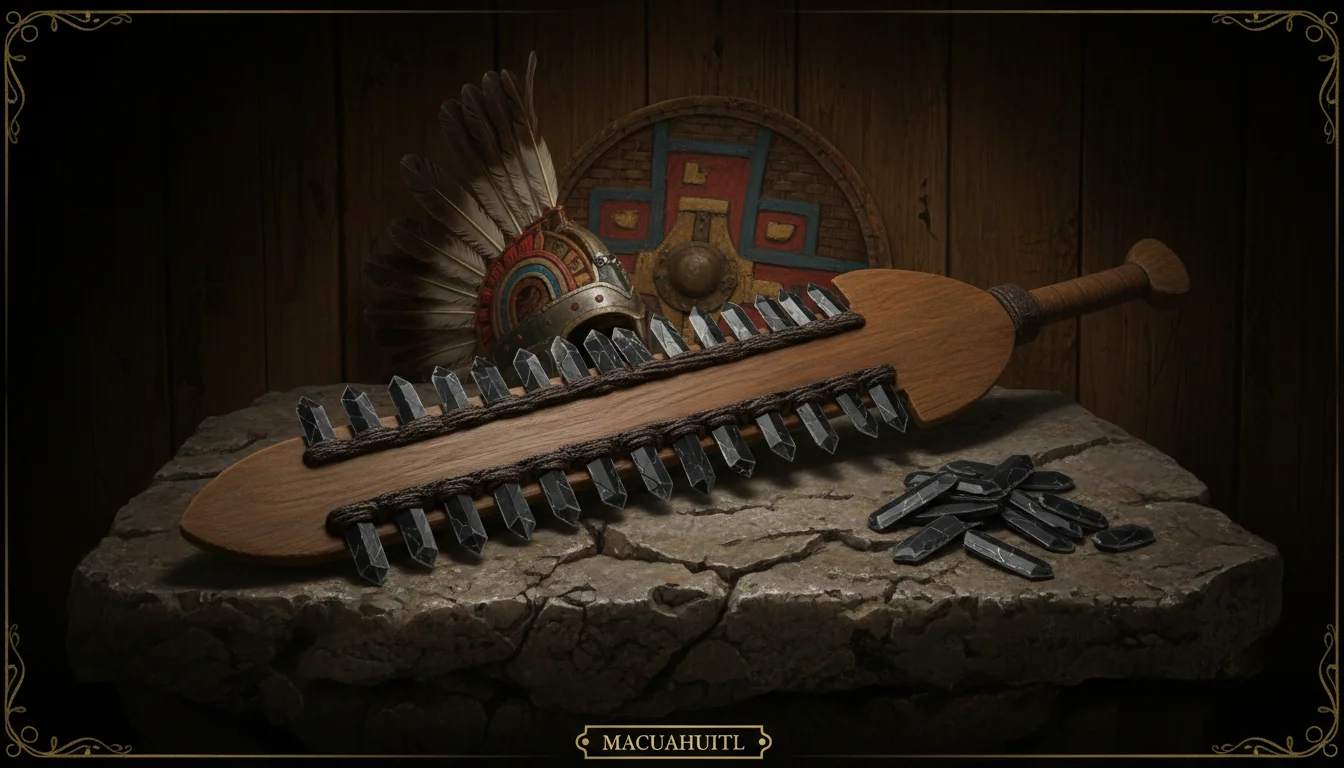
When Hernan Cortes landed near modern Veracruz in 1519 and began marching inland, his men encountered a weapon they had no European analogue for. It was not a sword. It was not a club. It was a flat wooden paddle the length of a man's arm, set with rows of black volcanic glass that could open a horse from withers to belly in a single swing. The conquistadors called it an espada, a sword, because they had nothing else to call it. The Nahuatl name, mostly lost in the chaos of conquest, was macuahuitl, meaning "hand-wood." For at least two centuries before the Spanish arrived, it had been the most feared close-combat weapon in Mesoamerica.
The macuahuitl is a strange object to a modern reader. It looks improvised. It is in fact one of the most sophisticated edged weapons any pre-industrial culture produced, the product of a long Mesoamerican tradition of working obsidian into tools that, on a pure cutting-edge basis, were sharper than anything Europe made before the 20th century.
Obsidian, the volcanic resource
The macuahuitl exists because central Mexico sits on top of one of the richest obsidian deposits on earth. Obsidian is a black volcanic glass formed when felsic lava cools too quickly to crystallize. The major deposits at Pachuca, Otumba, and Sierra de las Navajas in the modern Mexican states of Hidalgo and Mexico had been worked since the late Archaic period. By the time of the Toltec civilization in the 10th century, full industrial-scale workshops were producing obsidian blades for cutting tools, ritual implements, and weapons.
The technique is called pressure flaking. A skilled flintknapper, using a piece of antler or bone, presses against the edge of a prepared obsidian core and pops off long, thin, parallel-sided blades. These prismatic blades, sometimes 15 to 20 centimeters long and only a few millimeters thick, have a cutting edge that, measured at the molecular level, can be as fine as three nanometers wide. A modern surgical scalpel of stainless steel is roughly 300 to 600 nanometers across at the edge. Some 21st-century surgeons have used obsidian-bladed scalpels for cosmetic procedures because the wounds heal faster and scar less.
This is the material the macuahuitl was built around. The weapon's brutality starts with the physics of the edge.
Construction
A macuahuitl was made by an artisan who fitted prismatic obsidian blades into grooves cut along both edges of a flat wooden paddle. The wood was typically oak or some other hard tropical hardwood, shaped into a roughly rectangular cross-section about 5 to 10 centimeters wide. The paddle ranged from about 70 centimeters (one-handed) to 120 centimeters (two-handed) in total length, with a handle accounting for roughly a fifth of that.
The obsidian blades, six to eight on a side, were set close enough that the gaps between them were nearly continuous. The blades were glued in place with a mixture of plant resin (from various copal-producing trees), pine pitch, and sometimes ground bone. The resulting bond, when properly made and fully cured, was strong enough that the blades stayed seated under the lateral pressure of a slashing cut. Surviving Spanish illustrations and a few preserved fragments show the blades projecting roughly a centimeter from the wood, with no protective binding or strapping across the cutting surface itself.
The result was a weapon that combined the impact mass of a club with the cutting power of multiple parallel scalpel edges. A swung macuahuitl did not so much chop as plane through tissue, the wooden paddle delivering momentum while the obsidian rows opened a clean, deep wound. Against unarmored or cotton-armored opponents, the effect was catastrophic.
How it changed Mesoamerican warfare
The macuahuitl did not appear in a vacuum. It was the final flowering of a long Mesoamerican military tradition that had used obsidian-edged weapons for centuries: smaller knives, projectile points for atlatl darts, the spear-bladed tepoztopilli. What it changed was the structure of close combat.
In the warfare of the Aztec Triple Alliance and its neighbors, the goal of battle was usually capture rather than killing. Captives were essential to the Mexica religious economy, which depended on regular sacrifices to fuel the cycle of cosmic renewal. A warrior earned status, military promotions, and political standing by the number and quality of opponents he took alive. The macuahuitl was well suited to this. It could be used to deliver disabling but non-fatal wounds: a slash to the back of the knee, a deep cut along a thigh, a precise blow to a tendon. A skilled wielder could bring a man down, render him incapable of fighting, and bind him for the journey home.
This shaped Aztec tactical doctrine. Mesoamerican battles typically opened with an exchange of darts from atlatls and arrows from bows. The lines then closed, with the tepoztopilli halberd doing much of the early work. As the formations broke up into individual duels, the macuahuitl came out. Elite units, the Eagle Warriors (cuauhpilli) and Jaguar Warriors (ocelopilli) of the Mexica, were trained from boyhood in the weapon's use and were the men most likely to take captives in the chaotic close phase of a battle.
Tenochtitlan and the early conquest
Cortes arrived in central Mexico in 1519 with about 500 Spanish soldiers, 16 horses, and a small number of crude firearms. The Aztec armies he faced could field tens of thousands of warriors with macuahuitls, tepoztopillis, slings, and atlatls. On paper, the Spanish should have been overwhelmed.
What kept them alive in the first encounters was steel armor and the horse. Bernal Diaz del Castillo, a foot soldier under Cortes who wrote one of the most important first-person accounts of the conquest, records repeatedly that obsidian weapons could shatter against steel breastplates and helmets. Aztec warriors trained for capture, not killing, often hesitated when they should have struck decisively. And the horses gave the Spanish a mobile shock weapon that no Mesoamerican unit had a doctrine to counter.
But the macuahuitl also did real damage. Diaz records Spanish horses cut down by single swings, riders wounded through gaps in their armor, foot soldiers killed when an obsidian edge found an opening. The most famous account of the weapon's lethality is the alleged decapitation of a horse during the battle around La Noche Triste in 1520, when the Spanish were forced out of Tenochtitlan with catastrophic losses. Modern experimental archaeologists have replicated macuahuitls and demonstrated that the weapon can, in fact, sever a soft-tissue mass the size of a horse's neck in a two-handed blow, provided the blades are fresh and the swing is well placed.
The end
The macuahuitl had two structural weaknesses that doomed it against sustained Spanish warfare.
The first was the material. Obsidian's molecular sharpness is also its fragility. Each cutting edge is essentially a fracture face; it does not bend, and once chipped it cannot be honed back. After a few solid impacts against steel armor, the blades shattered or popped out of their resin beds. A Spanish swordsman could absorb several macuahuitl blows on his breastplate and his Toledo blade and keep fighting. A macuahuitl wielder could not absorb several blows in return and keep his weapon functional.
The second was the supply chain. Aztec warriors carried spare obsidian blades and could rebed them in the field, but the process took time. A pitched battle that lasted hours degraded the weapon faster than the warriors could refurbish it. Steel swords, sharpened on a stone in minutes between engagements, simply outlasted obsidian in extended combat.
The Mexica recognized the problem during the long siege of Tenochtitlan in 1521. They adapted, captured Spanish weapons, learned to use crossbows from defectors, and built makeshift armor against the horses. None of it was enough. By August 13, 1521, the city had fallen, and within a generation the macuahuitl had effectively disappeared from active use.
Echoes
The macuahuitl survived only briefly into the colonial period. A handful of indigenous auxiliaries continued to carry the weapon into the 16th-century Chichimeca Wars on Mexico's northern frontier, where it was useful against unarmored opponents. By 1600 it had been entirely supplanted by steel and firearms among any unit that did regular fighting.
Genuine surviving macuahuitls are exceptionally rare. At least one example, held in the Royal Armoury of Madrid, was destroyed in a 1884 fire; only watercolors and engravings remain. A handful of fragments and a few near-complete weapons exist in museum collections in Mexico City and a few European institutions. Modern reconstructions, built by experimental archaeologists using period-accurate materials, are the basis for most of what we now know about how the weapon was used and what it could do.
What endures is the reputation. The macuahuitl stands in the small subset of pre-industrial weapons, with the Norse Dane axe and the Indian katar, that earned a documented reputation for terrifying physical effect. It was the right weapon for the warfare of pre-conquest central Mexico: ritually meaningful, technically refined, and brutally effective against the bodies of the opponents Aztec armies actually expected to fight. When those opponents changed, in the spring of 1519, the weapon failed. But the failure was not a failure of design. It was a failure of context. Obsidian had no answer for steel because the centuries that produced the macuahuitl had not contained steel as a problem to solve.
For two hundred years, in the valley of Mexico, a paddle of oak and volcanic glass was the most feared thing a soldier could carry. That is more than most weapons in history can claim.
Quick Answers
Common questions about this topic
What was a macuahuitl?
A macuahuitl was a Mesoamerican wooden club, typically oak, about 70 to 120 centimeters long, with rows of razor-sharp obsidian blades inset into both edges and glued in place with plant resin and pine pitch. It was the primary close-combat weapon of the Aztec and other Nahua peoples in the late Postclassic period, used from roughly the 14th century to the Spanish conquest of 1521.
Could a macuahuitl really decapitate a horse?
Several Spanish eyewitnesses, including the conquistador Bernal Diaz del Castillo, recorded that obsidian-edged weapons could behead horses in a single blow. Modern replicas and experimental archaeology confirm that freshly napped obsidian flakes are sharper than a surgical scalpel, with cutting edges roughly three nanometers thick. A two-handed swing into an unprotected horse's neck would have severed soft tissue easily.
Why did the macuahuitl lose to Spanish swords?
Obsidian is extremely sharp but brittle. The blades shattered on Spanish steel armor and helmets after a few solid blows. Aztec warriors trained to capture rather than kill opponents, which slowed them in pitched combat. And the macuahuitl's edges, once broken off, could not be quickly replaced in the middle of battle. Steel swords held their edge through long engagements; obsidian weapons did not.
Did the Aztecs use anything besides the macuahuitl?
Yes. Standard Aztec infantry kit included a spear-thrower (atlatl) with darts, a long spear (tepoztopilli) similar to a halberd with an obsidian-edged head, a short club, a sling, and a round shield (chimalli) of cane or wood covered in leather. The macuahuitl was the elite close-combat weapon, used after the missile exchange and the initial spear charge.

Talk to the People Who Wielded These Weapons
Chat with the soldiers, smiths, and commanders whose lives were shaped by the weapons of their age.
Create your free account →No card required. Some figures and features require a paid plan.
Join the HistorIQly Club
Get smarter about the past.
Weekly stories, deep dives, and exclusive content straight to your inbox.