Arsenal: The Rapier
Rapier sword history: the civilian blade of Renaissance Europe, designed for the duel and the city street. For a century it defined how educated men settled disputes.
Read Wikipedia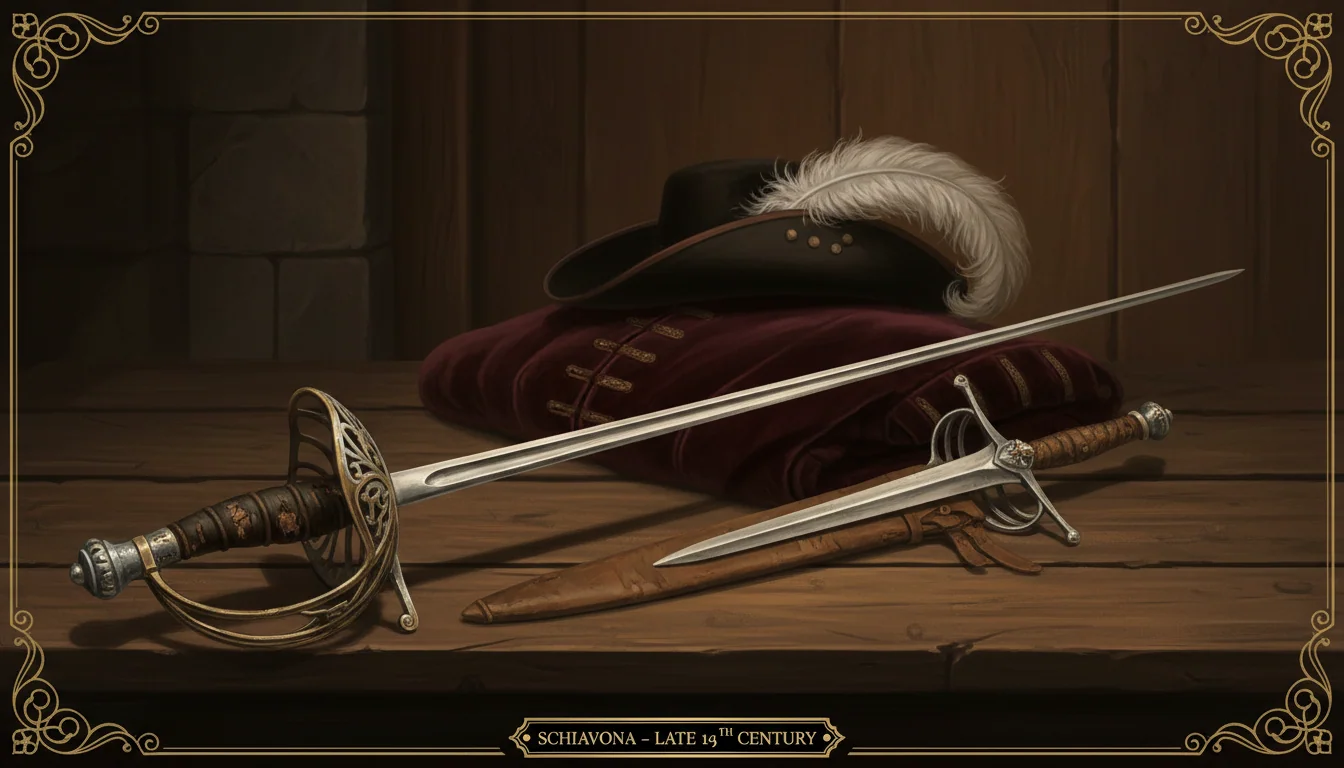
The rapier is the sword Cyrano de Bergerac actually carried, which is not the sword most people picture when they think of Cyrano de Bergerac. It is not the slender wisp of steel that twentieth-century film fencers wave around. It is a long, heavy, finely balanced piece of metal designed for one principal purpose: putting a point through another educated man at a measured distance, ideally before he can do the same to you.
For roughly a century, from about 1580 to 1680, the rapier was the standard sidearm of the European gentleman. It travelled with him to court, to the theatre, and most importantly to the meadow at dawn where most of the work the weapon was famous for actually got done. It generated entire schools of fencing and produced the basic vocabulary that classical fencing still uses today.
Origins in Spain and Italy
The rapier did not appear fully formed. It evolved out of the late-medieval sword in the second half of the 16th century, in response to changes in armour, urban life, and civilian social practice. Plate armour, which had dominated battlefield combat for two centuries, was becoming less universally worn. Pistols and arquebuses were making the heavy harness less protective against the most lethal threats. And for the civilian carrying a weapon in everyday life, the sword had stopped being a tool optimized for hacking through metal and become a tool optimized for handling a fellow citizen who was probably no more armoured than you were.
The Spanish word espada ropera, meaning roughly "dress sword" or "sword for clothing," appears in inventories from the early 16th century and gives the English language its term "rapier." The implication is precise: this was a sword you wore with your civilian dress, not a sword you put on with armour.
The Italian and Spanish schools of fence developed slightly different solutions to the same problem. The Italian masters, including Camillo Agrippa in the mid-16th century and later Salvator Fabris and Ridolfo Capo Ferro, emphasized geometry, angle, and timing. Agrippa's treatise of 1553 reorganized fencing around the four guards of prima, seconda, terza, and quarta, which gave subsequent generations a common framework. Capo Ferro's treatise of 1610 codified what most modern reconstructions consider the central Italian system: a forward stance, the point threatening at all times, and a strong reliance on the lunge as the decisive attacking action.
The Spanish school took a different path. Jeronimo de Carranza in the late 16th century and Luis Pacheco de Narvaez in the early 17th century developed what came to be called La Verdadera Destreza, "the true skill," which organized fencing around a mathematical understanding of the body's reach and the angles between the combatants. Spanish destreza practitioners worked from a more upright stance than the Italians, moved in circular patterns rather than the straight-line advance of the Italian system, and treated the duel as a problem in applied geometry. The Spanish style was considered cerebral by its admirers and excessively theoretical by its critics.
Anatomy of the weapon
A typical rapier from the early 17th century carried a blade between 40 and 45 inches long. The blade was narrow at the point, slightly broader at the base, and rigid enough to support a serious thrust without bending. Many rapiers had a fuller groove running down part of the blade to reduce weight without sacrificing rigidity. The total weight of a rapier was usually between 2.5 and 3.5 pounds, which feels heavier than the modern sport fencing weapons but balances forward of the hand in a way that makes the point feel light and responsive.
The hilt is what most clearly distinguishes the rapier from earlier swords. The earliest forms used a complicated cage of curved bars - the swept hilt - that protected the hand from cuts and thrusts coming in around the blade. Later forms simplified this into a single forged cup, the cup hilt, that surrounded the hand entirely. Both styles allowed the user to put the index finger over the cross-guard for better point control, which was standard rapier grip practice from the start.
The hand guard was not decorative. The principal danger in rapier fencing was a thrust to the unarmoured hand at the very moment of attack, which could end a fight by making it impossible to hold a weapon. The swept and cup hilts existed to make this kind of hand-snipe much harder to execute.
Many gentlemen carried a companion weapon in the off hand. The most common was a parrying dagger, called a main gauche in French, which had its own elaborate guard and was used to deflect or trap the opponent's blade while the rapier delivered the counterthrust. Some schools used a cloak wrapped around the off arm for the same purpose, and some used a small buckler. The combinations were taught systematically in the fencing manuals of the period.
How it changed civilian combat
The rapier transformed European honor culture for the simple reason that it gave the carrier a serious threat at significantly longer range than any earlier civilian weapon. A man with a rapier could threaten and kill a man without a rapier from a distance the unarmed man could not close without taking a thrust. This shifted the social calculation around personal disputes.
Dueling became a structured social institution in the rapier era. The code duello, which formalized when and how educated men were expected to challenge each other, developed in Italy and France in the 16th century and spread across the rest of western Europe. The rapier was the weapon assumed by these codes, with specifications for blade length, the conditions of the meeting, the presence of seconds, and the moment at which honor was considered satisfied.
The numbers are striking. Reliable casualty figures for civilian duels are difficult to assemble, but contemporary sources from late 16th century France suggest that hundreds of gentlemen were killed in duels in some years. Henri IV of France attempted to suppress dueling repeatedly without success. His son Louis XIII and Cardinal Richelieu pursued the campaign with more energy, executing prominent duelists in the 1620s as an example to others, but dueling continued through the 17th century at considerable cost.
The street and the campaign
A gentleman in 17th-century Madrid, Rome, Paris, or London wore his rapier nearly everywhere outside the household. The weapon was visible, expensive, and signalled both his social position and his willingness to defend it. Inside the city, the rapier was as much a tool of physical assertion as it was a weapon for prearranged duels. Street fights, tavern brawls, and ambushes happened, and the rapier was the weapon at hand for most of them.
The famous opening scene of Romeo and Juliet, in which Tybalt fights Mercutio in the streets of Verona, is set in exactly this world. Shakespeare wrote the play in the 1590s, when the rapier was newly fashionable in England and the audience knew what the weapon was. The technical vocabulary Mercutio uses to describe Tybalt's fencing style - the punto reverso, the hay - is Italian rapier terminology, and Shakespeare expected his audience to follow it.
On the battlefield, the rapier was less useful. The long thin blade was excellent for the controlled distance of the duel and the unarmoured opponent but less effective against an armoured infantryman or against the chaos of a melee. Soldiers carried shorter, broader cut-and-thrust swords, sometimes called sideswords or arming swords, that were better adapted to battlefield conditions. Officers might carry a rapier as a personal weapon, but the main infantry sword of the Thirty Years' War period was not a rapier.
Decline and the smallsword
By the 1670s the rapier was beginning to feel old-fashioned in the French court, and the French court was where European fashion in clothing and weapons was now decided. Louis XIV's reign produced a more elaborate civilian dress for men, and the long heavy rapier started to look like an awkward accessory next to the silk coats and shorter walking sticks of the new fashion.
What replaced it was the smallsword, a shorter and lighter thrusting weapon with a simpler shell-guard hilt. The smallsword retained the rapier's commitment to the thrust as the decisive action and discarded almost everything else. The blade was around 30 to 35 inches, the weight around 1 to 1.5 pounds, and the hand protection was a single small cup rather than a complex cage. The smallsword was easier to wear and lighter to use, and by the 1700s it had largely replaced the rapier as the gentleman's sword across western Europe.
The fencing schools adapted. The classical French smallsword fencing of the 18th century was a direct descendant of late Italian rapier practice, with techniques and vocabulary carried over and adjusted for the shorter blade. The terminology that classical fencing still uses today - tempo, distance, parries by number, the lunge - is the rapier era's gift to its descendant.
Legacy
The rapier survived in literature long after it disappeared from urban streets. The Three Musketeers, set in the 1620s, was written by Alexandre Dumas in 1844, when nobody was wearing rapiers anymore but everyone read about them. Cyrano de Bergerac, set in the 1640s, was written by Edmond Rostand in 1897, by which time the rapier was a fully literary object.
Modern sport fencing's three weapons - foil, epee, and sabre - are descendants of the rapier era. The foil and epee both retain the rapier's point-only attack principle. The sabre developed later out of the cavalry sword tradition. Historical European martial arts groups in the 21st century have spent decades reconstructing the techniques of Capo Ferro, Fabris, and the Spanish destreza masters from the surviving manuals, with some success.
The rapier had perhaps a century of dominance in civilian European combat. In that century it reorganized the social regulation of honor and produced a body of technical writing that survives intact. The weapon is now in museums. Its vocabulary is still used every time two fencers cross blades on a strip.
Not bad for a piece of steel optimized for putting holes in gentlemen.
For related weapons in the arsenal series, the crossbow covers the missile weapon that defined the era just before the rapier's rise, and the katana offers a point of comparison from Japanese blade culture of the same centuries.
Quick Answers
Common questions about this topic
What is a rapier?
A rapier is a long, narrow, primarily thrust-oriented sword developed in late 16th-century Europe as a civilian weapon for self-defence and dueling. Its defining features are a long thin blade, an elaborate hand guard often called a swept hilt or cup hilt, and a balance optimized for point work rather than cutting. The rapier was carried by gentlemen, soldiers off duty, and anyone wealthy enough to wear a sword in public.
When was the rapier used?
The rapier emerged in Spain and Italy in the mid-16th century, became the dominant civilian sword across western Europe between roughly 1580 and 1680, and was gradually replaced by the lighter smallsword in the late 17th and early 18th centuries. Its peak period of use coincides with the reigns of Elizabeth I, Philip II of Spain, and the early Bourbons of France.
Was the rapier a battlefield weapon?
Not primarily. The rapier was a civilian sidearm and dueling weapon. Soldiers on campaign generally preferred shorter, broader cut-and-thrust swords better suited to armoured combat and battlefield melee. A rapier could be carried by a soldier as a personal weapon, particularly by officers, but the heavy infantry sword on the battlefield was a different tool with different priorities.
How does the rapier differ from the smallsword?
The rapier is longer, heavier, and more elaborate in its guard than the smallsword that succeeded it. A typical rapier blade ran roughly 40 to 45 inches; a smallsword blade around 30 to 35 inches. The rapier retained some cutting capability and used a complex hilt to protect the hand; the smallsword was almost entirely a thrusting weapon with a simpler guard. The transition reflects changes in dress, social practice, and the speed of urban combat.

Talk to the People Who Wielded These Weapons
Chat with the soldiers, smiths, and commanders whose lives were shaped by the weapons of their age.
Create your free account →No card required. Some figures and features require a paid plan.
Join the HistorIQly Club
Get smarter about the past.
Weekly stories, deep dives, and exclusive content straight to your inbox.