Arsenal: Dane Axe History - The Viking Age's Most Devastating Weapon
Dane axe history spans two centuries of Viking warfare - from Norse raids to Hastings in 1066 and the Byzantine Varangian Guard who carried it to Constantinople.
Read Wikipedia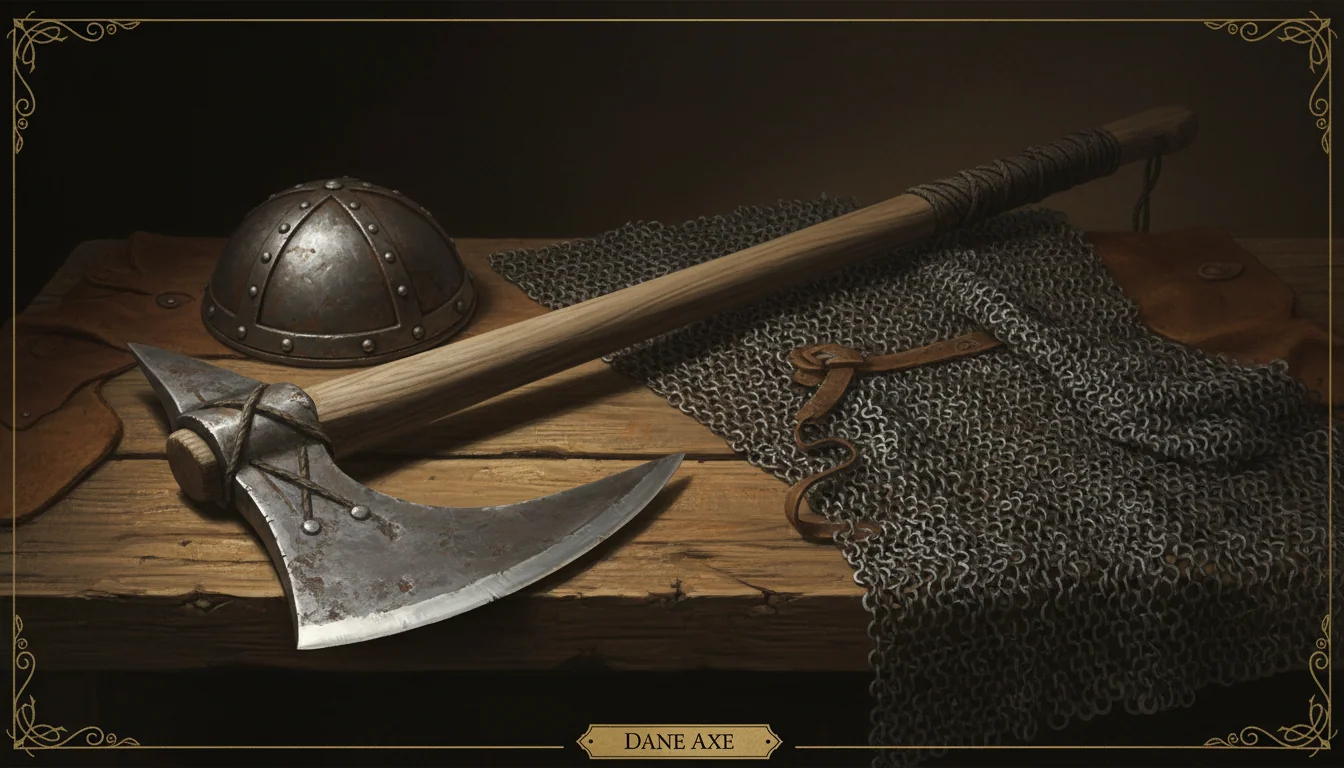
When the huscarls of King Harold Godwinson took their position on the ridge at Hastings on October 14, 1066, they carried with them the most effective infantry weapon of the Viking Age. It was not a sword, though they had those too. It was a long-hafted axe with a blade wide enough to split a Norman cavalryman from shoulder to hip in a single swing. The weapon's proper name in modern scholarship is the Dane Axe, and by the afternoon of October 14, 1066, every Norman knight on the field had developed a healthy respect for it.
The huscarls lost. That took most of the day, required a feigned retreat, and cost the Normans enormous casualties. The Dane Axe was not, in 1066, a weapon that had run its course. It was a weapon that had simply met an enemy willing to fight through extraordinary cost.
Origins of the long axe
The axe is among the oldest of human tools, predating metal by tens of thousands of years. The specific configuration that becomes the Dane Axe - a wide, thin blade on a long haft, used two-handed as a primary fighting weapon - appears in Scandinavia during the late 9th and early 10th centuries. This was the period of Viking expansion, when Norsemen were raiding, trading, and settling across an arc from North America to the Caspian Sea.
The development of the long war axe reflects a tactical calculation. Shorter one-handed axes had been Scandinavian tools and weapons for centuries: useful, portable, and effective in the chaos of close combat. But the one-handed axe sacrifices reach. Against an opponent in good armor, particularly one with a shield, reach matters enormously. A blow that lands on a shield does nothing. A blow that lands past the shield, delivered at extension from a longer weapon, changes the equation entirely.
The Dane Axe's designers - or more precisely, the generations of anonymous smiths who refined the form - solved the reach problem by lengthening the haft to roughly four to five feet and widening the blade to provide a large cutting surface. The blade's distinctive characteristic was its thinness. A thick, heavy blade that simply scaled up a carpenter's axe would have been too heavy to swing repeatedly at speed. The Dane Axe's blade was forged thin, with a pronounced convex edge geometry, which produced a weapon that looked massive but weighed considerably less than its visual size suggested.
Anatomy of the weapon
A typical Dane Axe from the 10th or 11th century had a blade spanning 20 to 25 centimeters across the cutting edge, with a pronounced curvature that concentrated force at the sweet spot of the edge. The haft was straight or very slightly curved wood - ash, oak, or hazel depending on regional availability - fitted through the axe's eye and typically secured with a wedge. The overall length of a combat example ranged from about four to five feet, with the haft representing the great majority of that length.
The grip for fighting was two-handed, with the front hand placed further up the haft to control direction and the rear hand providing power. This grip allowed both powerful strikes and controlled techniques: a huscarl who swung and missed could recover the weapon and redirect for a second blow faster than the mythology of clumsy axe-fighting suggests. Experimental reconstructions have demonstrated that the Dane Axe, in trained hands, is a fluid weapon - faster than it looks and more precise than a weapon of its weight class has any right to be.
The thin blade was also effective against mail armor in a way that thrusting weapons were not. Mail is excellent against cuts from a thin blade; it is vulnerable to blunt force trauma and to cuts from a wide, heavy edge delivered at the right angle. The Dane Axe's geometry concentrated enough edge length and momentum on a target to deform mail rings and drive the damaged metal into the body beneath.
The huscarls of England
The Dane Axe crossed from Scandinavia to England along the same cultural corridors as the Danish kings who ruled England from 1016 to 1042. Cnut the Great, who became King of England after defeating Ethelred's successor Edmund Ironside, brought with him the Danish military institution of the huscarl - the professional household warrior who served as a king's personal guard and core fighting force. The huscarls were paid, trained, and equipped to a standard that set them apart from the fyrd, the militia obligation that filled out English armies.
By the mid-11th century, English huscarls were identified specifically with the long axe. They trained with it, lived with it, and were buried with it. When Edward the Confessor died in January 1066 and Harold Godwinson became king, the huscarls he inherited were among the finest heavy infantry in northern Europe. Their weapon was the Dane Axe.
This presented a tactical problem for anyone who fought them. The long axe required two hands, which meant the huscarl's shield was unavailable while striking. Elite huscarls typically hung their shields at their sides or on their backs during offensive action, relying on speed, reach, and the axe itself as a parrying tool. Against infantry, this worked well enough. Against cavalry, it required careful management of ground and formation.
Stamford Bridge and Hastings, 1066
September 25, 1066. Harald Hardrada of Norway invaded Yorkshire with a force of Norsemen and allied English supporters. King Harold Godwinson marched north with shocking speed and fell on the Norse army at Stamford Bridge in a surprise attack. The battle was a decisive English victory. Harald Hardrada was killed, and the Norse threat to England was effectively ended.
The tradition - not certainly historical, but repeated in multiple Scandinavian sagas - holds that a single Norwegian warrior held the bridge over the River Derwent with a Dane Axe long enough to allow his comrades to form a defensive position. He reportedly cut down dozens of English soldiers crossing the bridge before one finally rowed beneath the bridge and thrust a spear upward. The tradition captures something accurate about the weapon's reputation for holding ground, even if the specific detail is disputed.
Three weeks later, Harold received news that William of Normandy had landed in the south. He marched his exhausted army back to London and then to Hastings. The huscarls, depleted but still formidable, formed the core of the English line on Senlac ridge.
The Bayeux Tapestry, woven within a generation of the battle by craftspeople who had access to eyewitness accounts, shows huscarls holding their long axes in both hands as Norman cavalry charge the ridge. The Norman knights' horses are depicted shying away from the axe-armed infantry, which matches the chronicle accounts of the Norman cavalry suffering badly in repeated frontal charges. The English shield wall, anchored by huscarl axemen, held through most of the day.
What broke it was a combination of sustained archery from above and a tactical maneuver - whether deliberate or accidental is still debated - in which the Normans feigned retreat, drew part of the English line off the ridge in pursuit, then turned on the pursuing infantry in the open. Harold was killed. The shield wall crumbled. The Dane Axe had held for hours but could not survive the dissolution of the formation it needed.
The Varangian Guard
The Dane Axe found a second institutional home far to the east. The Varangian Guard, established by the Byzantine Emperor Basil II in the late 10th century, was an elite unit of Norse warriors who served as personal bodyguards to the Byzantine emperors. Byzantine sources called them "the axe-bearing barbarians," a description that captures both their weaponry and the reaction it produced in the carefully stratified Byzantine court.
After 1066, many of the defeated English huscarls who survived Hastings and refused to serve under William made their way to Constantinople and joined the Varangian Guard. They brought their axes with them. Byzantine chronicles noted the arrival of the "axe-bearing English," and the Guard's composition shifted over the following decades from predominantly Norse to predominantly English.
Varangian guardsmen served in Byzantine campaigns across the Mediterranean, from the Balkans to Syria, and their long axes were a recognized feature of Byzantine military power for well over a century after Hastings.
Decline and legacy
The Dane Axe's dominance depended on the tactical context of close infantry formations - shield walls, massed combat, situations where reach and cutting power mattered more than versatility. As the 12th century progressed, European warfare increasingly organized itself around mounted knights fighting on open ground, supplemented by crossbowmen and missile troops. The infantry formations that gave the Dane Axe its context became less central.
The weapon did not vanish abruptly. Long axes continued to appear in manuscript illustrations well into the 12th century. The Varangian Guard carried them into the 13th century. But the weapon's design principles - long haft, wide blade, two-handed operation - gradually merged with other weapon traditions to produce the polearms of later medieval warfare: the halberd, the bill, the glaive. These were, in a direct technical lineage, the grandchildren of the weapon the huscarls carried at Hastings.
The Dane Axe had perhaps two centuries of battlefield prominence. That is a short career by the standards of the sword, which endured in various forms for millennia. But within those two centuries, it reshaped the military culture of northern Europe, defined the fighting identity of the English huscarl, and gave its wielders a reputation that traveled from Yorkshire to Constantinople.
Not bad for a piece of iron on a stick.
For other weapons that defined their era's battlefield, see our histories of the Viking Ulfberht sword and the Roman gladius.
Quick Answers
Common questions about this topic
What made the Dane Axe different from other axes?
The Dane Axe was distinguished by its very wide, thin blade - typically 20 to 25 centimeters across the cutting edge - mounted on a long haft of roughly four to five feet. The thin blade made it surprisingly light relative to its visual size, and the long haft gave it the reach of a short spear while delivering cuts far heavier than a spear could manage. It was primarily a two-handed weapon, which distinguished it from shorter one-handed axes.
Who used the Dane Axe?
Dane Axes were used across northern Europe from roughly the 10th through the 12th centuries. Viking warriors carried them on raids and in pitched battles. Anglo-Saxon huscarls - the professional household warriors of the English kings - adopted the weapon and became identified with it. The Varangian Guard, Norse and later Anglo-Saxon warriors serving as elite bodyguards to the Byzantine emperor, were specifically known throughout the Eastern Mediterranean for their two-handed axes.
How is the Dane Axe shown in the Bayeux Tapestry?
The Bayeux Tapestry, which depicts the Norman Conquest of 1066, clearly shows English huscarls wielding large two-handed axes at the Battle of Hastings. Several figures are shown holding the weapon with both hands while their shields hang at their sides, indicating the axe was their primary offensive tool. Norman cavalry are shown responding to huscarl charges with their lances.
When did the Dane Axe decline?
The Dane Axe was largely obsolete as a primary infantry weapon by the 12th century, as cavalry-focused warfare came to dominate European battlefields. The weapon survived in the hands of the Varangian Guard in Byzantium for another century in that specialized role. Its design principles - wide blade, long haft, two-handed grip - fed into the evolution of the halberd and other polearms that dominated later medieval warfare.

Talk to the People Who Wielded These Weapons
Chat with the soldiers, smiths, and commanders whose lives were shaped by the weapons of their age.
Create your free account →No card required. Some figures and features require a paid plan.
Join the HistorIQly Club
Get smarter about the past.
Weekly stories, deep dives, and exclusive content straight to your inbox.