Arsenal: The Viking Ulfberht Sword - A Weapon Out of Time
The Ulfberht sword mystery: roughly 170 Viking-age blades carry an inscription and crucible steel that Europe had no method of producing. Where did the metal come from?
Read Wikipedia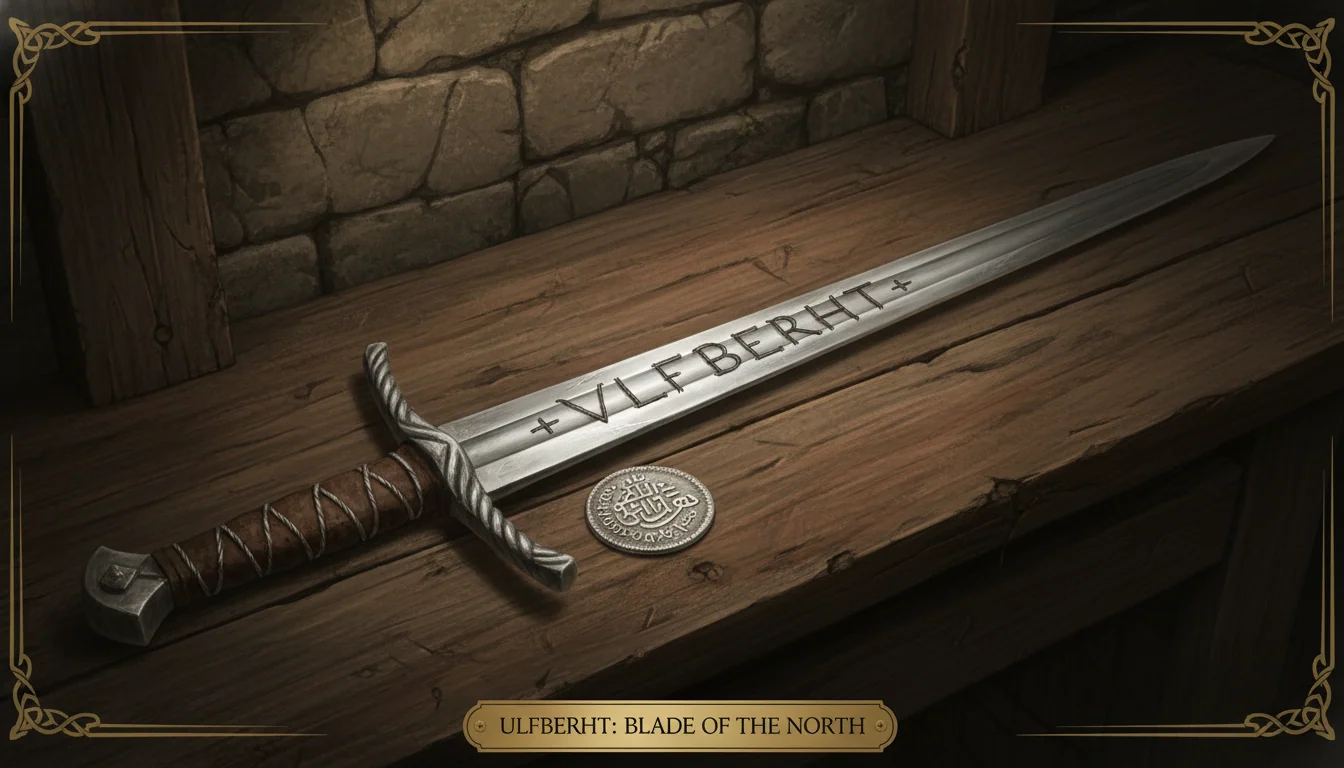
In the museum cases of Scandinavia, Germany, and France sit about 170 swords from the Viking Age that share an unusual feature: the inscription "+VLFBERHT+" inlaid in iron wire along the blade. For decades, archaeologists treated this as a craftsman's mark, unremarkable in itself. Then someone analyzed the steel.
The genuine Ulfberht swords - those dated roughly 850 to 1000 AD - are made from metal that the European smiths of the 9th and 10th centuries had no known method of producing. Their carbon content is characteristic of crucible steel: harder, more flexible, and capable of holding an edge far longer than the bloomery iron that equipped most Viking-age warriors. They are, in a very real sense, weapons from the wrong century. The puzzle is where they came from.
The sword and the age
The Viking sword is among the most studied weapons of the early medieval period. The typical pattern - a broad, double-edged blade roughly 70 to 90 centimeters long, with a short crossguard and a heavy pommel for balance - appeared in Northern Europe around the 8th century and persisted with gradual modification into the early medieval period. These swords were prestige objects. A well-made example cost roughly the equivalent of a small farm. They were passed through generations, named, repaired, and sometimes buried with their owners as declarations of status and identity.
The iron used to make most Viking swords came from bog iron - nodules extracted from the waterlogged soils of Scandinavia and processed in small bloomery furnaces that could not reach the temperatures needed to fully purify the metal. The resulting product was heterogeneous, containing variable amounts of carbon, slag, and other inclusions. A skilled smith could work with it and produce serviceable weapons, but the material had real limits. The edge would degrade. Under heavy stress, the blade could fail.
The Ulfberht swords did not have those limits.
The inscription
The "+VLFBERHT+" mark - the crosses flanking the name suggest Frankish Christian influence - appears on swords found across a wide geographic range: Scandinavia, the British Isles, the river systems of what is now Germany and France, and occasionally further east. The name "Ulfberht" is Germanic, broadly Frankish, and almost certainly a personal name. Its meaning is uncertain but may relate to the root words for "wolf" and "bright."
The genuine high-quality Ulfberht swords span a period of roughly 150 years, which is too long for a single craftsman but entirely plausible for a family workshop or a brand that later smiths continued to use after the original's death. Whether "Ulfberht" represents a person, a monastery scriptorium that organized production, or simply a mark that guaranteed quality to buyers is still debated.
The metallurgical revelation
Analysis of Ulfberht swords by metallurgists - including research by Alan Williams of the Wallace Collection in London, published in his comprehensive study of medieval swords - found something that did not fit the expected picture. The genuine early examples had a steel microstructure that was not achievable using European bloomery furnace technology of the 9th and 10th centuries. The carbon was evenly distributed through the metal at levels that made the blade behave more like modern high-carbon steel than like the variable, inclusion-heavy iron of typical medieval European blades.
This type of steel - homogeneous, high-carbon, produced by a process involving sustained high temperatures inside sealed crucibles - was well established in Islamic workshops in Central Asia and around the Persian Gulf during the early medieval period. Known as wootz or pulad in the regions where it was made, this steel was prized, traded, and occasionally transformed into the watered-patterned blades that Europeans later called Damascus steel. The pattern visible in cross-section of genuine wootz - a characteristic banding produced by the carbon distribution - is occasionally visible in analyzed Ulfberht blades.
European smiths working in Carolingian workshops could not replicate crucible steel. They did not have the furnace technology or the raw material sourcing to do so. The metal in the genuine Ulfberht swords had to come from somewhere else.
The Volga route
The most plausible explanation runs along the great river systems of what is now Russia. The Volga trade route connected Scandinavia to the Islamic world by an inland path requiring no voyage through the hostile waters of the Byzantine or Arab Mediterranean. From the Baltic, Norse traders - the Varangians - moved south down river systems through Novgorod, then further south and east through a series of portages and connections to reach the Caspian Sea and onward to the trading networks of the Abbasid Caliphate.
The Varangians were trading silver, furs, amber, and enslaved people. They received silver dirhams, silk, and manufactured goods in return. Among those manufactured goods, crucible steel is a plausible inclusion - either as finished blades from Islamic workshops or as raw steel ingots that could be reworked by Frankish or Scandinavian smiths who knew the inscription and its marketing value.
The evidence for this route is indirect but substantial. Enormous hoards of Arabic silver coins - some running to tens of thousands of dirhams - have been found along the Volga route and in Scandinavia, attesting to a commercial relationship of considerable scale. Viking-age graves in Sweden and Finland have yielded Islamic bronze vessels and glass beads of Middle Eastern origin. A small number of sword blades found in Scandinavian contexts show the same high-carbon characteristics as the Ulfberht weapons, suggesting that crucible steel reached the north in multiple forms.
The copies and the decline
At some point around 1000 to 1050 AD, the genuine Ulfberht swords stopped appearing in the archaeological record. In their place, swords bearing the same "+VLFBERHT+" inscription proliferated, but analysis shows these later examples are made from standard bloomery iron. The quality collapsed. The mark continued to be used - apparently as a reputation marker rather than a guarantee - by smiths who could not replicate the original's material.
The timing aligns with political disruption along the Volga route. The collapse of the Khazar Khaganate and subsequent instability in the steppe regions made the trade route more dangerous and eventually less viable in its earlier form. The Varangian commercial network that had brought crucible steel to Frankish and Scandinavian workshops was disrupted, and the supply of the critical raw material ceased.
What came next is the oldest story in commerce. The smiths who stamped "+VLFBERHT+" on blades of inferior iron were selling a brand that had outlasted its product. The buyers may or may not have known the difference. The blades certainly knew.
What made them weapons
A genuine Ulfberht sword in the hands of a trained warrior offered real material advantages over most opponents' blades. The higher carbon content allowed the blade to be hardened to hold a sharper edge without becoming brittle. The homogeneity of the steel meant it flexed under stress rather than cracking or developing stress fractures along slag inclusions. Against opponents carrying the typical heterogeneous bloomery-iron swords of the period, a genuine Ulfberht would have performed measurably better in sustained combat.
Whether individual warriors understood the metallurgical reasons for this superiority is unlikely. What they understood was that certain swords held an edge longer, bent without breaking, and felt different in the hand. Those swords were worth more, fought over, inherited carefully, and treated with the kind of reverence that attaches to genuinely superior tools.
Legacy
The Ulfberht swords occupy a specific place in the history of technology: they are evidence that medieval European warriors had intermittent access to materials produced by a metallurgical tradition they could not replicate, via trade routes whose complexity most popular histories of the period underestimate. They are also evidence that quality marks and brand names appear wherever there is trade - and that the incentive to counterfeit a prestigious mark is as old as the marks themselves.
In museum displays they tend to be presented as anonymous Viking-age artifacts. The "+VLFBERHT+" inscription is there on the blade, nine letters and two crosses, pressed in iron wire into the fuller groove of a sword that was made a thousand years ago and still, under analysis, holds its secrets tightly. It is the oldest known trademark in many of the collections that contain it, and it was counterfeited within a century of its creation.
Some things about commerce do not change.
For more on ancient and medieval weapons, see our features on the war chariot and the Roman gladius.
Quick Answers
Common questions about this topic
What made the Ulfberht sword special?
Scientific analysis has shown that genuine Ulfberht swords contain crucible steel with a carbon content significantly higher than typical early medieval European iron. This makes the metal harder, more flexible under stress, and capable of holding a sharper edge than anything European smiths could produce with standard bloomery furnace technology of the period.
Who was Ulfberht?
The name 'Ulfberht' is Frankish in origin, likely a personal name. It may refer to a master craftsman, a workshop, or a family of smiths active in the Carolingian sphere. The name appears on swords made over roughly two centuries, which suggests a brand or a lineage rather than a single individual.
Where did the crucible steel in Ulfberht swords come from?
The leading hypothesis is that Viking traders brought crucible steel from Islamic workshops in Central Asia and the Middle East, via the Volga River trade route through Russia to Scandinavia. This route connected Viking trading posts to markets where high-carbon steel was routinely manufactured and traded.
What happened to the Ulfberht swords after 1000 AD?
After roughly 1000 to 1050 AD, the quality of swords bearing the Ulfberht inscription declined sharply. Later examples are made from ordinary bloomery iron rather than crucible steel. The most likely explanation is that political upheaval disrupted the Volga trade route, cutting off the supply of high-carbon steel to Scandinavian workshops.

Talk to the People Who Wielded These Weapons
Chat with the soldiers, smiths, and commanders whose lives were shaped by the weapons of their age.
Create your free account →No card required. Some figures and features require a paid plan.
Join the HistorIQly Club
Get smarter about the past.
Weekly stories, deep dives, and exclusive content straight to your inbox.