Arsenal: The Brown Bess Musket
The Brown Bess musket was the standard British infantry arm for over a century, fighting at Bunker Hill, Waterloo, and across four continents.
Read Wikipedia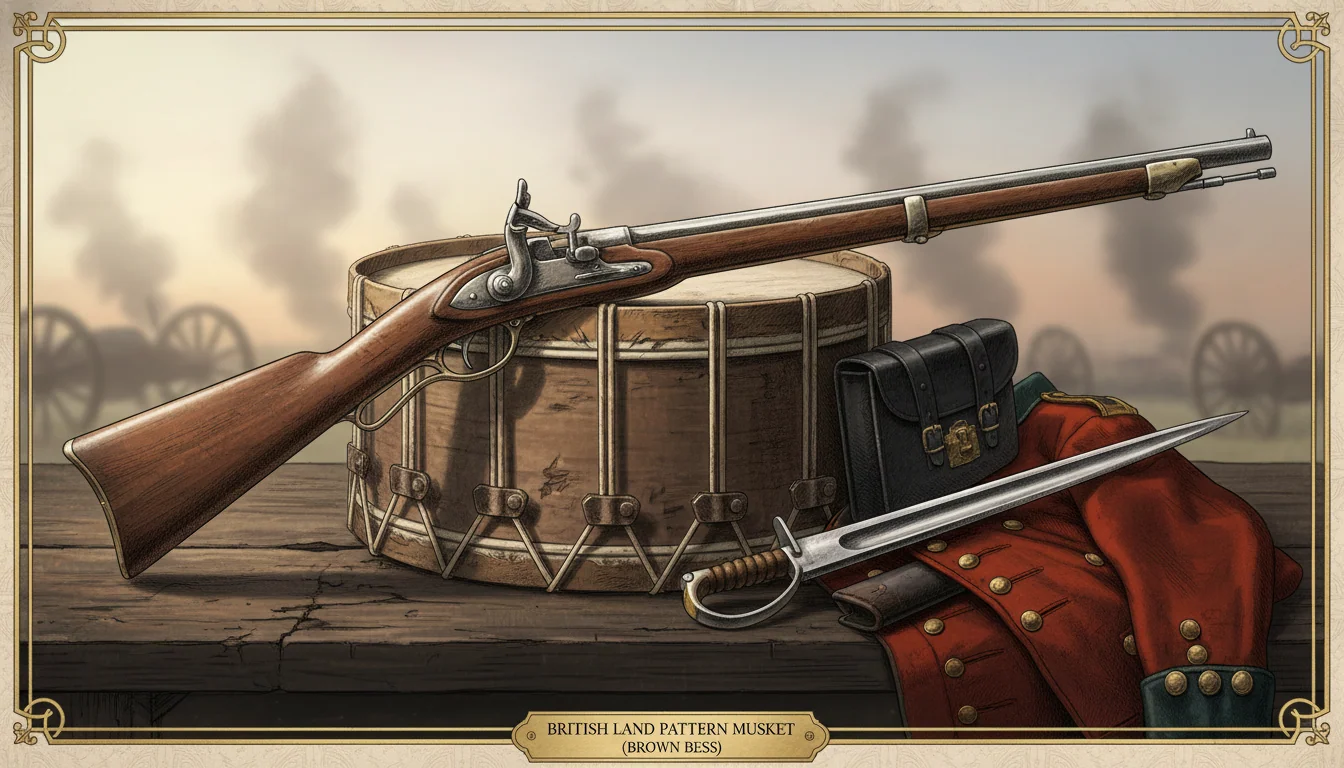
The British soldier who loaded his musket in the rain at Lexington in 1775, the one who fixed his bayonet at Waterloo in 1815, and the one who stood in a line outside an Indian fort somewhere in the 1820s all held essentially the same weapon. The Land Pattern Musket, known to soldiers across the English-speaking world as the Brown Bess musket, is one of the longest-serving standard infantry arms in military history. It was not a particularly elegant design, and it was not a particularly accurate one. It was cheap to make, robust enough to absorb rough handling, and capable of producing the one thing 18th-century infantry tactics actually required: a large volume of fire from a disciplined line of men.
How the design came together
The Land Pattern Musket evolved from earlier English military firearms through a series of standardization efforts in the early 18th century. The British government, frustrated by the variety of non-interchangeable muskets that regiments were purchasing from different gunsmiths, pushed for a uniform design that could be produced in quantity by both London and Birmingham makers.
By the 1720s, the Long Land Pattern had settled into its mature form: a smooth-bore flintlock, firing a lead ball of approximately .69 to .71 inches in diameter from a barrel nearly 46 inches long. The overall weight, loaded, was around ten pounds. The mechanism was a standard flintlock: a cock holding a piece of flint, a frizzen of hardened steel, and a pan filled with priming powder. Pull the trigger, the flint snaps forward against the frizzen, sparks fall into the priming pan, the priming ignites, and the main charge fires the ball down the barrel. In dry weather, this sequence took about a second. In rain, it sometimes took longer, or did not happen at all.
The windage between the undersized ball and the barrel was deliberate. A tighter fit would have required cleaning the barrel between every shot, impossible in sustained combat. The loose fit allowed rapid reloading but meant the ball bounced unpredictably down the barrel on its way out, degrading accuracy. This was accepted as a reasonable trade.
The variants
The original Long Land Pattern gave way over the decades to shorter, lighter versions that were easier to handle in close-order formations. The Short Land Pattern, introduced in the 1740s, reduced the barrel to approximately 42 inches. A Naval Pattern followed for ships' companies, with a still shorter barrel suited to cramped deck fighting.
The most important variant for volume and legacy was the India Pattern, introduced in the 1790s and produced in enormous quantities during the Napoleonic Wars. The India Pattern trimmed the barrel further to about 39 inches and simplified the furniture, the metal fittings around the stock and barrel, to reduce cost and manufacturing time. It was lighter and cheaper than its predecessors and slightly less robust, but by the 1790s the British government needed muskets in numbers that earlier production methods could not supply.
The Board of Ordnance contracted with hundreds of makers across Birmingham and London to produce India Pattern muskets at scale. Between roughly 1793 and 1815, somewhere around three million India Pattern muskets were produced, a figure that supplied the British army, its colonial forces, and large numbers of allied and subsidized troops across Europe and the Americas.
What it actually did in battle
The tactical doctrine built around the Brown Bess was evolved carefully over decades of European warfare and then tested against opponents ranging from French grenadiers to American frontiersmen to Zulu warriors.
A trained British infantryman was expected to fire three rounds per minute under combat conditions, occasionally four with a clean weapon at the start of an engagement. In practice, in the heat of battle, with fouled barrels and sweating hands, two rounds per minute was often the realistic rate. Each round required: bite the paper cartridge, pour a small amount of powder into the priming pan, close the frizzen, pour the remaining powder down the barrel, spit the ball in, ram the paper cartridge as wadding, half-cock the hammer, present, aim (at the center mass of the nearest enemy), and fire.
Officers drilled their men to perform these steps in a near-automatic sequence that bypassed conscious thought. The goal was that a man could load and fire in the dark, in smoke, surrounded by noise and death, without needing to think about the mechanism at all.
The resulting volley fire could be devastating at close range. A British regiment of 500 to 600 men firing together at 50 yards put several hundred lead balls into a target area in under a second. The psychological effect was as significant as the physical one. French troops at Waterloo, advancing toward British lines in column, described the effect of disciplined British volley fire as like walking into a sudden wall.
Beyond 100 yards, the effectiveness dropped sharply. Beyond 150 yards, aimed fire from a Brown Bess was essentially wasted. This is why 18th and early 19th century infantry engagements were fought at distances that seem extraordinarily close by modern standards: the weapons required it.
At Bunker Hill and Valley Forge
The American Revolutionary War gave the Brown Bess its first famous test against a sophisticated opponent in unfamiliar terrain. British regulars carried the Long Land Pattern throughout most of the conflict; American Continental and militia forces used a mix of Brown Bess muskets acquired before the war, captured weapons, and French-supplied firearms.
The colonial militias had a tradition of rifled hunting firearms that were individually more accurate than the Brown Bess but slower to reload, more vulnerable to fouling, and incompatible with bayonet fighting. The British advantage in organized volley fire and bayonet discipline was real, and it repeatedly broke American formations in open-field engagements. Where American forces succeeded was in choosing terrain that negated the Brown Bess's advantages: woods, earthworks, and distances that favored aimed individual fire.
Bunker Hill, in June 1775, demonstrated both sides of the equation. British regulars advanced in formal order and were repeatedly shredded by American fire from the Breed's Hill earthworks until a third assault, exploiting ammunition shortages among the defenders, finally succeeded. The musketry on both sides was effective at the ranges involved; the problem was not the weapon but the exposed advance.
At Waterloo
By June 1815, the India Pattern had been the standard British infantry arm for roughly twenty years. The Battle of Waterloo was, among many other things, one of the largest deployments of smooth-bore flintlock musketry in European history, with approximately 70,000 French and 70,000 allied troops firing Brown Bess variants and French Charleville muskets at each other across a few square miles of Belgian farmland.
Wellington's infantry spent much of June 18 standing in thin lines or sheltering behind the ridge at Mont-Saint-Jean while French artillery worked them. When the French infantry and cavalry attacked, the British tactic was to wait until the attackers were close, deliver controlled volleys, and hold the line with bayonet if the French closed. The India Pattern performed as designed. At Waterloo, it helped end the Napoleonic era.
The end of smooth bore
The Brown Bess survived into the percussion-cap era by conversion: many flintlock weapons were retrofitted with percussion mechanisms in the 1830s and 1840s, extending their service life at modest cost. The Crimean War (1853-1856) demonstrated conclusively that smooth-bore weapons could not compete with rifled percussion firearms in the field, and the last Brown Bess derivatives were retired from front-line British service before the decade was out.
What replaced it was the Pattern 1853 Enfield, a rifled percussion musket that was accurate to over 500 yards. The Enfield made everything the Brown Bess represented, the close-order volley, the massed advance, the formal linear tactics that had governed European warfare for a century, functionally obsolete within a generation. A weapon that could kill accurately at 500 yards could not be approached using tactics designed for a weapon that killed effectively only at 50.
The Brown Bess served for roughly 120 years in various forms. In that time it fought the armies of France, Spain, the American colonies, the Marathas, the Mysore sultans, and dozens of opponents across five continents. It is not a beautiful weapon and it is not a precise one. It is the weapon of an empire that needed to arm enormous numbers of men quickly and reliably, and it did exactly that.
For how the Brown Bess appeared on screen, see The Patriot vs. History. For another long-serving infantry rifle, see Arsenal: The M1 Garand.
Quick Answers
Common questions about this topic
Why was the musket called the Brown Bess?
The origin of the nickname is genuinely uncertain. The most credible theories suggest it derives from the brown finish applied to the stock and sometimes the barrel, combined with a common English name for a reliable working tool. Another theory traces it to a partial translation of German terms for a firearm. The nickname does not appear in official records; the weapon's formal designation was always the Land Pattern Musket.
How accurate was the Brown Bess?
The Brown Bess was a smooth-bore weapon with significant windage between the ball and the barrel, which meant aimed individual fire was accurate to perhaps 50-75 yards in trained hands. Its military value came from massed volley fire, not marksmanship. A regiment firing coordinated volleys at close range created a lethal wall of lead regardless of individual aim. Officers trained men to fire at the enemy's belt buckle and accept that hits were partly a function of volume.
Did American colonists use the Brown Bess?
Yes. American colonial militias and Continental Army units used large numbers of Brown Bess muskets throughout the Revolutionary War. Many had been purchased legitimately before the war, others were captured from British forces, and some were imported from France. The Brown Bess was effectively the standard infantry firearm of both sides for much of the conflict, a fact that complicated British attempts to deny the colonists resupply.
When did the Brown Bess stop being used?
The India Pattern variant remained the standard British infantry arm through the Napoleonic Wars, with official replacement by percussion-cap weapons beginning in the 1830s. The Pattern 1853 Enfield, a rifled percussion musket capable of far greater range and accuracy, replaced it definitively in front-line British service. However, Brown Bess muskets remained in use by colonial forces and secondary units into the mid-19th century.

Talk to the People Who Wielded These Weapons
Chat with the soldiers, smiths, and commanders whose lives were shaped by the weapons of their age.
Create your free account →No card required. Some figures and features require a paid plan.
Join the HistorIQly Club
Get smarter about the past.
Weekly stories, deep dives, and exclusive content straight to your inbox.