Arsenal: The Pennsylvania Long Rifle
The Pennsylvania long rifle was the most accurate shoulder weapon of the 18th century. German immigrant gunsmiths built the rifle that helped win American independence.
Read Wikipedia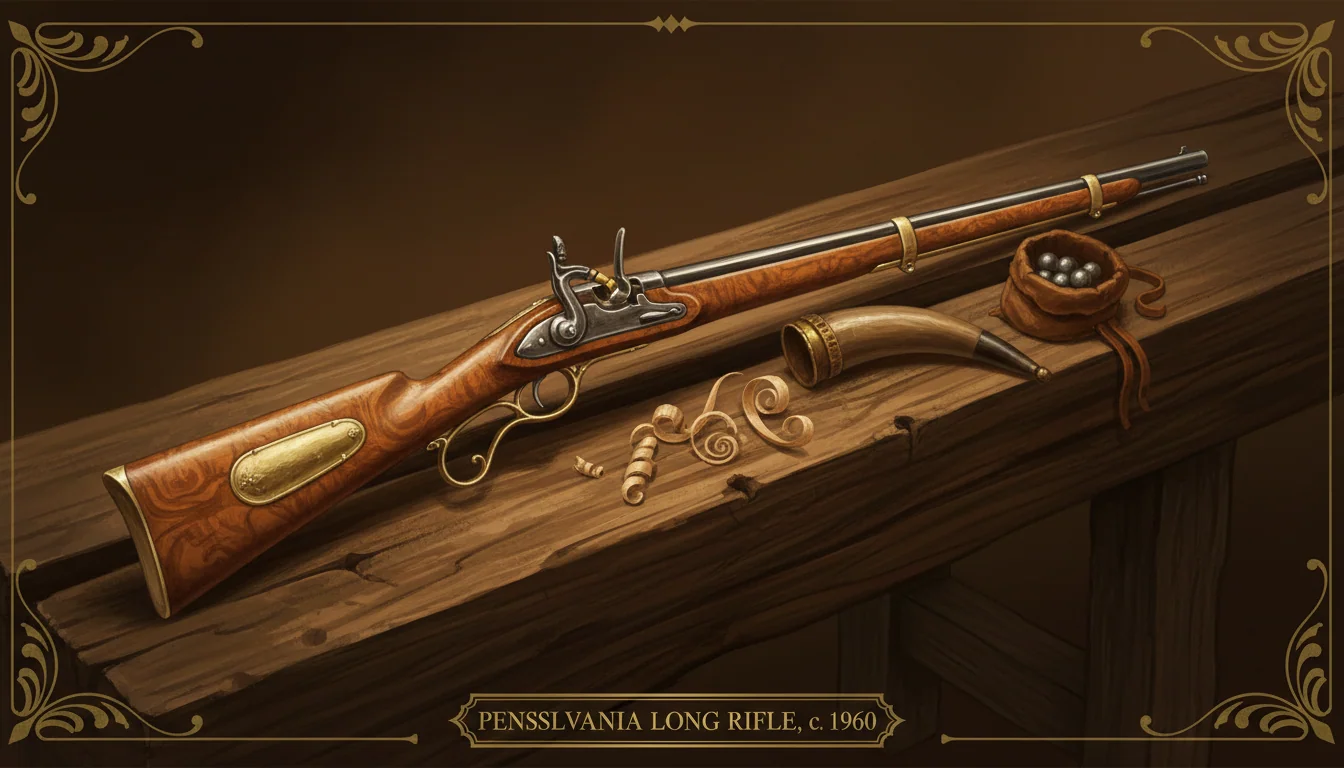
In the early decades of the 18th century, German-speaking gunsmiths in the Pennsylvania backcountry began solving a practical problem with an elegant result. The heavy, short-barreled Jaeger rifles they had brought from central Europe were fine for hunting in the dense forests of home, but the American frontier imposed different demands: longer shots across open ground, tighter powder budgets on long hunts, ammunition that had to last for weeks away from any supply point. The solution those craftsmen built became the most accurate shoulder weapon of the pre-industrial world, and the rifle that helped fracture the British Empire.
The Jaeger inheritance
The rifle's ancestors were the central European Jaeger rifles, hunting arms developed in German and Austrian lands during the 17th century for noblemen's gamekeepers. The Jaeger was short, relatively wide-bore (typically around .60 caliber), heavy enough to absorb recoil, and rifled with a slow twist to improve accuracy. It was a superb forest rifle for continental conditions, but it used substantial powder charges and heavy lead balls that limited how much ammunition a man could carry on a long scout.
German and Swiss gunsmiths began settling in Lancaster County, Pennsylvania, from around 1710. By the 1720s and 1730s, a recognizably distinct design had emerged from their workshops: a rifle with a barrel lengthened to 40 inches or more, narrowed in caliber to around .40-.50 rather than the Jaeger's .60, and built on a longer, slimmer stock suited to shouldering and carrying for long distances on foot. The longer barrel burned powder more completely, extracting more propulsive energy from each charge and reducing the amount of powder needed per shot. The smaller bore meant a lighter ball and more shots from the same pound of lead.
The rifling, spiral grooves cut into the bore that imparted spin to the ball, was carried over from the Jaeger tradition. But the Pennsylvania makers lengthened the twist and refined the depth and width of the grooves over decades of empirical adjustment. The result was a rifle that could put a ball into a ten-inch circle at 200 yards in the hands of a practiced shooter, compared to the roughly three-foot dispersion pattern of a smoothbore musket at the same distance.
What the rifle looked like
A mature Pennsylvania long rifle from the mid-18th century is an immediately recognizable object: a sinuous, graceful weapon between 54 and 64 inches overall, roughly 7-9 pounds, with an octagonal barrel, a maple or walnut stock that curves gently along its full length, and typically a small box (the patch box) inlaid into the right side of the buttstock with a hinged brass cover, used to store greased linen patches.
Those patches were the key to the rifle's accuracy. The ball had to be slightly larger than the bore and wrapped in a greased linen or buckskin patch that was rammed down the barrel with a wooden ramrod. The patch gripped the rifling, spun the ball, and then fell away at the muzzle. The entire loading process took 30-60 seconds for a trained man, compared to 15-20 seconds for a musket using a loose ball. Speed was not the rifle's virtue.
Brass was the metal of choice for the furniture: trigger guard, patch box, butt plate, and nose cap. The brass was often engraved, and many Lancaster County pieces are genuinely beautiful objects, with decorative work that reflects the craftsmen's European artistic traditions while also showing American folk motifs. These were not purely functional tools. They were household investments and family heirlooms.
The frontier context
The rifle's design was shaped by the work it was expected to do. A Pennsylvania frontiersman in the 1730s through 1770s hunted deer, elk, and bear across terrain where shots of 100-150 yards were routine. He might be out for a week or more with only what he carried. The lighter charge and smaller ball of the long rifle were not a compromise; they were a solution to the logistics of wilderness life where resupply was measured in days of walking.
The rifle was also used for defense against human threats, both in conflicts with Native American nations during the various frontier wars of the mid-18th century and in disputes between settlers. Its accuracy advantage in individual aimed fire made it a formidable weapon in terrain where the European linear tactics of massed volley fire were impractical.
By the time of the French and Indian War (1754-1763), Virginia and Pennsylvania colonial forces had enough rifles in their ranks that British commanders took notice. Provincial marksmen were sometimes used as skirmishers and scouts in ways that smoothbore-equipped regular soldiers could not be, because they could engage at ranges where a Brown Bess was irrelevant.
The American Revolution
The rifle's most significant military test came between 1775 and 1783. When the Continental Congress called for riflemen in the summer of 1775, Pennsylvania, Maryland, and Virginia companies arrived at the siege of Boston armed with long rifles and proceeded to unsettle the British garrison with aimed fire at distances the garrison's smoothbore sentries could not reply to effectively.
The psychological effect was immediate and documented in British correspondence. A British officer's letter from the siege period notes that riflemen were picking off soldiers at ranges "incredible to those who are not eye-witnesses of the fact." Whether the accounts are exaggerated or not, the British modified their behavior, keeping working parties further from the American lines and reducing exposure for individuals.
The practical military contribution of the rifle was concentrated in specific engagements. At the Battle of Saratoga in October 1777, Daniel Morgan's rifle corps played a critical role in the second day's action at Bemis Heights. Morgan's men, positioned in the woods, targeted British officers and artillery crews with the precision aimed fire the rifle enabled. The death of British General Simon Fraser during the battle, attributed to a shot from Morgan's corps, is sometimes called a turning point in the action that led to Burgoyne's surrender.
At Kings Mountain in October 1780, Patriot militia forces composed largely of frontier riflemen surrounded and destroyed a Loyalist force under Major Patrick Ferguson on a wooded South Carolina ridgeline. Ferguson, himself the inventor of an early breech-loading rifle, had positioned his men on the hilltop expecting the terrain to favor his defenders. Instead the trees gave the surrounding riflemen cover to shoot from, and they picked the hilltop apart with aimed fire. Ferguson was killed and his force surrendered.
The rifle's limitations
The long rifle was not a universal military solution and military commanders knew it. The loading process was its critical flaw on a conventional battlefield. A British infantry line could fire three volleys while a rifleman loaded once. The rifle could not take a bayonet in the standard configuration, leaving riflemen defenseless against cavalry or a determined bayonet charge at close quarters. Morgan's corps compensated by pairing riflemen with musket-armed infantry who could fix bayonets, but this required tactical coordination most commanders could not reliably achieve.
The rifle also demanded a specific kind of soldier. Learning to shoot one accurately required years of practice and a particular calibration of eye and judgment that was not universal. A musket-armed soldier could be functional in two weeks of training. A rifle company had to be recruited from men who already knew how to shoot, which in practice meant frontier hunters and woodsmen.
The craft after the Revolution
The Pennsylvania long rifle tradition did not end with independence. The craft spread south and west with the frontier, reaching Kentucky, Tennessee, and eventually Ohio, which is where the "Kentucky rifle" misnomer came from. As migration pushed the American frontier further west in the late 18th and early 19th centuries, the rifle went with it, evolving slightly in style and dimension to reflect local wood supplies and local tastes.
The percussion cap ignition system, developed in the 1820s and 1830s, eventually replaced the flintlock pan on new rifles and was retrofitted onto many existing ones. The percussion system was more reliable in wet weather and faster to prime, two real improvements on the flintlock's weaknesses.
The fundamental design, long barrel, rifled bore, smaller caliber, was carried into military use by the Model 1803 Harper's Ferry rifle, the first standardized American military rifle, which owed its accuracy and proportions directly to the Pennsylvania tradition. When American soldiers and militia carried rifles into the War of 1812 and the Battle of New Orleans, they were shooting descendants of the Lancaster County craft.
What replaced it
The breech-loading revolution of the mid-19th century ended the muzzle-loader's era on the battlefield. Rifles like the Springfield Model 1861, loaded from the muzzle with a Minie ball, were still used at the start of the Civil War, but by the war's end breech-loaders like the Spencer and Henry were in wide use. By 1870, a muzzle-loading rifle on any battlefield in the developed world was an antique.
The Pennsylvania long rifle never received a formal retirement. It simply became outpaced, the way all tools eventually are. But for roughly a century, from the Lancaster County workshops of the 1720s to the frontier settlements of the 1820s, it was the most individually accurate firearm in widespread American use, and at certain specific moments, it bent the arc of a revolution toward an outcome that a weapon less precise would not have produced.
For the firearms that succeeded it through America's later wars, see our entries on the M1 Garand and the M16 rifle.
Quick Answers
Common questions about this topic
What made the Pennsylvania long rifle different from a musket?
The Pennsylvania long rifle had a rifled barrel, with spiral grooves cut into the inside of the bore that spun the ball in flight and dramatically increased accuracy. A trained rifleman could reliably hit a man-sized target at 200 yards; the standard British Brown Bess smoothbore musket was considered effective at about 50-75 yards. The long rifle also had a smaller caliber bore, which reduced the weight of lead needed per shot and stretched ammunition supplies.
Why is it called the Kentucky rifle if it was made in Pennsylvania?
The name 'Kentucky rifle' became popular after a patriotic song celebrated the accuracy of frontier marksmen at the Battle of New Orleans in 1815. But the rifle itself was developed and primarily manufactured in Lancaster, York, and Berks counties in Pennsylvania by German and Swiss immigrant gunsmiths, from roughly the 1720s onward. Historians generally prefer 'Pennsylvania long rifle' for the colonial and revolutionary period version of the weapon.
Who made Pennsylvania long rifles?
The craft was established by German-speaking immigrant gunsmiths in Pennsylvania from around the 1710s to 1730s, adapting the shorter, heavier German Jaeger rifle to frontier conditions. Notable early makers included gunsmiths in Lancaster County whose names appear on surviving rifles. The craft became hereditary in many families, with sons learning from fathers through apprenticeship in a tradition that lasted well into the 19th century.
What replaced the Pennsylvania long rifle?
The rifle's key weakness was the slow loading process, which required patching the ball carefully in the rifled bore. By the early 19th century, standardized military rifles like the Model 1803 Harper's Ferry rifle offered comparable accuracy with faster manufacture and greater parts interchangeability. Percussion ignition in the 1820s-1840s improved reliability, and breech-loading technology in the 1850s-1860s made the muzzle-loading long rifle obsolete on the battlefield.

Talk to the People Who Wielded These Weapons
Chat with the soldiers, smiths, and commanders whose lives were shaped by the weapons of their age.
Create your free account →No card required. Some figures and features require a paid plan.
Join the HistorIQly Club
Get smarter about the past.
Weekly stories, deep dives, and exclusive content straight to your inbox.