Arsenal: The M16 Rifle - From Black Rifle Scandal to Global Standard
The M16 rifle history spans disaster in Vietnam, sweeping redesign, and five decades of development into the most widely copied rifle platform in history.
Read Wikipedia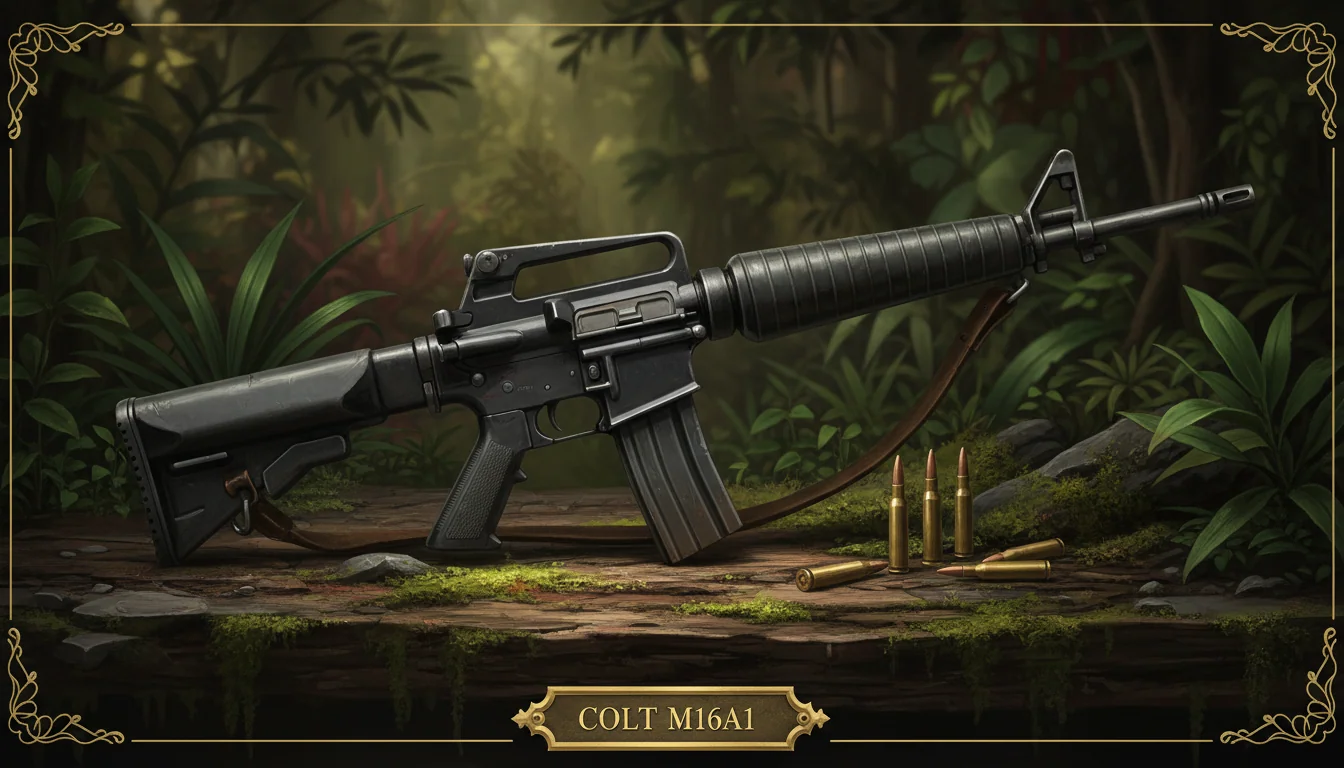
When the United States Army first fielded the M16 in Vietnam in 1965, soldiers wrote home describing a rifle that jammed, corroded, and killed them by failing at critical moments. Congressional hearings were held. Generals testified. The rifle's designer wrote formal protests to the Department of Defense. The black-painted aluminum weapon, which looked like a toy compared to the wooden-and-steel M14 it replaced, became a symbol of contractor greed, bureaucratic incompetence, and the particular cruelty of sending men to die with broken equipment.
That is one half of the M16 story. The other half is that the problems were fixed, the design was refined over five decades of continuous development, and the rifle platform Eugene Stoner invented in the late 1950s became the most widely copied military small arm in history. The AR-15 family, in its military and civilian variants, is now manufactured by over a hundred companies in dozens of countries. It changed what infantry rifles could be.
The design
Eugene Stoner was working at ArmaLite - a small California company founded specifically to develop innovative small arms using aerospace materials - when he produced the AR-15 around 1956-1958. The rifle broke with nearly every convention of the time.
Where military rifles were made of steel and walnut, the AR-15 used an aluminum alloy receiver and a fiberglass-reinforced composite stock. It was dramatically lighter than its contemporaries: the loaded M14 it would replace weighed more than five kilograms; the AR-15 weighed roughly three. Where most rifles of the era fired full-power cartridges designed to kill at 800 meters, Stoner chambered the AR-15 for a small, fast .223-inch projectile (later standardized as the 5.56x45mm NATO round) that was lethal at practical infantry engagement distances and allowed soldiers to carry twice as many rounds.
The gas system was another departure. When the rifle fires, expanding gas is tapped from the barrel and fed back through a tube directly into the bolt carrier, cycling the action without a separate gas piston. This direct impingement system is lighter and more accurate than piston designs, but it deposits fouling directly into the action, which is the core of the later Vietnam problems.
ArmaLite sold the manufacturing rights to Colt in 1959. Colt developed the design into a commercial product, sold it to the US Air Force in 1963 as the M16, and the Army followed with the XM16E1 in 1965 at the height of the Vietnam buildup.
Vietnam and the disaster
The conditions under which early M16s were deployed would have challenged any rifle. Jungle humidity corroded metal. Red laterite mud got into everything. Soldiers were on operations for weeks without resupply. And the rifle arrived with problems that were not the jungle's fault.
The original specification called for IMR powder, a relatively clean-burning propellant. The Army's Ordnance Corps switched to ball powder without adequately testing the consequences. Ball powder burns differently and produced excessive cyclic rates and more fouling. The fouling built up in the action and in the bore faster than the system could handle it.
The rifle was simultaneously marketed to soldiers as "self-cleaning," a claim that was not true and that led to cleaning kits being omitted from early shipments. Soldiers who had never been taught to clean the weapon, using an action that fouled faster than designed, in a jungle where moisture accelerated corrosion, encountered jamming at rates that ranged from embarrassing to fatal. Marines and soldiers were found dead in firefights with cleaning rods stuck in their barrels - evidence of desperate attempts to clear jammed rounds under fire.
The 1967 Congressional investigation led by Representative James Ichord documented the failures in systematic detail. The rifle was not at fault by design; it had been deployed with the wrong ammunition, without maintenance supplies, and without adequate training. The corrective program for the M16A1 addressed all of this: chrome lining was added to the barrel and chamber, cleaning kits were issued as standard equipment, the buffer was adjusted to manage cyclic rate, and a forward-assist device allowed soldiers to manually close the bolt if the action failed to cycle completely.
By the late 1960s, the M16A1 was a reliable weapon. Veterans who served with it from 1968 onward generally describe a rifle they trusted.
The evolution
Military small arms are never finished. The M16A1 gave way to the M16A2, adopted in the early 1980s, which incorporated a heavier barrel with a faster rifling twist to stabilize the new NATO-standard SS109/M855 bullet, replaced full-automatic fire with a three-round burst mechanism, and strengthened the receiver materials. It was more accurate at longer ranges and more suitable for the NATO standard ammunition being adopted across allied armies.
The M16A3 and M16A4 followed, primarily adding Picatinny accessory rails that allowed soldiers to attach optics, lights, and laser designators as standard equipment rather than improvised additions. The M16A4 with an ACOG scope became the standard US Marine Corps rifle for most of the Afghanistan and Iraq campaigns.
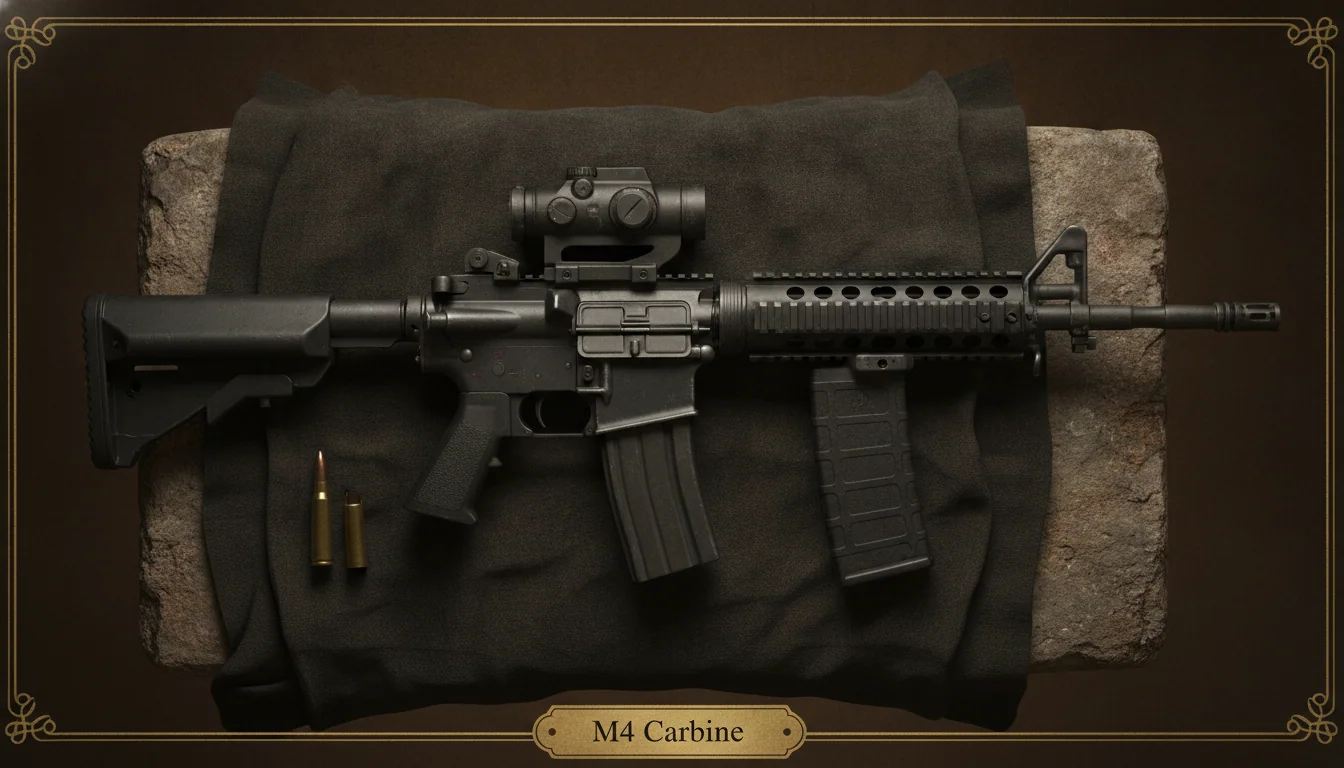
Running alongside the M16 development was the M4 carbine, a shorter variant with a 14.5-inch barrel and a collapsing stock. The M4 is easier to handle in vehicles, in buildings, and in the close terrain of modern urban combat. By the mid-2000s it had effectively replaced the full-length M16 in US Army use, while the Marines held on to the longer barrel for its accuracy advantage before eventually following suit.
The AK comparison
No discussion of the M16 family can avoid the AK-47 comparison, which has been conducted in military test ranges, combat experience, and internet forums for sixty years. The honest summary is that both comparisons contain real truth and real mythology.
The M16/M4 family, properly maintained, is more accurate at range than the Kalashnikov. Its lighter cartridge allows a soldier to carry more ammunition. Its ergonomics - particularly the in-line stock that puts the bore axis closer to the shooter's shoulder - reduce recoil and improve target acquisition. Its optics-mounting capability has evolved far ahead of most AK variants.
The AK family operates with looser manufacturing tolerances, which gives it more room to function when dirty. A Kalashnikov that has been dragged through sand and not cleaned will usually still fire. Early M16s demonstrably could not match this. Late M16A1s and M4s, properly chrome-lined and maintained with the training and equipment that should have been there from the start, perform at a level that makes the reliability comparison far less decisive.
Neither rifle is fragile. Neither is invincible.
The civilian legacy
The United States military stopped using the term "assault rifle" for the M16 early in its service life, preferring "service rifle" or "automatic rifle." The civilian version, marketed as the AR-15, became something else entirely.
Colt sold a semi-automatic-only version of the AR-15 for civilian use beginning in the early 1960s. After Colt's patents expired in the early 1990s, dozens of manufacturers began producing their own AR-15 pattern rifles. The combination of modularity - the rifle breaks into upper and lower receivers that accept hundreds of aftermarket components - and the availability of relatively affordable surplus parts created a market that grew steadily. By the 2020s, the AR-15 platform had become the best-selling rifle type in the United States, with estimates of the civilian stock running well above 20 million.
This civilian proliferation has made the AR-15 one of the most politically contested objects in American life. It has also ensured that Eugene Stoner's basic design, which emerged from a California garage operation trying to interest the Air Force in an aluminum rifle, will remain in production and active use long after every comparable design from its era has been retired.
What it changed
The M16's lasting contribution to military history is not any single battle but a shift in how armies think about the infantry rifle. Before Stoner, the assumption was that service rifles needed to fire full-power cartridges at long range with the same rounds the machine gun used. The M16 demonstrated that a lighter, faster round was adequate for the ranges at which infantry actually engaged each other - most under 300 meters - and that a lighter rifle allowed soldiers to carry more ammunition, move faster, and sustain fire longer.
Every major military rifle adopted since the 1970s reflects this lesson. The Soviet AK-74, which replaced the original AK-47 in Soviet service, fires a smaller 5.45mm cartridge. The British SA80, the French FAMAS, the Austrian Steyr AUG, and dozens of other national service rifles all fire 5.56mm NATO or comparable intermediate cartridges. The M16's cartridge philosophy won, even among armies that chose different mechanisms to fire it.
Stoner's rifle is, in this sense, the rifle that ended the era of the full-power battle rifle. The mess it made in Vietnam in 1965 is the footnote. The standard it set is the continuing story.
For other weapons that redefined warfare in their era, see the histories of the Dane Axe and the Katana.
Quick Answers
Common questions about this topic
Who designed the M16?
Eugene Stoner designed the original AR-15 while working at ArmaLite in the late 1950s. Colt purchased the manufacturing rights from ArmaLite in 1959 and developed it into the military M16. Stoner's design introduced a number of innovations, including aluminum and composite construction, a small-caliber high-velocity cartridge, and a direct impingement gas system.
Why did the M16 jam so much in Vietnam?
The early M16s deployed in Vietnam suffered from a combination of problems: the army specified a different propellant powder than Stoner's design required, creating excessive fouling; the rifle was issued without adequate cleaning kits after being advertised as 'self-cleaning'; and early production models lacked chrome lining in the barrel and chamber that would have resisted corrosion in the jungle environment. These problems were identified and largely corrected in the M16A1 by the late 1960s.
How does the M16 compare to the AK-47?
The M16 family is generally more accurate at range and fires a smaller, flatter-shooting cartridge. The AK-47 design has looser manufacturing tolerances that make it more tolerant of sand, mud, and poor maintenance. Both comparisons have been overstated by popular mythology: the M16A1 and later variants are highly reliable when properly maintained, and the AK-47 is not immune to jamming under severe conditions.
What replaced the M16 in US military service?
The M4 carbine, a shortened variant with a 14.5-inch barrel and collapsing stock, gradually replaced the full-length M16 as the standard US Army and Marine Corps weapon from the 1990s onward. Both fire the same 5.56x45mm NATO cartridge. The M16A4 remained in US Marine Corps service into the 2010s before being phased out.

Talk to the People Who Wielded These Weapons
Chat with the soldiers, smiths, and commanders whose lives were shaped by the weapons of their age.
Create your free account →No card required. Some figures and features require a paid plan.
Join the HistorIQly Club
Get smarter about the past.
Weekly stories, deep dives, and exclusive content straight to your inbox.