Arsenal: The Henry Repeating Rifle
The Henry repeating rifle history begins with an 1860 patent that put 16 rounds in the hands of Civil War soldiers and launched the Winchester dynasty.
Read Wikipedia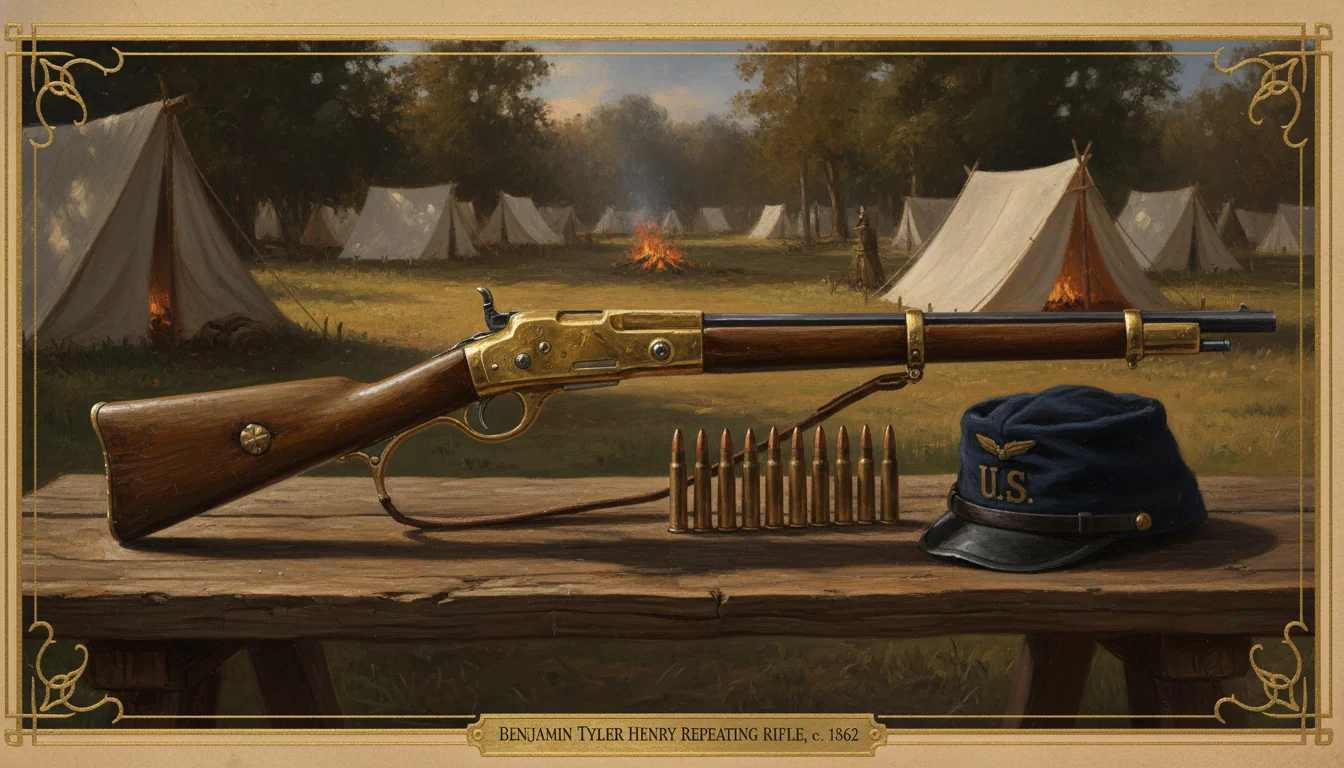
The Henry repeating rifle history begins not with an invention but with an improvement: it was not the first repeating firearm. Revolvers had been multiplying chambers for decades, and the Colt revolving carbine existed before the Civil War, though it was awkward and occasionally explosive. What Benjamin Tyler Henry designed and patented in 1860 was the first repeating rifle that actually worked at the level of field reliability: dependable enough to trust in combat, fast enough to change the arithmetic of a firefight, and chambered in a self-contained metallic cartridge that eliminated the powder flask, the percussion cap, and nine steps of the loading sequence.
It was lever-action, brass-framed, and held fifteen rounds in a tubular magazine beneath the barrel plus one in the chamber. A practiced shooter could fire all sixteen rounds in about fifteen seconds. The nearest standard weapon on either side of the Civil War was the Springfield rifled musket, which required nine to thirteen steps to reload after each shot and produced, under good conditions, two to three rounds per minute from a competent soldier. The Henry offered something like ten to twelve aimed shots in that same minute from a gun that did not need to be pointed skyward to reload.
In a war still largely defined by single-shot muzzle-loaders, the Henry was from the future.
Benjamin Tyler Henry and the New Haven Arms Company
Benjamin Tyler Henry was a skilled gunsmith who spent the 1850s working for the Volcanic Repeating Arms Company, part of the dense cluster of arms manufacturers in the Connecticut River Valley. When Volcanic reorganized as the New Haven Arms Company in 1857, Henry stayed on as plant superintendent. The company's controlling investor was Oliver Winchester, a Connecticut shirt manufacturer who had shifted his money into firearms and understood the market even if he did not understand the engineering.
Henry spent the late 1850s improving on the Volcanic's design. The Volcanic used a self-propelled bullet that was clever but underpowered and unreliable. The breakthrough Henry developed was the .44 Henry rimfire cartridge: a self-contained brass case with the primer compound pressed into the rim, so that the firing pin striking the rim ignited the powder. No separate cap needed. The brass case expanded on firing to seal the breech against gas blowback, a feature that made the action cleaner and faster.
The rifle chambered for this cartridge was patented on October 16, 1860. It weighed roughly nine pounds, measured just over 43 inches in total length, and carried the brass receiver that gave Confederate soldiers cause to describe it in terms that combined technical respect with genuine annoyance. One common Confederate phrase called it "that damned Yankee rifle that can be loaded on Sunday and fired all week," which captured the operational reality accurately if not charitably.
The Civil War
The federal government's official purchase of Henry rifles totaled approximately 1,730 - a modest procurement in a conflict that issued hundreds of thousands of Springfield muskets. What made the Henry a Civil War weapon was private purchase. Soldiers, especially in western theater regiments with access to ready cash, paid $40 to $50 of their own money for the gun. Some Union regiments pooled resources through regimental funds to arm a meaningful portion of their companies.
The tactical effects were noticed wherever Henry-armed soldiers appeared. The gun's rate of fire meant that a small group of men in a covered position could generate a volume of fire previously requiring a much larger formation. Confederate after-action reports from multiple engagements in the western theater noted the unusual firepower of certain Union units without always understanding its source. Officers who encountered Henry-armed opposition sometimes described the experience of receiving what seemed like continuous fire from positions they had expected to advance through with relative speed.
The overall impact was constrained by numbers. Approximately 10,000 Henry rifles were manufactured before the war ended in April 1865, in a conflict that mobilized over two million men on the Union side alone. The Henry was a convincing preview of what was coming, not a war-deciding factor.
What it proved was the tactical argument for the repeating rifle. Wherever a unit had Henrys, their opponents wrote it down. Military procurement offices in Europe and the United States were reading those reports.
Benjamin Tyler Henry versus Oliver Winchester
The story of the Henry rifle is partly the story of its inventor losing control of it.
Henry held the patent personally - the gun was his design and his achievement. But the New Haven Arms Company, in which he had no ownership stake, was the manufacturer. Oliver Winchester controlled the company and therefore the revenue. Henry received a salary and some royalties, but as the Civil War ended and the commercial value of the repeating rifle became obvious, the arrangement began to look less proportionate to what he had created.
In 1865, Henry petitioned the Connecticut legislature to alter the corporate charter of the New Haven Arms Company in ways that would have increased his control. Winchester opposed the petition and succeeded in defeating it. The following year, Winchester reorganized the company as the Winchester Repeating Arms Company, with a revised design by his plant superintendent Nelson King as the new product. King added a wooden forestock for better handling and a side-loading gate on the receiver that allowed the shooter to top off the magazine without fully unloading it - a genuine improvement over the Henry's design, which required loading from the front.
Henry received no equity in the Winchester Repeating Arms Company. He died in 1898 with his name on the most famous lever-action rifle in American history and no financial interest in the company that was manufacturing its successors by the hundreds of thousands.
The Winchester dynasty
The Model 1866, called the Yellow Boy for its brass receiver, sold strongly in the civilian and export markets in the years after the Civil War. The Ottoman Empire bought thousands. Indigenous warriors in the American West acquired them through trade, and the Winchester became part of the armament of conflicts from the southern plains to the Pacific Northwest. A further improved design, the Model 1873, was chambered in the same cartridges used by the Colt Single Action Army revolver - a deliberate commercial decision that meant a man on the frontier could carry one type of ammunition for both his rifle and his handgun.
The Model 1873 was marketed as "The Gun That Won the West," a tagline more effective as propaganda than as history, but not entirely dishonest. The repeating lever-action rifle, in Winchester's hands, became the standard civilian firearm of the American frontier in the 1870s and 1880s, present in range wars, cattle drives, Apache campaigns, and the personal arsenals of everyone from homesteaders to outlaws.
All of it traced back to the magazine design, the rimfire cartridge, and the lever mechanism that Henry patented in October 1860. The Colt Single Action Army, adopted by the U.S. Cavalry in 1873, used Winchester's .44-40 cartridge - a deliberate pairing that made both weapons standards of the frontier.
Why it mattered
The Henry rifle did not win the Civil War. It was too rare and too expensive to shift a conflict of that industrial scale. What it did was demonstrate the concept under fire in ways that changed how military planners thought about small-arms development.
The years immediately following the Civil War saw a rapid acceleration in breech-loading metallic cartridge weapons across European and American armies. The French Chassepot, the Prussian Dreyse needle gun, and the British Snider-Enfield conversion all moved in the same direction: away from the single-shot muzzle-loader and toward the metallic cartridge, the self-contained round that could be cycled quickly without stopping to measure powder. The mass-issue repeating rifle was still a generation away, but the direction had been made unmistakable.
In the longer view, every lever-action rifle manufactured in the 150 years since 1860 is a descendant of Henry's design logic. The tubular magazine, the rimfire metallic cartridge, the lever-operated cycling mechanism: these ideas passed through Winchester and then through the entire industry. The inventor did not profit from most of it. The ideas survived everything.
Henry designed a gun capable of firing sixteen rounds before reloading, in a war where two rounds per minute was the standard. That gap - between what was possible and what armies assumed was the ceiling - is what the Henry rifle exposed. The industry spent the next half-century closing it. The direction this set - toward higher capacity, faster cycling, self-contained ammunition - runs in a straight line through to weapons like the AK-47, though the principle Henry demonstrated in 1860 remained the same.
Quick Answers
Common questions about this topic
Who invented the Henry repeating rifle?
Benjamin Tyler Henry, a gunsmith and plant superintendent at the New Haven Arms Company, designed the Henry rifle and received a patent for it on October 16, 1860. The company's primary investor, Oliver Winchester, would later reorganize it as the Winchester Repeating Arms Company and build the Henry's commercial success into a firearms dynasty - without giving Henry ownership or credit.
How many rounds could a Henry rifle hold?
The Henry held fifteen rounds in a tubular magazine beneath the barrel, plus one in the chamber, for a total of sixteen. A practiced shooter could fire all sixteen rounds in roughly fifteen seconds. By comparison, a soldier with a single-shot muzzle-loading rifled musket could manage two to three shots per minute under ideal conditions.
Was the Henry rifle used in the Civil War?
Yes, though in limited numbers. The federal government ordered approximately 1,730 Henry rifles officially. Far more reached the battlefield through private purchase - soldiers who could afford the $40 to $50 price tag bought their own. Some Union regiments pooled regimental funds to equip substantial numbers of men. Confederate opponents documented the firepower advantage in their after-action reports.
What replaced the Henry rifle?
The Winchester Model 1866, designed with improvements by Nelson King, replaced the Henry in commercial production. King added a wooden forestock and a side-loading gate that allowed the shooter to top off the magazine during a fight. The 1866 was followed by the Model 1873, chambered in the same cartridges as the Colt Single Action Army revolver - a deliberate interoperability choice that made the combination the standard armament of the American frontier.

Talk to the People Who Wielded These Weapons
Chat with the soldiers, smiths, and commanders whose lives were shaped by the weapons of their age.
Create your free account →No card required. Some figures and features require a paid plan.
Join the HistorIQly Club
Get smarter about the past.
Weekly stories, deep dives, and exclusive content straight to your inbox.