The Colt Peacemaker: The Revolver That Built the American West
The Colt Peacemaker was the revolver that won the American West - at least in myth. The history and enduring legend of the 1873 Single Action Army.
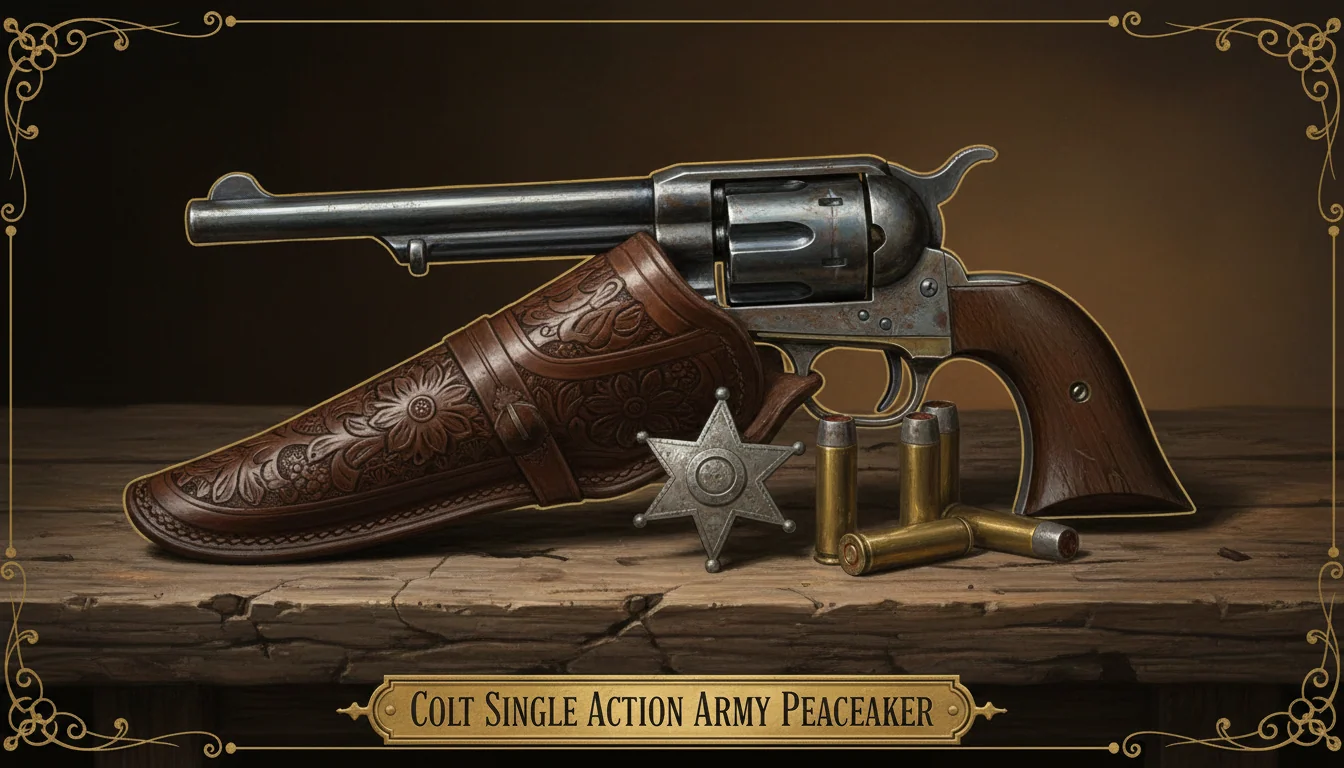
In 1873, the U.S. Army adopted a new sidearm: the Colt Single Action Army, a six-shot revolver chambered in the new .45 Colt cartridge. Within a generation, the Colt Peacemaker had become the most recognizable handgun in the world, a fixture of American culture, and the central prop of every Western dime novel and film for the next century. It was nicknamed the Peacemaker by Colt's distributors, although the nickname has always been ironic, and it has outlasted every revolver of its generation. Colt is still making them in 2026.
The percussion era
The Colt revolver was not a new idea in 1873. Samuel Colt had patented the rotating cylinder in 1836, and his Paterson, Walker, Dragoon, and 1851 Navy revolvers had been important sidearms in the Mexican War and the American Civil War. But the early Colts were percussion-cap weapons, loaded chamber by chamber with loose powder, ball, and a percussion cap on each nipple. They were slow to reload, vulnerable to chain-fire (multiple chambers igniting at once), and dependent on dry powder.
By the 1860s, two innovations were converging that would obsolete the percussion revolver. The first was the metallic cartridge, in which the bullet, powder, primer, and case were combined in a single sealed unit. The second was the bored-through cylinder, which allowed the cartridge to be loaded from the rear rather than the front of each chamber.
Smith & Wesson held a key patent on the bored-through cylinder, and used it to dominate the early metallic-cartridge market with their small-frame .22 and .32 revolvers. Colt was forced to wait. When the Smith & Wesson patent expired in 1869, Colt began designing a metallic-cartridge revolver of its own. The Single Action Army was the result.
The 1873 design
The 1873 SAA was a refined evolution of the percussion-era Colt frame. The barrel and cylinder were heavier; the loading mechanism used a hinged loading gate on the right side of the frame, with a spring-loaded ejector rod under the barrel for spent cases. The action was single-action, meaning the hammer had to be cocked manually for each shot, and the trigger had only one job: to release the cocked hammer.
The cartridge was developed in parallel: a centerfire .45 caliber round with a 250-grain lead bullet over 40 grains of black powder. Muzzle velocity was about 270 meters per second, less than a modern .45 ACP but with significantly heavier bullets and more recoil. At any practical range, the .45 Colt was lethal.
Three barrel lengths became standard. The 7.5-inch Cavalry model was the original army issue. The 5.5-inch Artillery model was a shorter cavalry variant. The 4.75-inch Civilian or Quickdraw model became the iconic Old West sidearm, balanced for fast holster work and personal defense.
Army issue and the Indian Wars
The U.S. Cavalry adopted the SAA in 1873 and used it through the Indian Wars of the 1870s and 1880s. It was issued alongside the Springfield Trapdoor carbine, a single-shot breechloader, and the standard saber. Custer's troopers carried Peacemakers at the Little Bighorn in 1876. Buffalo Soldiers, the African-American 9th and 10th Cavalry regiments, used them in the Apache Wars. The SAA was the army's standard sidearm until 1892, when the Colt Model 1892 double-action revolver replaced it.
In the field, the SAA had a mixed reputation. It was reliable, accurate enough for any reasonable handgun engagement, and its heavy bullet was decisively lethal. But the single-action mechanism required manual cocking before each shot, and the loading gate made reloading slow. Soldiers in real combat often kept five chambers loaded and the hammer down on an empty chamber for safety, reducing the practical capacity to five rounds.
The civilian boom
The SAA's civilian sales dwarfed its military use. From 1873 through the end of the century, Colt sold hundreds of thousands of Peacemakers to ranchers, lawmen, outlaws, miners, gamblers, frontiersmen, and ordinary citizens. The American West, which had been functionally lawless during the Civil War, was being settled, and a sidearm was a standard piece of personal equipment for anyone who traveled outside town.
The famous figures of the era, the people whose names later became synonymous with the Western myth, often carried Peacemakers. Wyatt Earp had several. Bat Masterson ordered them by mail directly from Colt. Doc Holliday, Tom Horn, Wild Bill Hickok (until his death in 1876, before the SAA was widely available), and Pat Garrett all owned them at various points. Outlaws too: Billy the Kid, Jesse James, the Wild Bunch.
The cultural elevation of the Peacemaker into the iconic Western gun came mostly later, in dime novels of the 1880s and 1890s and then in the 20th-century cinema. The Western film, from the silent era through Sergio Leone's spaghetti Westerns and beyond, made the SAA a near-universal prop. Even in films set decades before or after the SAA's actual use, prop Peacemakers were standard.
Variations and chamberings
Colt's marketing strategy was to chamber the SAA in as many cartridges as the market would buy. The .45 Colt was the original. The .44-40 Winchester became enormously popular in the 1870s and 80s because it allowed a shooter to carry a single ammunition type for both his Peacemaker and his Winchester 1873 rifle - a rifle that descended directly from the Henry repeating rifle Benjamin Tyler Henry had patented in 1860. The .38-40 Winchester filled a similar niche.
Special-order calibers ran into the dozens, including the .32-20, .41 Long Colt, .44 Smith & Wesson Russian, .476 Eley, and various rare and one-off chamberings for specific customers. Barrel lengths could be custom-ordered from 3 inches to 16 inches. Engraving, stocks, and finishes were available at every price point from plain blue steel to ivory grips with full coverage gold inlay.
The Buntline Special, a long-barreled SAA supposedly named after the dime novelist Ned Buntline, is largely a myth created by Stuart Lake's 1931 biography of Wyatt Earp. The story goes that Buntline gave matching long-barreled Peacemakers to five lawmen as a gift in the 1870s. There is no contemporary evidence for the gift. The "Buntline" name and the long-barrel SAA do exist as factory variants, but the Earp connection is unsupported.
The double-action displacement
By the 1890s, the single-action mechanism was clearly behind the curve. Smith & Wesson and Colt had both developed double-action revolvers that allowed the hammer to be cocked and released in a single trigger pull, dramatically increasing rate of fire. The U.S. Army replaced the SAA with the Colt 1892 double-action, although the new gun's .38 Long Colt cartridge proved underpowered against Filipino Moros in the Philippine-American War, leading the Army to issue surplus Peacemakers as a stopgap.
By 1900, the SAA was a 27-year-old design competing with the early swing-out cylinder revolvers and the first generation of practical semi-automatics. Production declined through the early 20th century. Colt suspended production in 1941 to focus on military contracts.
The midcentury revival
After the Second World War, Western films created huge consumer demand for SAA replicas. Colt restarted production in 1956 with the Second Generation SAA, which was a slightly modernized version of the original. The Third Generation, introduced in 1976, made further modifications to manufacturing methods.
Italian manufacturers, especially Uberti and Pietta, produced licensed and unlicensed copies of the SAA in enormous numbers. By the 1990s, the Italian copies dominated the lower end of the market, while genuine Colt SAAs remained at the top of the price ladder. Cowboy Action Shooting, a competitive sport that emerged in the 1980s, drove sustained demand for both originals and replicas.
Why it endured
The Colt SAA is one of those rare designs that reaches a stable optimum and then refuses to budge. Mechanically it is no better than dozens of revolvers that came after it. Practically it is worse than most. But it is balanced, it is beautiful in the spare way of late-19th-century industrial design, and it is so deeply embedded in American mythology that it has become almost impossible to think of the Old West without picturing one.
The Peacemaker is the perfect example of how a weapon's cultural reputation can long outlast its operational utility. It was an excellent revolver in 1873. By 1900 it was a legacy design. By 1950 it was an antique. Yet a hundred and fifty years after its introduction, Colt is still hand-fitting them at the Hartford factory, gunsmiths are still building specialty SAAs for cowboy shooters, and the silhouette of the Peacemaker still says "American West" more clearly than any other object. That is what it means to design a weapon so well that the design becomes a symbol. Most don't. For how the Peacemaker was depicted in Hollywood's most historically careful Western, see Tombstone (1993) vs. History.
Quick Answers
Common questions about this topic
Why is the Colt Single Action Army called the Peacemaker?
The nickname was a marketing label adopted by Colt's distributors in the late 1870s, in keeping with the era's habit of giving guns lofty names. The most famous variant is the seven-and-a-half-inch barrel, called the Cavalry model, which was issued to the U.S. Army from 1873. The shorter four-and-three-quarter-inch civilian model became the iconic Old West sidearm.
What caliber was the original Peacemaker?
The original 1873 model was chambered in .45 Colt, a centerfire cartridge developed specifically for it. Other calibers were added over the years, including .44-40 Winchester (popular because it matched the Winchester 1873 rifle's cartridge) and .38-40. The .45 Colt remains the iconic chambering.
Was the Peacemaker really used in the Wild West?
Yes, although the Wild West myth is much larger than the historical reality. The SAA was issued to the U.S. Cavalry from 1873 to 1892 and was widely sold to civilians. Wyatt Earp, Bat Masterson, and most of the famous lawmen and outlaws of the late 19th century used Peacemakers or similar revolvers at various points. But the high-noon duel of cinema is largely fiction.
Is the Colt Peacemaker still made?
Yes. Colt has produced the Single Action Army almost continuously since 1873, with breaks during the World Wars and the late 20th century. Modern Peacemakers are still hand-fitted, expensive, and produced in limited quantities. They are also extensively copied by Italian, Spanish, and Argentine manufacturers, and remain popular among cowboy action shooters and collectors.

Talk to the People Who Wielded These Weapons
Chat with the soldiers, smiths, and commanders whose lives were shaped by the weapons of their age.
Talk to a WarriorJoin the HistorIQly Club
Get smarter about the past.
Weekly stories, deep dives, and exclusive content straight to your inbox.