The Roman Gladius: How a Short Sword Built an Empire
The Roman gladius was barely two feet long, but in the hands of disciplined legionaries it conquered the Mediterranean world. A history of Rome's signature short sword.
Few weapons in history are so closely tied to a civilization as the gladius is to Rome. For roughly four centuries, this short, heavy, double-edged sword was the personal weapon of the Roman legionary. With it, Rome destroyed Carthage, conquered Gaul, broke the Hellenistic kingdoms, and held the largest contiguous empire the Mediterranean world had ever seen. The gladius was not a long blade, not a heroic blade, not even a particularly elegant one. It was a tool built around a single tactical idea, and that idea won wars for centuries. For the longer-reach ancient weapons it competed with, see our histories of the Macedonian sarissa and the war elephant.
A weapon borrowed from the enemy
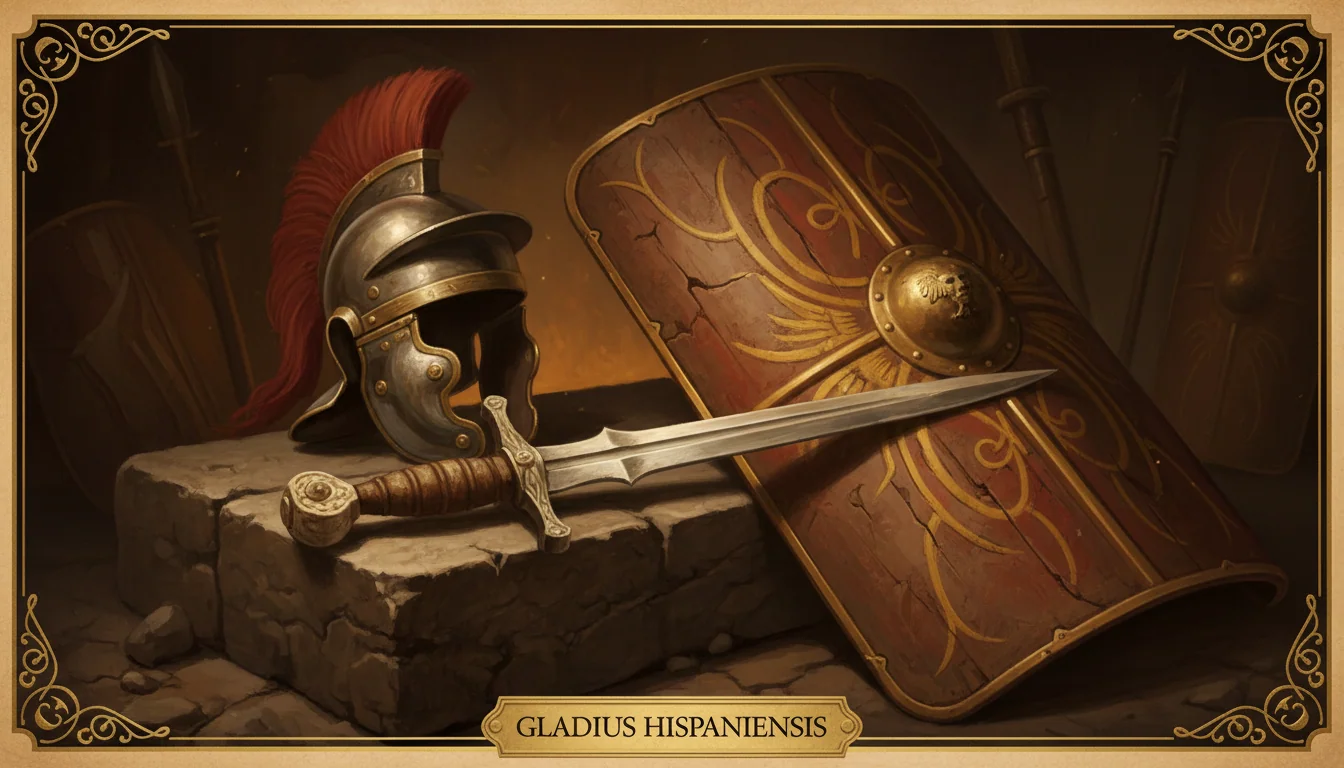
The gladius did not begin as Roman. Roman historians, including Livy and the encyclopedist Suidas, credited its design to the Celtiberian warriors of the Iberian Peninsula. During the Second Punic War, fought against Carthage from 218 to 201 BC, Roman armies campaigned through Iberia and encountered Celtic and Iberian troops carrying a short, sharply pointed sword superbly suited to both thrusting and cutting. The Romans called it the gladius Hispaniensis, the Spanish sword. By the early 2nd century BC, Roman legionaries had adopted it as their standard sidearm.
This pattern of Roman pragmatism is worth pausing on. Rome did not romanticize weapons. When something worked, the army absorbed it. The pilum, the lorica, the saddle, the artillery designs of Hellenistic engineers, and the gladius itself were all foreign in origin. What the Romans contributed was discipline, mass production, and tactics built around the new tool.
Anatomy of the blade
The classic gladius had a leaf-shaped or parallel-edged blade made of iron or low-carbon steel, typically 50 to 70 cm long, with a sharp point optimized for thrusting. The grip was bone or wood, ridged for finger placement, and ended in a heavy spherical or hemispherical pommel that balanced the blade's weight. The whole sword usually weighed about 700 to 1000 grams, light enough for a long day of fighting, heavy enough to drive a thrust through a leather cuirass or wickerwork shield.
Three main patterns appear in the archaeological record. The earliest, the Hispaniensis, kept much of the original Iberian shape with a longer, waisted blade. By the 1st century AD it had been replaced in legionary use by the Mainz pattern, slightly shorter with a more aggressive taper. The final form, the Pompeii pattern, named for examples found in the buried Roman city, was the shortest and most utilitarian, with parallel edges and a triangular point.
Built for the formation
The genius of the gladius was tactical, not metallurgical. The Roman legion fought in close formation, with the heavy scutum shield protecting the soldier and his neighbor on the left. A long sword in that formation is a liability. There is no room to swing it without hitting your own men. A short, thrust-oriented blade, by contrast, can be driven straight forward through the gap between shields, again and again, while the line advances as a wall.
The Roman writer Vegetius, summarizing earlier sources, made the case explicitly. A cut, he wrote, rarely kills, because bones and armor protect the vital areas. A thrust two inches deep into the chest or stomach is almost always fatal. Roman recruits were trained to thrust at wooden posts six feet tall, taller than most opponents, and were drilled to keep the point oriented forward, the body covered, and the cut reserved for emergencies.
Against the long slashing swords of Gallic and Germanic warriors, this doctrine produced lopsided casualty ratios. The barbarian raised his arm to swing; the legionary stepped forward and drove the gladius into the exposed armpit or chest. Polybius, describing the wars in the Po Valley, noted that the Gauls' long iron swords often bent on the first blow and had to be straightened underfoot, while the Roman blade kept its edge and its point.
The empire-builder
By the 1st century BC, the gladius was an instrument of strategic policy. Caesar's conquest of Gaul, Pompey's eastern campaigns, and the civil wars that ended the Republic were all fought primarily by men carrying it. When Octavian became Augustus, the standardized legion of about 5,000 men, equipped with pilum and gladius, became the basic unit of imperial power.
The blade's role was not only on the battlefield. The professional Roman army garrisoned cities, built roads, dug canals, and policed frontiers. The gladius hung at the right hip of every legionary on every project. It was the visible symbol of the soldier's status and pay, and the difference between a citizen and a subject. When the Praetorian Guard murdered emperors in the imperial palace, the gladius was the instrument.
The slow decline
By the 3rd century AD, the tactical world that had favored the gladius was changing. Roman armies fought less often in tight infantry battles and more often against mobile cavalry on the eastern and Danubian frontiers. Engagements increasingly turned on skirmishing, missile fire, and reach. Long-bladed cavalry swords, called spathae, had been used by Roman auxiliary horsemen for centuries. As the army's center of gravity shifted toward cavalry and lighter infantry, the spatha gradually replaced the gladius in legionary use as well.
The change was not abrupt. Late Roman infantry of the 4th century still carried short blades on occasion, and the spatha itself drew on the same Iberian-Celtic family of designs. But by the time of Diocletian and Constantine, the standard Roman sword was longer, more cut-oriented, and better suited to fighting on horseback or in looser formations than the classic legionary line.
What the gladius left behind
The gladius is one of the rare weapons whose name persisted long after the object itself disappeared. Latin gladius gave us "gladiator," literally swordsman, the slave or condemned man who fought for entertainment in the arena. The word "gladiolus," the flower, comes from the same root, named for its sword-shaped leaves. Modern Italian and other Romance languages preserve gladius variants in technical and literary vocabulary.
Archaeologically, the gladius is one of the most-studied ancient weapons. Examples have been found from Britain to Syria, in fortresses, graves, and shipwrecks. The famous "Sword of Tiberius," found in the Rhine and now in the British Museum, is a Mainz-pattern gladius with an exquisitely decorated scabbard celebrating the emperor's military triumphs. Another, the so-called "Sword of Mainz," gives the entire pattern its name.
Modern recreations and experimental archaeology have confirmed what Roman writers said about the gladius's effectiveness. Used correctly, in formation, it is brutally efficient. Used wrong, in single combat against a longer blade, it is at a clear disadvantage. The weapon was inseparable from the system that wielded it.
A weapon of system, not of romance
The gladius is not the kind of sword that gets named in legend. It is not Excalibur or Durendal or Kusanagi. There are no famous individual gladii passed down through dynasties. That is not an accident. The gladius was the weapon of a system, not of a hero. Rome did not need its swords to be magical. It needed them to be identical, available in the tens of thousands, and lethal in the hands of disciplined men trained the same way from Britain to Mesopotamia.
For four centuries, that is what it was. When Rome's tactical world finally changed, the gladius gave way to the spatha, and eventually to the long swords of the early medieval period. But the empire it built, and the cultural imprint it left, outlasted the blade by another thousand years.
Quick Answers
Common questions about this topic
What made the gladius effective?
The gladius was short enough to be used in tight formation without striking the soldier next to you, heavy enough to deliver killing thrusts, and balanced for both stabbing and slashing. Combined with the legionary's large rectangular shield, it allowed Roman troops to fight in the close formations that dominated their tactical doctrine.
How long was a gladius?
Roman gladii were typically 60-85 cm in total length, with blades of about 50-70 cm. The earlier Hispaniensis pattern was longer, around 75-85 cm; the later Pompeii pattern was the shortest, around 60-65 cm. All variants were dramatically shorter than the long swords used by most Roman opponents.
Why did the Romans switch to the spatha?
By the 3rd century AD, Roman armies were increasingly fighting cavalry-heavy enemies on open ground rather than infantry battles in close formation. The longer spatha gave horsemen and skirmishers the reach they needed, while the gladius was optimized for a tactical world that was disappearing. The transition was gradual and the gladius never fully vanished from Roman service.
Where did the gladius design come from?
Roman writers themselves credited the gladius Hispaniensis to Iberian Celtic warriors the Romans encountered during the Second Punic War in the late 3rd century BC. The Romans adopted and standardized the design, eventually replacing their earlier Greek-style swords with this Iberian import.

Talk to the People Who Wielded These Weapons
Chat with the soldiers, smiths, and commanders whose lives were shaped by the weapons of their age.
Talk to a WarriorJoin the HistorIQly Club
Get smarter about the past.
Weekly stories, deep dives, and exclusive content straight to your inbox.