Arsenal: The Thompson Submachine Gun
Thompson submachine gun history: designed for WWI trenches, adopted by Prohibition gangsters, then finally deployed in the war it was always built for.
Thompson submachine gun history begins with a retired general and a problem that trench warfare made urgent.
John T. Thompson retired from the U.S. Army as a brigadier general in 1914 with a specific problem on his mind. The problem was firepower at close range.
Thompson had spent his career in ordnance, was intimately familiar with the development of the .45 ACP pistol cartridge, and had observed that in the fighting at close quarters that characterized modern infantry combat, the bolt-action rifle was a slow and inadequate tool. A soldier who had fired his single round at a target twenty feet away could not work the bolt and reload before the target, if still standing, had crossed the remaining distance. Thompson wanted a weapon that could fire pistol-caliber cartridges at a fully automatic rate from the shoulder, light enough to carry into a trench, capable of clearing a position in seconds.
He called his concept a "trench broom." His weapon, when it finally emerged from the collaboration between Thompson, engineer Theodore Eickhoff, and financier Thomas Fortune Ryan, came too late for the trench war that had inspired it. By the time the design was refined, patented, and ready for production in 1919, the Armistice had been signed for a year and the armies of Europe were demobilizing.
The Thompson submachine gun spent the next two decades finding its market in less expected places.
The design
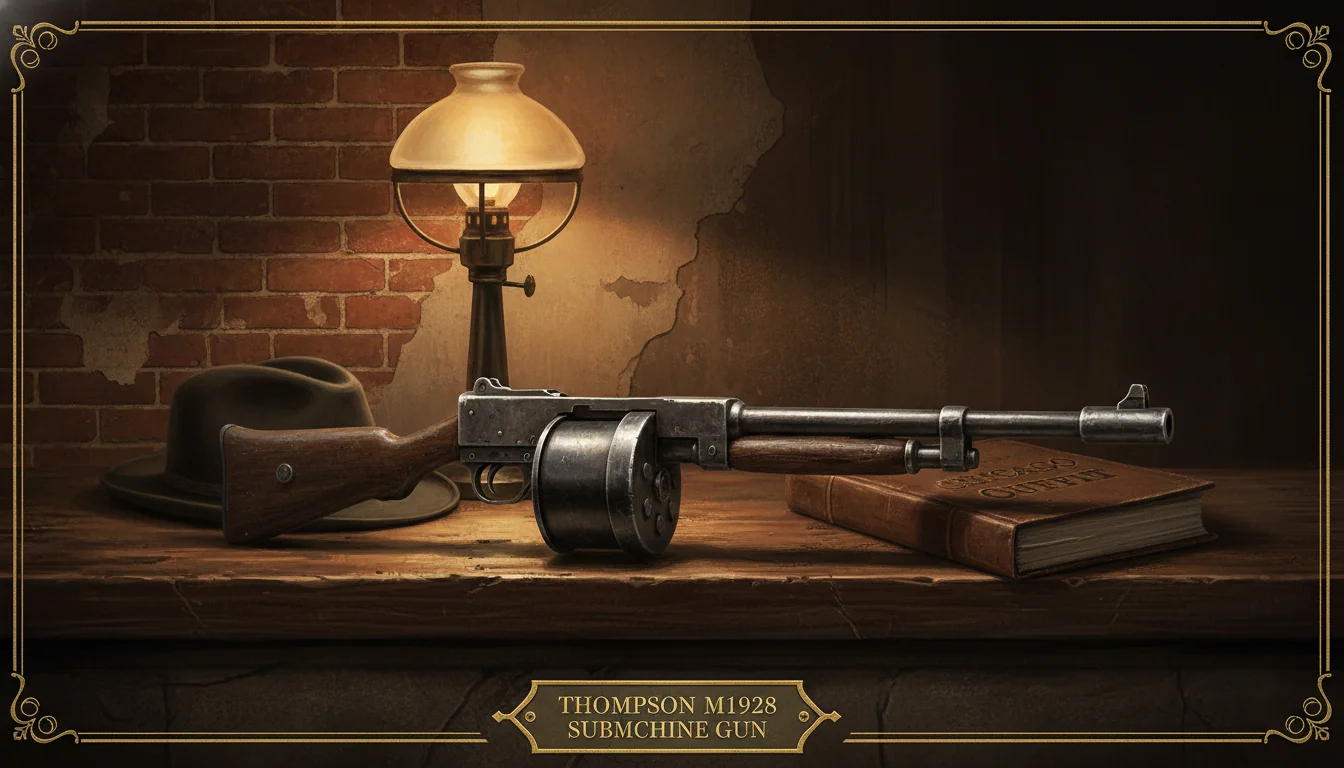
The initial production models, assembled by Colt under contract for Auto-Ordnance, were the M1921 and the later M1928 variants. The Thompson operated on a delayed-blowback system using the Blish principle, an innovation that Thompson and Blish believed was necessary for safety at the operating pressures involved. Later engineering analysis suggested the Blish principle was not actually doing what its proponents claimed, but the gun worked regardless, and the principle was retained in early production.
The M1928 Thompson, the model most associated with the Prohibition era, weighed approximately 10.8 pounds unloaded. Loaded with the 50-round L drum magazine that became its visual trademark, it was substantially heavier, around 15 pounds, and its weight combined with an early cyclic rate of up to 1,500 rounds per minute on the Colt Overstamp variant made it difficult to control under sustained fire. The more commonly encountered cyclic rate on standard M1928 models was 700-800 rounds per minute, which was controllable by trained shooters and devastating in a confined space.
Two types of magazine were available. The drum magazines held 50 rounds (the L drum) or 100 rounds (the C drum). Box magazines held 18 or 20 rounds in early production, later standardized to 20 and 30 rounds. The drums were dramatic, loud when empty and rattling, and slow to change in the dark. Experienced users often preferred the box magazines.
The .45 ACP cartridge fired by the Thompson was a heavy, subsonic round that transferred enormous energy at close range. At the distances where submachine guns operated, inside buildings, vehicle-lengths, doorways, it was ferociously effective. It was not a long-range weapon, and no one who sold it claimed otherwise.
The price problem
Auto-Ordnance priced the Thompson at $200 for the civilian market in the early 1920s. Two hundred dollars in 1921 was roughly the equivalent of a few thousand dollars today. At that price, the Thompson was emphatically not a weapon for common purchase. The target market was supposed to be law enforcement agencies, military forces, and wealthy ranchers in remote areas who needed serious firepower against rustlers.
Sales were modest. Law enforcement agencies were interested but budget-constrained. Military interest was limited because the Army was focused on demobilizing and had warehouses full of surplus weapons. The Thompson sat in Colt's inventory in substantial numbers throughout the early 1920s, and Auto-Ordnance was under consistent financial pressure.
Then Prohibition began generating the conditions that would make the Thompson famous.
The gangsters
The Volstead Act of 1919 created the underground economy that produced American organized crime as a modern institution. The scale of illegal alcohol distribution required muscle, and the inter-gang conflicts for territory required firepower. By the mid-1920s, surplus Thompson submachine guns were being diverted from legitimate channels into criminal hands at prices well below the retail cost. The specific supply chain varied by city. The demand was consistent.
The weapon's popular association with American gangsters was cemented on the morning of February 14, 1929. In a garage on North Clark Street in Chicago, seven members of the North Side gang associated with Bugs Moran were lined against a wall and shot. Two of the killers, who had entered disguised as police officers, used Thompson submachine guns. The others used shotguns. The scene, known immediately as the St. Valentine's Day Massacre, appeared in newspapers across the country and the world, and the Thompson submachine gun appeared with it.
Capone was never charged. The Thompson became the visual shorthand for organized crime in America for the next decade, appearing in newspaper photographs, newsreel footage, and every gangster film Hollywood produced in the 1930s. It was not, factually, the most commonly used weapon in criminal activity, which continued to involve handguns and shotguns in the overwhelming majority of cases. But it was the weapon that looked like serious business, and it photographed well, and the image was self-reinforcing.
The Irish Republican Army was also an early customer. Thompsons began appearing in IRA hands during and after the Irish War of Independence in 1919-1921, smuggled from the United States through sympathizer networks. The IRA used Thompsons through the civil war that followed and intermittently through the later decades of the 20th century. Thompson himself, when he became aware of this use, reportedly expressed considerable discomfort.
WWII: the weapon finds its war
The military market that Thompson had originally targeted eventually came through, roughly twenty years late.
The British Army and the French government both placed orders in 1940 as the threat of German invasion became clear. The U.S. military adopted the M1928A1 as a standard weapon in 1938. When the United States entered the war in December 1941, the Thompson was already in production and in the hands of Marine Corps units, Army Rangers, and airborne units.
The weapon performed well in jungle terrain, where the ranges were short and the vegetation was dense. U.S. Marines at Guadalcanal carried Thompsons alongside the M1 Garand. Paratroopers in Normandy carried them in 1944. British commandos used them in Norway, in North Africa, and in the Burma campaign. The Office of Strategic Services and its British equivalent the Special Operations Executive issued Thompsons to irregular forces across occupied Europe.
By 1942, however, Auto-Ordnance had simplified the design considerably. The M1 Thompson, introduced that year, eliminated the Blish locking principle, simplified the receiver, reduced machining requirements, and switched to a 30-round box magazine as the standard feed device. The M1A1 followed with further simplifications. The goal was speed of production. The M1928A1 required roughly 80 hours of machine work per weapon. The M1A1 required less than half that. Both variants fired the same .45 ACP cartridge and were functionally comparable in combat. The M1A1 was neither as elegant nor as mythologically weighted as the M1928, but it came off the production lines faster and that was what the war required.
The replacement
The Thompson's replacement was announced by utility rather than drama. The M3 submachine gun, introduced in late 1942 and nicknamed the grease gun for its resemblance to the auto shop tool, cost $15 per unit to produce versus roughly $40 to $70 for a wartime Thompson. It was stamped, welded, and brutally simple, with a wire stock that folded against the receiver and a 30-round magazine. It was less pleasant to shoot, less balanced, and considerably less photogenic.
It was, however, cheap, light, and adequate. The military began replacing Thompsons with M3s from 1943 onward, and by the end of the war the grease gun was the standard American submachine gun on paper. In practice, many units held onto their Thompsons throughout the war. The weapon's reliability was well established, and soldiers are conservative about trade-ins.
The Thompson remained in limited U.S. military use through Korea and into the early Vietnam era. Surplus weapons were distributed to dozens of allied and proxy forces around the world. Police forces in Ireland, the United Kingdom, and several Commonwealth nations carried Thompsons into the 1980s.
The legacy
The Thompson submachine gun never achieved the role its inventor imagined for it. It did not end trench warfare because it arrived after trench warfare was already over. It entered civilian consciousness as a gangster weapon, an association that damaged its reputation in ways that shaped American gun culture debates for generations. It was then adopted by the military it had been designed for and used in a war quite unlike the one that inspired it.
What the Thompson actually was, stripped of both its mythology and its infamy, was a well-engineered, heavy, reliable weapon that fired a powerful short-range cartridge and worked consistently in extreme conditions. It was not elegant and not subtle and not cheap, and it asked its users to carry something that weighed as much as a large bag of rice. Within those constraints it did what it was designed to do, which was to put a great deal of heavy lead downrange at close range in a very short time.
John Thompson died in 1940, before the weapon's most significant military service and before he could see the M1 simplifications he would not have enjoyed. He had spent years trying to sell the Army a weapon the Army did not want, survived long enough to see them want it, and did not quite survive to see them replace it.
For comparison with other weapons that defined their era, read about the MG 42 - the German machine gun that set the pace of fire Allied soldiers had to survive - and the M1 Garand, the American battle rifle that gave the Thompson its most frequent battlefield companion.
Quick Answers
Common questions about this topic
Who invented the Thompson submachine gun?
The Thompson was designed by Brigadier General John T. Thompson, a veteran ordnance officer who had previously developed the Pedersen Device. Thompson founded the Auto-Ordnance Corporation in 1916 with the specific intention of producing a fully automatic shoulder weapon, which he called a 'trench broom.' The weapon was patented in 1919, too late for the war it was designed to win.
Why was the Thompson submachine gun called the Tommy gun?
The Tommy gun nickname came from Tommy, the British slang for a British soldier (from Thomas Atkins, the generic name used on sample military forms). The weapon was marketed early on to military and law enforcement as a solution to trench warfare. The name stuck through the Prohibition era, where it gained a very different set of associations.
Was the Thompson gun actually used by gangsters?
Yes. The most famous documented use by American criminals was the St. Valentine's Day Massacre on February 14, 1929, when two Capone organization gunmen, dressed as police officers, used Thompson submachine guns to kill seven members of Bugs Moran's North Side gang in a Chicago garage. Thompsons also appeared in multiple other documented gang shootings of the Prohibition era, though they were expensive and less common than mythology suggests.
Was the Thompson submachine gun used in World War Two?
Yes, extensively. The U.S. military adopted the M1928A1 Thompson before Pearl Harbor, and the weapon served throughout WWII with U.S. Marines, paratroopers, Rangers, and commandos. The British also purchased large numbers. The original models were simplified into the M1 and M1A1 Thompson in 1942 to speed production. The Thompson was gradually replaced by the cheaper M3 grease gun from 1943 onward, though Thompsons remained in service through the end of the war and beyond.

Talk to the People Who Wielded These Weapons
Chat with the soldiers, smiths, and commanders whose lives were shaped by the weapons of their age.
Talk to a WarriorJoin the HistorIQly Club
Get smarter about the past.
Weekly stories, deep dives, and exclusive content straight to your inbox.