The Crossbow: The Medieval Weapon the Pope Tried to Ban
In 1139, the Catholic Church declared the crossbow too lethal for use against Christians. Three centuries later it had reshaped European warfare.
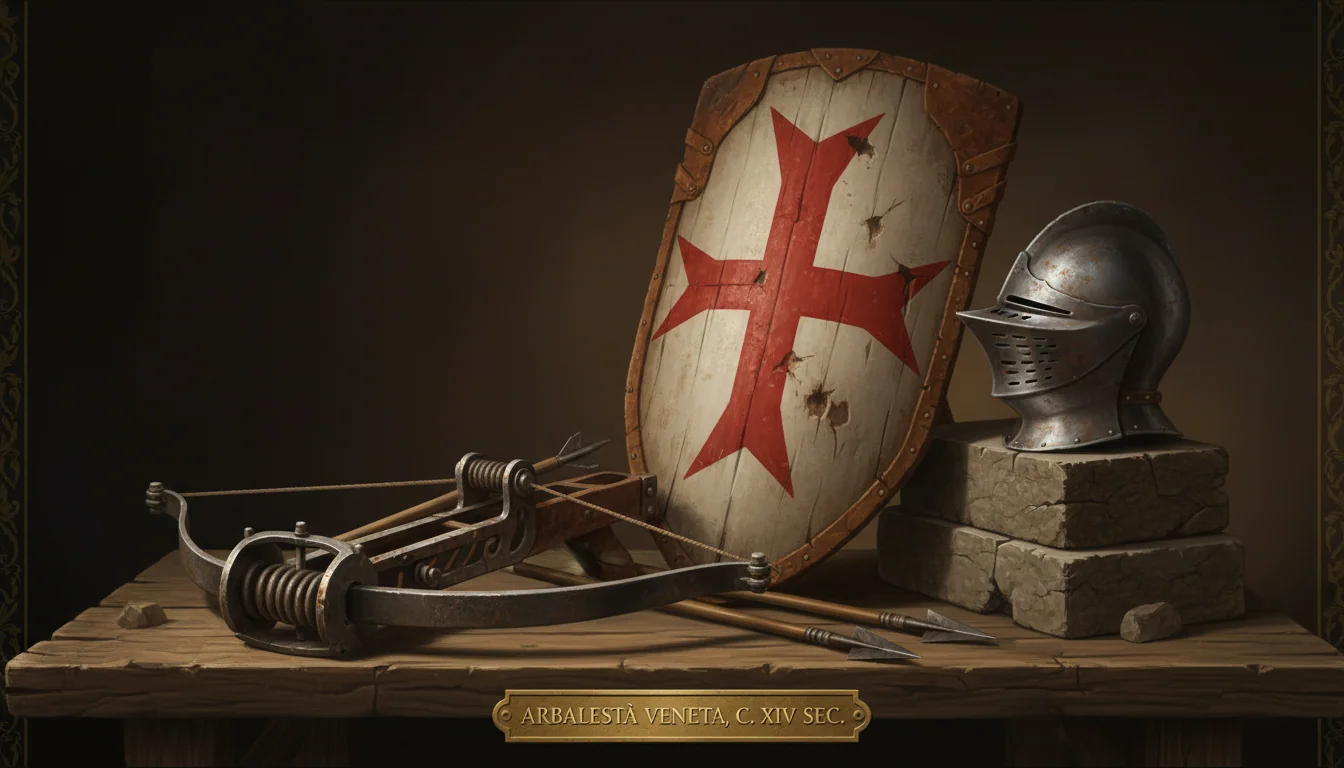
In 1139, the Catholic Church convened the Second Lateran Council and, alongside the year's other business, declared the crossbow too cruel for use among Christians. The council called it "a weapon hateful to God and unfit for Christians," and forbade its use except against pagans. The ban changed almost nothing. By the end of the 12th century, every major European army was fielding crossbowmen by the thousand, the papacy itself maintained a corps of them, and the most lethal mercenary companies in the Mediterranean were Genoese arbalesters paid in gold.
The medieval crossbow is the most disruptive personal weapon of its age. It threatened the social hierarchy of armored knighthood with mass-produced firepower, generated political and religious pushback from the start, and quietly normalized the idea that an unskilled levy could be turned into a deadly soldier in weeks. By the time gunpowder displaced it, it had already done much of the work that the matchlock would later finish.
Roots in antiquity
The crossbow is older than its medieval reputation suggests. Chinese sources describe handheld crossbows in use during the Warring States period, with the technology fully mature by the Han dynasty around 200 BC. The Chinese designs included sophisticated bronze trigger mechanisms, repeating crossbows, and large mounted artillery pieces. Roman armies used a similar device called the cheiroballistra, although it was an oddity rather than a standard weapon.
The Roman version more or less disappeared in the West with the empire. The medieval European crossbow seems to have re-emerged or been reinvented in the 9th and 10th centuries, possibly through Byzantine influence. By the time of the First Crusade in the 1090s, both Christian and Muslim armies in the Mediterranean were using crossbows in significant numbers. Anna Komnene, the Byzantine princess and historian, described Frankish crossbows in shock: "the bolt strikes through anything, no shield, no breastplate of bronze can stop it."
Mechanics
The basic crossbow is mechanically simple. A short, stiff bow (the prod) is mounted horizontally on a wooden tiller. A trigger holds the drawn string against the bow's tension. The user braces a foot in a stirrup at the front, hauls the string back to a locking position, places a bolt in the channel, aims, and pulls the trigger. The bow flexes back, the string drives the bolt forward, and the device is ready to be reloaded.
The interesting engineering is in the energy storage and release. Early prods were made of a single stave of yew, ash, or hornbeam. By the 13th century, composite prods of horn, sinew, and wood, glued in layers, allowed dramatically higher draw weights. By the 14th century, steel prods were standard for heavy crossbows, and draw weights of 500 to 1200 pounds equivalent were common.
The trigger mechanism evolved alongside. Early Latin trigger nuts were carved from bone or antler with a notch for the string and a sear that the trigger lever caught. Later mechanisms used metal rollers, leaf springs, and mechanical advantage to allow a clean release of very heavy strings. By the high medieval period, the trigger was a precision component, often signed and stamped by its maker.
Spanning the bow
The harder the prod was to draw, the more elaborate the mechanism for drawing it. Light hunting crossbows could be spanned by hand, hooking the string with the fingers and pulling it back over the trigger. Heavier military crossbows used a belt hook: the soldier bent forward, hooked the string, and stood up to lever the bow back into the trigger.
For very heavy crossbows, two main mechanical aids developed:
The cranequin was a rack-and-pinion device. A toothed steel bar slid through a housing, gripped the string, and was wound back by a hand crank. The cranequin was compact, fast, and reliable, and was the favored aid in 15th-century German and Burgundian crossbows.
The windlass was a more cumbersome rope-and-pulley system. Two cranks turned a drum that wound up ropes attached to the string. It was slower than the cranequin but allowed even higher draw weights. Genoese mercenaries, who specialized in heavy windlass crossbows, used pavise shields planted in the ground to cover themselves while spanning.
Both systems shaped tactics. A windlass crossbowman fired perhaps 2 bolts per minute, a cranequin crossbowman 3 to 4. Light belt-hook crossbows could approach 5 to 6 bolts per minute, although with much less power per shot.
The Lateran Ban
The Second Lateran Council's 1139 ban is one of the most quoted papal pronouncements in military history, and one of the most studied for what it reveals about medieval social anxieties. The text explicitly condemned the use of "the deadly art of crossbowmen and archers" against Christians, presumably with the implicit understanding that knights, properly armed, deserved to fight other knights and not to be picked off by anonymous infantry.
This is, fundamentally, an aristocratic concern. The crossbow erased a great deal of the value of a lifetime of knightly training. Knights were physically conditioned, expensively armed, and the embodiment of a ruling class whose authority depended on military monopoly. A crossbow bolt fired by an unhorsed peasant from behind a hedge bypassed all of that. Henry of Huntingdon, writing around the same time, called the crossbow "a foul invention" precisely because it dishonored the proper conduct of war.
The ban was enforced unevenly and ignored almost entirely on campaign. King Richard I of England, who was hit by a crossbow bolt at the siege of Châlus-Chabrol in 1199 and died of the resulting infection, is sometimes called the most famous victim of the weapon his own forces had used in tens of thousands.
Genoa, Catalonia, and the mercenary trade
By the 13th and 14th centuries, the heavy crossbow had become the specialty of professional mercenaries from northern Italy and the Catalan coast. Genoese crossbowmen, recruited in companies of hundreds or thousands, served in every major European army, from the kings of France and Castile to the dukes of Burgundy and the popes themselves. They were expensive, disciplined, and well-equipped, with their own pavise-bearers, sergeants, and quartermasters.
Their reputation was double-edged. At Crécy in 1346, Genoese crossbowmen marched in front of the French line, were caught in the rain that wetted their strings, and were mowed down by English longbowmen before they could span their bows. The French knights blamed them for the disaster and rode them down on the way to their own destruction. The episode became a cautionary tale about the limits of professional missile troops without infantry support.
Catalan and Aragonese crossbowmen, similarly, were the elite missile arm of the Mediterranean wars of the 13th to 15th centuries. Their tactics, weapons, and organization spread across southern Europe.
The bolt
A crossbow projectile is shorter, heavier, and stiffer than a long arrow. Bolts were 25 to 40 cm long, with an iron head and a hardwood shaft. The fletching was usually leather or stiff feathers, glued tight against the shaft so as not to be torn off by the trigger nut. Heads varied from broad hunting points to narrow armor-piercing bodkins. A 14th-century English inventory lists square-bodkin bolts intended specifically for piercing the lamellar armor used in some Mediterranean armies.
The bolt's combination of mass and short length gave it deep penetration. A heavy crossbow bolt at close range could pass through chainmail and continue into the body. Even plate armor was vulnerable at close range, especially at the joints. The English longbow's killing power against French knights at Crécy and Agincourt is the more famous story, but the crossbow's reputation against armored opponents was, in its own time, equally feared.
Civilian and ceremonial uses
The crossbow had a civilian life as well. It was the favored hunting weapon of medieval and Renaissance European aristocracy. It produced minimal noise compared to a hunting horn, was usable from a stand or a horse, and required less practice than the longbow. Charles V, Maximilian I, and Henry VIII all kept crossbow stables.
Target-shooting societies emerged in cities and remain active today in parts of Switzerland, Belgium, and Germany. The Schützenfest tradition, which grew from medieval militia practice, was originally focused on the crossbow. Modern target crossbow shooting is a recognized World Archery discipline.
The matchlock takeover
The crossbow's decline was slow because the early matchlock was, in many ways, a worse weapon. A heavy 16th-century arquebus had less penetration than a windlass crossbow, less accuracy at any range past 50 meters, a slower rate of fire, and a much greater logistical burden. What it had was scalability. A matchlock could be operated reliably by a soldier with a few weeks of training, did not require expensive prods or specialist craftsmen to maintain, and improved year on year as metallurgy and powder chemistry advanced.
By the early 16th century, mass infantry armies were transitioning to matchlocks. By 1550, the crossbow was a niche or auxiliary weapon. By 1600 it was largely gone from European battlefields, although Spanish, Portuguese, and Italian armies in colonial contexts kept them in service for decades longer.
Legacy
The crossbow's modern echo is the modern hunting and competition crossbow, which is a high-tech derivative of the medieval design. Compound prods, scopes, and machined trigger systems have replaced horn and bone, but the basic mechanical idea, of a trigger holding a stored-energy bow until needed, is exactly what the medieval arbalest did.
In the broader history of weapons, the crossbow occupies a strange middle ground. It was the first European personal weapon to seriously threaten the armored knight, and the first to make missile troops effective without long childhood training. It was the dress rehearsal for the matchlock revolution. The Pope's 1139 condemnation was, in retrospect, a perfectly accurate prediction of what the weapon would do to medieval society. He was right that it would change everything. He was wrong to think it could be banned.
For other weapons in the arsenal series, the Roman pilum covers the heavy throwing spear, and the rapier picks up the story of European personal weapons two centuries after the crossbow's decline.
Quick Answers
Common questions about this topic
Why did the Pope ban the crossbow?
The Second Lateran Council of 1139 forbade the use of crossbows and bows against Christians, declaring them 'a weapon hateful to God and unfit for Christians.' The ban reflected aristocratic concerns: a crossbow allowed an untrained peasant to kill an armored knight from a distance, which threatened the social order that warfare was supposed to reinforce. The ban was widely ignored from the start.
How does a crossbow compare to a longbow?
A heavy windlass crossbow could deliver more energy per shot than even the heaviest longbow, with a draw weight equivalent of 600-1200 pounds versus 100-180 for the longbow. But the crossbow shot 2-4 bolts per minute compared to the longbow's 10-12. The crossbow won on power and ease of training; the longbow won on volume of fire.
How long did it take to train a crossbowman?
A few weeks to a few months, depending on the size of the weapon. The basic loading and aiming actions were straightforward, and unlike the longbow they did not require a lifetime of physical conditioning. This made the crossbow ideal for citizen militias and mercenary companies, who could be raised for a campaign and trained on the march.
When did the crossbow become obsolete?
Crossbows remained in use through the early 16th century, especially in southern Europe and Scandinavia, but were gradually replaced by matchlock muskets after about 1500. By 1600 they were rare on European battlefields, although they survived in hunting and target shooting through the 18th century and into the present day.

Talk to the People Who Wielded These Weapons
Chat with the soldiers, smiths, and commanders whose lives were shaped by the weapons of their age.
Talk to a WarriorJoin the HistorIQly Club
Get smarter about the past.
Weekly stories, deep dives, and exclusive content straight to your inbox.