The Maxim Machine Gun: The Weapon That Industrialized Killing
The Maxim machine gun, invented in 1884, turned one trigger into the firepower of a hundred riflemen and defined the trench warfare of the First World War.
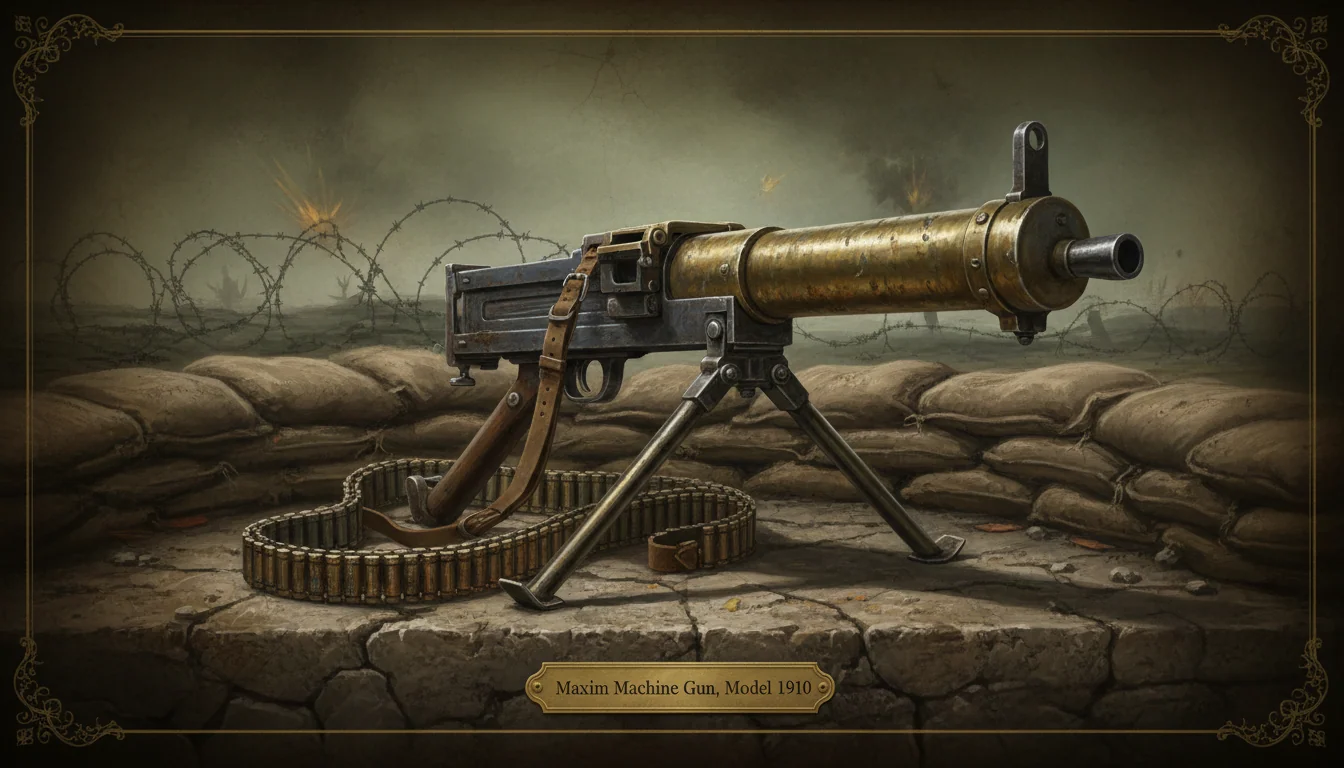
In 1884, the American inventor Hiram Maxim demonstrated a working prototype of what would become the first practical automatic machine gun. He had taken the recoil energy of a fired cartridge, which had previously been a problem to be absorbed, and turned it into the engine that would chamber the next round, fire it, and chamber the round after that, and so on for as long as the trigger was held and the ammunition belt was fed. The mechanism worked the first time. It revolutionized warfare. And by the time the world's armies fully understood what Maxim had built, the First World War had already happened.
A weapon for the inventor era
The Maxim machine gun is a creation of the late Victorian inventor culture, the same milieu that produced Edison's electric light, Bell's telephone, and the dozens of patent battles that defined American industrial history. Hiram Maxim was born in Sangerville, Maine in 1840, started his career as an apprentice carriage maker, and by his thirties had patented dozens of devices in fields as varied as steam pumps, hair-curling irons, and electric lighting. He emigrated to England in the 1880s, where the patent and capital environment for armaments was more favorable than in the United States.
His machine gun was developed in his London workshop. The story, possibly apocryphal but repeated by Maxim himself, was that another American inventor told him, "If you want to make a fortune, invent something that will allow these European fools to kill each other more easily." Maxim took the advice. He set out specifically to build a weapon that would do the work of many soldiers and that any European army would feel obliged to buy.
The mechanism
The genius of the Maxim was the recoil-operated action. When a cartridge is fired, the bullet travels forward and the breech and barrel are pushed backward by the same impulse. In every previous gun, this rearward energy had been absorbed by the shooter's shoulder and the gun's frame. Maxim designed a mechanism in which the rearward motion was harnessed: the recoiling barrel briefly pulled a lock backward, which compressed a spring and ejected the spent case, while a feed mechanism pulled the next round from a fabric belt and pushed it into the chamber. As the barrel returned forward, the lock cycled the new round into firing position. Pull the trigger again, and the cycle repeated.
The whole sequence took about a tenth of a second per round. With a 250-round canvas belt and water cooling for the barrel, a Maxim crew could put out 600 rounds per minute, sustained, for as long as ammunition lasted.
The water cooling was as innovative as the action. A jacket around the barrel held seven to ten liters of water, which boiled off in long bursts and was condensed back into a separate container. Sustained fire heated the barrel to glowing red without melting it, and the steam escaping the gun was such a giveaway of the position that crews had to vent it through hoses to camouflaged condensers.
Adoption by the great powers
The Maxim's first major customer was the British Empire, which used the gun in the colonial wars of the late 19th century. At the Battle of Omdurman in 1898, six Maxims and twenty Royal Navy machine guns helped a British expeditionary force destroy a Mahdist army of 50,000 men. British casualties were 47 killed; Mahdist casualties were perhaps 10,000 dead. Hilaire Belloc summarized the technological gap with brutal economy: "Whatever happens, we have got / The Maxim Gun, and they have not."
The German Empire, the Russian Empire, the Ottomans, the Italians, and the Japanese all bought Maxims or licensed the design within a decade. By 1914, the major variants were:
The British Vickers, an improved Maxim adopted by the British Army in 1912 after Vickers Ltd. acquired the Maxim Company.
The German MG 08, the Maschinengewehr 08, an almost direct German license of the Maxim, with minor improvements.
The Russian Pulemyot Maxima PM 1910, a Tula Arsenal license made on a wheeled mount.
The American M1904 Maxim, used in limited numbers by the U.S. Army before being replaced by the Browning M1917.
These four guns, with minor variations, were the heavy machine guns of the First World War.
The Western Front
In 1914, European armies still expected war to be a matter of mass infantry assaults supported by artillery, with cavalry exploiting breakthroughs. The Maxim and its descendants made that doctrine impossible. A single MG 08 could scythe down an attacking battalion in a few minutes. A defensive line of well-emplaced machine guns, supported by barbed wire and pre-registered artillery, could repulse any frontal infantry attack with overwhelming losses to the attacker.
The Battle of the Somme on July 1, 1916 demonstrated this with horrifying clarity. The British Fourth Army attacked German positions held by perhaps 200 to 300 machine guns. By the end of the day the British had suffered 57,470 casualties, including 19,240 dead. Most of the killing was done by machine guns. The pattern repeated at Ypres, Passchendaele, Verdun, and dozens of smaller actions. The Western Front congealed into static trench warfare not because generals were stupid, although some of them were, but because the geometry of machine gun fire made offensive maneuver almost impossible without huge casualties.
The trench system that defined the war was specifically a response to the Maxim and its derivatives. Without machine guns, the war would have looked very different.
A weapon as inflection point
The First World War's casualty total, between 15 and 20 million dead and another 20 million wounded depending on what is counted, was the result of many factors: artillery, gas, disease, the duration of the conflict. But the weapon that defined the war's tactical character was the machine gun. Without it, the offensive doctrines that had worked in the wars of 1815 to 1900 might have continued to work. With it, those doctrines collapsed almost in real time.
After the war, military thinkers in every country tried to design around the machine gun. The tank, developed during the war and matured between the wars, was an answer to it: a mobile platform that could cross machine-gun fire and engage the gunner. The squad-level light machine gun, a portable weapon assigned to small infantry units, was another answer: take the firepower forward with the attacker. The combined-arms doctrine of the late 1930s, expressed in German Blitzkrieg and in equivalent Soviet, French, and British thinking, was an attempt to restore offensive maneuver in a world where defensive automatic fire was permanent.
The second war
The Maxim and its direct descendants fought through the Second World War as well. The German MG 08 served as a second-line and training weapon, supplemented by the more modern MG 34 and MG 42 air-cooled belt-feds. The Soviet PM 1910 was used in vast numbers on the Eastern Front, with the iconic wheeled mount appearing in countless newsreel images of Red Army assaults. The British Vickers served from Burma to Italy. By 1945, the basic Maxim mechanism was 60 years old and still in front-line service.
After 1945, the heavy water-cooled machine gun gradually disappeared from front-line use. Air-cooled machine guns like the Browning M2 .50 caliber, the Soviet DShK, and the West German MG3 (a near-direct continuation of the wartime MG 42) replaced the Maxim mechanism in regular armies. Maxim variants remained in service in Soviet client states and various national militaries through the 1970s and 80s.
Civilian and ceremonial afterlife
The Maxim is a frequent fixture in war museums, regimental collections, and demonstration shoots. The Imperial War Museum, the Tower of London, and the German military museum at Dresden all hold examples. Demilitarized Maxims are sometimes restored to live-fire condition by collectors in the United States, where the National Firearms Act allows possession of registered pre-1986 transferable machine guns.
The mechanism itself, the recoil-operated belt-fed automatic, lives on in dozens of subsequent machine gun designs. Browning's M1917 borrowed the recoil principle and the water-cooled barrel from the Maxim, although the locking mechanism differed. The Soviet PK and the Western M240 series are gas-operated rather than recoil-operated, but their tactical role and rate of fire descend directly from what Maxim invented in 1884.
What Maxim did
Hiram Maxim died in 1916, in the middle of the war his invention had helped make catastrophic. His knighthood, his fortune, and his reputation as one of the era's great inventors were secure. His machine gun is in the history books as the technology that ended the cavalry age, hardened the trenches, and defined the most lethal three years of European history.
Whether Maxim deserves blame for the war's casualties, or whether the men who deployed his weapon without thinking carefully about its implications deserve more, is a question for historians and ethicists. What is undeniable is that one inventor, working in a London workshop, designed a mechanism that made killing a hundred men no harder than killing one. Every machine gun that has been fired since, from the trenches of the Somme to the streets of Mogadishu, is descended from that workshop and that idea. The 20th century is what it is in part because Hiram Maxim was good at engineering. For the weapons that preceded it and were made obsolete by it, see our Arsenal entry on the Gatling gun, and for the German weapon that evolved from the Maxim mechanism into the most feared machine gun of the Second World War, see the MG 42.
Quick Answers
Common questions about this topic
Was the Maxim the first machine gun?
It was the first true automatic machine gun. Earlier rapid-fire weapons like the Gatling gun and the Mitrailleuse were manually operated, requiring the gunner to turn a crank. The Maxim was the first to use the energy of the cartridge itself to cycle the action, allowing fully automatic fire as long as the trigger was held and the ammunition belt held out.
How fast did the Maxim fire?
About 600 rounds per minute, equivalent to roughly 30 trained riflemen firing as fast as they could load. The water-cooled barrel allowed sustained fire that no air-cooled weapon could match. A single Maxim crew could maintain a defensive arc that earlier doctrine would have required an entire infantry company to cover.
Did Hiram Maxim become rich from his invention?
Yes, very. He sold his company to Vickers in 1897 for what would today be tens of millions of dollars and was knighted by the British government in 1901. Maxim was an American by birth but became a British subject. His brother Hudson, who stayed in America, became a major figure in the U.S. explosives industry.
When did the Maxim become obsolete?
The basic Maxim mechanism, with variants like the Vickers in Britain and the MG 08 in Germany, was the dominant heavy machine gun through both World Wars. It was gradually replaced after 1945 by lighter air-cooled weapons like the Browning M2 and various belt-fed machine guns. Some Maxim variants remained in use into the 1980s in former Soviet client states.

Talk to the People Who Wielded These Weapons
Chat with the soldiers, smiths, and commanders whose lives were shaped by the weapons of their age.
Talk to a WarriorJoin the HistorIQly Club
Get smarter about the past.
Weekly stories, deep dives, and exclusive content straight to your inbox.