Arsenal: The Egyptian Khopesh
The Egyptian khopesh was a curved bronze sickle-sword that armed pharaohs and infantry for nearly a thousand years, reshaping warfare across the ancient Near East.
Read Wikipedia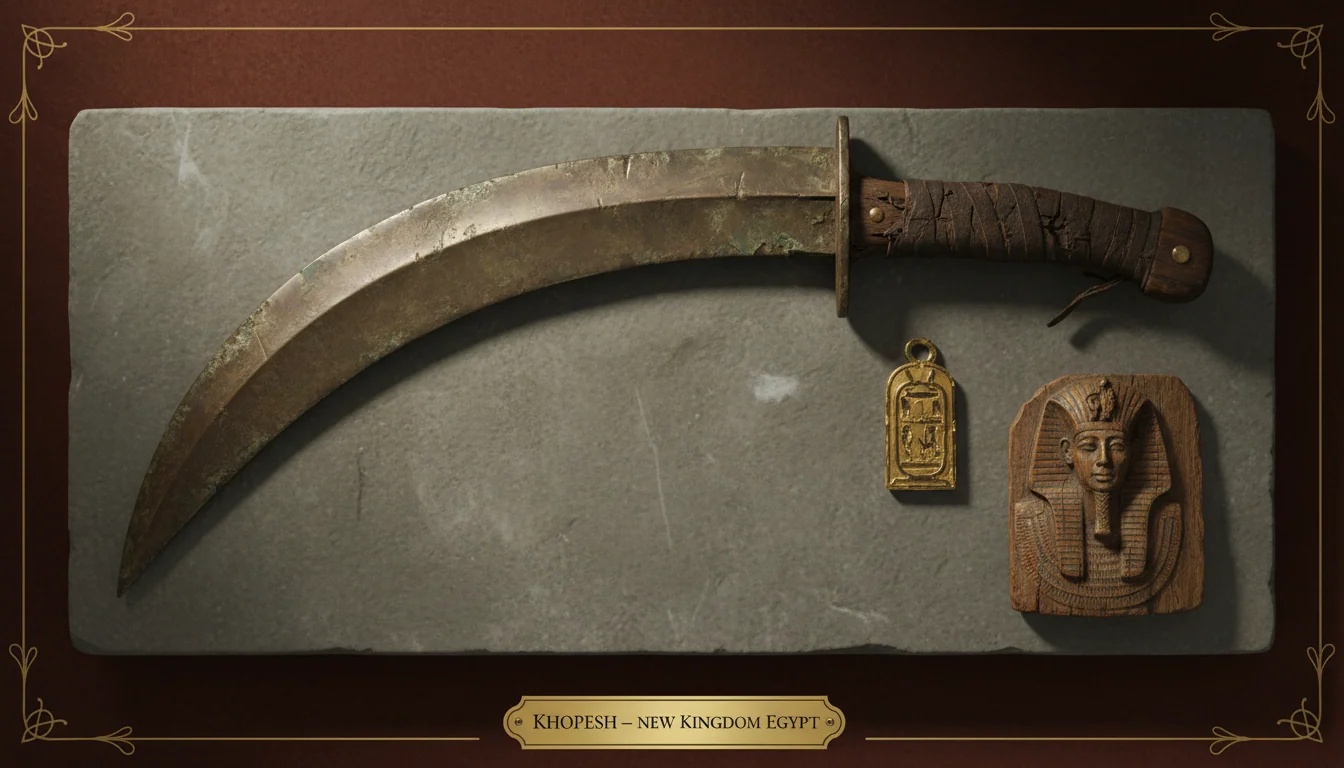
The curved blade of the khopesh is one of the most recognizable shapes in ancient weapons. Walk through the Egyptian collection of any major museum and you will find it in relief carvings and painted papyri, gripped by pharaohs in the act of smiting their enemies, raised above kneeling prisoners, or presented as divine gifts from gods to kings. The khopesh was a military weapon, but it was also an object of symbolic power - and the gap between those two roles reveals something important about how Egypt organized and projected military authority for nearly a thousand years.
For most of that time, the khopesh was also a genuinely effective battlefield tool.
The sickle-sword and its origins
The khopesh belongs to a family of weapons that appears across the ancient Near East during the Bronze Age: the sickle-sword. This family includes Canaanite and Mesopotamian variants sharing the same fundamental geometry - a handle and straight guard transitioning into a curved, single-edged blade shaped like a harvesting sickle, with the cutting edge on the outer convex side.
Where Egypt's version came from is contested. One prominent argument traces it to the Hyksos, the West Asiatic people who ruled northern Egypt during the Second Intermediate Period (roughly 1650 to 1550 BC). The Hyksos introduced the composite bow, the horse-drawn chariot, and new bronze-working techniques to Egypt. Some scholars have placed the khopesh on that list of military imports.
The difficulty is that khopesh-like weapons appear in Egyptian artistic representations before the Hyksos period, and the Canaanite sickle-sword tradition may have reached Egypt through ordinary commercial and diplomatic contact well before conquest. The safest position is that the khopesh developed in dialogue with the broader Near Eastern sickle-sword family, with Egypt adapting the design to its own needs. Whatever its precise origin, by the New Kingdom it was distinctively and unmistakably Egyptian - in standardized form, in ceremonial role, and in association with royal power.
Anatomy of the blade
A typical khopesh ran roughly 50 to 60 centimeters from handle to tip, with the grip and crossguard accounting for perhaps a quarter of that total. The blade curved outward from a straight base, bending through something close to a third of a circle. The cutting edge was on the outside of the curve - the convex edge, the one facing away from the user's body.
Construction was bronze through most of the weapon's military history. Egypt had access to copper deposits in the Sinai and to Cypriot copper through trade networks, and had been alloying bronze since at least the Old Kingdom. A New Kingdom khopesh would typically have a blade cast from high-quality bronze, with a handle of wood or bone secured by rivets through the flat of the blade and wrapped in leather.
The weight of surviving examples - most of which are ceremonial pieces and therefore better preserved than battlefield weapons - falls typically between one and two kilograms. This was a one-handed weapon, designed to be paired with a shield held in the other hand. The weight distribution, with the mass concentrated in the curved outer portion of the blade, gave blows considerable momentum even without a full overhead swing.
What made it effective in formation
The khopesh's geometry gave it capabilities a straight sword lacked. The curved outer edge could hook around an opponent's shield, pulling it aside or catching a limb in close-quarters press. A strike with the outer edge delivered a gash rather than a clean cut. Against the infantry Egypt faced in its Levantine campaigns - Canaanite city-state forces, Hittite auxiliaries, various coalition forces that operated with similar shields and similar tactics - these properties were directly useful.
New Kingdom infantry typically carried the khopesh paired with a rectangular or rounded shield. Officers and chariot crew often carried it as a secondary weapon alongside the composite bow, which delivered casualties at range before chariots closed to contact. The standard Egyptian battle sequence involved archery at range, chariot charges to disrupt formations, and then infantry closing to melee where the khopesh operated.
Against opponents using long thrusting spears, the khopesh's ability to get around a shield presented a genuine tactical advantage. Against lightly armored infantry, a well-delivered strike with the curved outer edge was devastating. Against heavily armored enemies, the thrusting capability of the pointed tip came into play. The weapon was flexible in a way that some more specialized blades were not.
The pharaoh's weapon
The khopesh's military function was inseparable from its ceremonial and symbolic role. Egyptian royalty was depicted receiving the khopesh directly from the hand of a deity - Atum, Seth, or Amun - as a sign that divine authority supported the pharaoh's military campaigns. Temple reliefs throughout the New Kingdom show the king in the formal smiting posture: one hand gripping the raised khopesh, the other holding a mass of enemies by the hair, the king enlarged to heroic scale above the compressed crowd of foreign prisoners.
This was not purely symbolic. Pharaohs led armies personally. Thutmose III, who conducted roughly twenty military campaigns in the Levant over his reign, is believed to have fought from his chariot. Ramesses II at the Battle of Kadesh in 1274 BC - the most extensively documented engagement of the ancient Near East - reportedly led his household troops in a counterattack after a Hittite ambush nearly destroyed the Egyptian army. The reliefs at Abu Simbel and Karnak that show Ramesses wielding the khopesh from his chariot are stylized, but they reference real fighting.
Giving a khopesh to a loyal general or a foreign client ruler was also a documented diplomatic act. The weapon carried weight as a token of Egyptian favor and military authority. Letters from the Amarna archive of the mid-14th century BC reference weapons among the gifts exchanged between Egypt and its Levantine client states, and depictions of foreign rulers receiving the khopesh from pharaonic hands appear in the formal diplomatic iconography of the New Kingdom.
Decline and the Iron Age transition
By the end of the New Kingdom in the late 12th century BC, the world that had favored the khopesh was ending. The Late Bronze Age collapse, which disrupted Mediterranean and Near Eastern trade networks between roughly 1200 and 1150 BC, cut the supply chains that delivered the copper and tin needed for bronze weapons at scale. In the subsequent centuries, iron technology spread from its origins in the Hittite sphere into Egypt and the Levant, and iron offered a cheaper, harder material for blade production once the smelting methods were mastered.
The Iron Age sword was generally longer, straighter, and better suited to the more open, cavalry-influenced warfare that replaced the chariot-and-formation battles of the Bronze Age. The Greek and later Ptolemaic Egyptian armies that operated in Egypt from the 7th century BC onward carried straight-bladed weapons. The khopesh ceased to appear in military contexts by roughly the 7th or 6th century BC, though it retained ceremonial and artistic significance for longer.
What the khopesh left behind
The hieroglyphic sign for "foreleg" resembles the khopesh's shape closely enough that scholars long debated whether the word "khepesh" originally referred to the weapon or the limb. The connection to power persisted in the language: the word carried connotations of strength and authority that outlasted the weapon's military relevance.
In the modern revival of ancient weapons through experimental archaeology, the khopesh has attracted serious attention. Working bronze reproductions have confirmed what the Egyptian relief carvings suggest: the hooking capability is real and can defeat a shield held in the standard ancient guard position, the impact on the outer cutting edge is substantial, and the weapon requires different training and different body mechanics than a straight sword or a thrusting spear.
Three thousand years after the last New Kingdom infantry carried one into a Levantine campaign, the khopesh remains the ancient Egyptian weapon most people can identify by silhouette. That recognition is not accidental. It was built into the culture from the beginning - on temple walls, on papyri, in the hands of stone pharaohs standing forever in the smiting posture, facing enemies who never rise.
For more on the Egyptian army that carried the khopesh into battle, see The War Chariot. For the civilization that built these armies, see Visiting Old Kingdom Memphis in 2500 BC.
Quick Answers
Common questions about this topic
What was the khopesh used for?
The khopesh was used primarily in hand-to-hand combat. Its curved blade was particularly effective for hooking around an opponent's shield or striking at exposed limbs and the neck. Some scholars also emphasize its slashing capability on the outer convex edge. It served both military and ceremonial functions throughout ancient Egypt.
When was the khopesh used?
The khopesh appears in Egyptian art and the archaeological record from at least the Middle Kingdom period (roughly 2055 BC to 1650 BC) and remained in use through the end of the New Kingdom (around 1070 BC). Its military peak was the New Kingdom, when Egypt fought its greatest campaigns in the Levant and Nubia.
Where did the khopesh come from?
The khopesh shares clear design features with Canaanite and Levantine sickle-swords that appear at roughly the same period. Some scholars link its adoption to Hyksos influence during Egypt's Second Intermediate Period. Others suggest it developed in parallel from Egyptian sickle-shaped agricultural tools. The connection to the Levantine tradition is widely accepted; the exact route of adoption is debated.
How heavy was a khopesh?
Most surviving examples weigh roughly one to two kilograms, comparable to a heavy European short sword. Total length is typically 50 to 60 centimeters. It was designed for one-handed use, allowing the soldier to carry a shield in the other hand.

Talk to the People Who Wielded These Weapons
Chat with the soldiers, smiths, and commanders whose lives were shaped by the weapons of their age.
Create your free account →No card required. Some figures and features require a paid plan.
Join the HistorIQly Club
Get smarter about the past.
Weekly stories, deep dives, and exclusive content straight to your inbox.