The Macedonian Sarissa: The Eighteen-Foot Pike That Conquered the World
Philip II's eighteen-foot Macedonian sarissa turned his phalanx into the most feared formation in the ancient world, carrying Alexander the Great to India and back.
Most weapons of antiquity have a generation of fame, a few famous battles, and a long retirement. The Macedonian sarissa belongs to a different category. For roughly 175 years, from the reforms of Philip II in the 350s BCE to the catastrophe at Pydna in 168 BCE, a thicket of long pikes was the dominant battlefield weapon in the world from the Adriatic to the Indus. It carried Alexander the Great into Persia, Egypt, and India. It set the standard against which every other infantry weapon was measured. And when it finally lost, in two careful Roman afternoons, it took the entire model of Greek warfare with it.
The sarissa is one of the rare weapons whose history is, almost exactly, the history of the empire that wielded it.
Origins and design
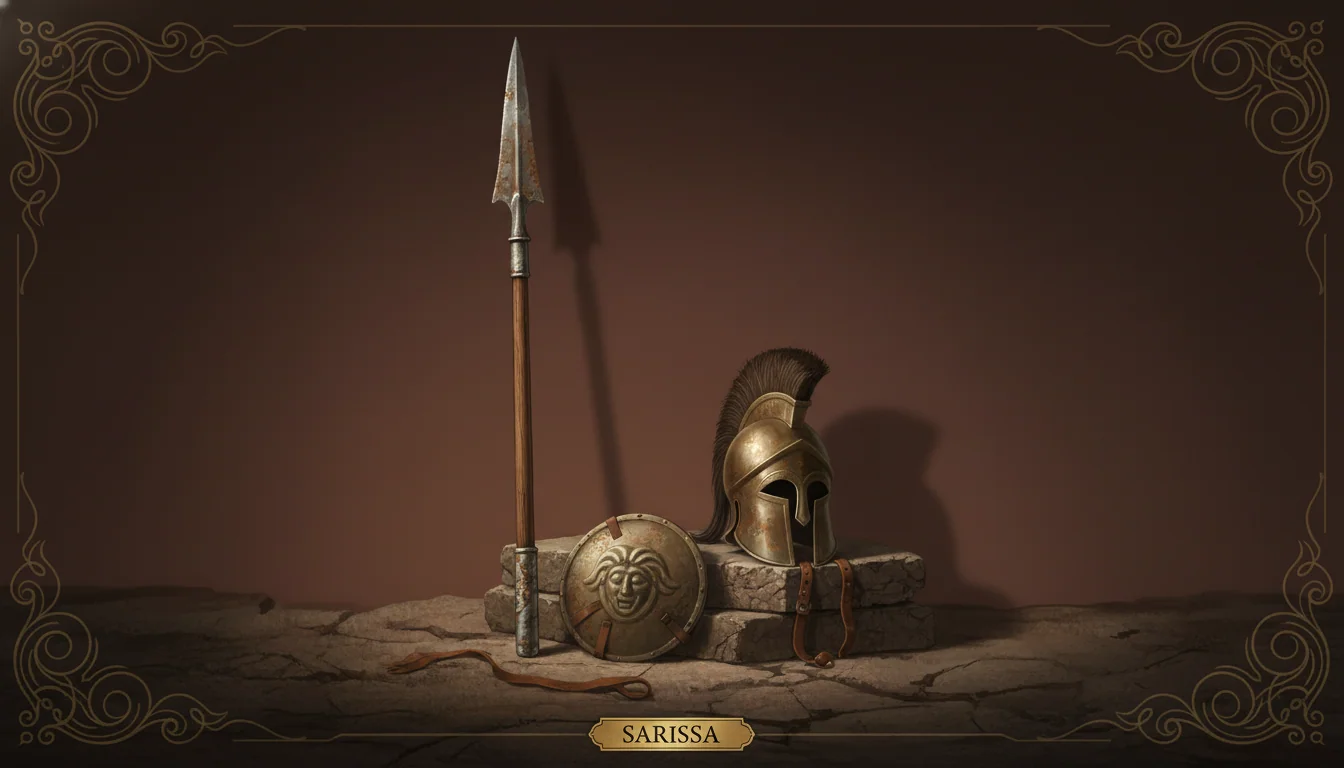
The sarissa was a long thrusting pike, two-handed and tipped with iron. Surviving fragments and the painstaking reconstruction by the Greek archaeologist Manolis Andronicos in the 1970s, working from the royal tombs at Vergina, give us a reasonably clear picture of the weapon.
It was made in two halves, joined by a bronze sleeve. The head was a long iron blade, leaf-shaped or sometimes more elongated, weighing between 700 grams and a kilogram. The butt was a heavy iron spike called the sauroter (literally lizard-killer), which served three purposes: it counterbalanced the weight of the head, it could be planted in the ground to anchor the weapon against a charge, and it gave the rear ranks a back-up point if the head was broken.
The shaft was made of cornel wood, a dense, heavy, springy hardwood that grew on the Macedonian highlands. Cornel was crucial: it was strong enough to support the length of the pike without snapping under its own weight when held horizontally, and yet flexible enough to absorb the shock of a strike without shattering. No other available wood, certainly not the ash or oak of southern Greek spears, could do the job at sarissa lengths.
The earliest sarissas under Philip II were 12 to 14 feet long. By Alexander's eastern campaigns the standard was 16 to 18 feet. By the late 3rd century, Macedonian kings had pushed the length to 21 feet. The weapon grew because the men who held it kept asking the same question: how can we make our line of pikes reach further than the enemy's?
How it changed warfare
The Macedonian phalanx, organized around the sarissa, deployed in blocks 16 men deep and broad enough to cover a battlefield front. The first five ranks held their pikes level, projecting forward; the rear eleven held theirs at an angle, ready to move into position as casualties opened gaps. Polybius, writing about 150 BCE, describes the formation: a hedge of iron points so dense that nothing approaching from the front could survive contact, with each enemy hoplite or footsoldier facing not one but five pike heads at once.
This was a tactical revolution. The classical Greek hoplite, fighting with a 7 to 9 foot spear and a heavy shield, depended on the cohesion of his line and the strength of his shield wall. The sarissaphoros depended on the geometry of his pike. He did not need to be physically strong, only disciplined. He did not need a huge shield, only a small strapped buckler at the shoulder, freeing both hands for the pike.
The result was a formation that could be raised more easily, trained at scale, and moved on the battlefield by professional officers using a clear chain of command. The Macedonian army that Philip II built was the first in Greek history that resembled a modern military rather than a citizen militia. The sarissa was both the weapon and the organizational principle.
Key battles
Chaeronea, 338 BCE
Philip II's son Alexander, then 18, commanded the Macedonian left at the Battle of Chaeronea, where the combined forces of Athens and Thebes attempted to halt Macedonian expansion into central Greece. Philip held the right with his veteran sarissa companies; Alexander, with the Companion cavalry and supporting infantry, struck the Sacred Band of Thebes on the left.
The phalanx held the Athenian center while Alexander's flank attack rolled up the Theban line. The Sacred Band, three hundred elite soldiers who had sworn never to retreat, were killed almost to the last man. The battle ended hoplite warfare as a strategic concept. From that afternoon, no Greek city could field an army that fought like the old phalanxes and survive a Macedonian engagement.
Issus and Gaugamela
Alexander used the sarissa phalanx as the anchor of his battle plans during the conquest of Persia. At Issus in 333 BCE and at Gaugamela in 331 BCE, the phalanx held the center against vastly larger Persian forces while Alexander led the cavalry around the wings to hit Darius III's command position.
The technical lesson of these battles is consistent. The Persians, with shorter spears and less disciplined formations, could not break the phalanx frontally. Their attempts to do so cost them tens of thousands. Meanwhile the Macedonian cavalry, freed by the phalanx's stability, struck where they pleased. The sarissa was, in this period, less a killing weapon than an immovable wall around which the rest of the battle pivoted.
The Hydaspes, 326 BCE
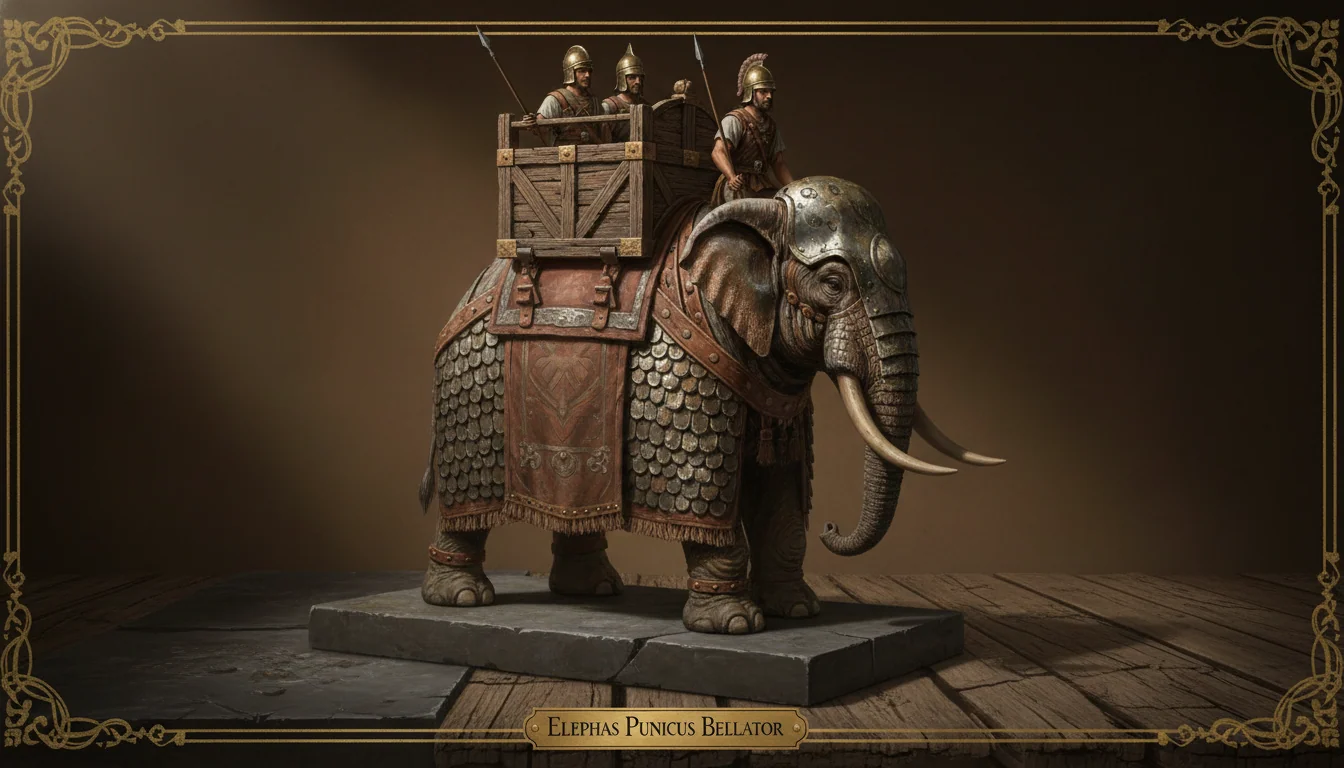
At his last great battle, against the Indian king Porus on the Hydaspes River in modern Punjab, Alexander faced a new opponent: war elephants. The phalanx adapted. The pikes were used to drive elephants away from the formation, the cavalry attacked the elephants' handlers, and the phalanx pressed forward as the elephants panicked.
The battle showed both the strength and the limits of the sarissa. It worked against unfamiliar opponents. It also nearly broke when the elephants turned on the Macedonian flanks. After the Hydaspes, the men of the phalanx mutinied, refused to march further east, and forced Alexander to turn back. The sarissa had reached the geographical limit of its empire.
Technical evolution
After Alexander's death in 323 BCE, his successors (the Diadochi) inherited the phalanx and competed in modifying it. The trend was toward longer pikes, deeper formations, and more specialized infantry types. Antigonus Gonatas's Macedonian army of the mid-3rd century BCE used 18-foot pikes; Philip V and Perseus of Macedon, fighting Rome a century later, fielded sarissas of about 21 feet.
The longer the pike, the heavier the formation became and the harder it was to maneuver. Late Hellenistic phalanxes worked best on absolutely flat ground. They struggled crossing streams, climbing rises, or wheeling on a mobile enemy.
The Hellenistic kingdoms also added supporting infantry: thureophoroi (medium spearmen with oval shields) and thorakitai (armored swordsmen) to fight on broken ground that the phalanx could not enter. These were tacit admissions that the sarissa, for all its dominance, had narrowed too far. It needed protection it had not needed under Philip and Alexander.
Decline and successor
The Roman legion, organized in maniples of swordsmen carrying the Roman gladius and javelins, met the Macedonian phalanx three times in the 2nd century BCE and won all three engagements. At Cynoscephalae in 197 BCE, the Roman consul Titus Quinctius Flamininus exploited broken ground that disrupted the phalanx's formation and turned its line. At Pydna in 168 BCE, the consul Lucius Aemilius Paullus did it again on harder ground, with the legions infiltrating gaps in the pike line as the Macedonians advanced unevenly across rough terrain.
Polybius, who watched Pydna with his own eyes, wrote one of the most influential analyses of the sarissa ever produced. He argued that the phalanx was unbeatable when it could form on flat ground and move in straight lines, but that it could not adapt. The Roman maniple, by contrast, could deploy on broken terrain, fight in smaller units, and turn to face new threats without losing cohesion. The phalanx was a single mass that won or lost as a single mass. The legion was many small masses, each able to fight independently.
After Pydna, the Antigonid dynasty was abolished, Macedonia became a Roman province, and the sarissa effectively ended as a primary battlefield weapon. Smaller pike formations would persist in Hellenistic armies for another century, but the strategic logic that had carried Alexander to India was finished.
Echoes
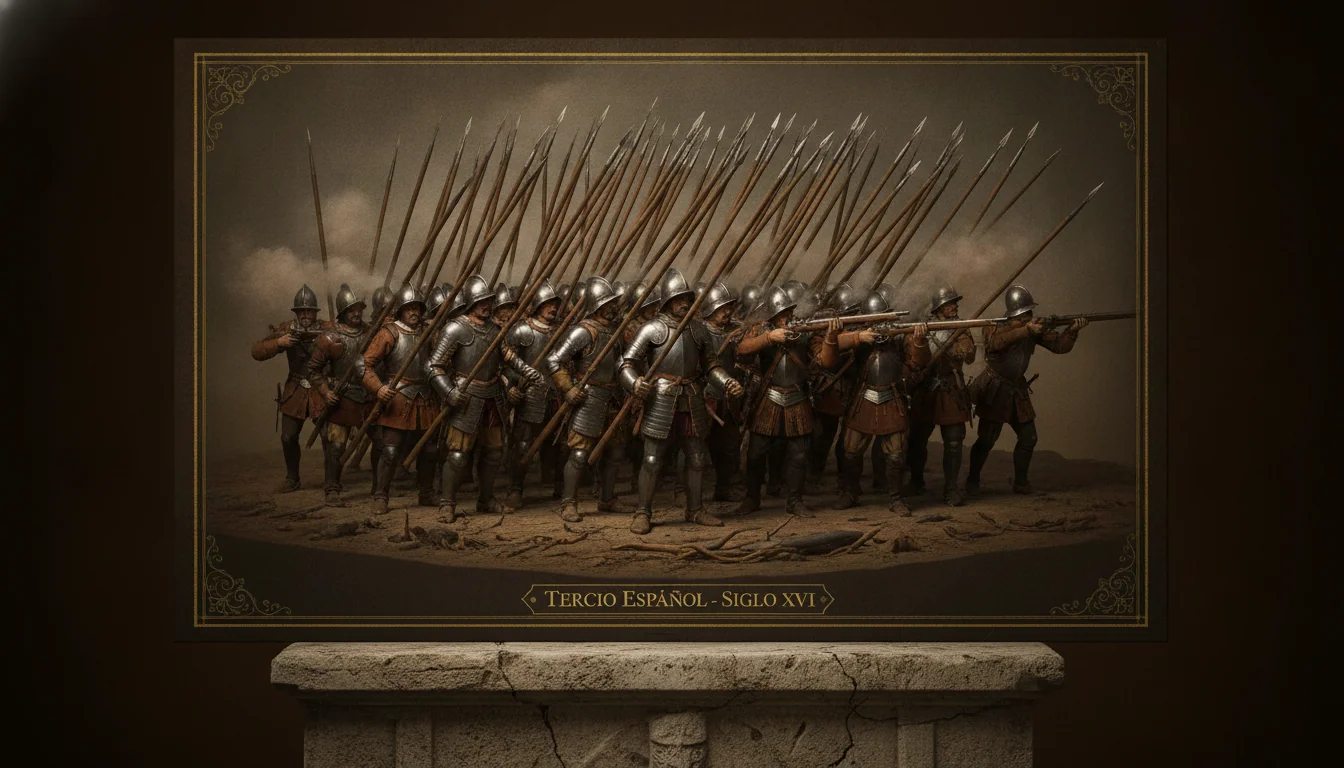
The sarissa returned, in essence, two thousand years later. The Swiss and Landsknecht pike squares of the Renaissance fought with weapons of similar length and used many of the same tactical principles: a deep block of disciplined infantry presenting an unbroken hedge of points to the enemy. They too dominated their period of warfare and they too were eventually undone by smaller, more flexible formations using firearms.
The historical lesson is that long pikes wielded in mass formation are decisive against opponents who cannot match either the discipline or the geometry. They are vulnerable to enemies who can break the formation by mobility rather than by force. The Romans learned this from the Macedonians. The Spanish tercios learned it from the Swiss. The 19th-century industrial armies learned it from the Napoleonic columns.
The sarissa itself, with its two-piece cornel shaft and its iron head and butt-spike, sits in fragments in the archaeological museums of northern Greece. It is rarely the most striking weapon in any case it occupies. But for almost two centuries, it was the most consequential infantry weapon on earth, and it took an army from a small mountain kingdom to the Indus valley before any cohesive force in the world found a way to break it.
Quick Answers
Common questions about this topic
How long was a Macedonian sarissa?
The earliest sarissas under Philip II in the 350s BCE were probably 12 to 14 feet long. By the time of Alexander the Great's eastern campaigns in the 330s BCE, the standard was 16 to 18 feet. By the late Hellenistic period under Philip V and Perseus of Macedon (3rd to 2nd centuries BCE), sarissas of 21 feet are recorded. The weapon got steadily longer as Macedonian kings tried to push the formation's reach further.
Who invented the sarissa?
The sarissa is generally credited to Philip II of Macedon, who reformed the Macedonian army in the 350s BCE. Philip drew on earlier experiments with longer Greek spears, particularly the reforms of the Theban general Iphicrates a generation earlier, but it was the Macedonian combination of the long pike with new tactics, training, and unit organization that produced the weapon's military revolution.
What was the difference between a sarissa and a hoplite spear?
A classical Greek hoplite spear, the doru, was 7 to 9 feet long, used one-handed with a large shield, and worked by stabbing in close formation. The sarissa was 16 to 18 feet long, used two-handed with a small strapped shield (the pelte), and worked by projecting a hedge of pikes well in front of the formation. The hoplite fought face to face. The sarissaphoros stabbed at men he could barely see.
Why did the sarissa eventually fail?
The sarissa phalanx demanded flat ground and a protected formation. Once Roman legions, fighting in the more flexible manipular system, learned how to disrupt the pike line by attacking its flanks or by exploiting gaps on broken ground, the phalanx's weakness was exposed. The decisive defeats at Cynoscephalae (197 BCE) and Pydna (168 BCE) ended Macedonian military dominance and convinced the Mediterranean that Roman tactics had surpassed Greek pike warfare.

Talk to the People Who Wielded These Weapons
Chat with the soldiers, smiths, and commanders whose lives were shaped by the weapons of their age.
Talk to a WarriorJoin the HistorIQly Club
Get smarter about the past.
Weekly stories, deep dives, and exclusive content straight to your inbox.