The MG42: How Hitler's Buzzsaw Set the Pattern for Every Modern Machine Gun
The MG42 machine gun fired so fast it sounded like tearing canvas. Allied troops called it Hitler's Buzzsaw, and its descendants still arm NATO armies eighty years later.
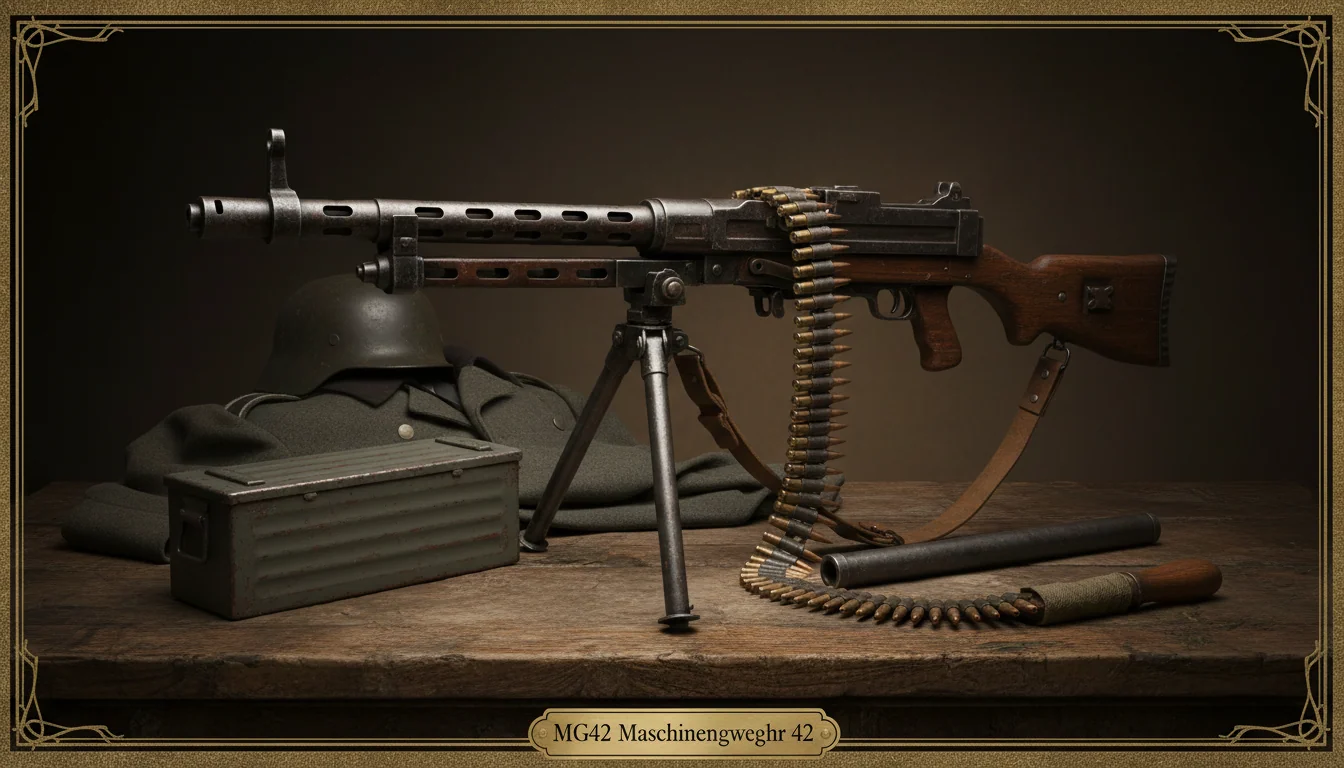
The first time American infantry encountered the MG42 machine gun in Tunisia in early 1943, they thought the Germans had developed a new kind of weapon. The sound was wrong. Where every other machine gun on the battlefield made a discrete chatter, this one tore. It produced a flat continuous ripping noise, like canvas being shredded in a wind tunnel, and it ate through bursts so fast that even experienced riflemen instinctively flattened against the dirt. The US Army eventually produced a training film, Sound Off!, specifically to teach replacements that the noise was not a magic super-weapon but a regular gun running unusually hot.
It was a regular gun. It was also, by almost any technical measure, the best general-purpose machine gun of the Second World War, and the direct ancestor of half the machine guns in service today. For the rest of the German infantry small-arms picture, see our histories of the Mauser K98 bolt-action rifle and the StG 44 assault rifle.
The problem the Germans wanted to solve
The Wehrmacht's doctrine in the late 1930s, codified in the Truppenführung manual of 1936, was unusual among major armies. The German rifle squad was built around its machine gun, and the riflemen existed primarily to feed, defend, and reposition the gun. Every other army had it the other way around: the rifle squad was the unit, and the machine gun was a support weapon attached to it.
This doctrine demanded a single weapon that could fill multiple roles. It had to be light enough to advance with the squad on a bipod, like a light machine gun. It had to be capable of sustained defensive fire from a tripod, like a heavy machine gun. And it had to be cheap enough to manufacture in genuinely wartime quantities. The Germans called the resulting concept the Einheitsmaschinengewehr, the universal machine gun.
The first attempt, the MG34, was a beautiful piece of engineering. It was light, accurate, and mechanically sophisticated. It was also too expensive to produce, too tightly toleranced for the muddy Eastern Front, and required nearly 50 hours of skilled machining to build. By 1940 it was clear that Germany could not arm a continental army with MG34s.
The Mauser-Werke design team, led by Werner Gruner, was given the brief in 1939. Build a weapon that does the same job, but stamp the parts out of sheet steel, weld them together, and finish the gun in under half the labor hours. Gruner was an engineer with no firearms background. He had been recruited specifically because the Heereswaffenamt wanted someone who would design for production, not for elegance. The result, accepted into service in early 1942 as the Maschinengewehr 42, was one of the most consequential industrial pieces of small-arms engineering of the 20th century.
The technology
The MG42 was a recoil-operated, air-cooled, belt-fed weapon firing the standard 7.92x57mm Mauser cartridge. Its receiver was a single piece of stamped sheet steel, folded and spot-welded into a rectangular tube. The barrel was held in a quick-change sleeve that could be released by rotating the locking lever. A trained loader, using a heavy asbestos pad, could change a hot barrel in under seven seconds.
The locking mechanism was the gun's most influential feature. Gruner adapted a roller-locking system from a Polish-designed automatic rifle prototype that the Germans had captured in 1939. Two hardened steel rollers in the bolt head wedged outward into recesses in the barrel extension at the moment of firing, then were cammed back inward as the barrel and bolt recoiled together. The system was simple, used few moving parts, and tolerated dirt and bad ammunition in ways that the MG34's lock did not.
The cyclic rate of fire was 1,200 to 1,500 rounds per minute, depending on the recoil booster and bolt weight. Comparable Allied weapons fired at less than half that speed. The MG42's bolt traveled a distance of only about 90 millimeters per cycle, which was the geometric reason the rate was so high. The fire was so fast that individual reports blurred into a continuous tone. The sound, recorded on dozens of newsreel and combat-film clips, became one of the most distinctive auditory signatures of the war.
The gun fed from non-disintegrating Gurt 34 metal-link belts in 50 or 250 round lengths. From the bipod, in the light role, it weighed 11.6 kg, lighter than the British Bren equivalent in role. From the Lafette 42 tripod, in the medium role, it could reach effective ranges of 2,000 meters, with optical sights and an indirect-fire arc.
It cost the Reich 250 Reichsmarks and about 75 hours of labor to make a complete MG42, against 327 Reichsmarks and 150 hours for an MG34.
How it changed infantry tactics
The MG42 made German defensive doctrine work in ways that no comparable Allied weapon could match. A single Wehrmacht squad with an MG42 in good ground could pin down an entire Allied platoon's worth of riflemen, because the saturating fire reliably hit anyone exposed for more than a fraction of a second. American infantry doctrine adapted by relying on artillery, mortars, and tanks to suppress German positions before riflemen advanced. The simple cost of crossing 200 meters of open ground in front of a sited MG42 was unacceptable.
The 1944 US Army study The Effects of Fire on Infantry found that German machine-gun fire was responsible for a disproportionate share of American casualties in Europe, and that the MG42 specifically accounted for the majority of those casualties in many sectors. The same study noted, however, that the MG42's high rate of fire was a tactical disadvantage in some situations: a panicky German gunner could exhaust his ammunition supply during a single firefight, and a 50-round belt was gone in 2.5 seconds at maximum rate.
German training therefore emphasized fire discipline above all else. Crews were drilled to fire short bursts of 5 to 7 rounds, traversing the gun in small arcs rather than locking on a single point. The standard phrase taught at the Maschinengewehrschule was Drei kurze Stoesse, three short bursts, then move or change barrel. Crews who followed the doctrine were devastating. Crews who did not burned through their barrels and their ammunition in minutes.
The defining battles
By 1943 the MG42 had become the standard squad weapon of the Wehrmacht, the Waffen-SS, and most allied formations of the Reich. It served in every theater of the European war, from the Volga steppes to the Apennine hills to the Norwegian fjords.
Its most documented engagements were in Normandy in June and July 1944. American Army Ranger and infantry units encountered MG42 nests at Pointe du Hoc, in the bocage country south of the Cotentin, and along the hedgerow approaches to Saint-Lô. The gun's combination of saturating fire and rapid barrel-change capacity made hedgerow defenses, which used MG42s in pairs covering each other's barrel changes, extremely costly to clear. The American counter, eventually, was the Sherman tank with a hedge-cutting prong improvised in the field, which let armor flank positions that infantry could not approach directly.
On the Eastern Front, the MG42's mass-production cost-effectiveness mattered more than its tactical brilliance. By 1944, German infantry divisions had on paper more than twice the machine-gun strength of their Soviet counterparts, but were facing armies that were being equipped at industrial scales the Reich could no longer match.
What the gun cost the Wehrmacht
The MG42 was a tactical success and a logistical liability. Its rate of fire required ammunition consumption that the Reich's overstretched supply chain struggled to deliver. A single sustained German defense in Normandy could consume tens of thousands of rounds in an afternoon. By late 1944, MG42 ammunition shortages were one of the recurring complaints in Wehrmacht situation reports, alongside fuel and replacement crews.
The barrel-change requirement also extracted a quiet cost. The high rate of fire meant barrels had to be swapped every 250 rounds in sustained fire, and a crew that did not have spare barrels at hand was effectively disarmed within seconds. German crews carried two spares as standard. Late-war crews, scrambled together in the chaos of 1945, often did not.
For all these limits, the MG42 served at scale until the end. Mauser, Steyr, Großfuß, and several other German firms produced more than 425,000 of them between 1942 and 1945. American postwar inspection teams found the surviving examples remarkable for their simplicity and the genuinely industrial quality of the stampings.
The afterlife
In 1948 the new Bundeswehr's planners faced a question with an obvious answer. The German army needed a general-purpose machine gun. The country had just produced one of the best ever made. The MG42's design was rebarreled to fire the new 7.62x51mm NATO cartridge, accepted as the MG1 in 1958, and refined into the MG3 in 1968. The MG3 served as the German army's standard general-purpose machine gun for more than half a century, finally beginning to be replaced by the MG5 in the 2010s.
Italy adopted the MG42/59 in 1959. Pakistan, Iran, Yugoslavia, Turkey, Spain, and Mexico either licensed or copied the design. By the early 21st century, descendants of the MG42 were in service with more than thirty national armies.
The American M60, accepted into US service in 1957, drew its belt-feed system and overall configuration from the MG42. The Soviet PK general-purpose machine gun, accepted in 1961, did not copy the German design directly but adopted the same doctrinal concept of a single belt-fed weapon serving in light and medium roles, an idea the MG42 had introduced.
Why the design lasted
Most successful weapons are eventually replaced by something faster, lighter, or more accurate. The MG42's basic configuration has not been. Eighty years after the prototype passed acceptance trials at the Heereswaffenamt's Kummersdorf range in 1941, the same recoil-operated, roller-locked, belt-fed, air-cooled architecture is still the default for general-purpose machine guns in dozens of armies, including the United States, the United Kingdom, Russia, China, and Germany itself.
The reason is that Werner Gruner, working under wartime pressure with a brief that valued production over elegance, accidentally solved the problem the Einheitsmaschinengewehr concept had set. He built a weapon that did three jobs adequately, none of them poorly, at a manufacturing cost that no comparable design has been able to undercut. The MG42 is the rare case in arms history where a wartime expedient produced a peacetime standard.
Allied infantry called it Hitler's Buzzsaw. Wehrmacht crews called it the Knochensäge, the bone saw. The Bundeswehr today, sixty-six years after first issuing the descendant, calls it simply das MG. The instrument has changed names. The machine has not.
Quick Answers
Common questions about this topic
How fast did the MG42 actually fire?
The cyclic rate ranged from 1,200 to 1,500 rounds per minute depending on the bolt and recoil booster fitted, with a service standard of about 1,200. American and British contemporaries fired at 450 to 600. The MG42's distinctive ripping-canvas sound came from individual rounds blurring into a continuous hum at those rates - a feature US Army training films explicitly addressed because the noise demoralized green troops.
Why did the Germans want such a high rate of fire?
Wehrmacht doctrine treated the machine gun as the squad's primary weapon, with riflemen as supporting elements. A high rate of fire let a single MG42 saturate a target zone for the brief moment a moving infantryman exposed himself. The trade-off was barrel wear and ammunition consumption: the gun was designed for quick barrel changes, with a trained crew swapping in under seven seconds.
Did the MG42 really survive after WWII?
Yes. The Bundeswehr adopted the slightly modified MG3, chambered for 7.62x51mm NATO, in 1959, and it remained the German general-purpose machine gun until the MG5 began replacing it in the 2010s. Variants are still in service with armies including Italy, Pakistan, Iran, Mexico, and several others. The basic recoil-operated, roller-locked action has lasted more than eighty years.
Was the MG42 the inspiration for the M60?
Partially. American postwar designers studied captured MG42s extensively. The M60's belt feed system and overall layout owe a clear debt to the German weapon, while the operating mechanism was drawn from the FG42 paratrooper rifle. The result was a genuine hybrid, though American crews who served with both generally preferred the older MG42's reliability.

Talk to the People Who Wielded These Weapons
Chat with the soldiers, smiths, and commanders whose lives were shaped by the weapons of their age.
Talk to a WarriorJoin the HistorIQly Club
Get smarter about the past.
Weekly stories, deep dives, and exclusive content straight to your inbox.