Greek Fire: The Lost Byzantine Weapon That Burned on Water
For four centuries, Byzantine warships deployed Greek Fire, a liquid flame water could not extinguish. The secret weapon that saved the empire and was then forgotten.
Of all the weapons that no longer exist, Greek Fire is the one that most fascinates historians. For four centuries, the Byzantine Empire wielded a secret incendiary mixture so terrifying that hostile fleets sometimes turned and fled at the sight of the bronze siphons used to deliver it. The recipe was guarded as a state secret. When the empire fell in 1453, the secret died with it. We have detailed descriptions of how Greek Fire was used, what it looked like, what it did, and what could and could not put it out. We do not have, and may never have, a confirmed recipe.
A weapon born of desperation
The story begins in the 670s, with the Byzantine Empire fighting for survival. The Arab conquests had swept across Syria, Egypt, and North Africa within a single generation. By 674, an Arab fleet was wintering at Cyzicus on the Sea of Marmara, raiding the walls of Constantinople each spring. The empire's army, exhausted by Persian and now Arab wars, was outnumbered. Its fleet was in disarray. The Byzantine emperor Constantine IV needed something the enemy did not have.
According to the chronicler Theophanes, an architect or engineer named Kallinikos arrived in Constantinople from Heliopolis (modern Baalbek) in Syria. He had been a Greek-speaking subject of the Byzantine Empire until the Arab conquest, after which he fled west. He brought with him a recipe for a sea-fire that could be projected through bronze tubes mounted on warships. Constantine's navy adopted the weapon, and in 678 broke an Arab fleet anchored off Cyzicus so badly that the surviving ships limped home and the siege of Constantinople was lifted.
The Arab caliph Mu'awiya signed a thirty-year peace treaty with the empire afterwards. He had bombards, infantry, and superior numbers. He did not have an answer to the fire.
What it actually did
Byzantine accounts, hostile chronicles, and travelers' descriptions agree on roughly the same picture. Greek Fire was a sticky liquid, projected through a heated bronze siphon by some kind of pump, and ignited just before or after it left the nozzle. It traveled in a spray or stream and clung to whatever it hit. It burned with intense heat. Water could not extinguish it. Sources mention the only effective remedies as sand, vinegar, and old urine, presumably because of the alkali or salt content.
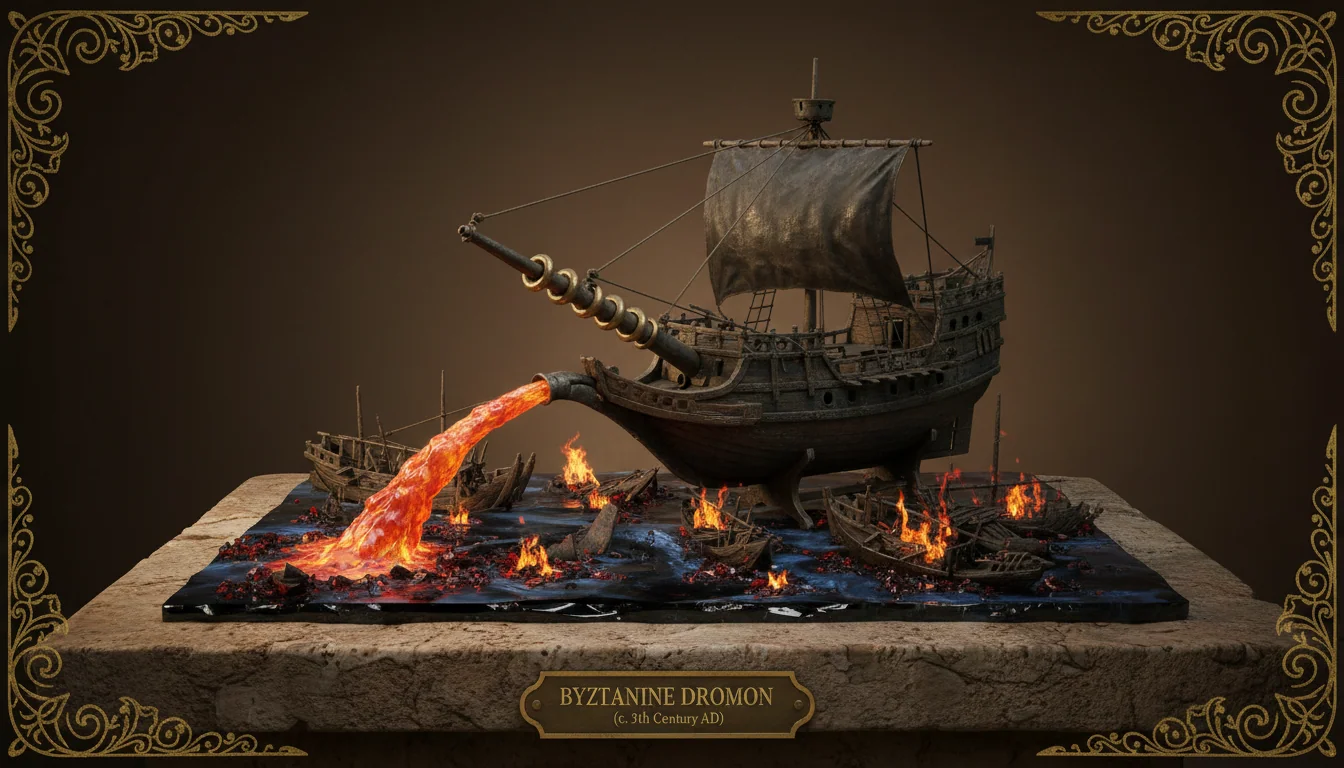
The siphons were mounted on the prow of dromons, the standard Byzantine warship, and shot fire from a height onto the wooden decks of enemy vessels. Some accounts describe a roar like thunder and a smoke so dense it blinded the enemy. The crew of the receiving ship had only seconds to choose between the fire and the water, and water was no escape because the burning liquid floated on the surface and continued to burn.
There were also smaller hand-pumps, called cheirosiphones, used in land sieges, and clay grenades filled with the same substance and thrown by hand. A late-Byzantine military manual, the Tactica of Leo VI, describes a complete tactical doctrine built around different formulations and delivery methods.
The recipe problem
We do not know what Greek Fire was. Anna Komnene, a Byzantine princess and historian writing in the 12th century, gave a vague description: "Pine and certain other evergreen trees yield a thick resin which is mixed with sulfur and finely powdered, then tubes are made and fire is blown through them by men using their breath." This is suspiciously close to a recipe a foreigner might write to mislead, and was possibly intentional misdirection.
Modern reconstructions and chemical analysis suggest the base was almost certainly petroleum or naphtha. The ancient world had access to crude oil from natural seeps in the Caucasus, around the Caspian Sea, and along the eastern Mediterranean coast. The Byzantine state controlled or traded with all of these regions during its peak. Refined naphtha, when properly distilled, burns hot, sticks to surfaces, and floats on water.
To this base, scholars have proposed adding sulfur, quicklime, saltpeter, pine resin, and a host of other ingredients. Each addition does something useful: sulfur raises the temperature, quicklime reacts violently with water, resin thickens the mixture so it sticks, saltpeter provides oxygen for combustion. The combinations are plausible but unconfirmed.
The Byzantine state guarded the recipe as a matter of imperial policy. The emperor Constantine VII Porphyrogenitus, in a famous mid-10th century passage, told his son and heir that three secrets must never be shared with foreigners: the imperial regalia, marriages with the Byzantine royal family, and "the manufacture of liquid fire, which God himself disclosed through an angel to the Christian emperor Constantine the Great." The story of angelic delivery was almost certainly a deterrent against insider leaks. The point was that anyone who shared the secret would be guilty of impiety as well as treason.
A weapon at sea
Greek Fire was at its best in naval combat. Byzantine dromons fought at close quarters, used the wind and current to maneuver, and fired their siphons at point-blank range against wooden ships packed with men and combustibles. A single accurate shot could turn a galley into a torch within minutes.
In 717, when the Umayyad caliphate launched a second great assault on Constantinople with a massive fleet, the Byzantine navy under Emperor Leo III used Greek Fire to destroy the Arab transports. The siege failed. The historian Gibbon, writing in the 18th century, called this battle one of the great defensive victories of European history.
In 941, the Kievan Rus' prince Igor sailed his fleet to the Bosphorus and was met by an outnumbered Byzantine squadron equipped with siphons. Liutprand of Cremona, a Western diplomat who later interviewed survivors, described the Rus' jumping into the sea in their armor to escape the fire and drowning rather than burn. Igor's chronicler agreed.
The weapon was decisive in repeated naval crises. Without it, the Byzantine state would almost certainly have fallen between 674 and 941. With it, the empire survived another five centuries.
On land
Greek Fire was less revolutionary in land warfare. The bronze siphons required heat, pressure, and a stable platform. They were too cumbersome for open battle. But during sieges, both Byzantine defenders and besiegers used handheld cheirosiphones to defend walls, and clay grenades thrown from the parapet to set fire to siege works.
The chronicler John Skylitzes describes a 10th-century Byzantine army using small Greek Fire devices in the field, with mixed results. The accounts are vague enough that historians disagree about how often the weapon was used outside naval contexts. The bronze siphons themselves are entirely missing from the archaeological record, although a few possible nozzle fragments have been tentatively identified.
Decline
By the late 12th century, the strategic situation had changed. The Byzantine state had lost much of its territory, including the regions where the petroleum base was sourced. The Crusader sack of Constantinople in 1204 disrupted the imperial bureaucracy that maintained the secret. After 1261, when the empire was restored under the Palaiologoi, references to Greek Fire become vague, and it appears that the operational doctrine was already fading. By the 14th century, Byzantine writers seem unsure exactly what Greek Fire was.
The Ottoman conquest of Constantinople in 1453 effectively ended any chance of recovering the recipe. Whatever knowledge survived in the imperial archives was scattered or destroyed. The Ottomans had their own incendiary weapons, but they did not match the Byzantine sea-fire of the 7th to 11th centuries. By the time European chemistry could plausibly reconstruct the formula, the weapon belonged to legend.
Echoes
Greek Fire shaped warfare in ways that outlasted its use. Crusader-era armies, Saracen fleets, and medieval Italian city-states all developed their own incendiary weapons in conscious imitation. The naphtha-based pots used at the siege of Acre in 1191 are a direct lineal descendant. Late-medieval European writers refer to "wildfire" or "wet fire" recipes that are clearly trying to recreate the Byzantine secret without success.
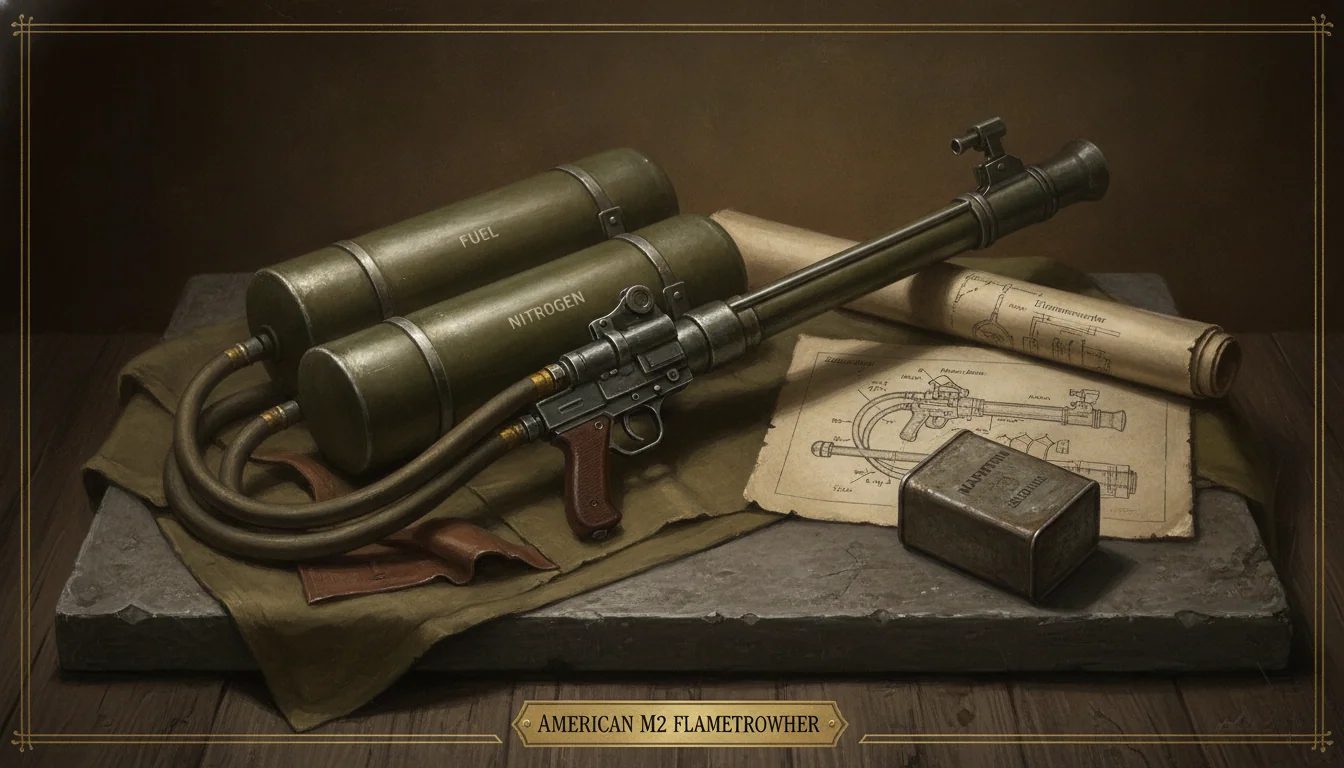
In the modern era, the principle reappeared in industrial form. Flamethrowers in the trenches of the First World War, napalm dropped from the air over Korea and Vietnam, and modern thermobaric weapons all share Greek Fire's central design idea: an incendiary that clings to its target, burns through water and air, and is psychologically devastating as well as physically destructive. The technology has changed beyond recognition. The intent has not.
Greek Fire is the most famous lost weapon in history because the loss is so complete. Other ancient technologies, from Roman concrete to Damascus steel, have been at least partially reconstructed. The Byzantine sea-fire has not, and probably never will be. What Kallinikos brought to Constantinople in 670 went into the imperial archives, and from the imperial archives into the silence that follows the fall of empires. The smoke is still hanging over the Bosphorus, but the fire itself is gone.
Quick Answers
Common questions about this topic
What was Greek Fire made of?
We do not know. The Byzantine government treated the formula as a state secret of the highest order, and the recipe was lost when the empire fell. Modern scholars suspect a base of crude oil or naphtha mixed with sulfur and quicklime or other accelerants, possibly with resin to thicken the mixture. The exact formulation has been the subject of debate for over a thousand years.
Why couldn't water put it out?
Multiple ancient sources insist that Greek Fire continued to burn on water. If the mixture contained quicklime, water would actually accelerate the reaction by generating heat. Petroleum-based oils also float on water, allowing the fire to spread across the surface of the sea. Vinegar, sand, or urine were said to be the only effective extinguishants.
When was Greek Fire first used?
The first documented use was during the Arab siege of Constantinople in 678 AD. The siphon-projection device that delivered it was reportedly invented by Kallinikos, a Greek-speaking refugee engineer from Heliopolis in Syria, who fled to Byzantine territory ahead of the Arab conquests. Greek Fire is credited with destroying the Arab fleet and saving the empire.
Did Greek Fire really decide battles?
Yes, especially at sea. The 678 and 717 sieges of Constantinople were both broken in part by Greek Fire attacks on Arab fleets. The 941 raid by the Kievan Rus' under Igor was repulsed when his ships were burned in the Bosphorus. Multiple chronicles, both friendly and hostile to Byzantium, describe the weapon as decisive. Its psychological effect, on top of the physical damage, was immense.

Talk to the People Who Wielded These Weapons
Chat with the soldiers, smiths, and commanders whose lives were shaped by the weapons of their age.
Talk to a WarriorJoin the HistorIQly Club
Get smarter about the past.
Weekly stories, deep dives, and exclusive content straight to your inbox.