Arsenal: The Mauser K98k - Germany's Bolt-Action Standard
A history of the Mauser K98: the Karabiner 98 Kurz armed the German Wehrmacht through WWII. Some 14 million were made, but its bolt-action rate of fire was its downfall.
Read Wikipedia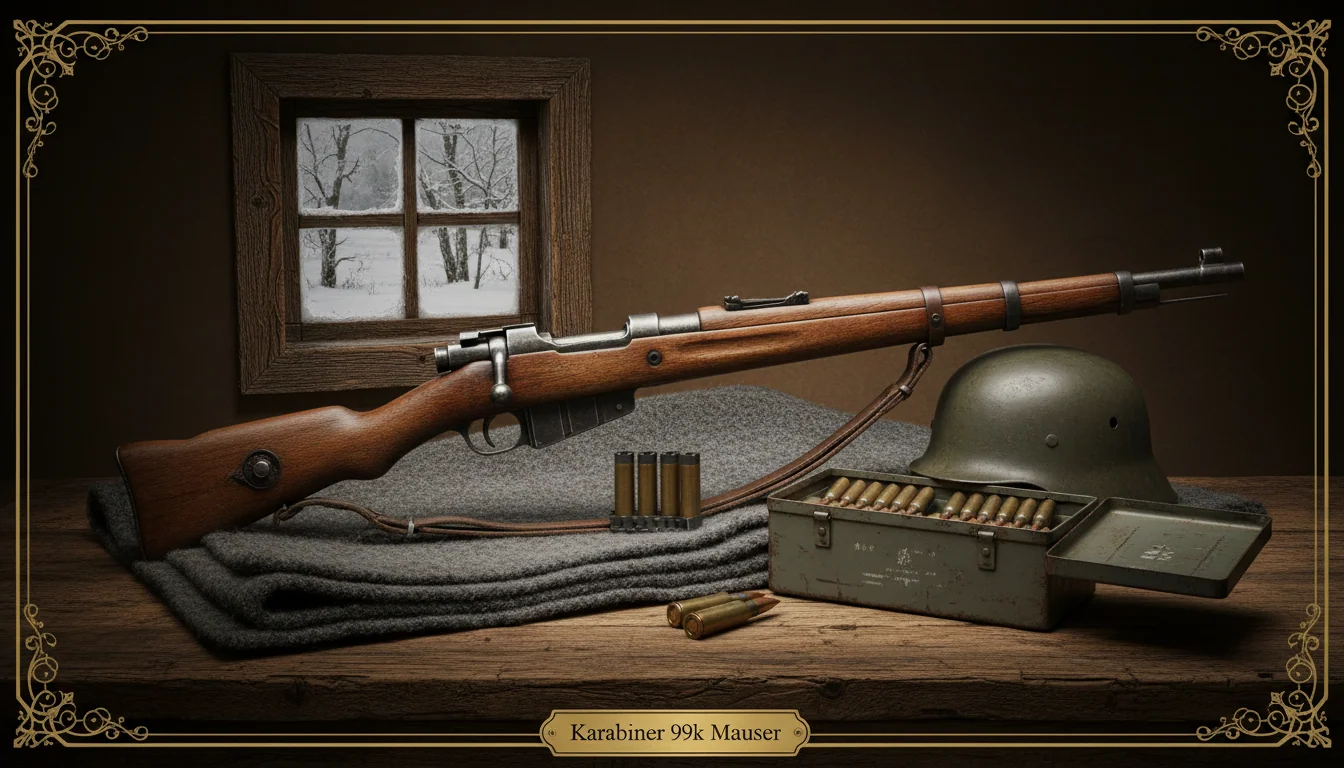
The Mauser K98 history starts before the rifle itself. Paul Mauser had been dead for two decades when the rifle bearing his family's name became the most produced military bolt-action of the twentieth century. He would not have been surprised. He had spent his career designing weapons for German armies, refining the bolt-action mechanism that he and his brother Wilhelm first brought to military service in 1871, and by the time the Gewehr 98 left his workshops at Oberndorf am Neckar in 1898, he had produced what many engineers then and since have considered the definitive statement of the bolt-action rifle. The Karabiner 98 Kurz - the K98k - was its direct descendant, shortened and refined for the second great industrial war.
If you want the full picture of German infantry firepower in WWII, our companion histories of the MG42 general-purpose machine gun and the StG 44 assault rifle fill in the squad-level context this rifle worked inside, while the M1 Garand is the semi-automatic counterpart that out-shot it on the Western Front.
Roughly 14 million were manufactured between 1935 and 1945. They went to every theater Germany fought in. They were buried in the mud of Stalingrad, carried through the North African desert, shouldered through the hedgerows of Normandy, and pointed across the frozen Eastern Front at men carrying rifles that fired twice as fast. By 1945, that rate-of-fire gap had become a verdict.
A design with deep roots
The 98 in the K98k refers to the Gewehr 98 of 1898, the full-length German infantry rifle from which the K98k directly descended. The Gewehr 98 itself built on Paul Mauser's earlier work - the various Turkish, Belgian, and Spanish contract rifles that refined his ideas through the 1880s and 1890s. (The Gewehr 88 of that era was not a Mauser design at all but a German army commission rifle that beat Mauser's submission, which Paul Mauser took as a professional insult and answered, ten years later, with the Gewehr 98.) By 1898, the core Mauser system was mature: a rotating bolt with two forward locking lugs, a controlled-round-feed extractor that gripped the cartridge case as it rose from the magazine and held it through the entire feeding cycle, and a flat non-rotating internal magazine loaded from a five-round stripper clip.
The controlled-round-feed system was the feature that defined the Mauser action's character. The cartridge was captured by the extractor at the moment of feeding and held firmly until ejection. This produced extreme reliability under adverse conditions - mud, sand, cold, rough handling. Feeding failures, common in some competing designs, were rare. The action was smooth and consistent. It could be operated quickly by a trained soldier without looking at the weapon.
The K98k, adopted by the Wehrmacht in 1935, was a shortened version of the earlier Karabiner 98b - the suffix "Kurz" meaning "short." The overall length dropped to about 1,110 mm from the full-length Gewehr 98's 1,250 mm. The barrel shortened accordingly to 600 mm. The shorter profile made the rifle more manageable for mechanized infantry, paratroopers, and soldiers operating in confined environments. It retained the same 7.92x57mm Mauser cartridge - a powerful intermediate-to-full-power round capable of lethal effect at ranges well beyond what most infantry engagements required.
Anatomy of the weapon
The K98k's bolt is its centerpiece. Three turns of the handle lift, retract, advance, and lock the mechanism - a cycle that a practiced soldier could execute in about two seconds without looking, ejecting the spent case and chambering a fresh round in one smooth motion. Military rifle instructors of the era described the sound of a well-oiled Mauser bolt as one of the most satisfying in small-arms operation.
The trigger group used a two-stage pull: a light uptake followed by a clean break. The safety was a wing-type mounted at the rear of the bolt, operable with the thumb. Setting it required a slight lifting motion before rotating, which prevented accidental disengagement.
The five-round capacity was loaded using a standard five-round stripper clip pressed down into the open magazine. Two clips gave a rifleman ten rounds before the pouch had to be opened. In theory this was adequate; in practice, against opponents with semi-automatic rifles firing eight rounds per trigger press, it was not.
Iron sights were adjustable for windage and elevation, graduated to 2,000 meters - optimistic for most combat but reflecting the infantry doctrine of aimed long-range fire. Scoped versions produced for sharpshooter use mounted ZF 39, ZF 41, and other optics, and a skilled sniper with a scoped K98k was genuinely dangerous at ranges beyond 600 meters.
What the rifle was built for
German infantry tactical doctrine entering World War II was not primarily based on individual riflemen trading shots at long range. The German system centered on the light machine gun section as the base of fire, with the rifle squad's role being to maneuver and support the machine gun. In this framework, the rifleman's bolt-action was not the critical fire-rate element - the MG34 or MG42 provided sustained suppressive fire while the squad worked through cover.
This logic held well in the rapid, high-tempo campaigns of 1939-1941. The Blitzkrieg in Poland, France, and the early phase of the Soviet invasion moved so quickly that sustained infantry firefights were often brief. The system worked.
It stopped working in the grinding attritional battles that began at Moscow in late 1941 and intensified through Stalingrad in 1942-43. In the rubble-and-ruin fighting of urban combat, in the frozen static lines of the Eastern Front, in the hedgerow country of Normandy, the American rifleman with an M1 Garand had a significant individual advantage. The Garand fired eight rounds semi-automatically before requiring a magazine change. A trained American soldier could deliver three to four times the rate of aimed fire of a trained German soldier with a K98k. This did not determine every engagement, but across thousands of engagements it added up.
The Soviet infantry response was even more pointed. The PPSh-41 submachine gun, produced in millions and issued freely to Soviet infantry units, fired pistol-caliber rounds at high cyclic rates. Against it in close-range urban combat, the bolt-action K98k was badly outclassed. Soviet squads used the PPSh-41 to generate overwhelming volume of fire at close quarters while their own machine guns handled anything at distance.
Key campaigns
The K98k first saw sustained combat in the Spanish Civil War, where Germany sent weapons and advisors in support of Francisco Franco's Nationalist forces from 1936-1939. These deployments served as field tests for weapons, tactics, and doctrine - the rifle performed well in the dust and heat of the Iberian Peninsula.
In Poland in September 1939, the K98k was the primary German infantry weapon through what became the template Blitzkrieg campaign. In France in 1940, the same. Operation Barbarossa in June 1941 sent millions of K98k-armed soldiers into the Soviet Union on a front that eventually stretched thousands of kilometers.
At Stalingrad in 1942-43, the limits of the weapon became visible in the most brutal terms. Street fighting in the ruined city placed infantrymen within meters of each other. The Soviets' higher-volume fire, especially from the PPSh-41 and the later semi-automatic SVT-40 rifle, was a constant operational pressure. German forces at Stalingrad captured Soviet weapons and used them where they could.
In North Africa with Rommel's Afrika Korps, the K98k performed reliably in sand and heat - the controlled-round-feed system's reliability advantage showed clearly in desert conditions where competing designs might have struggled. In the Western Front fighting of 1944-45, the same basic pattern held: reliable weapon, inadequate fire rate in the individual exchange.
The assault rifle interlude
By 1944 the Wehrmacht was fielding the Sturmgewehr 44 - the StG 44 - in growing numbers. The StG 44 fired an intermediate cartridge (the 7.92x33mm Kurz), used a 30-round detachable magazine, and offered selective fire between semi-automatic and fully automatic modes. It was lighter than the K98k over a similar engagement, and at close to medium range it was vastly superior.
Hitler famously opposed the project for years, preferring a more powerful cartridge and distrusting intermediate solutions. The engineers worked around his opposition by renaming the weapon multiple times. By the time the StG 44 reached production in meaningful numbers, it was too late to equip the infantry broadly. Perhaps 400,000 to 500,000 were made, against the millions of K98k rifles already in service. The K98k remained the standard issue through the end of the war.
The bolt action that built all other bolt actions
The K98k was defeated less by any intrinsic flaw in its design than by the trajectory of infantry weapons technology. By the mid-1940s the semi-automatic rifle had established that a soldier's individual fire rate was tactically significant, and the self-loading mechanism had become reliable enough to issue to front-line infantry. The bolt action's reign as the universal military standard rifle was ending.
But the Mauser action's legacy is not military. It is found in every bolt-action hunting and precision rifle made since 1945. Remington's 700 series, Winchester's Model 70, virtually every premium bolt-action from any manufacturer worldwide descends from or was directly influenced by the system Paul Mauser refined through the 1890s. The controlled-round-feed extractor, the twin-lug bolt, the smooth magazine feed - these remain the template for rifles used by hunters and precision marksmen across every continent.
The K98k was a flawless expression of a design philosophy that was reaching its limits at the moment of its widest use. That is not a failure. That is the ordinary fate of any technology that was, for its time, the best of its kind.
Quick Answers
Common questions about this topic
What is the Mauser K98k?
The Karabiner 98 Kurz (K98k) was the standard bolt-action infantry rifle of the German Wehrmacht from 1935 through the end of World War II. It chambered the 7.92x57mm Mauser cartridge and held five rounds loaded via stripper clips. Approximately 14 million were manufactured by multiple German and occupied-territory factories between 1935 and 1945.
Why was the K98k inferior to the M1 Garand in combat?
The M1 Garand was a semi-automatic rifle that fired as fast as its operator could pull the trigger, feeding from an eight-round en-bloc clip. The K98k required the shooter to manually cycle the bolt between each shot. In sustained fire exchanges, an American rifleman with a Garand could deliver roughly three to four times the volume of aimed fire as a German rifleman with a K98k, a tactical disadvantage that became significant in the grinding infantry combat of 1943-1945.
Is the Mauser bolt action still used today?
The Mauser controlled-round-feed bolt-action design, with its two forward locking lugs and reliable extractor, became the template for virtually every modern bolt-action hunting and precision rifle. Rifles by Remington, Winchester, Ruger, and dozens of other manufacturers descend from or were directly influenced by Paul Mauser's 1898 design.
Where was the K98k manufactured?
Multiple German manufacturers produced the K98k, including Mauser Werke at Oberndorf am Neckar (where the original Mauser designs were developed), Erma-Werke, Sauer and Sohn, Gustloff-Werke, and others. Factories in occupied Czechoslovakia and other territories also contributed production. Each manufacturer used a code stamped on the receiver to identify its work.

Talk to the People Who Wielded These Weapons
Chat with the soldiers, smiths, and commanders whose lives were shaped by the weapons of their age.
Create your free account →No card required. Some figures and features require a paid plan.
Join the HistorIQly Club
Get smarter about the past.
Weekly stories, deep dives, and exclusive content straight to your inbox.