The Mongol Composite Bow: How a Recurve of Horn and Sinew Conquered Eurasia
The Mongol composite bow built history's largest land empire. How a recurve of horn and sinew let horse archers outrange and outlast every medieval rival.
In the early 13th century, an army of perhaps 100,000 horse archers rode out of the Mongolian steppe and, in the space of a generation, conquered the largest contiguous land empire in human history. They beat the Khwarezmian Shahdom, sacked Baghdad, took most of China, defeated the Russian principalities, and shattered the Hungarian and Polish armies in two of the most one-sided cavalry victories ever recorded. They did it on horseback, with a single weapon at the center of their tactical doctrine: a small, savagely engineered recurve bow built from laminated horn, wood, and sinew.
The Mongol composite bow was not a Mongol invention. The technology was already two thousand years old when Genghis Khan was born. But the Mongols industrialized it, integrated it with a doctrine of mounted archery the world had never seen at scale, and applied it with a discipline that no rival military culture could match. The result was the most lethally effective ranged weapon of the medieval world.
The deep prehistory
Composite bows of horn, sinew, and wood appeared on the Eurasian steppe at least by 1500 BC. The Scythians shot recurve bows at Greek hoplites by the 5th century BC. The Huns under Attila terrified the late Roman Empire with a closely related weapon. The Sasanian Persians and the early Turkic peoples developed parallel traditions.
What made the steppe bow different from the simple wooden self-bow was the recognition that compression and tension stresses in a bent stave behave differently and could be engineered by laminating materials. Horn, which compresses without splintering, went on the belly facing the archer. Sinew, which stretches without breaking, went on the back. A wooden core held the assembly together. The whole bow stored more energy per inch of stave than any wooden bow could.
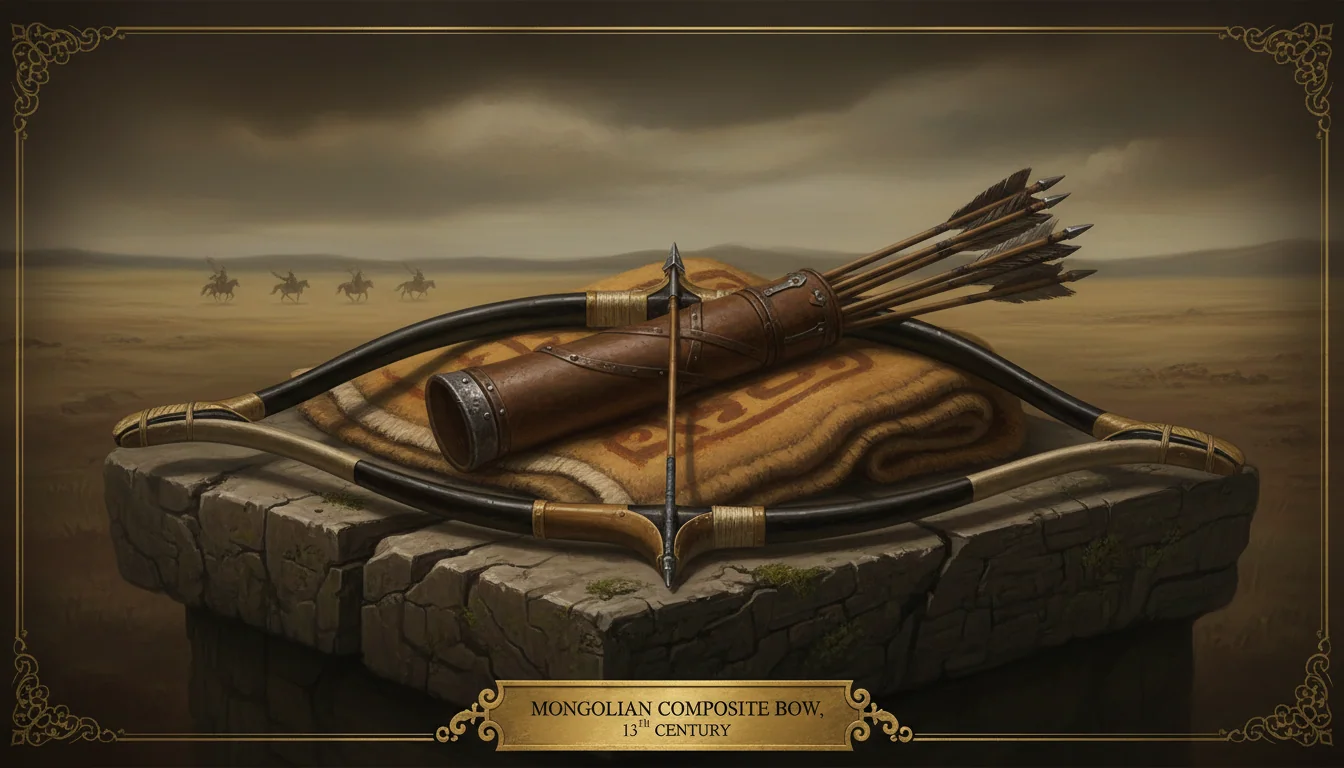
By the 12th century the Mongolian variant had refined the design into a short, deeply recurved bow, typically about 110 to 130 cm long unstrung, with rigid bone or horn ear pieces called siyahs at the tips. Unstrung, the bow curled backwards into a near-circle. Strung, the recurve loaded the limbs with stored tension before the archer ever drew.
The materials and the craft
A war-grade Mongol bow was an engineering project. It took up to a year to make, in stages dictated by the seasons.
The core was a strip of birch or maple, sometimes mulberry, planed to a precise taper. The belly was glued with strips of horn from water buffalo, ibex, or wild sheep. The back received layers of dried animal sinew from the leg tendons of cattle or deer, hammered into fibers and laid in glue parallel to the bow's length.
The glue was the most consequential component. Made from boiled fish bladders, animal hides, and a closely guarded recipe of additives, it had to set slowly enough to cure without cracking and strongly enough to hold the layers under repeated draw. The best Mongol glue could survive temperature swings from minus 30 in winter to plus 35 in summer, essential for an army that fought from Manchuria to the Caucasus.
Each layer had to cure before the next was added. The horn strips were clamped for weeks. The sinew layers dried through a Mongolian winter. The bow was then shaped, recurved, and stored under tension for a final cure. The bow string was twisted from raw silk, sinew, or rawhide.
The horse archer
The Mongol bow alone did not win the empire. The bow plus the Mongolian horse plus the trained horse archer did.
A Mongol warrior was raised in the saddle. By the age of three or four, children were riding sheep and shooting child-sized bows at marmots and birds. By six or seven they were on horses. By the time of military service in their late teens, they could ride at a canter, shoot from any direction including over the horse's rump, change horses without dismounting, and sleep upright in the saddle on long marches.
Each warrior on campaign had four to five remounts, a sustenance reserve of dried curd and fermented mare's milk, and a personal kit of two bows, sixty arrows of varying types, a saber, a small lance, a felt-lined helmet, and lacquered leather lamellar armor. The remounts allowed the army to move at a sustained 60 to 80 miles per day, switching horses to keep them fresh, and to outrun any pursuing force.
The classic Mongol tactic was the feigned retreat. A small detachment would attack, then break and flee, drawing the enemy into pursuit across miles of open ground. The retreating archers shot back over their horses' rumps the entire time, the Parthian shot, killing pursuers without ever stopping. After ten or twenty miles the pursuing force was strung out, exhausted, and disorganized. Then a second Mongol force, hidden along the line of retreat, fell on the flank, while the original detachment turned, regrouped, and counterattacked. The maneuver destroyed armies at the Kalka River in 1223, at Liegnitz in 1241, and at Mohi in 1241.
The arrows
A Mongol horse archer carried sixty arrows in two quivers. They were not interchangeable. Long, thin armor-piercing bodkins for mail and lamellar at close range. Heavy, sharp-edged broadheads for unarmored cavalry and horses. Whistling signal arrows with bone heads drilled to scream in flight, used for tactical communication and to terrify enemy infantry. Incendiary arrows for sieges. Hunting arrows for game on the march. Fletching was usually three goose or eagle feathers, glued and bound with sinew. The arrowheads were forged iron, stored in waxed leather quivers to resist rust on long campaigns.
Range and rate of fire
The historical evidence on Mongol bow performance is unusually solid. The Yesüngge inscription, a stone stele erected in 1224 to commemorate a target shoot held by Genghis Khan's nephew, records a marked arrow shot of 335 alds, roughly 502 meters (549 yards), in the presence of the Great Khan. This was an exhibition shot, not battle range, but it establishes the upper bound of what the weapon could do.
In combat, Mongol horse archers engaged at 200 to 300 yards against unarmored targets and at 50 to 100 yards against armored ones, where penetration mattered more than range. Sustained rate of fire was about six to ten aimed arrows per minute, comparable to the English longbow. The crucial difference was that the Mongol archer was firing while moving at speed, and could keep moving and firing for as long as his arrows held out and his horses lasted.
A Mongol tumen of 10,000 horse archers, fully supplied, could put 60,000 to 100,000 arrows per minute in the air for sustained periods. There was no medieval defensive formation that could absorb this kind of fire indefinitely.
Key campaigns
The Mongol bow's reputation was made on three battlefields above all.
At Mohi in April 1241, the Hungarian army under King Béla IV, perhaps 40,000 strong, was lured into a defensive camp on a single river meadow and shot to pieces by horse archers stationed across the river. Mongol arrows reportedly fell in such density that the ground around the Hungarian wagons was covered. Casualties were perhaps half the Hungarian army. Mongol losses were minor.
At Liegnitz two days earlier, on April 9, 1241, a smaller Mongol force destroyed a Polish-German army under Henry II of Silesia using the same combination of feigned retreat, smoke screen, and concentrated archery. The aftermath included the famously gruesome shipment of nine sacks of severed ears back to the Mongol command.
At the Battle of Ain Jalut in September 1260, the Mongol bow met the Mamluk composite bow, in the hands of slave-soldier archers who had been trained from boyhood with the same weapon by Egyptian masters. The Mamluks won. Ain Jalut was the first major Mongol defeat in open battle and is sometimes cited as the moment the western advance of the empire stopped, though the underlying reasons were political as much as technical.
The decline
The Mongol composite bow itself never declined as a weapon. It remained in use across the steppe and the Middle East into the 19th century, and traditional Mongolian, Turkish, and Korean variants are still made today as sporting bows.
What declined was the strategic dominance of the horse-archer army. By the late 14th century, infantry firearms were beginning to appear on European and Asian battlefields. Early matchlocks were slow, inaccurate, and short-ranged, but they had two decisive advantages over the composite bow: they could be issued to a peasant with two weeks of training, and their lethality at close range against mass formations was greater than any bow could match.
The Battle of Mohács in 1526, where Ottoman composite bows still played a major role alongside firearms, was one of the last great steppe-tradition cavalry victories. By the 17th century, even the Manchu bannermen who conquered Ming China and ruled it as the Qing dynasty were carrying matchlocks alongside their bows. By the 18th century the bow was a ceremonial weapon and a hunting tool, not a primary military instrument.
The horse archer, the combined weapon system that the bow served, was finally rendered obsolete by repeating firearms in the late 19th century. The last serious horse-archer cavalry actions in central Asia took place during the Russian conquests of the 1860s and 70s.
Echoes
The Mongol composite bow is the most successful war bow ever made. For nearly four centuries it was the dominant ranged weapon of the largest land empire in human history. It outshot the English longbow in distance, matched it in penetration, and outperformed it in mobility. It lost only to the closely related Mamluk and Indian composite bows of equally trained opponents.
What it could not conquer was time. The infrastructure required to produce and use it, the bowyers, the herds for sinew and horn, the riders, the horses, the steppe culture itself, was a civilization, not a workshop. When that civilization shifted, the bow followed it into ceremonial use, even though the weapon itself was as deadly as it had ever been.
For four hundred years the recurve of horn and sinew was the most feared sound on the open ground of central Eurasia: the soft whoosh of an arrow released from the saddle of a galloping horse, fired by a man who had been doing this since he was four years old. For the wider arsenal the Mongols faced and overcame, see our analyses of the war chariot and the crossbow.
Quick Answers
Common questions about this topic
How powerful was a Mongol composite bow?
Surviving examples and reconstructions suggest draw weights between 100 and 170 pounds, comparable to or exceeding the English longbow. Effective range against unarmored targets was around 200 to 300 yards, with the famous Yesüngge inscription of 1224 recording a marked shot of 502 alds, roughly 335 meters (366 yards). Specialized armor-piercing arrows could punch through mail at close range.
What was the bow made of?
The composite bow combined three materials, glued in laminated layers: a wooden core of birch or maple, strips of horn (typically water buffalo or ibex) on the belly facing the archer, and dried sinew on the back. Horn resists compression, sinew resists stretching, and wood holds the assembled shape. The whole bow took up to a year to build because each layer had to cure before the next was added.
Why was the Mongol bow so effective on horseback?
The composite bow's recurve design packed enormous power into a short stave, typically four feet long unstrung, which could be drawn and released from a galloping horse without striking the saddle or the horse's neck. The English longbow at six feet was simply too long to fire effectively from horseback. Mongol horse archers could shoot in all four directions, including the famous Parthian shot over the rump while retreating.
Did the Mongol bow really outrange the English longbow?
On the historical evidence, yes, slightly. Modern target archers using authentic reconstructions of both weapons consistently record longer ranges with the Mongol composite, though the comparison depends on arrow weight, draw weight, and shooting technique. The longbow excelled at delivering massed, plunging fire from a defensive line; the composite excelled at mobile, individual shooting at sustained pace from horseback.

Talk to the People Who Wielded These Weapons
Chat with the soldiers, smiths, and commanders whose lives were shaped by the weapons of their age.
Talk to a WarriorJoin the HistorIQly Club
Get smarter about the past.
Weekly stories, deep dives, and exclusive content straight to your inbox.