Arsenal: The PPSh-41 Submachine Gun
The PPSh-41 submachine gun armed millions of Soviet soldiers, dominated the close-quarters hell of Stalingrad, and became the defining weapon of the Eastern Front.
Read Wikipedia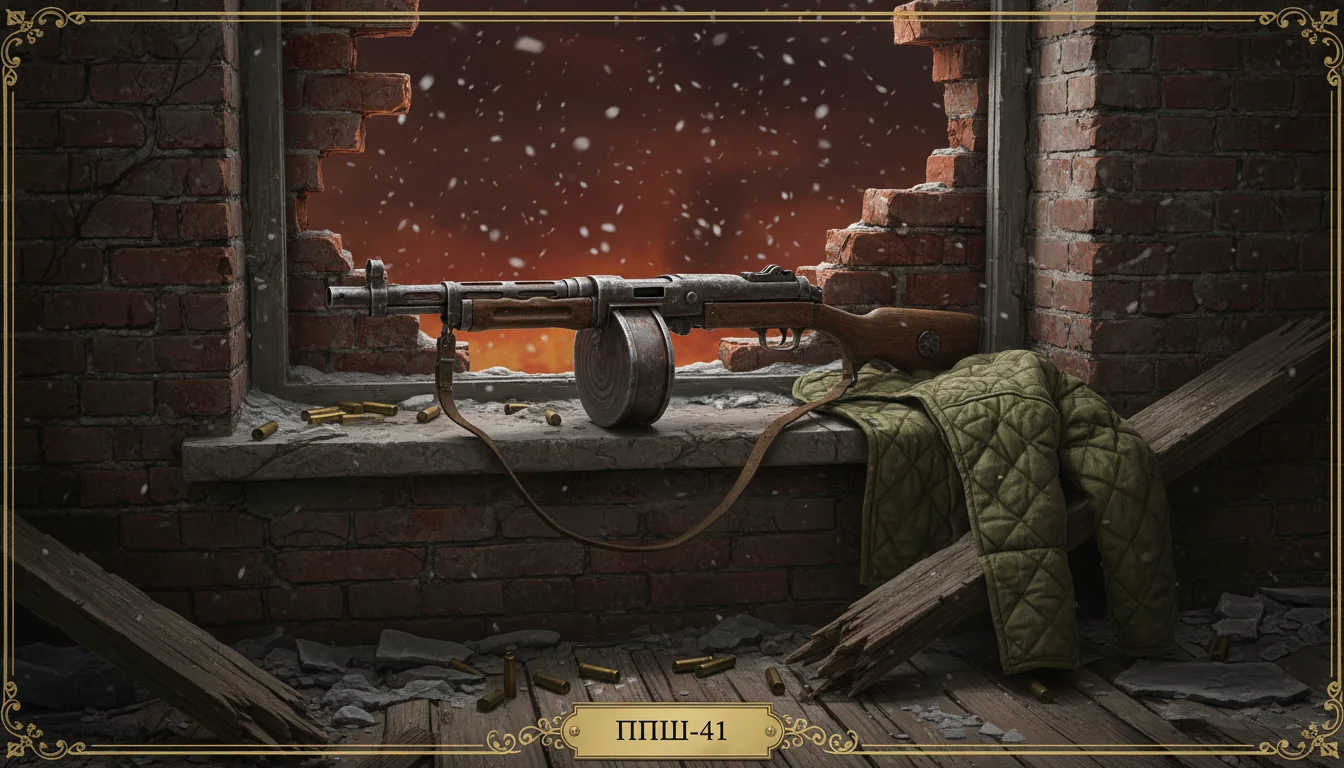
In the autumn of 1941, the Soviet Union was losing the war. German Army Group Centre had encircled entire Soviet armies, taken millions of prisoners, and was within striking distance of Moscow. Soviet industry, much of it located in the territories now occupied or threatened, was being physically dismantled and shipped east of the Urals on flatcars. The Red Army needed a weapon that a semi-skilled worker could build from sheet steel stamped by a factory press, that a soldier with minimal training could use effectively in the close-quarters fighting that urban and winter combat demanded, and that could fire fast enough to compensate for the quality gap between exhausted Soviet conscripts and the most professional military on earth.
Georgi Shpagin gave them that weapon.
The problem with what came before
The Red Army entered the war with the PPD-40, a submachine gun designed by Vasily Degtyarev that was broadly competent but ruinously expensive to manufacture. The PPD-40 required extensive machining of components from solid bar stock, a process that demanded skilled machinists, precision machine tools, and significant production time per unit. Soviet industry, reorganizing under emergency conditions, could not produce it in the numbers the war demanded.
Shpagin had been working on an alternative design since 1940. His solution was almost brutally simple: build most of the weapon from sheet-steel stampings instead of machined components. A stamped part is pressed from flat steel sheet using a die, requires far less machining, and can be produced by relatively unskilled workers on basic press equipment. The receiver - the main body of the weapon - was a stamped steel tube. The barrel was chrome-lined to resist corrosion and extend service life, but otherwise the weapon demanded little from Soviet industry that Soviet industry could not rapidly provide.
The PPSh-41, formally designated Pistolet-Pulemyot Shpagina, was adopted by the Red Army on December 21, 1941. Within months it was being manufactured in enormous quantities not just in dedicated arms factories but in converted workshops across the country.
The weapon in detail
The PPSh-41 fired the 7.62x25mm Tokarev cartridge, a bottlenecked pistol round that the Soviet Union had adopted for its standard pistols in the 1930s. The cartridge was faster and flatter-shooting than the 9mm Parabellum used by most German submachine guns. At the ranges relevant to close-quarters combat - inside buildings, in trenches, across the width of a street - this mattered less than the PPSh's other properties, but the round's characteristics gave it slightly better penetration through winter clothing and light cover.
The gun weighed around 3.6 kilograms unloaded, closer to 5.3 kilograms with a loaded 71-round drum. The cyclic rate was approximately 900 rounds per minute, faster than almost any weapon of its type. The drum magazine was based on a Finnish design, the Suomi KP/-31, which Soviet designers had captured during the Winter War of 1939 to 1940 and found highly effective. The 71-round drum was reliable and capacious but also slow to reload and prone to rattling during movement. Later in the war a 35-round box magazine was introduced that was lighter, quieter, and faster to change.
The weapon required minimal maintenance. The barrel could be removed and replaced in the field without tools. The chrome lining meant it could tolerate extended use in mud, snow, and rain without cleaning. Soviet soldiers called it the Papasha - daddy, or the old man - a term of gruff affection for a weapon that was ugly, heavy, and completely reliable.
Stalingrad and the Soviet way of war
The battle that defined the PPSh-41's reputation lasted from August 1942 to February 1943, in and around the city on the Volga that bore Stalin's name. Stalingrad was not primarily a tank battle or an artillery duel, though both occurred. It was a building-by-building, floor-by-floor, room-by-room contest of attrition in which the side that could bring the most firepower to bear at ranges of ten to thirty meters tended to survive.
In those conditions the PPSh-41 was exceptionally well suited. Soviet tactical doctrine at Stalingrad evolved toward what became known as "hugging" the Germans, keeping Soviet units so close to German lines that German artillery and air support could not be used without hitting their own men. In these conditions a soldier's primary tool was his submachine gun. Soviet assault groups, the "storm groups" that specialized in clearing buildings, were often armed almost entirely with PPSh-41s, supplemented by grenades and entrenching tools for final close-quarters work.
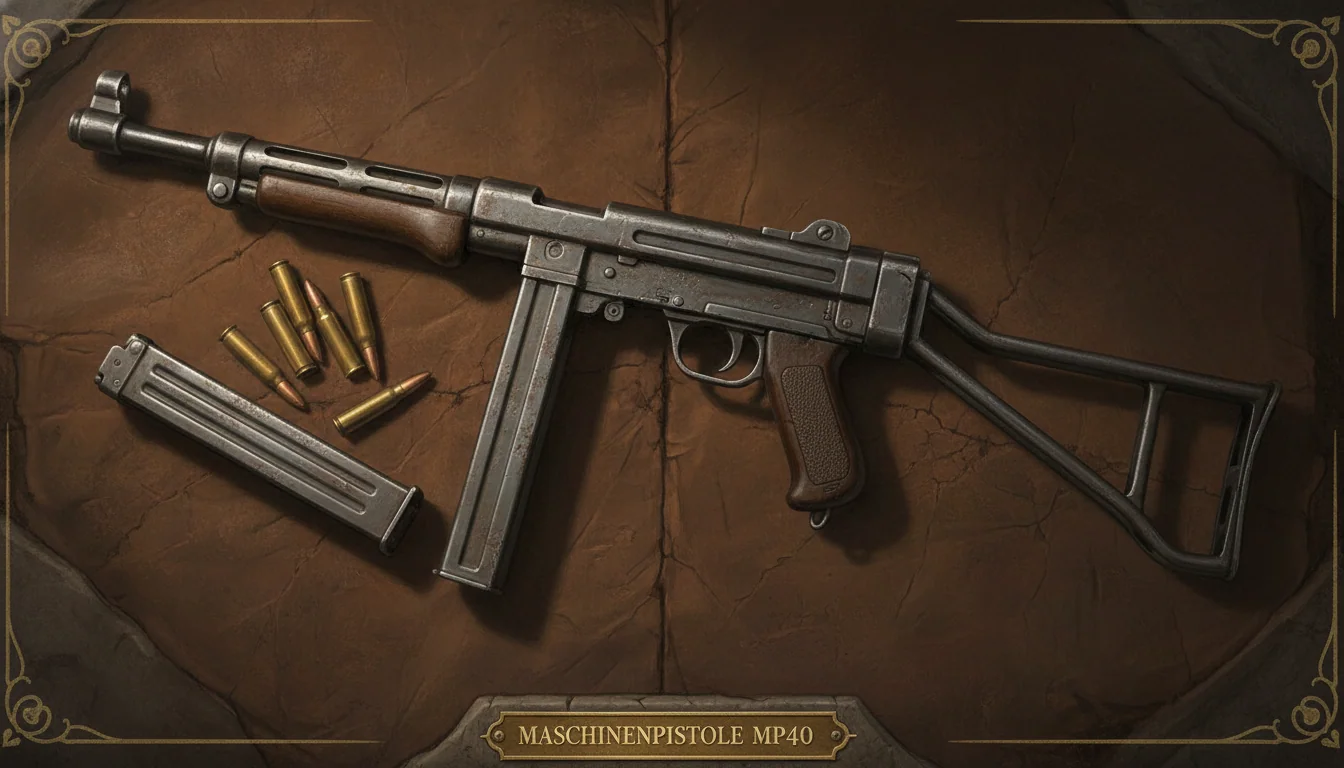
German infantry in the same environment were generally equipped with the Karabiner 98k bolt-action rifle, a superb long-range weapon almost useless at room-clearing distances. German submachine gun production, centered on the MP 40, could not match Soviet output. Soldiers who survived the house-fighting at Stalingrad consistently reported that Soviet firepower at close range was overwhelming, and the PPSh-41 was the main source of it.
By the battle's end, the encircled German Sixth Army surrendered in February 1943. Field Marshal Friedrich Paulus, who commanded the German forces at Stalingrad, was captured along with the remnants of his army. Soviet output of PPSh-41s during the Stalingrad campaign year exceeded two million units.
The German response and the captured weapon
German soldiers recognized the PPSh-41's quality immediately and took captured weapons with considerable enthusiasm. The Wehrmacht officially designated the captured gun the MP 717(r), and it appeared widely in German frontline use. German soldiers particularly valued it for the same reason Soviet soldiers did: its magazine capacity and rate of fire in close fighting far exceeded what German issue weapons provided.
The demand was high enough that German ordnance engineers developed a field conversion kit to re-chamber captured PPSh-41s from the Soviet 7.62x25mm Tokarev round to 9mm Parabellum, allowing them to use German MP 40 magazines. The conversion was widely applied throughout the Eastern Front, and factory-modified units were also produced. German soldiers nicknamed the gun the Burp gun, a reference to its distinctive high-speed stuttering sound at its near-900-round-per-minute cyclic rate, a sound that became closely associated with Soviet assault in German veterans' accounts.
The capture and enthusiastic reuse of enemy weapons is a reliable indicator of quality. German soldiers could and did refuse to use captured Soviet equipment they considered inferior, accepting resupply problems rather than rely on bad tools. That they sought out the PPSh-41 specifically, and that their own ordnance service devoted resources to making it compatible with German ammunition, indicates the weapon's genuine tactical value.
Scale and output
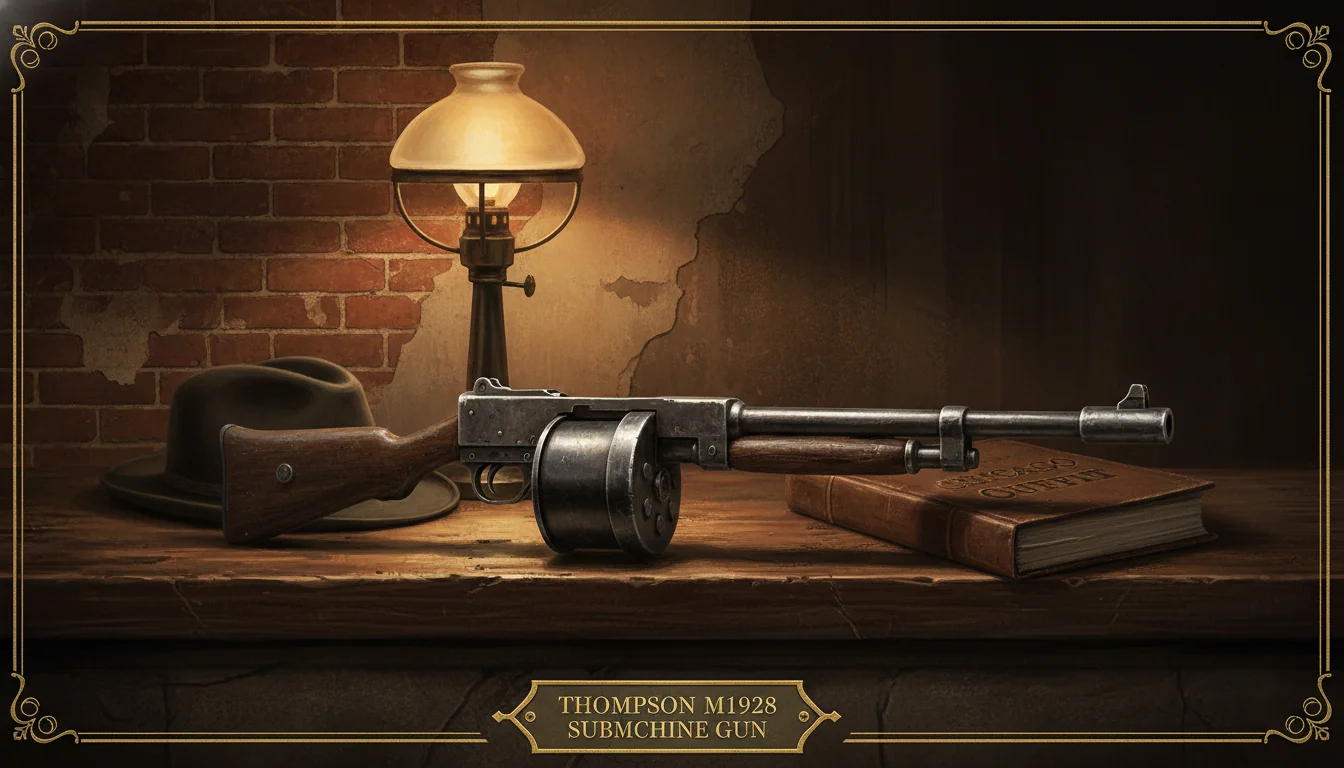
Total Soviet production of the PPSh-41 exceeded six million units by the end of the war. To put this in context, the United States produced about 1.5 million Thompson submachine guns during the same period, and Germany produced fewer than two million MP 40s. No other submachine gun in any army approached the PPSh-41's production volume.
The weapon was also distributed to partisan groups operating behind German lines throughout occupied Soviet territory, and supplied in quantity to other Allied nations. Chinese forces used PPSh-41s and its derivatives through the Korean War. North Korean and Chinese troops in Korea also carried the weapon. Soviet advisors distributed it to client states and revolutionary movements across Southeast Asia, Africa, and the Middle East during the 1950s and 1960s, long after it had been replaced in front-line Soviet service.
After the war
The PPSh-41's successor in Soviet service was the AK-47, adopted in the early 1950s. The AK-47 fired a proper intermediate rifle cartridge with far greater range and penetration than the Tokarev pistol round, and it made the submachine gun category largely obsolete for military purposes in Soviet doctrine. The PPSh-41 was withdrawn from front-line Red Army service during the 1950s, though it remained in reserve stocks and continued in use by Soviet-aligned states for decades.
The weapon's influence on Soviet small-arms doctrine was considerable. The emphasis on high volume of fire, ease of manufacture, and mechanical reliability that characterized Shpagin's design carried directly into the Kalashnikov era. The AK-47 was designed with similar manufacturing priorities, and its emphasis on function over finish, on keeping a soldier firing rather than keeping a weapon beautiful, drew from the same industrial and tactical philosophy that produced the Papasha.
In the Soviet military museum tradition, the PPSh-41 occupies something close to a sacred place. The image of a Red Army soldier in a padded telogreika jacket with a PPSh-41 slung across his chest is as distinctive an image of the Eastern Front as the Tiger tank or the Stuka dive-bomber. It is the weapon of the war's most brutal and decisive theater, and six million of them were made, used, and lost across four years of industrialized destruction that no other weapon captures quite so plainly.
For more on the iconic weapons of World War II, see our histories of the M1 Garand and the M16 rifle.
Quick Answers
Common questions about this topic
What does PPSh-41 stand for?
PPSh-41 is an abbreviation of Pistolet-Pulemyot Shpagina, model 1941, which translates roughly as Shpagin submachine gun, 1941. It was designed by Georgi Shpagin and officially adopted by the Red Army in December 1941, shortly after the German invasion and during the crisis phase of the war on the Eastern Front.
How fast did the PPSh-41 fire?
The PPSh-41 had a cyclic rate of fire of approximately 900 rounds per minute, among the highest of any WWII submachine gun. In practice, soldiers fired in short bursts. The 71-round drum magazine could be emptied in under five seconds on full automatic, which is one reason the Red Army eventually supplemented drums with 35-round box magazines that were harder to accidentally drain.
Why was the PPSh-41 so important to the Soviet war effort?
The PPSh-41 was critically important because it could be manufactured rapidly by factories with limited tooling. Most of its parts were stamped from sheet steel rather than machined from bar stock, which meant Soviet industry could produce the weapon using semi-skilled labor and damaged or repurposed metalworking equipment during a period when the German advance had overrun much of the country's industrial base.
Did German soldiers use captured PPSh-41s?
Yes. German soldiers valued captured PPSh-41s highly for close-quarters fighting and carried them in large numbers, giving them the designation MP 717(r). The Wehrmacht also developed field conversion kits to re-chamber some captured weapons from the Soviet 7.62x25mm Tokarev cartridge to 9mm Parabellum so they could use German ammunition. German soldiers nicknamed it the 'Burp gun' for its distinctive high-speed firing sound.

Talk to the People Who Wielded These Weapons
Chat with the soldiers, smiths, and commanders whose lives were shaped by the weapons of their age.
Create your free account →No card required. Some figures and features require a paid plan.
Join the HistorIQly Club
Get smarter about the past.
Weekly stories, deep dives, and exclusive content straight to your inbox.