The Spear of Longinus: The Roman Lance That Pierced Christ
The Spear of Longinus: from Golgotha to the Vienna Hofburg, the 2,000-year history of the most mythologized weapon in Western legend - and Hitler's obsession with it.
No weapon in Western history is more mythologized than the Spear of Longinus, which supposedly pierced the side of Jesus on Good Friday. For two thousand years it has been a relic, a coronation talisman, an imperial symbol, and finally an occult fetish. Kings and emperors built their legitimacy on it. Crusaders dug for it. Hitler is said to have stared at it for hours in the Vienna Hofburg before the Anschluss made it his.
What the actual weapon was, in the Roman cavalry of 33 AD, is a simple question with a technical answer. What it became in the Christian imagination is one of the most extraordinary afterlives any object has ever had.
The weapon at Golgotha
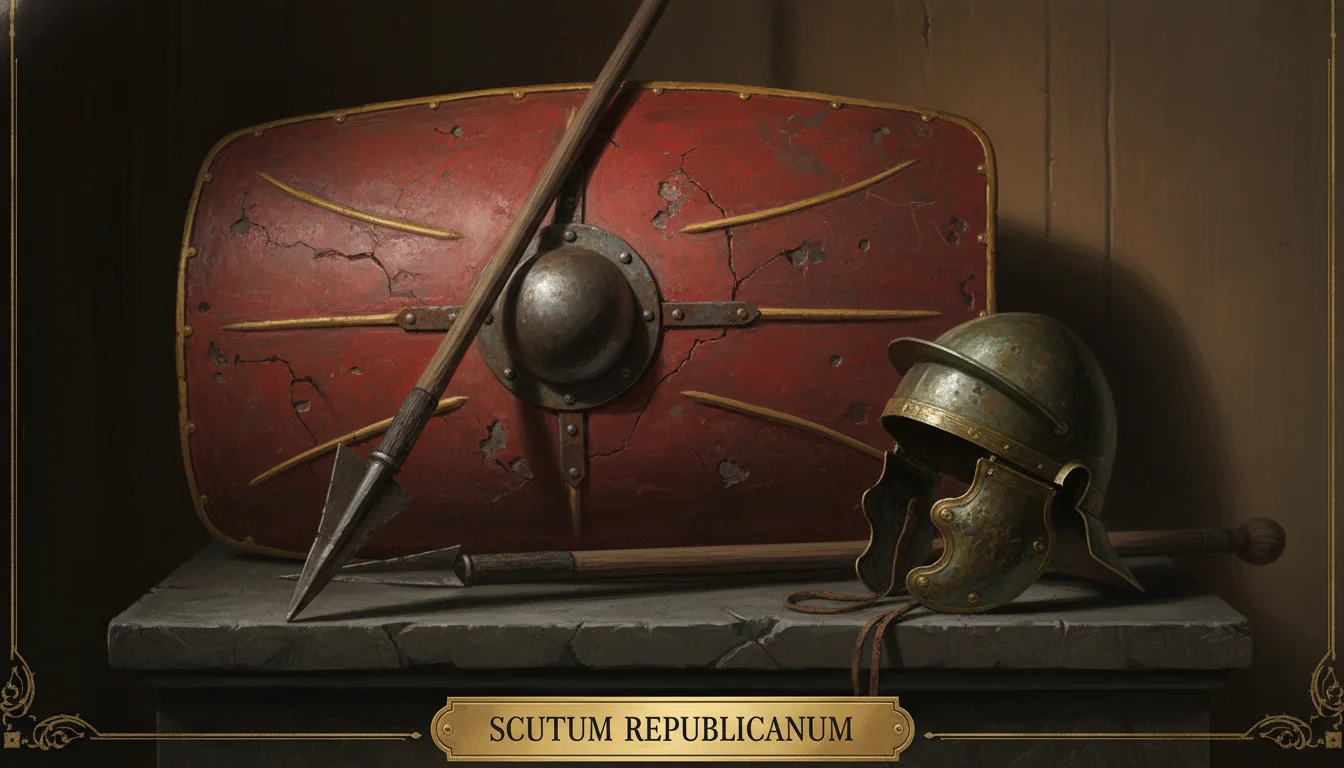
The Roman army of the early 1st century AD did not use a single kind of spear. The legionary infantryman carried the pilum, a short throwing javelin with a soft iron shank designed to bend on impact so that an enemy could not pull it out of his shield and throw it back. The auxiliary cavalryman carried the hasta, a longer thrusting lance with a steel head, used from horseback. The executioner's tool at a crucifixion would not have been a pilum, which was disposable, but a hasta or a similar polearm in routine service with the cohort on duty.
John 19:34 says only that "one of the soldiers with a spear pierced his side, and forthwith came there out blood and water." The Greek word is lonche, which can mean either a thrown javelin or a thrusting lance. Roman execution squads at Jerusalem in the 1st century would have been auxiliary troops, often Syrian or Samaritan, equipped with the long hasta. The blade itself would have been a steel leaf or diamond shape roughly 25 to 35 cm long, mounted on an ash or oak shaft of about 2 meters. There was nothing remarkable about it. Tens of thousands were in service across the Roman frontier in any given year.
Longinus and the legend
The canonical Gospels never name the soldier. The name Longinus appears for the first time in the apocryphal Gospel of Nicodemus, also called the Acts of Pilate, a text composed in Greek probably in the 4th century. The name is almost certainly a backformation from the Greek lonche, the spear itself. Once the name existed, the legend grew around it.
By the 6th century, Longinus had a full hagiography. He was said to have been blind or partially blind, and to have been healed when blood from the wound ran down the shaft of his spear and into his eyes. He converted on the spot, left the army, and became a missionary in Cappadocia, where he was eventually martyred. The Catholic and Eastern Orthodox churches both recognize him as a saint, with a feast day on October 16 in the West and October 16 or 22 in the East. His relics, such as they are, are kept in the basilica of Sant'Agostino in Rome.
The medieval relics
The number of relics claiming to be the lance multiplied through the early Middle Ages, in the same way fragments of the True Cross multiplied. By the 12th century at least four major candidates were being venerated.
The first was kept at Constantinople in the imperial chapel of the Pharos. After the city fell to the Fourth Crusade in 1204, it was taken to Paris by Louis IX and housed in the Sainte-Chapelle alongside the Crown of Thorns. It vanished during the French Revolution.
The second appeared at Antioch in 1098, dug up by a Crusader named Peter Bartholomew during the siege. The Antioch lance was discredited within months, when Peter Bartholomew, accused of fraud, walked through fire to prove his claim and died of his burns. The relic itself drifted through Crusader hands and was lost.
The third, in Etschmiadzin in Armenia, has been there continuously since at least the 13th century and is still venerated by the Armenian Apostolic Church. The fourth, the Vienna Hofburg lance, came through a different and more imperial route.
Charlemagne and the imperial talisman
The Vienna spear is the one that mattered most for European political history. By the 10th century it was already in the possession of the kings of the East Frankish realm, who would become the Holy Roman Emperors. Otto the Great carried it at the Battle of Lechfeld in 955, where he broke the Magyar invasion of central Europe. From that point on it was part of the Imperial Regalia, the coronation kit of the Holy Roman Empire.
The lore that grew around it was political theology in compressed form. Whoever held the lance, the saying went, would rule the world; whoever lost it would lose his kingdom. The phrase appears in various forms in medieval chronicles and was repeated, and probably invented, more than once. Charlemagne was said to have carried it on forty-seven campaigns. Frederick Barbarossa was said to have dropped it in a river crossing in Anatolia in 1190 and to have died within hours. None of these stories survives source criticism, but all of them attached themselves to the object.
The Vienna Hofburg spear
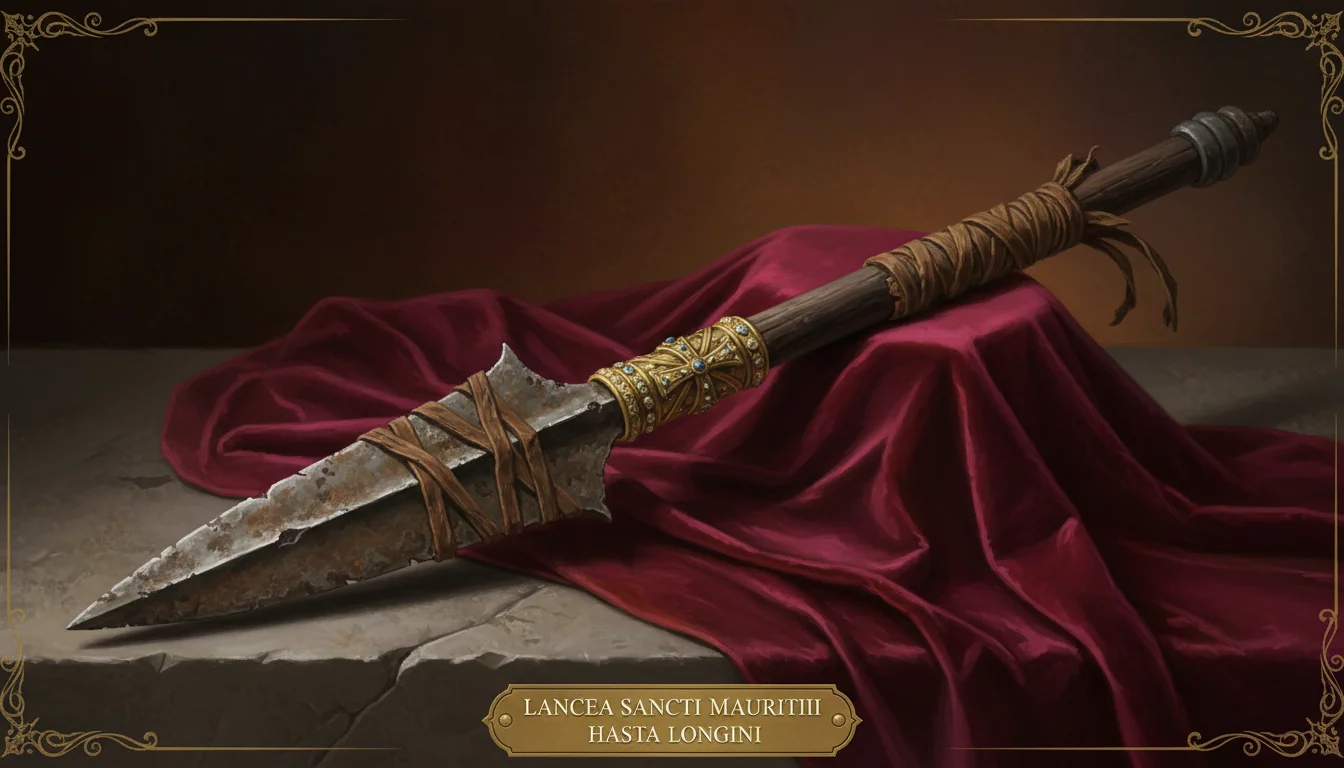
The lance now displayed in the Schatzkammer, the Imperial Treasury of the Vienna Hofburg, is a winged spearhead about 50 cm long, badly corroded, with a thin iron strip wrapped around its central socket and bound with silver and gold wire. Set into a slot in the blade is a small iron pin, identified in medieval inscriptions as a nail from the True Cross.
In 2003, the Hofburg curators commissioned a full metallurgical and X-ray study, conducted by Robert Feather in collaboration with Stuart Pyhrr of the Metropolitan Museum and Alan Williams of the Wallace Collection. The results were unambiguous. The iron core of the spearhead is consistent with 7th-century Frankish or early Carolingian forging. It is not Roman, not 1st-century, and not from Judea. The "nail of Christ" embedded in the blade is also iron of medieval composition, bound into the spearhead with copper wire that is younger still.
The Vienna spear is, in other words, a real medieval weapon, probably forged in the 7th or 8th century and venerated as the Holy Lance from at least the 9th. The relic-status was attached to the object retroactively. The object itself is genuinely old, but the story is older than the metal.
Want to ask Jesus what he remembers from his last moments on the cross? Chat with him on HistorIQly - the AI history platform with 144+ historical figures, from $9/month.
The Hitler obsession
The Vienna spear entered modern legend in March 1938, when Hitler annexed Austria and ordered the Imperial Regalia transferred to Nuremberg, the symbolic capital of the Reich. The lance, the Imperial Crown, the orb, and the sword went into a vault under St. Catherine's Church and stayed there through the war. In April 1945, soldiers of the U.S. Third Army under General George Patton recovered the regalia, identified them, and returned them to Vienna in 1946.
The story that Hitler had a personal mystical fixation on the lance, that he visited it as a young man in Vienna and felt its power, that he believed possession of it would make him master of the world, comes almost entirely from one book: 'The Spear of Destiny', published in 1973 by the British author Trevor Ravenscroft. Ravenscroft claimed to have received the story from the German esotericist Walter Stein. Almost every claim in the book has since been challenged. Stein's papers do not support Ravenscroft's account. There is no contemporary record of Hitler visiting the lance before 1938. The "death within hours of losing the lance" story, applied to Hitler dying on the day Patton's men recovered it, is chronologically wrong: Patton's troops took the regalia on April 30, 1945, but had located the vault days earlier, and Hitler had been planning his suicide for weeks.
What is true is that the lance was real, it was in Nuremberg, and it was recovered. What is invented is most of the supernatural framework that surrounds those facts.
The Spear today
The Vienna Hofburg spear is on permanent display in the Schatzkammer. The Etschmiadzin lance is in Armenia. The Vatican holds a fragment, possibly from the Constantinople relic, in a reliquary at St. Peter's. Krakow's Wawel Cathedral has a copy of the Vienna lance, given by Otto III to the Polish king Boleslaw I in the year 1000. None of them is Roman. All of them are venerated.
The persistence of the lore says more about Western political theology than about archaeology. The spear is the ultimate kingmaker's relic, the object that made you Caesar and Christian at once. That fusion, of imperial Rome and Christian sacrifice, is what every Holy Roman Emperor from Otto to Franz Joseph claimed to embody. The lance was the visible token of that claim.
The actual weapon at Golgotha, if it ever existed as a single identifiable object, was a working hasta from a routine cohort, indistinguishable from a thousand others. The relic the world ended up with is a 7th-century Frankish spear, beautifully wrapped, bound with a nail that someone insisted was from the True Cross. That object accumulated a thousand years of imperial mythology and another century of occult misinformation. It is, in its own strange way, exactly what a holy relic is supposed to be: not the original, but the believing.
For other weapons with outsized historical legacies, see the Roman Pilum, the infantry javelin that gave Rome's legions their tactical edge.
Quick Answers
Common questions about this topic
What is the Spear of Longinus?
The Spear of Longinus, also called the Holy Lance or the Spear of Destiny, is the weapon a Roman soldier used to pierce the side of Jesus during the crucifixion, according to John 19:34. The soldier's name, Longinus, comes from the apocryphal Gospel of Nicodemus rather than the canonical text. Several relics have claimed to be the original lance over the centuries.
Where is the real Spear of Destiny today?
There is no single authentic relic. The most famous candidate is the Holy Lance kept in the Imperial Treasury of the Vienna Hofburg, but rival relics exist in the Vatican, in Etschmiadzin in Armenia, and in Krakow. Metallurgical analysis of the Vienna spear in 2003 dated its iron core to the 7th century, more than six hundred years after the crucifixion.
Did Hitler really steal the Spear of Destiny?
Hitler did transfer the Vienna Hofburg lance to Nuremberg after the 1938 Anschluss, where it was held with the rest of the Imperial Regalia of the Holy Roman Empire. American forces under General Patton recovered it in April 1945 and returned it to Vienna. The story that Hitler personally believed it gave him supernatural power was largely invented or embellished by Trevor Ravenscroft in his 1973 book 'The Spear of Destiny'.
Is the Vienna Hofburg spear authentic?
No. The 2003 study by Robert Feather and the Hofburg curators Stuart Pyhrr and Alan Williams concluded that the iron of the spearhead matches 7th-century Frankish or Carolingian metallurgy, not Roman. The 'nail of Christ' bound into the blade with copper wire was added later, possibly during the Carolingian period, to consecrate an already venerated weapon.

Talk to the People Who Wielded These Weapons
Chat with the soldiers, smiths, and commanders whose lives were shaped by the weapons of their age.
Talk to a WarriorJoin the HistorIQly Club
Get smarter about the past.
Weekly stories, deep dives, and exclusive content straight to your inbox.