The Medieval Trebuchet: How Warwolf and Counterweight Engines Cracked Open Castles
Edward I's Warwolf was the largest trebuchet ever built. The full history of the counterweight siege engine that cracked open castles for two centuries.
For two centuries between roughly 1180 and 1380, no weapon in Europe was heavier, more expensive, or more decisive than the counterweight trebuchet. Castles that had withstood Roman and early medieval armies for generations could be reduced in weeks once a king arrived with his trebuchet train. The machine looked absurd, an enormous wooden seesaw with a sling on one end and a bathtub-sized box of stone on the other, but the physics it expressed turned medieval fortification on its head and set the stage for the gunpowder age that would eventually replace it.
Before the trebuchet
Siege artillery is older than the trebuchet by a thousand years. Roman armies used torsion machines, the ballista and the onager, that stored energy in twisted ropes of horsehair and sinew. These were fearsome and ancient by the early Middle Ages, but limited by the materials they relied on. Twisted ropes lost tension in damp weather, stretched after every shot, and required constant maintenance. They worked, but they were the limit of what classical engineering could deliver.
The earliest medieval engines used a different principle: a long lever arm, with a sling on one end, swung by a team of men hauling on ropes attached to the short end. This is the so-called traction trebuchet or perrière. It originated in China in the 4th century BC, spread west through the Islamic world, and was in regular European use by the 12th century. Traction machines were cheap and quick to build, but limited in size by the number of men who could pull on the ropes at once.
The counterweight revolution
Around 1180, in the late Crusader period, an unknown engineer replaced the team of pullers with a hinged box of stone or earth. The principle was the same: drop one end of the lever, whip the other end up. But a counterweight could be made arbitrarily heavy. Where the largest traction machines could throw a 30 kg stone perhaps 100 meters, a large counterweight machine could throw a 100 kg stone three times as far.
The new design appears in the chronicles within a few years. Saladin used counterweight engines at the siege of Acre in 1191. By the early 13th century, the great kings of Western Europe were investing heavily in their construction. Philip II of France, Frederick II of Sicily, and Edward I of England all maintained corps of master carpenters and engineers whose job was to design, build, and operate trebuchets.
How a trebuchet was made
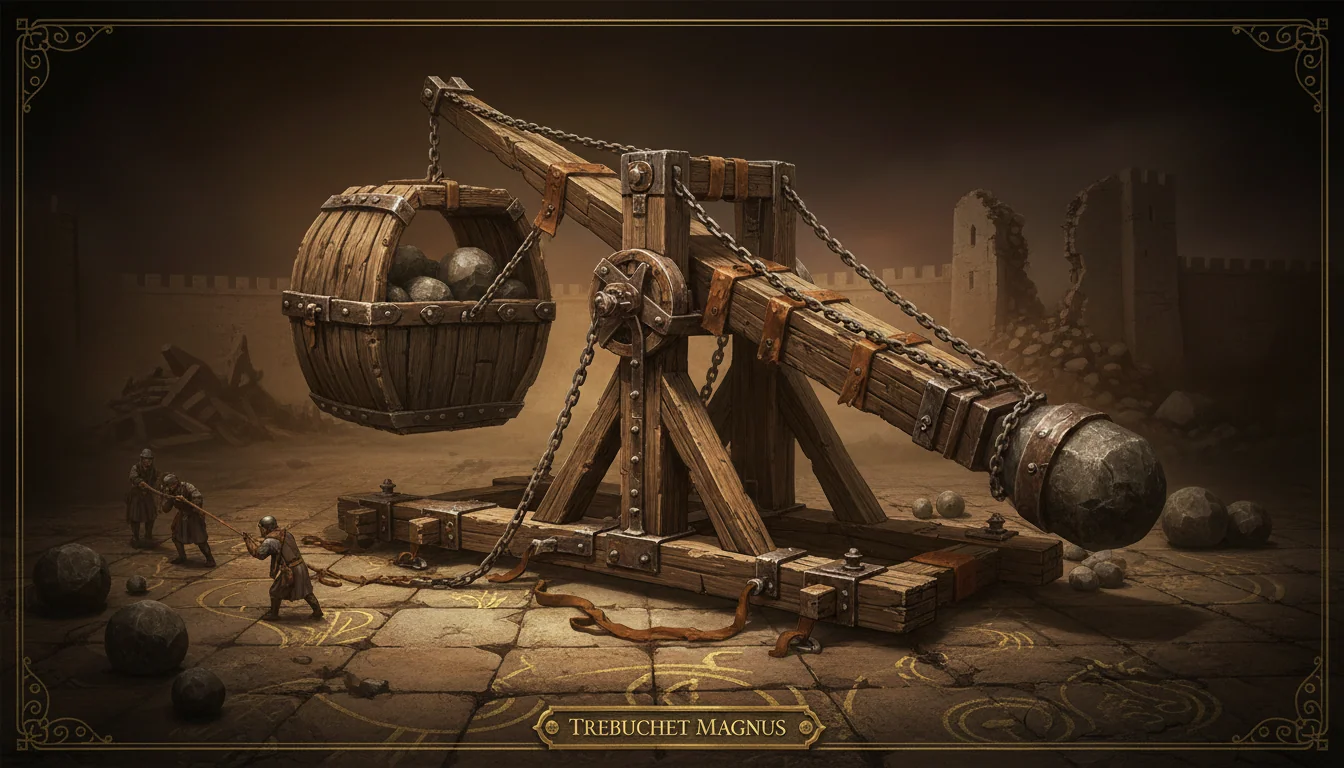
A counterweight trebuchet was an enormous timber sculpture. The main beam was a long oak or ash trunk, often 9 to 15 meters long, hollowed at one end to receive a sling and weighted at the other with a hinged box. The pivot was an oiled iron axle running through the beam at a calculated point about a third of the way from the heavy end. The whole thing rested on a frame of cross-braced posts up to 4 meters tall.
The counterweight itself was the heart of the machine. A fixed weight, rigidly bolted to the beam, transferred its energy somewhat inefficiently. A hinged box, swinging freely as it fell, kept the load directly below the pivot through the entire arc and dramatically increased the energy delivered to the sling. Master engineers tuned the hinge length, sling length, and weight to the projectile.
Each shot involved a team of perhaps 20 to 40 men. The counterweight was raised by a windlass and capstan, the sling was loaded, the trigger pin was pulled. The whole structure groaned, the counterweight fell, the long arm whipped up, and the sling released the stone with a snap heard for kilometers. A practiced crew could shoot every two to three minutes for hours.
Calibrating the shot
Trebuchet operation was a serious mathematical exercise, although the calculations were empirical rather than theoretical. The first few shots of a siege were spent calibrating: the engineer would test the throw with a stone of known weight and adjust the sling length, the counterweight, and the angle until the stones struck the chosen point on the wall.
Once the range was set, the trebuchet could fire stone after stone into the same patch of curtain wall for days. Repeated impacts at the same point cracked the masonry, eventually opening a breach. Round stones with carefully selected center-of-gravity behavior were preferred; cube-shaped stones tended to skip and lose energy on bounce. Many besieging armies brought stone-cutters along to shape ammunition on site from local quarries.
Warwolf and other monsters
In 1304, during his siege of Stirling Castle, Edward I of England commissioned the largest trebuchet in recorded history. Known as Warwolf, or Lupus Guerre, it took five master carpenters and fifty workmen three months to build. Modern reconstructions suggest a counterweight of 6 to 7 tons and a beam over 15 meters long. The Scottish defenders, who had been holding out for months, offered to surrender as soon as Edward unveiled the machine. Edward refused the surrender, fired Warwolf at the castle anyway just to see what it could do, and only accepted the garrison's submission afterwards.
Warwolf was extreme but not unique. Philip Augustus's Bad Neighbor at the siege of Acre, Frederick II's machines at Brescia, and the Mongol siege engines used at Hsiang-yang in the 1270s were all of comparable size. The Mongols, by the way, hired Persian and Iraqi engineers to bring counterweight trebuchets to China, where the technology was older but had not developed the counterweight refinement. Chinese sources describe the resulting machines as the largest weapons that had ever been deployed in East Asia.
The biological warfare incident
In 1346, a Mongol army besieging the Black Sea trading port of Caffa found itself dying of plague faster than the defenders. Gabriele de' Mussi, a contemporary chronicler, claimed that the Mongols loaded their plague dead into trebuchets and hurled the corpses over the walls. Genoese ships fleeing the city are widely thought to have carried the Black Death from Caffa to the Mediterranean.
How much of this is literal truth and how much is moralizing legend is debated. Trebuchet corpses are unlikely to have been the main vector for plague, which spread through fleas and rats already present in shipping. But Caffa is a striking example of how trebuchets were used psychologically as well as kinetically. A wall of dead bodies arriving over the parapet was a message about the besieger's reach.
The fall of the trebuchet
The trebuchet's eclipse came not from castles getting tougher but from artillery getting better. The first European cannon appear in the 1320s. They were crude, leaky, dangerous to crews, and not as reliable as a well-tuned trebuchet. But cannon improved. By 1380 they were a regular part of siege trains. By 1430 they were the primary breaching tool, and trebuchets had become the backup.
The decisive moment was the Ottoman siege of Constantinople in 1453, where Sultan Mehmed II's enormous bombards broke the millennium-old Theodosian walls in fifty-three days. Constantinople had repulsed traditional siege engines, including trebuchets, for centuries. Gunpowder ended that tradition.
Trebuchets did not vanish overnight. They appeared in inventories well into the 16th century. The Spanish brought one to Mexico in 1521 for the siege of Tenochtitlan, where it broke on its second shot and was abandoned. After that, the trebuchet was a museum piece.
What it left behind
Modern reconstructions have made the trebuchet a regular feature of medieval festivals, university physics courses, and television documentaries. The annual Punkin Chunkin contests in the United States included trebuchet divisions that routinely launched pumpkins more than 800 meters. These are toys compared to a Warwolf, but they confirm what medieval chroniclers wrote: the counterweight machine is one of the most efficient pre-industrial energy converters ever built.
In the broader history of weapons, the trebuchet is the precursor to the howitzer and the heavy mortar. It is the first European weapon to put serious effort into indirect, plunging fire against fortifications, and the first to make the mass-and-velocity calculation a routine part of military engineering. Without the trebuchet, the bombards of the early gunpowder age would have arrived in a world that did not know what to do with them. The trebuchet wrote the textbook the cannon eventually replaced.
For related siege-era weapons, the war chariot was the ancient world's other dominant shock weapon, eventually made obsolete by infantry tactics in the same way the trebuchet was displaced by artillery. The Roman pilum illustrates how engineers of an earlier era optimized projectile design with the same empirical precision.
Quick Answers
Common questions about this topic
How far could a trebuchet throw?
A large counterweight trebuchet could hurl a stone of 100-150 kg about 200-300 meters. Smaller machines threw lighter projectiles farther; larger ones, like Edward I's Warwolf, are believed to have thrown stones close to 200 kg. The flight was deliberately high and arcing so that stones came down nearly vertically onto a wall or roof, multiplying impact damage.
What is the difference between a trebuchet and a catapult?
A catapult, in the strict sense, uses tension or torsion (twisted ropes or springs) to launch a projectile. A trebuchet uses gravity, with a counterweight pulling the short arm of a lever down so that the long arm whips up and around. Trebuchets are mechanically simpler, more powerful at scale, and easier to build with medieval materials.
What did trebuchets actually throw?
Cut stone shaped like a bowling ball was the standard projectile, but historical sources record almost everything: dead horses, severed heads, plague-infected bodies, manure, fire pots, beehives, and even messages. The point was to terrorize the defenders as much as to break the walls. The most famous biological attack with a trebuchet, at Caffa in 1346, may have helped spread the Black Death.
When did trebuchets stop being used?
Trebuchets were dominant from roughly 1180 to 1380. As gunpowder bombards developed in the 14th century, the trebuchet was gradually replaced. By 1450, almost no major siege used trebuchets as the primary breaching tool. Their last documented use in a European battle was in 1521 at the Spanish siege of Tenochtitlan, and that one performed badly.

Talk to the People Who Wielded These Weapons
Chat with the soldiers, smiths, and commanders whose lives were shaped by the weapons of their age.
Talk to a WarriorJoin the HistorIQly Club
Get smarter about the past.
Weekly stories, deep dives, and exclusive content straight to your inbox.