Arsenal: The War Chariot
War chariot history: how the spoked-wheel platform dominated ancient battlefields for 1,500 years, from the Nile to the Yellow River, and why it was eventually replaced by cavalry.
Read Wikipedia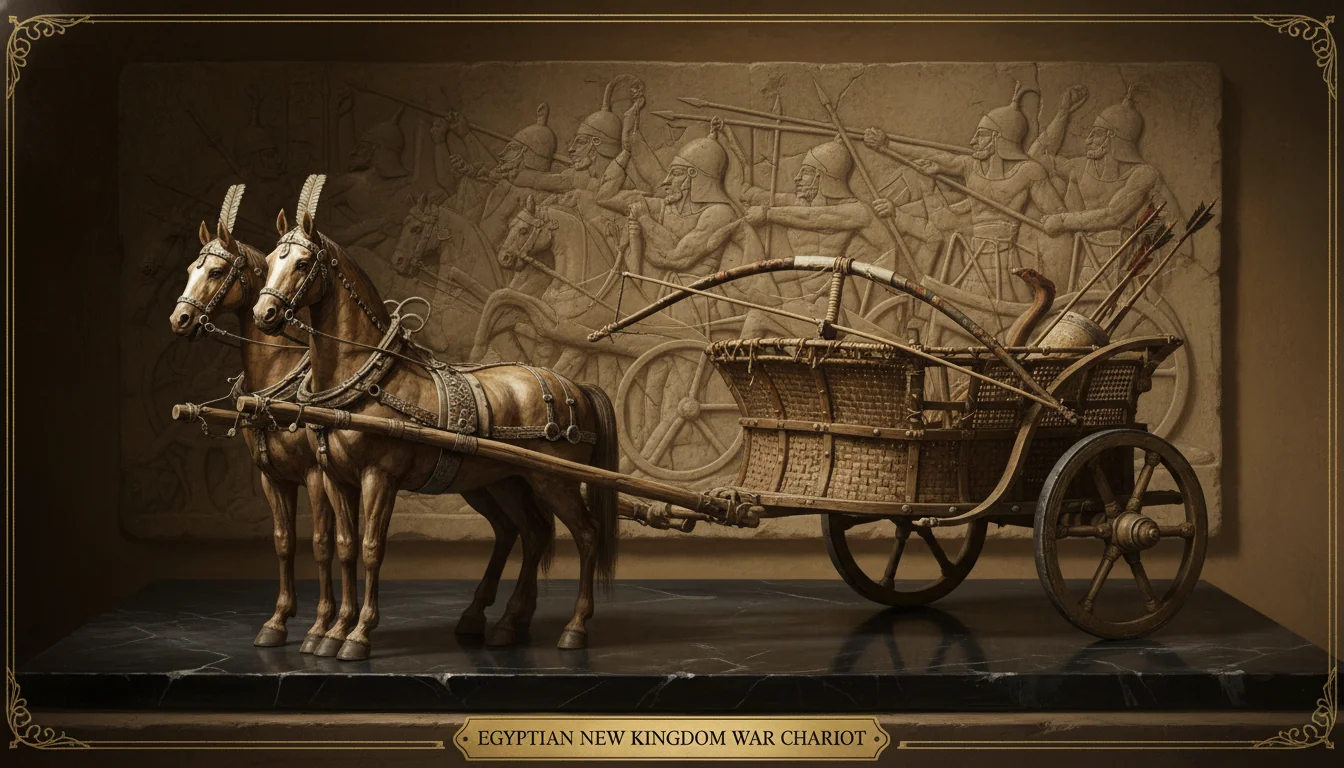
Before the tank, before the cavalry charge, before artillery organized on an industrial scale, there was the chariot. For roughly fifteen centuries, from around 2000 BC to around 500 BC, the spoked-wheel war chariot was the dominant weapons platform on battlefields from the Nile Delta to the Yellow River Valley. No single technological invention changed the nature of ancient warfare as fundamentally or as quickly. The chariot was not merely a transport vehicle. It was a platform, a psychological weapon, and an organizational system that reorganized entire armies around its requirements.
Understanding war chariot history means first understanding the problem it solved.
The problem on the ancient battlefield
Before the chariot arrived, ancient armies fought as infantry formations. Archers, spearmen, and slingers could deliver ranged fire and hold ground. What they could not do was deliver that firepower at speed and then withdraw before the enemy closed the distance. The horse had been known for thousands of years, but horses in the ancient world were smaller than modern warhorses, difficult to ride effectively without stirrups, and not yet bred to carry armored men in combat at scale.
The chariot solved this by separating the horse problem from the fighter problem. One man drove. Another fought. The platform absorbed the jarring of movement well enough that an archer could shoot with reasonable accuracy at speeds no foot soldier could match.
The critical technical innovation was the spoked wheel. The earliest wheels were solid wood disks - heavy, slow, and prone to shattering under battlefield stress. The spoked wheel, which appears to have been developed among the pastoral cultures of the Eurasian steppe around 2100 BC, achieved comparable structural integrity at a fraction of the weight. A chariot body of perhaps 25 to 35 kilograms could now move behind a pair of horses at genuine combat speed. Suddenly the archer on a moving platform became a practical weapon of war rather than an expensive experiment.
Origins on the steppe
The Sintashta culture, a Bronze Age pastoralist people living in the southern Ural region from roughly 2100 BC to 1800 BC, produced the earliest unambiguous examples of spoked-wheel vehicles associated with horse traction in a military context. Sintashta burial mounds in what is now the southern Ural region of Russia contain dismantled chariot components interred alongside horses, indicating that these vehicles were already associated with high-status martial identity.
From the steppe heartland, the technology spread in multiple directions within a few centuries. South into the Caucasus and the Near East. West toward Europe. East into Central Asia and eventually into China, where the Shang dynasty was using chariots by approximately 1200 BC. The Hyksos, a Near Eastern people who conquered Lower Egypt around 1650 BC, introduced the chariot to the Nile Valley, where the Egyptians initially had none. The Egyptians learned from their conquerors, expelled them over several generations, and then built one of the most sophisticated chariot armies in antiquity.
Egypt and the Hittites
Egyptian chariot warfare reached its peak during the New Kingdom period, from roughly 1550 to 1070 BC. The Egyptian design was light - perhaps 25 to 35 kilograms - built from bent wood, rawhide, and bronze fittings, with a crew of two: a driver and an archer carrying a composite bow. Speed and maneuverability were the design priorities. Egyptian crews worked in disciplined sweeps, releasing arrows at close range before withdrawing and repositioning for another pass.
The Hittites, the dominant power of Anatolia and the Near East through the same era, favored a heavier design. Hittite chariots typically carried three men: a driver, a fighter with a spear or sword, and a shield-bearer who protected them both. This gave the vehicle more direct combat power but reduced its speed and range. The two philosophies - Egyptian light archery platform versus Hittite heavy assault vehicle - met most dramatically at Kadesh.
The Battle of Kadesh, fought near the Orontes River in what is now Syria in 1274 BC, is the largest chariot engagement in recorded history and one of the most thoroughly documented battles of the ancient world. Ramesses II of Egypt and the Hittite king Muwatalli II committed forces whose exact numbers are disputed - ancient sources give large and probably exaggerated figures - but even conservative modern estimates suggest several thousand chariots were engaged on each side.
Ramesses nearly lost. His advance division was ambushed by Hittite chariots that had concealed themselves on the far side of Kadesh, and the Egyptian formation was badly disrupted before reinforcements arrived. Ramesses himself fought at the center of the chaos, a fact he ensured was commemorated in every major temple he subsequently built. He survived, rallied, and eventually fought the Hittites to a standstill. Neither side won decisively.
What followed was the earliest known international peace treaty - the Egyptian-Hittite agreement of 1259 BC, in which both powers acknowledged mutual exhaustion and established formal borders. The chariot, as a weapon of mass destruction, had produced its first arms race and its first arms control agreement.
Assyria and the heavy chariot
As the Iron Age progressed, chariot design in the Near East moved toward heavier, more thickly crewed vehicles. Assyrian reliefs from the 9th and 8th centuries BC show chariots with four-horse teams and crews of up to four men, operating alongside disciplined infantry, cavalry, and siege engineers in coordinated campaigns. The Assyrian military, one of the most systematically organized fighting forces of the ancient world, used chariots as part of a combined-arms system rather than as the decisive arm on its own.
This evolution reflected a genuine tactical shift. As infantry formations grew more disciplined and terrain became a larger strategic variable, the purely mobile archery platform became less decisive in isolation. The Assyrian chariot was simultaneously a shock weapon, a command platform for senior officers, and a psychological instrument - the presence of the king on his royal chariot in battle carried ritual weight alongside its military function.
The scythed chariot and its failure
The Persians and later commanders introduced a desperate modification: the scythed chariot, which mounted long rotating blades on the wheel axles to cut through enemy infantry formations. In theory, a disciplined charge of scythed chariots through enemy lines would shred formations and create the gap for a decisive assault.
In practice, it rarely worked. Darius III deployed scythed chariots at Gaugamela in 331 BC against Alexander the Great's Macedonian army. Alexander's men simply opened gaps in their own formation, let the chariots pass through harmlessly, and then killed the crews from behind. The scythed chariot required two conditions almost never present simultaneously on ancient battlefields: perfectly flat open ground and an opponent who would stand still. Any disciplined infantry that could open and close its formation destroyed the concept.
Britain and the Atlantic chariot
While the chariot had effectively disappeared from Middle Eastern warfare by the later Iron Age, the Celtic peoples of Western Europe retained it considerably longer. Julius Caesar described the British use of chariots in his account of his 55 and 54 BC expeditions to Britain, noting with evident professional respect their tactical sophistication: drivers who could maneuver at full speed on rough terrain while warriors balanced standing on the pole, fighters who dismounted to engage on foot and then reboarded to withdraw. This hybrid infantry-cavalry function was something Caesar's legions had not encountered in mainland Gaul.
The most famous British chariot commander is Boudicca, the queen of the Iceni tribe whose revolt against Roman occupation in 60 or 61 AD briefly threatened the Roman position in Britain. Roman accounts describe her massed chariot force as terrifying and psychologically effective - until it met a disciplined legionary formation in favorable terrain, at which point the chariots became a liability.
Technical evolution and the craft behind it
Building a war chariot was a specialist trade. The body required bentwood work of considerable skill - ash or elm steamed and bent to shape, held with rawhide that tightened as it dried. The wheels required seasoned wood for the hub, carefully measured spokes, and a rim that could flex over rough ground without shattering. The axle fitting had to allow rotation while bearing the weight of two or three men at speed. The harness for the horse team was a specialized discipline in itself; the collar design that would eventually allow horses to pull at full strength without choking themselves was still centuries away, which is one reason chariot horses were paired and drove with a yoke rather than individual collars.
A competent chariot required roughly the same investment as a modern military vehicle: it was expensive to build, required skilled maintenance, needed trained horses, trained crew, and trained support personnel, and had a significant logistical footprint. Bronze Age armies that deployed hundreds of chariots were making enormous institutional investments in a single weapons platform.
Why the chariot ended
The chariot's decline was not a sudden defeat but a gradual displacement. Improvements in saddle design and horse breeding eventually made mounted cavalry viable for the tasks the chariot had monopolized. A single rider is cheaper, faster over varied terrain, and far more logistically simple than a chariot with its two-horse team and requirement for flat ground. Infantry tactics evolved to exploit the chariot's specific vulnerabilities. Pike formations, ditch-and-stake defenses, and coordinated archer fire could disrupt charges that would have broken earlier armies.
By roughly 300 BC in the Mediterranean world and somewhat later in China, the chariot had been displaced from front-line combat. What remained were ceremonial functions - the Roman triumph, the Egyptian royal procession - and chariot racing, which persisted as spectacle entertainment for centuries after the weapon itself had become obsolete.
The Circus Maximus in Rome still held chariot races in the 5th century AD, more than a thousand years after the vehicle had ceased to be a serious weapon of war. Entertainment outlasted necessity, as it often does. But for fifteen centuries before that, the fastest moving object on any ancient battlefield had been pulled by horses and carried a man with a bow, and that combination had been enough to reshape civilization.
For more on ancient weapons and their tactical legacy, see our features on the Ulfberht sword and the sling.
Quick Answers
Common questions about this topic
Where was the war chariot invented?
The spoked-wheel chariot developed on the Eurasian steppe, most clearly among the Sintashta culture in the southern Ural region around 2100 BC to 1800 BC. The light spoked wheel, which made chariot warfare practical, was a steppe innovation that spread south into the Middle East and east into China within a few centuries of its development.
What made chariots effective in battle?
Chariots combined speed, shock, and platform stability in a way nothing else on the ancient battlefield could match. A pair of horses pulling a light two-wheeled platform could move much faster than infantry, deliver an archer at high speed across open ground, and withdraw before infantry could close with it. Against undisciplined troops, a chariot charge was psychologically overwhelming before the first arrow was loosed.
What happened at the Battle of Kadesh?
The Battle of Kadesh in 1274 BC, between Ramesses II of Egypt and the Hittite king Muwatalli II near the Orontes River, was the largest chariot battle in recorded history. Neither side won decisively. The Egyptians and Hittites fought to a standstill and eventually signed the earliest known international peace treaty. Both sides claimed victory in their respective propaganda.
Why did chariots disappear from warfare?
Chariots declined as cavalry improved. By the later Iron Age, better saddle technology and horse breeding made mounted cavalry faster, more maneuverable, and far cheaper than chariot crews. Chariots also required flat open terrain. As infantry tactics developed ways to disrupt chariot charges - rough ground, obstacles, tight formations with pikes - the chariot's advantages eroded. By roughly the 2nd century BC, most major powers had transitioned to cavalry and disciplined infantry.

Talk to the People Who Wielded These Weapons
Chat with the soldiers, smiths, and commanders whose lives were shaped by the weapons of their age.
Create your free account →No card required. Some figures and features require a paid plan.
Join the HistorIQly Club
Get smarter about the past.
Weekly stories, deep dives, and exclusive content straight to your inbox.