Arsenal: The War Elephant - Ancient World's Living Tank
War elephant history: from ancient India to Hannibal's Alpine crossing and Scipio's counter at Zama. How armies mastered the most terrifying weapon of the ancient world.
Read Wikipedia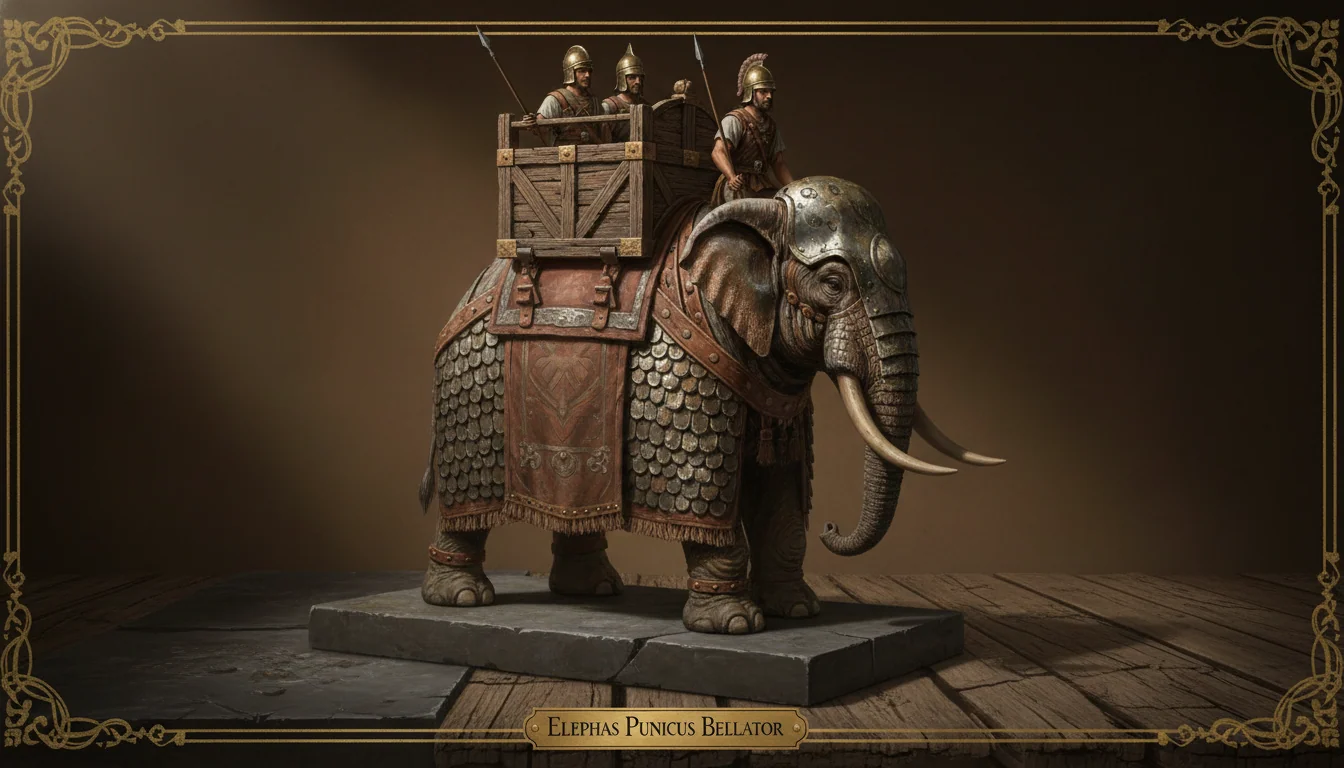
Every great weapon in military history has a moment when the side facing it for the first time experiences not just military surprise but something approaching primal terror. Legionaries who heard the rumble of Pyrrhus of Epirus's elephants advancing through the smoke at Heraclea in 280 BC called them "Lucanian cows" afterward - a bravado nickname that barely concealed what they had actually felt. The Macedonian cavalrymen who faced King Porus's elephant line at the Hydaspes had seen much of the known world, but they had never seen this.
For roughly 2,000 years, the war elephant was the heaviest shock weapon available to any army. It was not always decisive. It was often turned, panicked, and used against the side that deployed it. But the question of how to face war elephants and how to use them consumed military planners from the Punjab to Portugal, and the solutions they devised - fire, noise, open corridors, targeted mahout-killing - became a small literature of their own.
The Indian origin
The practice of training elephants for warfare originated in the Indian subcontinent, where Asian elephants had been domesticated for centuries before anyone thought to put a soldier on one. The Arthashastra, the political and military treatise attributed to the Mauryan minister Kautilya, describes the elephant corps as one of the four classical divisions of an Indian army - alongside infantry, cavalry, and chariots - and gives it the highest prestige ranking.
By the time Chandragupta Maurya founded the Maurya Empire around 321 BC, Indian armies had developed an entire infrastructure around the war elephant: specialist mahouts who trained with a specific animal for years, armored cloth or leather caparisons protecting the flanks, and in some traditions a wooden howdah (battle platform) on the back carrying archers or javelin-throwers. Chandragupta's army reportedly included thousands of elephants, though ancient figures for elephant corps should be treated with the same caution as all ancient army-size figures.
The practical logic was straightforward. An adult Asian bull elephant weighs up to five metric tons. In motion it can reach short-burst speeds of around 25 kilometers per hour. Against infantry armed with spears and short swords, an elephant at charge was a battering ram attached to a terrifying noise, an overwhelming smell, and a creature that could pick up and throw a man. Horses that had never encountered elephants would not advance toward them. Infantry formations that held their nerve under cavalry and archers sometimes broke at the sound of elephants before contact was even made.
West into Persia, then into the Hellenistic world
Persian armies acquired war elephants through contact with the Indian subcontinent, and both Darius III and Xerxes used elephant corps in their operations. Alexander the Great encountered war elephants at his invasion of northwestern India in 326 BC, when he faced the army of King Porus (known in Sanskrit records as Puru) at the Battle of the Hydaspes, on the banks of what is now the Jhelum River in Pakistan.
Porus fielded around 200 elephants, and they caused genuine problems for the Macedonian cavalry in the early stages of the engagement. Alexander's solution was tactical: he deployed his light javelin-armed infantry to target the mahouts and the elephants' feet, and used his cavalry's superior mobility to avoid frontal engagement with the elephant line and strike the flanks and rear. The battle was hard-fought and costly, but Alexander won. He was so impressed by Porus's performance that he confirmed him as a regional ruler and by some accounts presented him with additional territory.
After the Indian campaign, Alexander had war elephants of his own. His successors, the Diadochi who divided his empire after his death in 323 BC, all sought elephant corps as prestige weapons and practical deterrents.
The Seleucid dynasty, which controlled the eastern portion of Alexander's former empire, acquired one of the largest elephant forces in the Hellenistic world. Around 305 BC, Seleucus I signed a treaty with Chandragupta Maurya in which he ceded significant eastern territories in exchange for 500 Indian elephants. The transaction was considered worth it. At the Battle of Ipsus in 301 BC, Seleucus's 400 elephants were a decisive factor in defeating Antigonus Monophthalmus.
Pyrrhus and the Roman introduction
The Romans first encountered war elephants in 280 BC when Pyrrhus of Epirus brought a force of around 20 elephants to Italy in support of the Greek city of Tarentum against Roman expansion. At the Battle of Heraclea, the Roman cavalry's horses refused to approach the elephants, breaking the Roman line that had otherwise performed well. Pyrrhus won. The Romans regrouped.
At the Battle of Asculum the following year, Roman engineers had devised countermeasures: ox-drawn carts fitted with long poles carrying burning pitch and armed with anti-elephant weapons. The measures were partially successful. Pyrrhus won again, but with losses so heavy that the victory gained nothing - hence the phrase "Pyrrhic victory."
By the third engagement, at the Battle of Beneventum in 275 BC, Roman skirmishers targeting the animals with fire and concentrated missile fire turned Pyrrhus's elephants against his own troops. He retreated to Greece. The Romans had found the elephant's central vulnerability: an animal in panic is worse than no animal at all.
Carthage and the North African elephant
The war elephants of Carthage were not Asian elephants. They were almost certainly North African forest elephants (Loxodonta cyclotis), a subspecies significantly smaller than the Asian or African savanna elephant. Standing perhaps 2.5 meters at the shoulder, they were still larger than horses and psychologically intimidating, but they were not the five-ton machines of the Seleucid elephant corps.
Hamilcar Barca and his successor Hasdrubal used Carthaginian elephants in Spain and North Africa during the 220s BC. When Hannibal assembled his army in New Carthage (modern Cartagena) for the invasion of Italy in 218 BC, he had approximately 37 war elephants. The Alpine crossing consumed most of them. The passes were narrow, the cold was exceptional, and the animals had no physiological preparation for the altitude and the cold. By the spring of 217 BC, having descended into the Po Valley and won the Battle of Trebia the previous winter, Hannibal had one surviving elephant.
The single survivor is often called Surus - a name that suggests "Syrian" and hints at a possible Syrian forest elephant rather than a North African one. Ancient sources describe Hannibal using a large one-tusked elephant as his personal mount for at least part of the Italian campaign, riding it through swamps to keep above the flood water even when he lost an eye to infection. Whether Surus specifically was this animal is debated.
Zama: the elephant's worst day
When Hannibal was recalled to face Scipio Africanus in North Africa in 202 BC, he had rebuilt an elephant corps of roughly 80 animals - the largest Carthaginian force of elephants ever assembled. At the Battle of Zama, Scipio turned them to nothing.
The Roman commander had prepared his formation with unusual care. Instead of the standard checkerboard of maniples, Scipio aligned his cohorts in straight longitudinal files with clear lanes between them. When Hannibal's elephants charged the Roman front, the legionaries blew horns and trumpets from every direction simultaneously, panicking many of the animals before they reached the Roman line. Those that did charge found the lanes open - the infantry stepped aside, the elephants passed through into the open ground behind the formation, and Roman cavalry and light troops dealt with them there. The Carthaginian flanking cavalry, outmatched by Masinissa's Numidian horse, was scattered.
The main infantry engagement that followed was between relatively equal forces of veterans, and it came down to Scipio's maneuver. Hannibal was defeated for the first time in a major engagement. He later said Scipio was the greatest general he had ever faced.
The slow disqualification
War elephants continued in service in South and Southeast Asia for centuries after Zama, because the conditions that made them useful - psychological shock effect against infantry and cavalry unaccustomed to them - persisted where armies had not developed countermeasures.
In the Hellenistic Mediterranean, the combination of Roman tactical innovation and the simple fact that opposing armies now all had access to elephants meant the shock value eroded. At Raphia in 217 BC, Ptolemy IV's African forest elephants faced Antiochus III's larger Asian elephants; the smaller African animals reportedly refused the engagement. By the 1st century BC, elephants in the Mediterranean theater were primarily prestige weapons rather than reliable tactical instruments.
In South and Southeast Asia the story ran longer. Armored elephants with howdahs carrying archers remained part of Mughal and Southeast Asian armies through the 17th century. Tipu Sultan of Mysore deployed armored elephant corps against British forces in the 1780s and 1790s. Musket volleys, artillery, and targeted mahout-killing ended their effectiveness; Tipu's death at Seringapatam in 1799 marked the close of the last significant use of elephants in shock cavalry roles.
What the war elephant actually was
The consistent pattern across two millennia of war elephant history is this: against armies that had never faced elephants, the psychological effect was decisive. Against armies that had developed countermeasures - fire, noise, open corridors, targeted mahout-killing - the elephant became a liability. The animal in full panic was more dangerous to its own army than to the enemy.
The war elephant was not a tank. It was closer to a siege weapon that could move. Its power was shock, noise, and the refusal of horses to advance toward it. Its weakness was that it had a mind of its own, and a terrified four-ton animal moving at speed through friendly infantry is one of the worst things that can happen on a battlefield.
What it left behind is a strand of military history running from the Arthashastra to the officers of Mughal India and the generals of colonial Southeast Asia - every one of them trying to solve the same problem that Scipio solved at Zama, which is how to face the most terrifying thing on any ancient battlefield and turn it into a harmless inconvenience. War elephant history is ultimately the history of shock weapons: their brief dominance, then the inevitable countermeasure.
For related ancient weapons, the war chariot is the other great ancient shock weapon that followed the same arc from revolutionary to obsolete. The Macedonian sarissa and Roman tactics show how infantry adapted to neutralize both threats.
Quick Answers
Common questions about this topic
Where did war elephants originate?
War elephants originated in the Indian subcontinent, where Asian elephants were domesticated and trained for battle from at least the 4th century BC, and likely earlier. Indian military doctrine described in the Arthashastra organized armies into four branches - infantry, cavalry, chariots, and elephants - and the elephant corps was the prestige arm. From India, the practice spread west through Persian contact and then into the Hellenistic world.
Did Hannibal's elephants actually cross the Alps?
Yes. Hannibal crossed the Alps in 218 BC with approximately 37 war elephants. Most died during or shortly after the crossing from cold, disease, and starvation. By the spring of 217 BC, only one elephant was still alive. The famous Surus, believed to be a one-tusked elephant and possibly Hannibal's personal mount, may have been the last survivor, though ancient sources differ.
Why did war elephants fail at the Battle of Zama?
At Zama in 202 BC, Scipio Africanus ordered his infantry to open corridors when the elephants charged, letting them pass through the Roman lines harmlessly. Roman trumpets also panicked many of Hannibal's elephants, causing some to turn back on Carthaginian troops. The result was a tactical nullification of the elephant corps before the main infantry engagement began.
When were war elephants last used in battle?
War elephants were used in South and Southeast Asian warfare well into the early modern period. Tipu Sultan of Mysore used armored elephants against the British in the late 18th century. Elephant corps remained part of various South Asian armies into the 19th century, though primarily in ceremonial or logistical roles. Their effective battlefield use in shock tactics ended long before that, as firearms made them too vulnerable.

Talk to the People Who Wielded These Weapons
Chat with the soldiers, smiths, and commanders whose lives were shaped by the weapons of their age.
Create your free account →No card required. Some figures and features require a paid plan.
Join the HistorIQly Club
Get smarter about the past.
Weekly stories, deep dives, and exclusive content straight to your inbox.