Ben-Hur vs. History: How Accurate Is the Legendary Chariot Race Epic?
Ben Hur 1959 historical accuracy check: Roman warfare and crucifixion practices are solid, but the chariot race and miraculous healing are pure Hollywood invention.
Read Wikipedia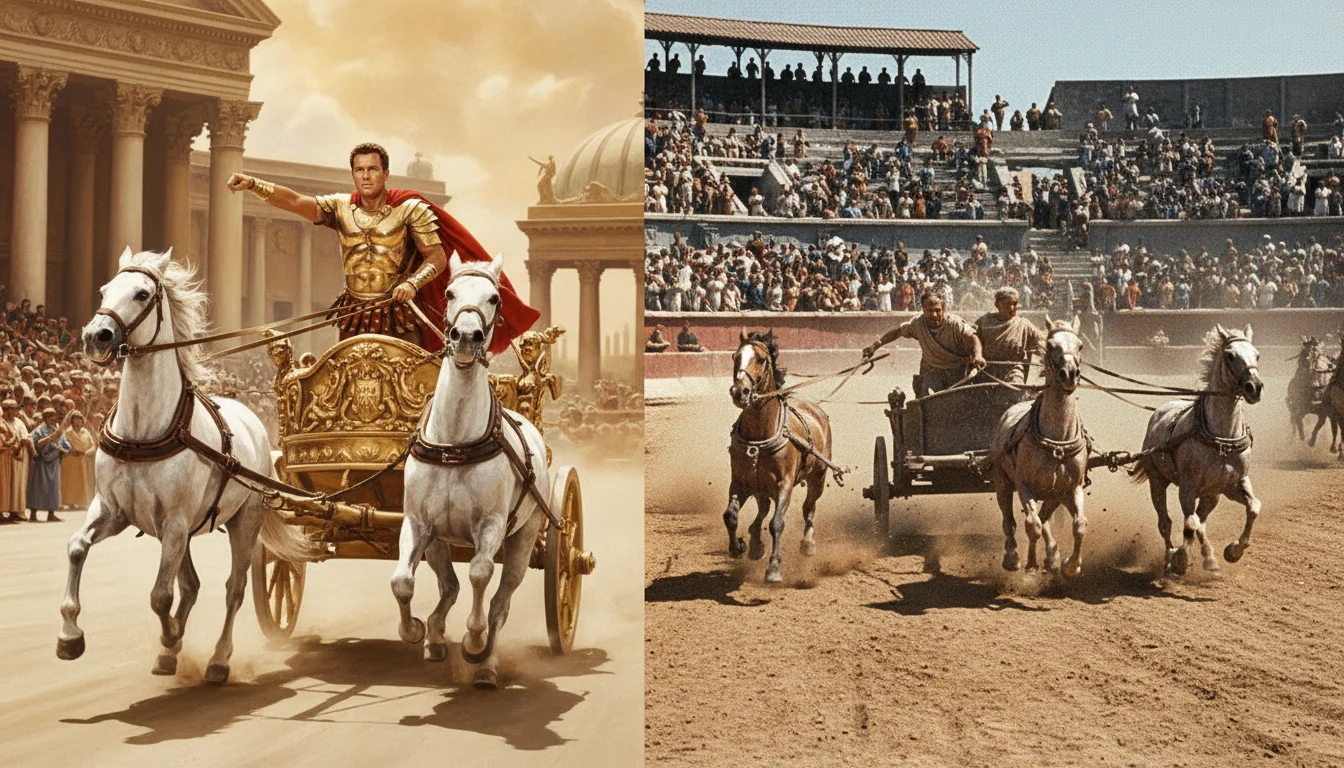
Ben-Hur (1959) remains one of Hollywood's most ambitious epics - 11 Academy Awards, a runtime of over three hours, and a chariot race that still leaves audiences breathless. Charlton Heston's portrayal of Judah Ben-Hur, a Jewish prince betrayed into slavery who seeks revenge against his Roman friend Messala, became an instant cultural icon.
But beneath the sweeping cinematography and Miklós Rózsa's thunderous score lies a story mixing biblical drama with historical fiction. How much of first-century Judea and Rome did William Wyler get right?
Let's separate the wheat from the chaff.
What Hollywood Got RIGHT
1. Roman Naval Warfare Was Brutal
The galley battle scene where Ben-Hur earns his freedom is one of the film's most harrowing sequences. Roman quinqueremes (five-banked warships) did employ enslaved rowers chained to their benches, and naval combat in the first century AD was as vicious as depicted.
Historical Accuracy: Ramming tactics, the use of corvus boarding bridges, and the sheer chaos of ancient naval warfare are all credibly portrayed. Romans did employ slaves and prisoners of war as galley rowers, though free men also served.
Score: 8/10
2. Crucifixion Was Common Roman Punishment
The depiction of crucifixion - though tastefully restrained - reflects the historical reality. Rome used crucifixion extensively as both punishment and deterrent, particularly in rebellious provinces like Judea. The Romans crucified thousands after the Jewish-Roman wars.
Historical Accuracy: The film shows crucifixion as public, humiliating, and agonizingly slow. The victims carried the crossbeam (patibulum), not the entire cross. The posture, the nails through wrists (not palms), and the presence of Roman guards are all correct.
Score: 9/10
3. Leprosy Was a Death Sentence
Ben-Hur's mother and sister contract leprosy in the film and are forced into isolation. In first-century Judea, leprosy (likely Hansen's disease) was feared, stigmatized, and seen as ritually unclean. Lepers were indeed segregated in leper colonies outside city walls.
Historical Accuracy: The social ostracism, the Valle of the Lepers setting, and the hopelessness of diagnosis are all grounded in reality. Roman and Jewish society both treated leprosy as incurable and contagious.
Score: 8/10
4. Roman Occupation of Judea Was Tense
The film captures the uneasy relationship between Rome and the Jewish population. Pontius Pilate's administration (26-36 AD) was marked by tension, periodic uprisings, and brutal crackdowns. The presence of Roman soldiers, the collaboration of Jewish elites, and resentment among the populace are all accurate.
Historical Accuracy: The political powder keg is real. Rome ruled Judea through a combination of military force and collaboration with local aristocrats. Resentment simmered constantly.
Score: 7/10
What Hollywood Got WRONG
1. The Chariot Race Is Pure Fantasy
Let's address the elephant - or rather, the four-horse chariot - in the room. The nine-minute chariot race in the Circus of Antioch is cinema's most famous sporting event. It's also wildly, gloriously inaccurate.
The Problems:
- No spikes on chariot wheels: Romans never used bladed wheels in chariot racing. It would have been illegal and defeated the purpose of sport - entertainment, not death.
- Race violence: While accidents happened, deliberate ramming and sabotage would have resulted in immediate disqualification and punishment.
- Winner's purse: The prize money shown would have been enormous by Roman standards. Charioteers could get rich, but not overnight.
Historical Reality: Real Roman chariot racing (at the Circus Maximus or similar venues) involved four teams (Red, White, Blue, Green), intense fandom, gambling, and yes, crashes. But it was regulated sport, not demolition derby.
Score: 2/10 (Spectacular cinema, terrible history)
2. Jesus Christ's Role Is Ahistorical
Jesus appears multiple times in the film as a mystical, almost magical figure - giving water to Ben-Hur on the road to slavery, healing his mother and sister of leprosy at the crucifixion, and serving as moral anchor.
The Problems:
- No historical evidence: There's no contemporary record of Jesus performing public miracles witnessed by Roman soldiers or non-Christian sources.
- The water scene: Roman guards would never have allowed a condemned galley slave to receive aid from a bystander.
- Instant healing: The film shows Ben-Hur's family instantly cured of leprosy during a thunderstorm at the crucifixion - pure biblical drama, not historical event.
Historical Reality: Jesus of Nazareth likely existed as a Jewish preacher executed by Rome around 30-33 AD. But the miraculous healing, the divine interventions, and the cosmic significance are matters of faith, not history.
Score: 1/10 (Religious narrative, not historical documentation)
3. Ben-Hur's Character Is Fictional
Judah Ben-Hur is not a historical figure. The character was invented by Lew Wallace for his 1880 novel Ben-Hur: A Tale of the Christ. While Wallace drew on knowledge of Roman-Jewish relations, Ben-Hur himself never existed.
Historical Accuracy: There's no record of a wealthy Jewish prince named Judah who became a galley slave, won his freedom, and sought vengeance in a chariot race. It's a compelling narrative, but entirely fictional.
Score: 0/10
4. Messala's Betrayal Timeline Is Compressed
The film shows Messala and Ben-Hur's friendship shattering overnight when Messala demands collaboration. In reality, the kind of social maneuvering, betrayal, and revenge depicted would have taken years, not weeks.
The Problem: Roman administrative careers didn't move that fast. Messala's rise to power, Ben-Hur's fall, his enslavement, escape, return, and revenge - all crammed into a few years - stretches credibility.
Historical Reality: Political intrigue, legal battles, and social mobility in Rome were glacially slow processes involving patronage, family connections, and decades of service.
Score: 3/10
5. The Roman Triumph Scene Is Over-the-Top
When Ben-Hur is celebrated after saving the consul Quintus Arrius, he's treated like a conquering hero with a quasi-triumphal procession. In reality, triumphs were reserved for Roman generals after major military victories - not for former slaves who happened to save an admiral.
Historical Accuracy: Rome had strict rules for triumphs. You had to be a magistrate with imperium, command an army, kill at least 5,000 enemies, and expand Roman territory. Ben-Hur qualifies for none of these.
Score: 2/10
The Verdict
Ben-Hur (1959) is a masterpiece of cinema - a sweeping, emotional, technically groundbreaking epic. But as history? It's a biblical costume drama wrapped in selective Roman details.
William Wyler nailed the feel of ancient Rome - the architecture, the costumes, the sense of imperial power. But the story itself is pure fiction, and many of the most iconic scenes (chariot race, miraculous healing) range from exaggerated to impossible.
Historical Accuracy Score: 4/10
What It Gets Right:
✅ Roman naval warfare
✅ Crucifixion practices
✅ Leprosy stigma
✅ Roman-Jewish tensions
What It Gets Wrong:
❌ The chariot race (completely fantastical)
❌ Jesus' role (religious faith, not history)
❌ Ben-Hur himself (fictional character)
❌ Compressed timeline
❌ Triumph ceremony
For other ancient world epics graded for accuracy, compare our Gladiator accuracy review and Cleopatra (1963) vs. history.
Should You Still Watch It?
Absolutely. Ben-Hur is a landmark of American cinema - 11 Oscars, breathtaking cinematography, and a chariot race that remains one of film's greatest action sequences. Just remember: it's inspired by history, not a documentary.
Think of it as historical fiction meets biblical epic. Enjoy the spectacle, appreciate the craftsmanship, and don't fact-check the chariot wheels.
Because when Charlton Heston screams "You have eyes to see, but you cannot see!" while dodging a four-horse crash at 40 mph, who cares if it's accurate?
It's cinema.

Debate the Accuracy with the Real Figures
Ask the real people what Hollywood got wrong about their lives.
Create your free account →No card required. Some figures and features require a paid plan.
Join the HistorIQly Club
Get smarter about the past.
Weekly stories, deep dives, and exclusive content straight to your inbox.