Casino vs. History: How Accurate Is Scorsese's Las Vegas Epic?
Casino movie accuracy is surprisingly high: Scorsese's 1995 epic gets the mob skim, Spilotro's reign of terror, and the Indiana cornfield murders strikingly right.
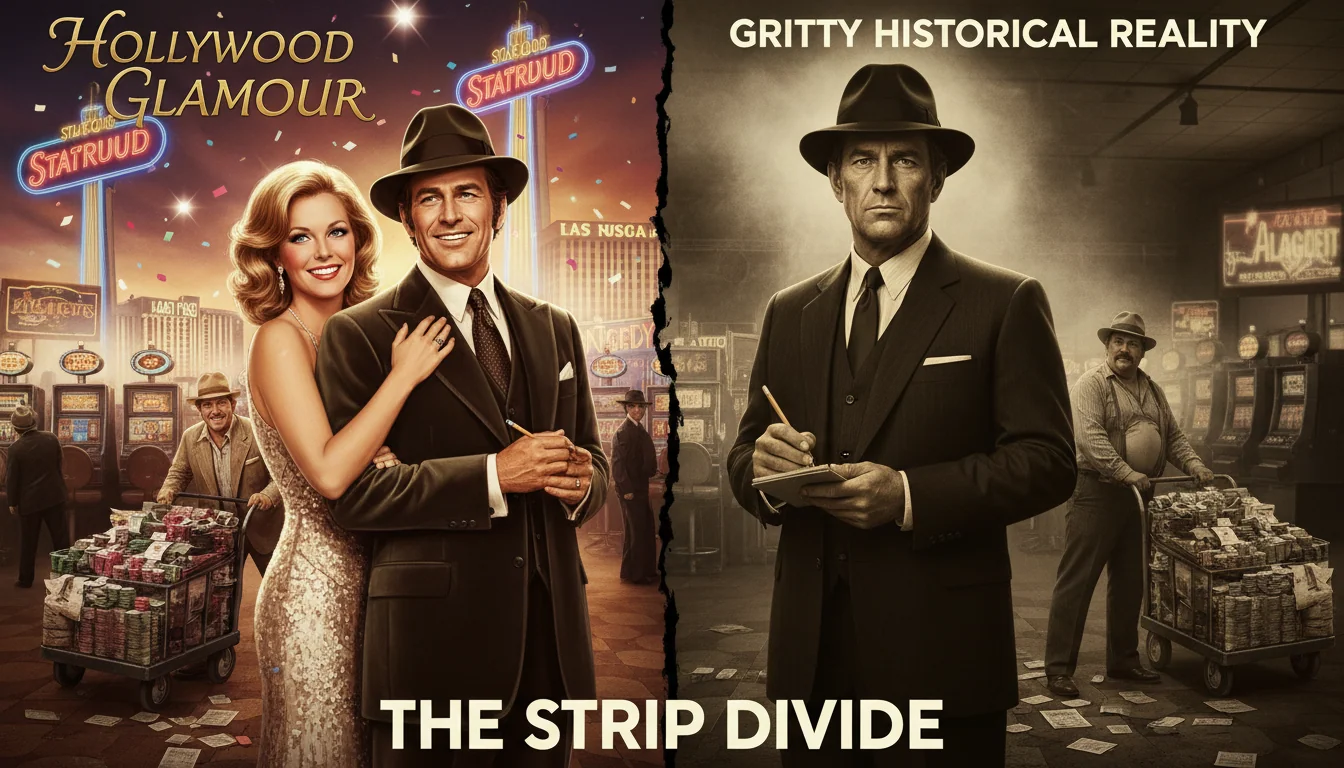
Casino movie accuracy is one of Hollywood's most impressive records for a crime epic. When Casino opened in November 1995, five years after Goodfellas, Martin Scorsese was again working with screenwriter Nicholas Pileggi, again telling a true mafia story, and again drawing from extensive nonfiction interviews. The result was a three-hour epic about how the Chicago Outfit ran Las Vegas through the 1970s, what they took out of it, and how the entire arrangement collapsed in the early 1980s. It was longer, colder, and more clinical than Goodfellas. It was also, in its specifics, almost terrifyingly accurate.
So how close to the real story is Casino? Closer than most viewers realize. The film is fiction in name only. The names of the central figures were changed because some of them were still alive, and a few details were compressed for narrative clarity. But the bones, the personalities, and the body count are real.
What Hollywood Got RIGHT
Sam Rothstein is Frank "Lefty" Rosenthal
Robert De Niro's Sam "Ace" Rothstein is a thinly veiled portrait of Frank "Lefty" Rosenthal, a Chicago-born sports handicapper who ran four Las Vegas casinos for the Outfit during the 1970s. The film's depiction of his obsessive attention to operational detail, his refusal to allow his name on the gaming license, his ill-fated television talk show, and his enormous wardrobe of color-coordinated suits are all real. So is his decade-long battle with the Nevada Gaming Control Board, which culminated in his being placed in the state's Black Book in 1988.
Rosenthal really did refuse to back down from his fight to keep working in casino management, and his stubbornness genuinely accelerated the federal scrutiny that brought down the entire arrangement. The De Niro performance, with its frosty composure and clipped speech, captures something true about Rosenthal that even his FBI handlers commented on: he was a man who did not raise his voice when other people would have screamed.
Nicky Santoro is Tony Spilotro, and the violence is real
Joe Pesci's Nicky Santoro is Anthony "Tony the Ant" Spilotro, a Chicago Outfit enforcer sent to Las Vegas in the early 1970s to protect the family's interests. The film's portrayal of Spilotro's burglary crew, the so-called Hole in the Wall Gang, his ownership of the Gold Rush Limited jewelry store as a base of operations, his murderous personal style, and his eventual placement in the Nevada Black Book are accurate.
The famous head-in-a-vise scene, in which Santoro tortures a debtor for information, is based on the real 1962 killing of Outfit associate William "Action" Jackson, who was tortured in similar fashion by Spilotro and others. Spilotro's casual willingness to kill, and his violation of Outfit protocol by drawing constant attention to himself, are both well documented.
The skim from the Stardust, Fremont, Marina, and Hacienda
The film's central economic engine, the systematic theft of cash from the casino count rooms before it could be reported to the IRS, is one of the most accurately depicted financial crimes in American cinema. Through the 1970s, the Chicago Outfit, the Kansas City crew under Nick Civella, and the Milwaukee family under Frank Balistrieri skimmed an estimated $7 to $15 million from the Stardust, Fremont, Marina, and Hacienda casinos. The mechanics shown in the film, the pre-count room, the suitcases, the couriers ferrying cash to the Midwest, and the eventual division among the families, are all drawn from FBI surveillance and testimony from the 1983 Strawman trials in Kansas City.
The Strawman case, which prosecuted the bosses of three crime families and led to multiple convictions, is the real-life conclusion the film does not name but tracks closely.
The car bomb
Sam Rothstein's car bomb in the film is a near-shot-for-shot dramatization of the October 4, 1982 bombing of Frank Rosenthal's Cadillac in the parking lot of Tony Roma's restaurant in Las Vegas. Rosenthal really did walk back to his car after dinner, really did turn the ignition, and really did survive only because the steel plate that General Motors had installed under the driver's seat as part of the Cadillac Eldorado's frame deflected the blast upward. The bomb was a directional charge of plastic explosive triggered by an ignition switch.
Rosenthal escaped with burns and minor injuries. The case was never solved, though most investigators have always assumed Spilotro's crew was responsible.
The cornfield ending, almost
The film's ending, in which Nicky and his brother are beaten to death and buried in an Indiana cornfield, is rooted in the real June 1986 murders of Anthony and Michael Spilotro. The brothers really did disappear after being summoned to a meeting in Bensenville, Illinois, and their bodies really were unearthed in a cornfield in Newton County, Indiana, on June 23, 1986. The brutal beating shown on screen is consistent with the autopsy findings.
What the film gets slightly wrong is the location of the killing itself. For two decades it was widely believed that the Spilotros had been beaten to death in the cornfield where they were buried. In 2007, during the Family Secrets trial in Chicago, Outfit member Nick Calabrese testified that the brothers had been killed in a basement in Bensenville and only transported to the cornfield afterward. The film's location is the popular legend; the actual location came out twelve years after the movie was released.
Geri and Ginger
Sharon Stone's Ginger McKenna is loosely based on Geri McGee, Frank Rosenthal's wife and a former Las Vegas cocktail hostess. The film's portrayal of their volatile marriage, her drug and alcohol problems, the abduction of their daughter, the safety deposit box raid, and the eventual collapse into addiction is rooted in Pileggi's reporting and FBI files.
Geri McGee died of a drug overdose in November 1982 at a motel in Los Angeles, just weeks after Rosenthal's car bombing. She was 46. The film telescopes the timeline somewhat but captures the substance of her tragedy.
What Hollywood Got WRONG
The nicknames and Frank Rosenthal's real personality
Real-world Lefty Rosenthal was reportedly less icy than De Niro plays him. Associates described him as warm in private and protective of his employees, particularly the women who worked the floors at the Stardust. The film's relentlessly composed Rothstein loses some of that warmth.
Rosenthal also did not have a magenta-and-gold wardrobe nearly as flamboyant as De Niro's. The film's costume designer Rita Ryack consciously exaggerated the suits as a visual code for Rothstein's compulsive control. The real Rosenthal was loud, but not that loud.
Ginger versus Geri
The film fictionalizes parts of Ginger's story for cinematic purposes. The character's relationship with Lester Diamond, played by James Woods, draws on Geri's real-life on-and-off attachment to a small-time hustler named Lenny Marmor, but several specific scenes, including the one where Ginger threatens her own daughter, are dramatized. The general arc, addiction, infidelity, custody chaos, and an early death, is true. The specifics in some scenes are not.
The Outfit's response to Spilotro
The film implies that Spilotro's Las Vegas operation collapsed primarily because of his affair with Ginger and his disrespect for Sam. In real life, the Outfit's tolerance of Anthony Spilotro had been wearing thin for years. By 1986 he had been indicted multiple times, had escaped conviction in two major cases, and was bringing federal heat on the entire Chicago organization. His personal feuds with Rosenthal were a contributing factor; they were not the central reason he was killed.
Compressed timeline
The film telescopes events from 1968 to 1988 into roughly a decade of perceived narrative time. Rosenthal's various managerial roles at different casinos, in real life staggered across years and shaped by a complex set of license disputes, are simplified into a single arc at one main casino called the Tangiers. The real chronology was messier, with Rosenthal moving between the Stardust, Fremont, Marina, and Hacienda as his licenses were challenged.
The aerial shot of Las Vegas
The opening scene of Casino, in which Sam Rothstein's car explodes and he is hurled into the sky over Las Vegas, is purely a Scorsese flourish. The real bombing was a parking-lot detonation. Rosenthal was not lifted into the air. The film's opening is a metaphor for the destruction of the entire arrangement, not a literal record.
Historical Accuracy Score: 9/10
Casino is one of the most accurate organized-crime films ever made, perhaps even more rigorous than Goodfellas in its handling of financial mechanics. The skim is real. The personalities are real. The murders are real. The ending is real, though we now know the precise geography of the final killing was slightly different. Pileggi's source material is well-documented and the film hews to it closely.
What the film gets most right: the operational details of the casino skim, Tony Spilotro's reign of terror, the destruction of Rosenthal's Las Vegas career, and the brutal end of the Spilotro brothers.
What it gets most wrong: the personalities are sharpened for cinema, the timeline is compressed, and the location of the Spilotro killing was off by about twenty miles.
The bottom line is that Casino dramatizes a true story whose ugliness needed almost no exaggeration. The mob really did run Las Vegas. They really did steal from the count rooms in suitcases. They really did kill anyone who threatened the arrangement. And in the end, federal indictments, infighting, and the corporatization of the Strip together did what no rival family ever managed: they pushed the Outfit out of Nevada for good.
If Goodfellas was Scorsese's portrait of the mob in the streets, Casino is his portrait of the mob in the boardroom. It is colder, longer, and harder to love. It is also closer to the documentary record than almost any other gangster film of its era.
For more Scorsese crime fact-checks, see The Departed vs. History on the FBI's protection of Whitey Bulger, and Gangs of New York vs. History for how Scorsese handled 19th-century Manhattan's underworld.
Quick Answers
Common questions about this topic
Is Casino based on a true story?
Yes. Casino is based on Nicholas Pileggi's 1995 nonfiction book of the same name, drawn from interviews with Frank Rosenthal, Geri McGee's family, FBI agents, and other Las Vegas insiders. Sam Rothstein is Frank Lefty Rosenthal, Nicky Santoro is Anthony Tony the Ant Spilotro, and Ginger McKenna is loosely based on Geri McGee.
How accurate is Casino?
It is one of the most factually grounded mafia films ever made. The skim of the Stardust, Fremont, Marina, and Hacienda casinos by the Chicago Outfit and the Kansas City and Milwaukee crews is real. The Hole in the Wall Gang and Anthony Spilotro's reign of terror in Las Vegas are real. The cornfield burial that ends the film actually happened. The names were changed because Rosenthal and others were still alive.
Was Sam Rothstein a real person?
Sam Rothstein is closely based on Frank Lefty Rosenthal, a Chicago-born sports handicapper who ran the Stardust, Fremont, Marina, and Hacienda casinos for the Outfit through the 1970s. He survived a real car bombing in 1982, was barred from Nevada gaming, and lived the rest of his life in Florida and California. He died in 2008.
Did Tony Spilotro really die the way the movie shows?
Anthony Spilotro and his brother Michael were beaten to death in June 1986. For decades the assumption was that they were killed in an Indiana cornfield, as depicted in the film. In 2007, Outfit member Nick Calabrese testified that the brothers were actually killed in a basement in Bensenville, Illinois, and only buried in the cornfield. The film's version is the popular legend, the cornfield is real, the brutality is accurate, but the location of the killing itself is now known to be wrong.

Debate the Accuracy with the Real Figures
Ask the real people what Hollywood got wrong about their lives.
Chat with HistoryJoin the HistorIQly Club
Get smarter about the past.
Weekly stories, deep dives, and exclusive content straight to your inbox.