The Great Escape vs. History: How Accurate Is the Legendary POW Classic?
Analyzing the historical accuracy of the 1963 film 'The Great Escape' and its depiction of the real-life breakout from Stalag Luft III.
Released in 1963, The Great Escape is one of the most beloved war films ever made. With Steve McQueen’s cool charisma, Elmer Bernstein’s unforgettable score, and a cast full of Allied heroes outwitting their captors, it helped cement a particular image of World War II in popular culture. The film dramatizes a mass prison break from a German POW camp and turns it into a suspenseful, almost mythic adventure. But how close is it to the real event?
The answer is interesting because The Great Escape gets a surprising amount right. It was based on Paul Brickhill’s 1950 book, and Brickhill had actually been a prisoner at Stalag Luft III, the camp where the real escape took place. Many of the details about tunnel construction, forgery work, and camp organization are rooted in reality. At the same time, the movie makes several major changes, especially when it comes to the nationality of the escapees and the action-heavy set pieces that turned a grim historical event into a crowd-pleasing blockbuster.
The Real Story Behind the Film
The true escape happened at Stalag Luft III, a German prisoner-of-war camp near Sagan in Lower Silesia, now Żagań in Poland. The camp held mostly Allied airmen and was specifically designed to prevent tunneling. Barracks were elevated off the ground so guards could notice disturbed soil. The surrounding earth was a light yellow sand that would stand out if scattered on the surface. German authorities also used microphones and other detection methods to make digging even harder.
Despite that, the prisoners created one of the boldest escape plans of the war. Led by Squadron Leader Roger Bushell, known as "Big X," they intended not just a handful of men to escape, but 200. To maximize their odds, they began work on three separate tunnels, codenamed Tom, Dick, and Harry. If one was discovered, another might still survive.
That basic framework is absolutely true, and it is one of the reasons the movie still feels grounded even when it drifts into fiction.
What Hollywood Got Right
The film deserves real credit for capturing the ingenuity of the prisoners.
The tunnels were real
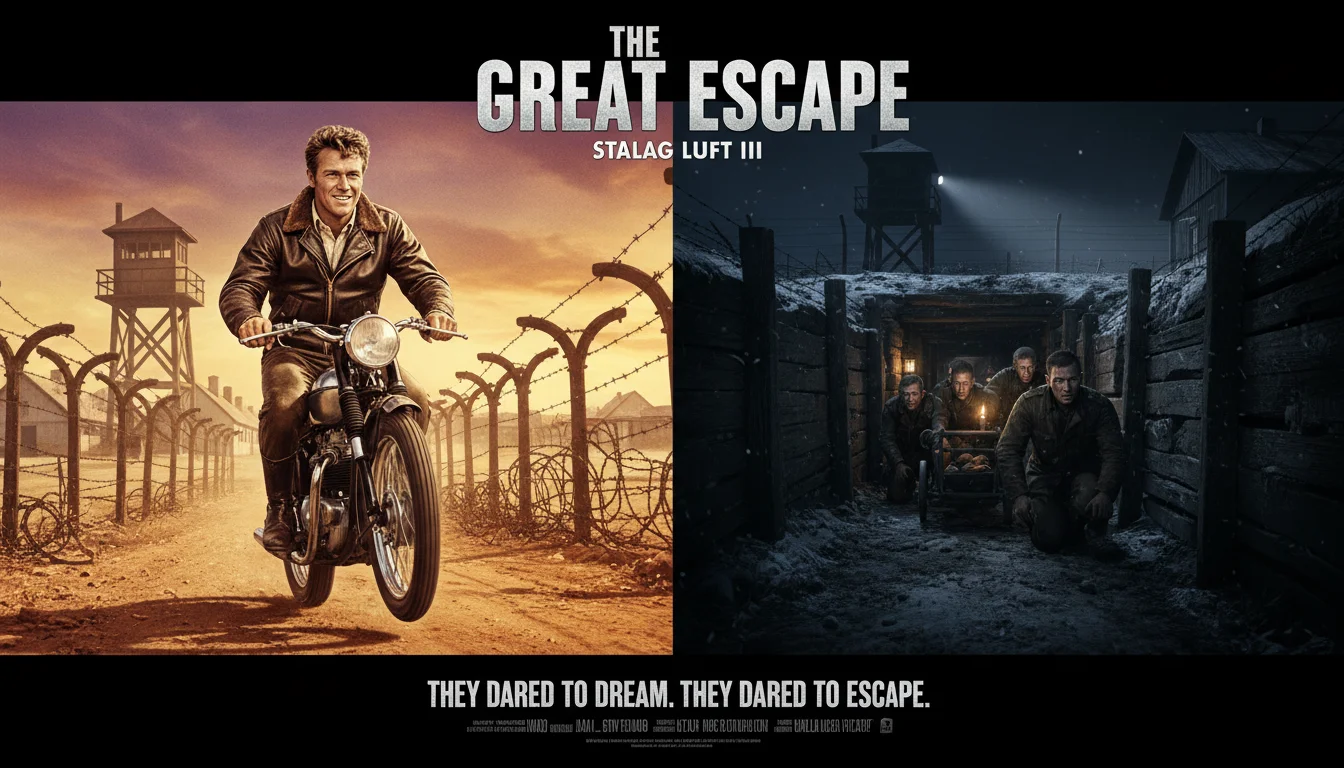
The three-tunnel system of Tom, Dick, and Harry was not invented for the screen. It came directly from the historical escape plan. The tunnels were narrow, reinforced with scavenged wooden bed slats, and fitted with improvised ventilation. Prisoners made lamps, air pumps, and even a small rail trolley system to move sand and supplies. Those details sound like screenwriter embellishments, but they were very real.
The dirt-disposal trick was real too
One of the cleverest elements in the movie is the way prisoners get rid of excavated soil. In reality, they really did build hidden bags inside their trousers, nicknamed "penguins," so they could release sand gradually while walking around the camp. It was awkward, risky, and brilliantly inventive. That kind of detail gives the movie much of its authenticity.
Forgery and tailoring were major parts of the operation
The movie also gets the scale of the supporting work right. This was not just about digging. Prisoners forged travel papers, created civilian clothes, altered uniforms, and prepared maps and compasses. The escape operation was basically an underground factory run by POWs. On that front, the movie captures the extraordinary organization and discipline of the real men involved.
The tunnel coming up short is based on fact
In the film, the escape tunnel ends short of the nearby trees, forcing men to crawl out one by one under guard lights. That happened in real life, though the exact distance was somewhat different. The historical tunnel did emerge short of the intended cover, creating a dangerous bottleneck and slowing the escape.
What Hollywood Got Wrong
This is where the movie shifts from faithful recreation to mythmaking.
The Americans were given center stage
The single biggest distortion is the role of American prisoners. In the film, American characters, especially Steve McQueen’s Virgil Hilts and James Garner’s Hendley, are central to the story. Historically, that is misleading. American prisoners had helped with earlier escape work, but most had been transferred out of the compound months before the actual breakout. The real Great Escape was carried out overwhelmingly by British, Commonwealth, and other Allied personnel, not Americans.
This was a classic Hollywood move. A war story aimed at a global audience, and especially an American one, was refocused around American stars.
The motorcycle chase never happened
The most iconic scene in the film, Steve McQueen racing a motorcycle and leaping over barbed wire, is pure fiction. No such escape attempt occurred. It is thrilling cinema, but it has almost nothing to do with the real breakout from Stalag Luft III. Most escapees were recaptured while traveling by train, on foot, or while trying to blend into civilian movement across occupied Europe.
Hilts is a fictional composite
McQueen’s "Cooler King" is not a real historical figure. He is a composite character built to give the film an individualist rebel hero. Real prisoners certainly had strong personalities, but the repeated solitary confinement and swaggering defiance shown in the movie would have made sustained escape work difficult. The actual operation depended more on teamwork, discipline, and secrecy than on lone-wolf bravado.
The deaths of the recaptured escapees were sanitized
The movie does show the horrifying aftermath: 50 recaptured prisoners were executed on Hitler’s orders. That part is true and historically significant. But the film presents some of these killings in a more simplified, cinematic way. In reality, the murders were carried out in small groups by the Gestapo at different locations. It was colder, more bureaucratic, and arguably even more disturbing than the version on screen.
The Grim Historical Aftermath
On the night of March 24 to 25, 1944, 76 prisoners made it out through Harry before the escape had to stop. Only three eventually reached safety: two Norwegians, Per Bergsland and Jens Müller, and one Dutchman, Bram van der Stok. The rest were recaptured.
Hitler, furious at the embarrassment, ordered severe reprisals. After some internal debate within the Nazi leadership, 50 of the recaptured officers were murdered by the Gestapo. The executions were a war crime and later became part of postwar investigations and prosecutions.
This grim ending matters because it reminds us that the real Great Escape was not just an adventure story. It was an act of resistance in a brutal war, and many of the men involved paid with their lives.
Historical Accuracy Score: 7/10
The Great Escape earns a strong score because it gets the structure, ingenuity, and spirit of the escape largely right. The tunnels, tools, concealment methods, forged papers, and camp atmosphere all have a real historical basis. You can feel that the filmmakers were working from a story that actually happened.
But it loses points for reshaping the event around American protagonists and for inventing its most famous action scene. Those choices do not just add excitement, they change how audiences remember who did the escaping and what the event looked like.
So, how accurate is The Great Escape? Technically, often impressive. Dramatically, frequently embellished. Historically, it captures the courage and inventiveness of the real prisoners, even while turning them into a more glamorous, more American, and more cinematic legend.
For more WWII film accuracy assessments, see our deep dives into 1917 and Dunkirk.
Quick Answers
Common questions about this topic
Is The Great Escape based on a true story?
Yes. The film dramatizes a real mass prison break from Stalag Luft III, a German POW camp near Sagan in Lower Silesia (now Zagan, Poland). The escape was led by Squadron Leader Roger Bushell, nicknamed 'Big X.' The film is based on Paul Brickhill's 1950 book, and Brickhill himself had been a prisoner at the camp.
Did prisoners really dig three tunnels named Tom, Dick, and Harry?
Yes. The three-tunnel system of Tom, Dick, and Harry was real. Prisoners built hidden bags inside their trousers, nicknamed 'penguins,' to gradually release tunnel sand while walking around the camp so guards wouldn't notice fresh dirt. The tunnels were narrow, reinforced with wooden bed slats, and fitted with improvised ventilation pumps built from kit bags and milk tins.
How many prisoners actually escaped and got home?
On the night of March 24-25, 1944, 76 prisoners made it out through tunnel Harry before the escape was discovered. Only three eventually reached safety: two Norwegians, Per Bergsland and Jens Muller, and one Dutchman, Bram van der Stok. Most of the rest were recaptured, and Hitler personally ordered severe reprisals - 50 of the recaptured officers were murdered by the Gestapo.
Did Steve McQueen's motorcycle jump over the fence really happen?
No. The most iconic scene in the film - Steve McQueen racing a stolen motorcycle and leaping over barbed wire - is pure Hollywood invention. No such escape attempt occurred. Most real escapees were recaptured while traveling by train, on foot, or trying to blend in with civilian movement across occupied Europe.

Debate the Accuracy with the Real Figures
Ask the real people what Hollywood got wrong about their lives.
Chat with HistoryJoin the HistorIQly Club
Get smarter about the past.
Weekly stories, deep dives, and exclusive content straight to your inbox.