Black Hawk Down vs. History: How Accurate Is Ridley Scott's Modern War Classic?
A Black Hawk Down historical accuracy verdict on Ridley Scott's war film: the 1993 Mogadishu battle tactics are real, the Somali perspective and politics largely are not.
Read Wikipedia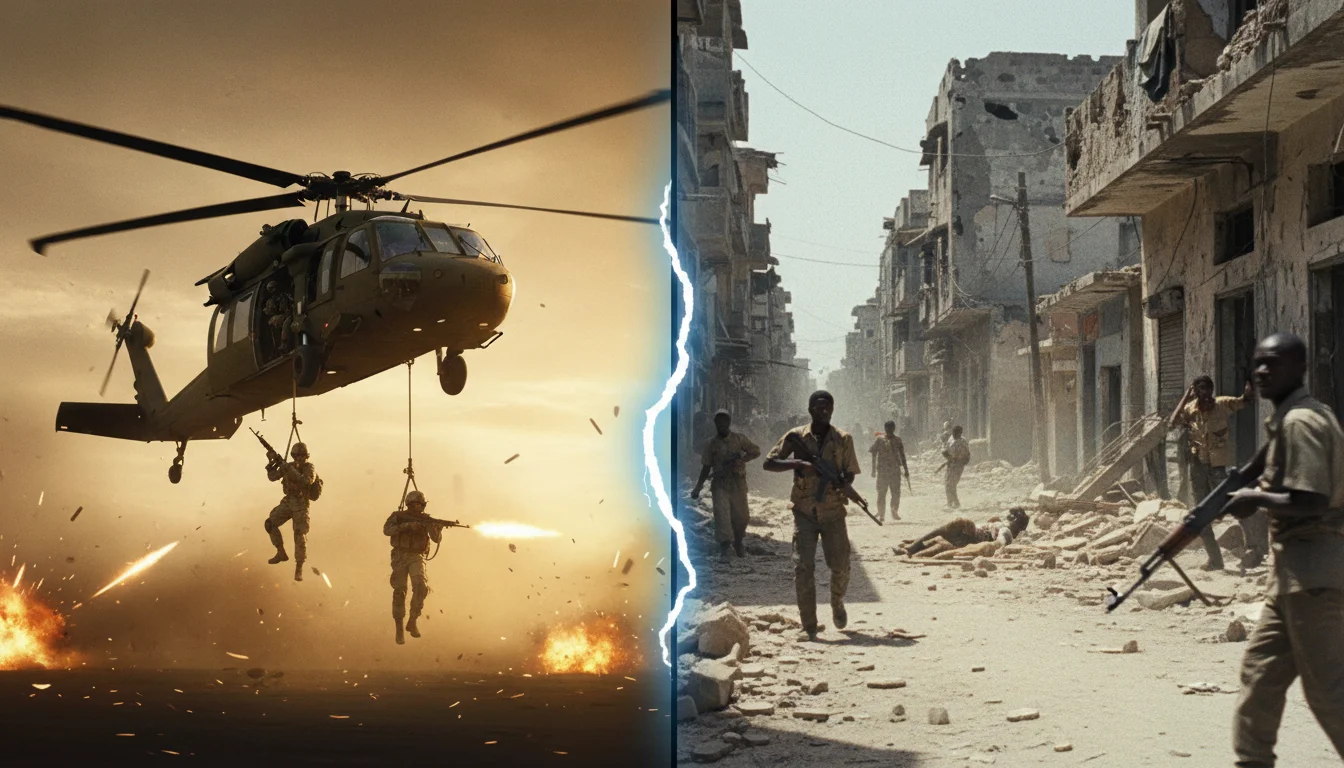
Ridley Scott's Black Hawk Down (2001) brought the brutal reality of modern urban warfare to the screen with unflinching intensity. Based on Mark Bowden's meticulous book, the film recounts the disastrous October 3, 1993 raid in Mogadishu, Somalia, where what should have been a one-hour mission turned into an 18-hour nightmare that left 18 American soldiers dead and 73 wounded.
The movie was praised for its visceral combat sequences and technical accuracy. Veterans of the actual battle served as advisors, and the production used authentic equipment. But how much did Hollywood embellish? What did they get right, and where did they bend history for dramatic effect?
What Hollywood Got RIGHT ✅
The Mission Plan Was Exactly That Ambitious (and Flawed)
The film accurately depicts the U.S. plan: Delta Force and Rangers would fast-rope into central Mogadishu in broad daylight, snatch high-ranking lieutenants of warlord Mohamed Farrah Aidid, and extract within an hour. The operation, codenamed Gothic Serpent, was the seventh such raid - the Americans had gotten cocky.
Historical accuracy: 100%. The hubris was real. General William F. Garrison, commander of Task Force Ranger, had repeatedly requested AC-130 gunships and armor support. Washington denied both, fearing "mission creep." That decision cost lives.
The Helicopters Really Did Get Shot Down
Super Six One (piloted by CW3 Cliff Wolcott) and Super Six Four (piloted by CW3 Michael Durant) were both downed by RPGs fired by Somali militia using tactics learned from Afghan mujahideen - aiming at the tail rotor.
Historical accuracy: The film faithfully recreates both crashes. Wolcott's Black Hawk crashed first, triggering the rescue convoy that got lost in Mogadishu's maze of streets. Durant's crash came later, and his capture was broadcast worldwide. The movie shows Durant's helicopter being hit in the tail rotor - exactly how it happened.
Delta Snipers Gary Gordon and Randy Shughart Were Heroes
The film's most powerful sequence shows Master Sergeant Gary Gordon and Sergeant First Class Randy Shughart requesting to be inserted at Durant's crash site to protect the crew. They knew it was a suicide mission. They did it anyway.
Historical accuracy: This is not Hollywood embellishment. Gordon and Shughart fought off hundreds of Somali militia with only their personal weapons. They died defending Durant and crew. Both were posthumously awarded the Medal of Honor - the first since Vietnam. The movie undersells their heroism, if anything.
The "Mogadishu Mile" Was Real
After being trapped overnight, the surviving Rangers and Delta operators had to fight their way on foot to a Pakistani/Malaysian rescue convoy staging area. This desperate running battle through hostile streets became known as the "Mogadishu Mile."
Historical accuracy: The film compresses the timeline, but the chaos, exhaustion, and sheer terror of that fighting withdrawal were real. Survivors describe it as the longest run of their lives - under constant fire, carrying wounded comrades, running on adrenaline and willpower alone.
The Casualties Were Catastrophic
18 Americans died. 73 were wounded. Two MH-60 Black Hawks were destroyed. The film shows bodies being dragged through the streets - a horrifying reality that shocked America and contributed to the U.S. withdrawal from Somalia.
Historical accuracy: Somali casualties were far higher - estimates range from 300 to 1,000 killed, with thousands wounded. The film barely mentions this disparity, focusing entirely on the American experience.
What Hollywood Got WRONG ❌
The Timeline Was Compressed
The film condenses 18 hours of fighting into what feels like continuous action. In reality, there were long periods of tense waiting - pinned down in buildings, treating wounded, rationing ammunition.
Historical reality: Night fell. Soldiers sat in darkness, hearing Somalis gathering outside. They fought exhaustion, dehydration, and the knowledge that rescue wouldn't arrive until morning. That psychological ordeal is missing from the film.
The Somali Perspective Is Barely Shown
The film portrays Somalis almost entirely as faceless enemies - RPG teams, militiamen, angry mobs. There's no political context, no explanation of why they were fighting.
Historical reality: Somalia was in the grip of a brutal civil war and famine. Aidid was a warlord, yes, but to many Somalis, the Americans were foreign invaders. The UN peacekeeping mission had already killed hundreds of civilians in earlier engagements. The rage wasn't irrational - it was a response to perceived occupation.
The film's one sympathetic Somali character is a translator. Everyone else is an enemy combatant or a screaming civilian.
Some Characters Were Composites
To streamline the narrative, several soldiers in the film are composite characters representing multiple real people. Some heroic actions were attributed to the "wrong" soldier for dramatic simplicity.
Example: The character of Specialist John "Grimes" (played by Ewan McGregor) is fictional - a composite of several Rangers. His famous line, "Once that first bullet goes past your head, politics and all that shit just goes right out the window," is pure Hollywood.
The Pakistani and Malaysian Rescuers Get Short Shrift
The film shows the rescue convoy arriving, but downplays the crucial role of Pakistani and Malaysian forces. Without their armored personnel carriers and tanks, the Americans would have died.
Historical reality: 10th Mountain Division soldiers and the international coalition were critical to the extraction. The Pakistanis and Malaysians drove into the teeth of Somali fire to pull the Americans out. One Malaysian soldier was killed, seven wounded. The film barely acknowledges their sacrifice.
The Politics Were Oversimplified
The movie presents the mission as a clear-cut manhunt gone wrong. The reality was messier.
Historical context: The U.S. was in Somalia on a humanitarian mission - Operation Restore Hope - to stop mass starvation. But mission creep turned peacekeepers into hunters. Aidid had attacked UN peacekeepers (killing 24 Pakistanis in June 1993), prompting the U.S. to go after him personally.
The film ignores this backstory. It also skips the aftermath: President Clinton's decision to withdraw from Somalia, the long-term impact on U.S. military doctrine, and the emboldening effect it had on groups like al-Qaeda (Osama bin Laden later cited Mogadishu as proof Americans couldn't stomach casualties).
The "Leave No Man Behind" Narrative Is Selective
The film emphasizes the ethos of never abandoning a comrade. That's true - but it also led to catastrophic decisions.
Historical complexity: The entire disaster escalated because of the "leave no man behind" principle. When the first Black Hawk went down, commanders diverted the convoy to rescue the crew - getting trapped in the city. When the second Black Hawk went down, they repeated the mistake.
Veterans later questioned whether the rescue attempts, while morally right, were tactically sound. The movie doesn't engage with that moral ambiguity.
What Hollywood EXAGGERATED 🎬
The Enemy Marksman "Firimbi"
The film features a recurring villain: an expert Somali marksman who picks off Americans from a distance. He's named "Firimbi" in the credits.
Reality check: There was no single elite Somali sniper hunting Delta operators. This character is a Hollywood invention to personalize the faceless enemy. The real danger came from RPGs and massed AK-47 fire - not precision marksmanship.
The "Black Sea" Scene
One of the film's most surreal moments shows American soldiers peering into an alley filled with Somalis - a "black sea" of humanity surging toward them.
Creative license: While there were large crowds, this specific shot is cinematic exaggeration. The real battle involved smaller, dispersed groups of militia - not human wave assaults.
The Verdict: Historical Accuracy Score 7/10
Black Hawk Down is one of the most tactically accurate war films ever made. The weapons, tactics, radio chatter, and chaos of urban combat are meticulously recreated. Veterans praise its realism.
Where it succeeds:
- The combat is visceral and authentic
- The heroism of soldiers like Gordon and Shughart is honored
- The tactical mistakes are shown honestly
- The confusion and fog of war are palpable
Where it fails:
- The Somali perspective is almost entirely absent
- The political context is ignored
- The timeline is compressed, losing psychological depth
- The international coalition's role is minimized
The film is a powerful tribute to soldiers caught in an impossible situation. But it's also a one-sided telling of a complex disaster. For Americans, it's a reminder of sacrifice and courage. For Somalis, it's a reminder that their side of the story is rarely heard.
Ridley Scott made a gripping war film. He did not make a balanced historical account. That distinction matters.
For similar war-film accuracy reviews, see Platoon vs. History and Saving Private Ryan vs. History.
Sources:
- Black Hawk Down: A Story of Modern War by Mark Bowden (1999)
- The Battle of Mogadishu: Firsthand Accounts from the Men of Task Force Ranger edited by Matt Eversmann and Dan Schilling (2004)
- Declassified U.S. military after-action reports (1994)
- UN Security Council Report S/1994/653 on Somalia operations

Debate the Accuracy with the Real Figures
Ask the real people what Hollywood got wrong about their lives.
Create your free account →No card required. Some figures and features require a paid plan.
Join the HistorIQly Club
Get smarter about the past.
Weekly stories, deep dives, and exclusive content straight to your inbox.