Glory vs. History: How Accurate Is the Civil War Epic About Black Soldiers?
Glory's historical accuracy is mixed: the assault on Fort Wagner is real, but most of the soldiers on screen never existed. We separate fact from invention.
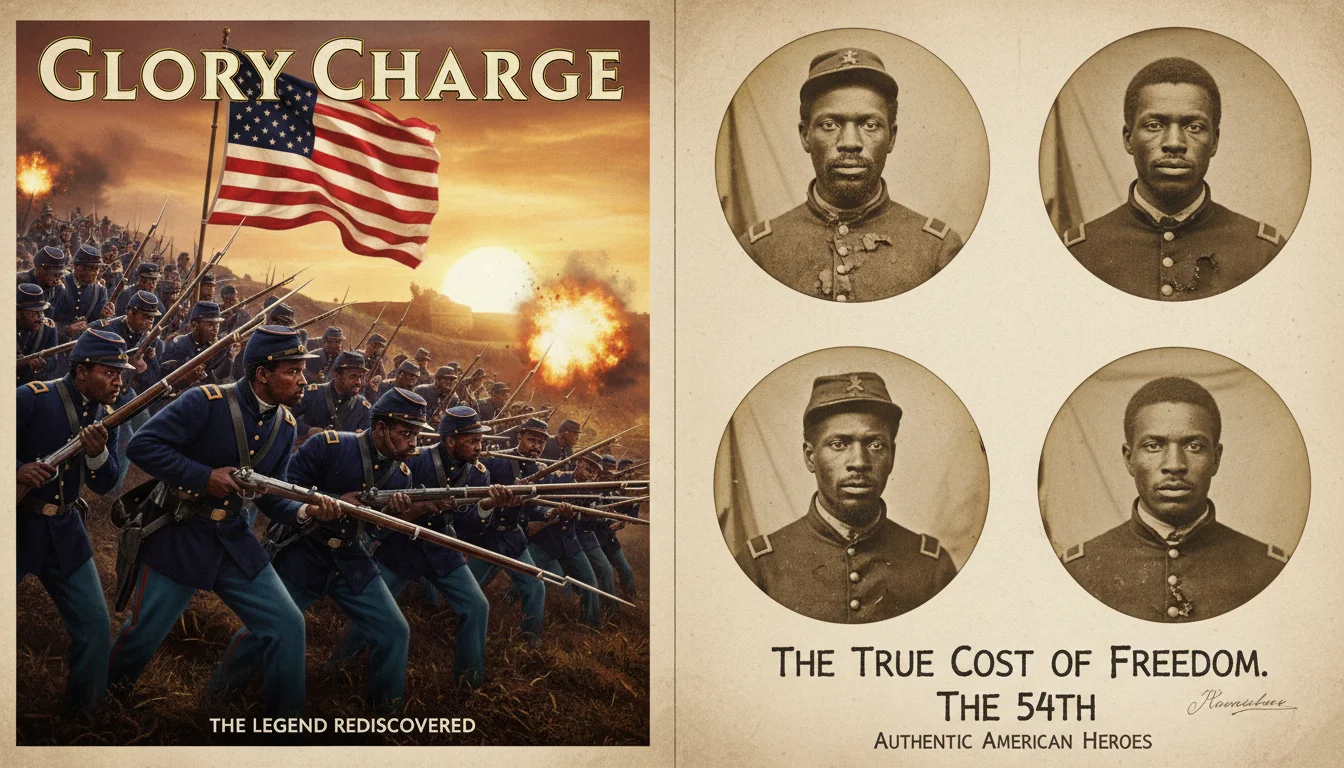
In 1989, director Edward Zwick released Glory, a film that would fundamentally change how Americans understood the Civil War. The movie told the story of the 54th Massachusetts Infantry, one of the first African American units in the Union Army, and their legendary assault on Fort Wagner. It won three Academy Awards, including Best Supporting Actor for Denzel Washington, and has been shown in classrooms across America for over three decades.
But how much of what we see on screen actually happened?
What Hollywood Got RIGHT
The Assault on Fort Wagner
The climactic attack on Fort Wagner on July 18, 1863, is depicted with brutal accuracy. The 54th was indeed forced to advance down a narrow strip of beach between the Atlantic Ocean and swamps, directly into Confederate fire. The dusk timing shown in the film matches the historical record - the attack began at twilight.
The outcome is tragically accurate: the assault failed. Colonel Robert Gould Shaw was killed leading his men over the parapet. The regiment suffered nearly 50% casualties. The Confederates did bury Shaw in a mass grave with his men, intending it as an insult. Shaw's father responded with words the film captures: he wouldn't want his son's body removed from among his "brave and devoted soldiers."
The Racist Treatment They Faced
The film accurately portrays the discrimination faced by the 54th. Black soldiers were indeed given inferior equipment and assigned to manual labor rather than combat. The unequal pay depicted in the film was real - Black soldiers were paid $10 per month with $3 deducted for clothing, while white soldiers received $13 with no clothing deduction.
Shaw's pay boycott happened. He encouraged his men to refuse all wages until Congress changed the law, which eventually happened in June 1864. However, the film shows Private Trip (Washington's character) leading this protest when Shaw actually initiated it.
Colonel Shaw's Background
Shaw really was born to a prominent Boston abolitionist family. His parents, Francis and Sarah, were wealthy reformers connected to the transcendentalist movement. The film correctly shows his privileged upbringing and his previous service - he was indeed a veteran of Cedar Mountain and Antietam before taking command of the 54th.
The Historical Significance
The film accurately captures why the 54th mattered. Their performance at Fort Wagner answered the skeptics who asked, "Will the Negro fight?" The regiment's courage helped convince the Union to recruit approximately 180,000 African American soldiers during the war.
What Hollywood Got WRONG
The Men of the 54th Were NOT Former Slaves
This is the film's biggest departure from history. Glory implies the regiment was composed mainly of former slaves and uneducated men from the South. In reality, the exact opposite was true.
Governor John Andrew wanted the 54th to be an elite unit. He specifically did not accept runaway slaves. Nearly all the men could read and write. Most were free-born Northerners from professional backgrounds - clerks, farmers, teachers, craftsmen.
Two of Frederick Douglass's sons - Lewis and Charles - were among the first to enlist. Lewis became sergeant major, a position of significant responsibility. The grandson of Sojourner Truth, James Caldwell, served in the regiment. First Sergeant Robert Simmons had previously served in the British Army. These were educated men who had been free their entire lives.
Only about one-quarter of the regiment was born in slave states, and an even smaller portion had actually experienced enslavement.
The Main Characters Are Almost Entirely Fictional
While Colonel Shaw was real, nearly every other named soldier in the film was invented:
- Trip (Denzel Washington): No historical basis. The angry, rebellious escaped slave was created to dramatize the experience of bondage.
- John Rawlins (Morgan Freeman): Fictional. The wise, dignified gravedigger who becomes sergeant major never existed. The real sergeant major was Lewis Douglass, Frederick Douglass's educated, free-born son.
- Thomas Searles (Andre Braugher): The childhood friend of Shaw? Made up entirely. There's no record of Shaw having such a relationship.
- Jupiter Sharts (Jihmi Kennedy): Fictional character representing enslaved people from the Deep South.
Shaw's Acceptance of Command
The film shows Shaw receiving his command at a fancy dinner party and accepting immediately. The reality was more complex and more interesting.
Shaw was actually with his regiment when his father brought the letter from Governor Andrew. He struggled with the decision for days, initially rejecting it. He was reluctant to leave his comrades in the 2nd Massachusetts for a regiment he doubted would ever see action. He eventually accepted partly to appease his abolitionist mother - not from immediate enthusiasm.
This hesitation would have made for a more nuanced character on screen.
The Watermelon Training Scene
That memorable scene where Shaw attacks a row of watermelons to teach bayonet drill? Symbolically powerful, historically impossible. The regiment trained in Massachusetts from February to May - watermelons wouldn't have been available in New England winter and spring.
The Film Ignores Other Black Regiments
The 54th Massachusetts was not the first African American unit in the Union Army. Several other Black regiments had already been raised and used quietly to test their performance. Some had been praised for battlefield courage in May and June 1863 - before Fort Wagner. The film presents the 54th as the sole experiment, which overstates their uniqueness.
What Happened After Wagner
Glory ends with the failed assault, but the 54th's story continued. In February 1864, the regiment executed a heroic rearguard action at the Battle of Olustee in Florida, protecting the retreating Union force. The film makes no mention of this significant engagement or the regiment's continued service through the end of the war.
The Verdict
Historical Accuracy Score: 6/10
Glory's historical accuracy is a paradox. It gets the big picture right while inventing almost everything in the foreground. The assault on Fort Wagner is cinematically accurate. The racism faced by Black soldiers is truthfully depicted. The historical significance of the 54th is properly conveyed.
But the men on screen bear little resemblance to the men who actually served. The film creates a narrative of escaped slaves rising to prove their humanity, when the reality was educated free Black men fighting for principles they had studied and debated their entire lives. Both stories are powerful - but they're different stories.
Director Edward Zwick has acknowledged this tension. He didn't want to make "a black story with a more commercially convenient white hero," but the invented characters ended up substituting Hollywood archetypes for real men whose actual stories were equally compelling.
Glory remains valuable as a film that introduced millions to a history they never learned in school. It changed the conversation about Black soldiers in the Civil War. For that, it deserves its place in cinema history. Readers interested in how Hollywood handles other chapters of Black American history might also see our fact-check of 12 Years a Slave, or compare a different kind of war accuracy question in Saving Private Ryan.
But the real 54th Massachusetts - the sons of Frederick Douglass, the grandson of Sojourner Truth, the former British soldier killed days after his nephew died in the New York Draft Riots - their stories still await their movie.
The Augustus Saint-Gaudens memorial to Shaw and the 54th Massachusetts stands on Boston Common, directly across from the Massachusetts State House. It took 14 years to create and was unveiled in 1897. It remains one of the greatest public sculptures in American art.

Debate the Accuracy with the Real Figures
Ask the real people what Hollywood got wrong about their lives.
Chat with HistoryJoin the HistorIQly Club
Get smarter about the past.
Weekly stories, deep dives, and exclusive content straight to your inbox.