BlackBerry vs. History: How Accurate Is the Canadian Tech Biopic?
BlackBerry movie accuracy review: Matt Johnson's 2023 film fact-checks Research In Motion's rise and fall through Jay Baruchel and Glenn Howerton.
Read Wikipedia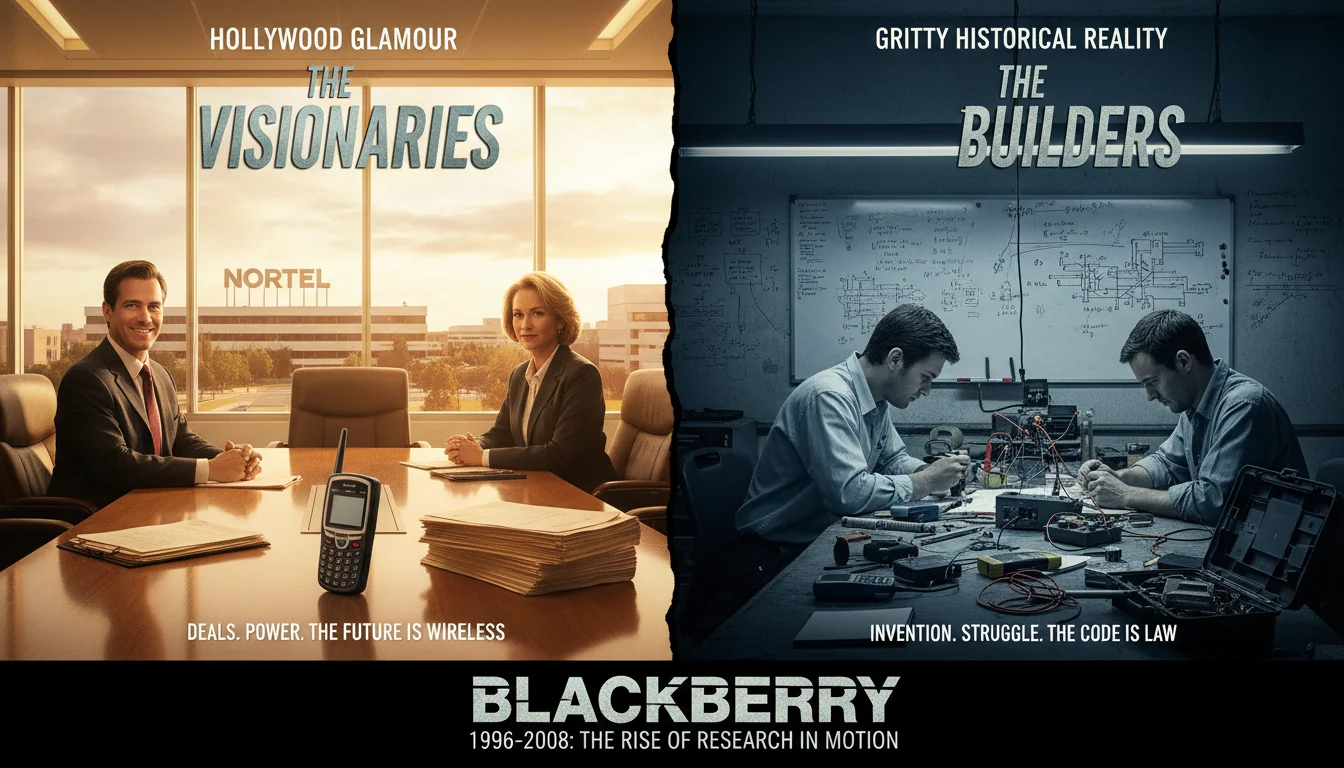
When BlackBerry opened in May 2023, Canadian critics were surprised by how good it was, and how unsparing. Matt Johnson's film took a story that most North American technology coverage had treated as a punchline, the slow collapse of the company that invented the modern smartphone, and turned it into a startup tragedy with the rhythm of a sports movie and the emotional architecture of a Greek play. Jay Baruchel plays Mike Lazaridis as a soft-spoken obsessive who is right about the engineering and catastrophically wrong about the market. Glenn Howerton plays Jim Balsillie as a finance executive whose hunger is bigger than the company he keeps trying to feed.
The film is faithful to the broad shape of Research In Motion's history. It is also looser with specifics than a Wikipedia summary would be, which has caused some confusion among viewers who have gone looking for verification. So what is the BlackBerry movie accuracy score, and how close to the historical record does BlackBerry actually stay? Surprisingly close on the big beats. Looser on the chronology and on individual scenes than its documentary aesthetic suggests.
What Hollywood Got RIGHT
The founding partners
Mike Lazaridis really did co-found Research In Motion in 1984 in Waterloo, Ontario, with his childhood friend Douglas Fregin, before he had finished his electrical-engineering degree at the University of Waterloo. The two grew up together in Windsor, Ontario, and shared a fascination with electronics that went back to high school. Fregin, played in the film by director Matt Johnson, was the co-founder Lazaridis trusted most, and he stayed at the company in various engineering and culture roles for decades. The headband, the Doritos, the relentless movie nights are stylistic exaggerations, but the underlying friendship was real, and Fregin's role as the keeper of the company's playful internal culture is well attested.
Jim Balsillie joined in 1992 after RIM had been operating for eight years and was struggling to commercialize its engineering. He invested about 250,000 Canadian dollars of his own money, took the title of co-CEO and effectively ran the business and commercial side of the company while Lazaridis ran engineering. The arrangement was unorthodox for a public company but lasted nearly two decades. The film's portrait of Balsillie as the abrasive outsider who arrives to professionalize a comfortable engineering shop is a fair compression of how Waterloo veterans remember the transition.
The breakthrough with the BlackBerry
The film correctly identifies the BlackBerry's actual innovation. The device was not the first wireless email tool, but it was the first one that integrated push email over the existing pager networks with a thumb-friendly QWERTY keyboard, a small monochrome screen, and a robust corporate server back end. The BlackBerry 850, launched in 1999, was followed by the 957 and then the 7200 series, each iteration cementing the position of the device on the belts of investment bankers, lawyers, and government officials. By the mid-2000s, BlackBerry was the only smartphone that mattered in regulated industries. Barack Obama famously refused to give his up when he became president in 2009.
The film's depiction of RIM's engineering culture, the in-house repair of Verizon's network bottlenecks, the relentless focus on battery life and bandwidth efficiency, and Lazaridis's hands-on involvement in product decisions is broadly accurate. So is the company's willingness to negotiate brutally with carriers. RIM was, by the early 2000s, a Canadian company telling Verizon what its network needed.
The NTP patent fight
The 2002-2006 patent dispute with NTP Inc., a small Virginia-based patent-holding company, almost killed RIM at the peak of its growth. NTP claimed that BlackBerry's push-email system infringed on patents owned by an inventor named Thomas Campana. A US district court ruled in NTP's favor, and at one point the BlackBerry service in the United States faced a court injunction that would have shut it down. RIM eventually settled for 612.5 million US dollars in March 2006, an enormous sum that humiliated Balsillie publicly. The film captures the existential pressure of this fight and Balsillie's belief that he was being shaken down. Some legal commentators sympathize with his view; the patent system in the early 2000s did, on the whole, favor NTP-style entities.
The iPhone moment
The film's depiction of the June 2007 iPhone launch as the moment RIM's leadership underestimated the threat is accurate and well documented. Lazaridis genuinely watched the keynote and concluded, on technical grounds, that the iPhone could not work as advertised, particularly the touchscreen typing experience and the demands on carrier bandwidth. His initial assessment, that the iPhone was a clever consumer toy that would never displace the BlackBerry in enterprise, was widely shared inside the company. It turned out to be the most consequential strategic misjudgment in Canadian business history.
The film also correctly captures the moment, around 2008 and 2009, when RIM's response, the BlackBerry Storm, with its tactile clicking touchscreen, missed badly on user experience. The Storm shipped on Verizon as an iPhone alternative and was returned in extraordinary numbers. The film's portrayal of Verizon's frustration with the Storm is close to what contemporaneous reporting described.
The options-backdating scandal
The film's depiction of the stock-options backdating issue is essentially accurate, even if it compresses the timeline. An internal review, followed by a 2007 Ontario Securities Commission investigation, found that RIM had backdated options grants for executives and directors over many years. Lazaridis and Balsillie ultimately reached settlements that involved restatements of earnings and personal financial penalties. The matter contributed to the loss of board confidence in the co-CEO structure, and by January 2012 both founders had stepped down from their operational roles. The film telescopes the regulatory process for dramatic effect but identifies the right villains and the right consequences.
What Hollywood Got WRONG
The basement and the timeline
The film's most consistent stylistic move is to compress and to dramatize. RIM's earliest workshops in the late 1980s and early 1990s were modest, but the company was not literally inventing the BlackBerry in a basement when Balsillie arrived in 1992. By that point RIM had several dozen employees, a contract relationship with the wireless-data network Mobitex, and revenue. The film's basement-of-snacks-and-Doritos aesthetic compresses a longer, more professional R&D history into a shorter, more cinematic one.
Similarly, several of the film's set pieces, the Lazaridis-Balsillie first meeting, the abrupt firings, the all-night coding sprints, are dramatic constructions. The actual rise of RIM was steadier and slower than the film implies, and many of the most cinematic moments are amalgamations of meetings that took place over months.
Doug Fregin's character
Fregin's portrayal as a perpetually adolescent presence keeping the engineering team in a state of arrested development is broadly affectionate but overdrawn. The real Fregin was a serious electrical engineer who held senior internal roles and was instrumental in the company's hardware decisions. The film's instinct to use him as a comic-relief embodiment of "Old RIM" is a useful narrative device but unfair to his actual contributions.
The Carl Yankowski subplot
The film includes a fictionalized COO recruited from outside who imposes harsh management and dramatically streamlines the engineering culture. RIM did at various points bring in senior operators from outside, but the specific antagonist arc the film constructs is a composite. The real story of RIM's middle management was less of a single hatchet-man figure and more of a slow drift toward a larger, more bureaucratic company that struggled to keep its engineering ambition.
The Verizon meeting
The famous scene in which Balsillie commits to a touchscreen device on a phone call with Verizon, then turns to his engineering team to ask if they can actually build it, is a compression of a longer, more collaborative product-roadmap process. Something like it did happen, in the sense that Verizon pressed RIM hard for an iPhone competitor and Balsillie agreed before the engineering team was certain, but the specific scene is a Hollywood crystallization of a months-long negotiation.
Historical accuracy score
7.5 out of 10. BlackBerry gets the shape of the story right and treats its subjects with more care than most American tech biopics. The founders are recognizable. The strategic errors are real. The cultural texture of Waterloo engineering, of nineties pager networks, of small-Canadian-company-takes-on-the-world ambition is faithfully rendered. Where the film loses points is the same place every two-hour biopic does: it compresses years into days, invents single scenes to stand in for long processes, and personalizes structural failures into individual ones.
What it gets that most tech films miss is the tragedy. RIM was not destroyed by a villain. It was destroyed by a pair of founders who built the right device for one decade, refused to believe the next decade would belong to a different one, and were proven wrong by a company in Cupertino that took the user experience seriously. The film respects that. The history is unkind in roughly the same way.
For related technology biography fact-checks, see The Social Network vs. History and The Founder vs. History.
Quick Answers
Common questions about this topic
Is BlackBerry based on a true story?
Yes. The 2023 film, written and directed by Matt Johnson, dramatizes the rise and collapse of Research In Motion, the Waterloo, Ontario, company behind the BlackBerry smartphone. It is adapted from the 2015 book Losing the Signal by Jacquie McNish and Sean Silcoff. The film telescopes the timeline and invents some scenes, but the core events of the company's founding, NTP patent fight, options-backdating scandal, and post-iPhone decline are accurate.
Did Mike Lazaridis really invent the BlackBerry in a basement?
Approximately. Lazaridis co-founded Research In Motion in 1984 in Waterloo with his school friend Douglas Fregin. The earliest pager-style two-way devices were built in cramped offices and modest workshops near the University of Waterloo. By the time the BlackBerry 850 launched in 1999, RIM had outgrown the garage-shop phase. The film's basement aesthetic is a compression of a longer, more professionalized R&D history.
Was Jim Balsillie really as ruthless as the movie shows?
Balsillie's reputation in Canadian business journalism is broadly consistent with the film. He invested 250,000 dollars in 1992 to become co-CEO and chief dealmaker, ran the company's commercial side aggressively, and pursued multiple failed bids to buy an NHL franchise. The shouting, the deadlines, and the willingness to break rules in service of a deal are documented. The film exaggerates individual scenes for dramatic effect, but the personality it sketches is the one that contemporaries describe.
How accurate is the movie's account of RIM's collapse?
Mostly accurate. The 2007 iPhone launch genuinely caught RIM flat-footed; the company underestimated how quickly carriers and consumers would migrate to touchscreens and apps. The film correctly shows Lazaridis's faith that BlackBerry users would always prefer a physical keyboard, the disastrous PlayBook tablet launch in 2011, and the share-price collapse. The options-backdating scandal that forced both founders to step down as co-CEOs in 2012 is also accurately depicted, though the film compresses its actual timeline of investigations.

Debate the Accuracy with the Real Figures
Ask the real people what Hollywood got wrong about their lives.
Create your free account →No card required. Some figures and features require a paid plan.
Join the HistorIQly Club
Get smarter about the past.
Weekly stories, deep dives, and exclusive content straight to your inbox.