Cabrini vs. History: How Accurate Is the Frances Cabrini Biopic?
The 2024 Cabrini film depicts America's first saint fighting for immigrants. Here's how cabrini movie accuracy holds up to the historical record.
Read Wikipedia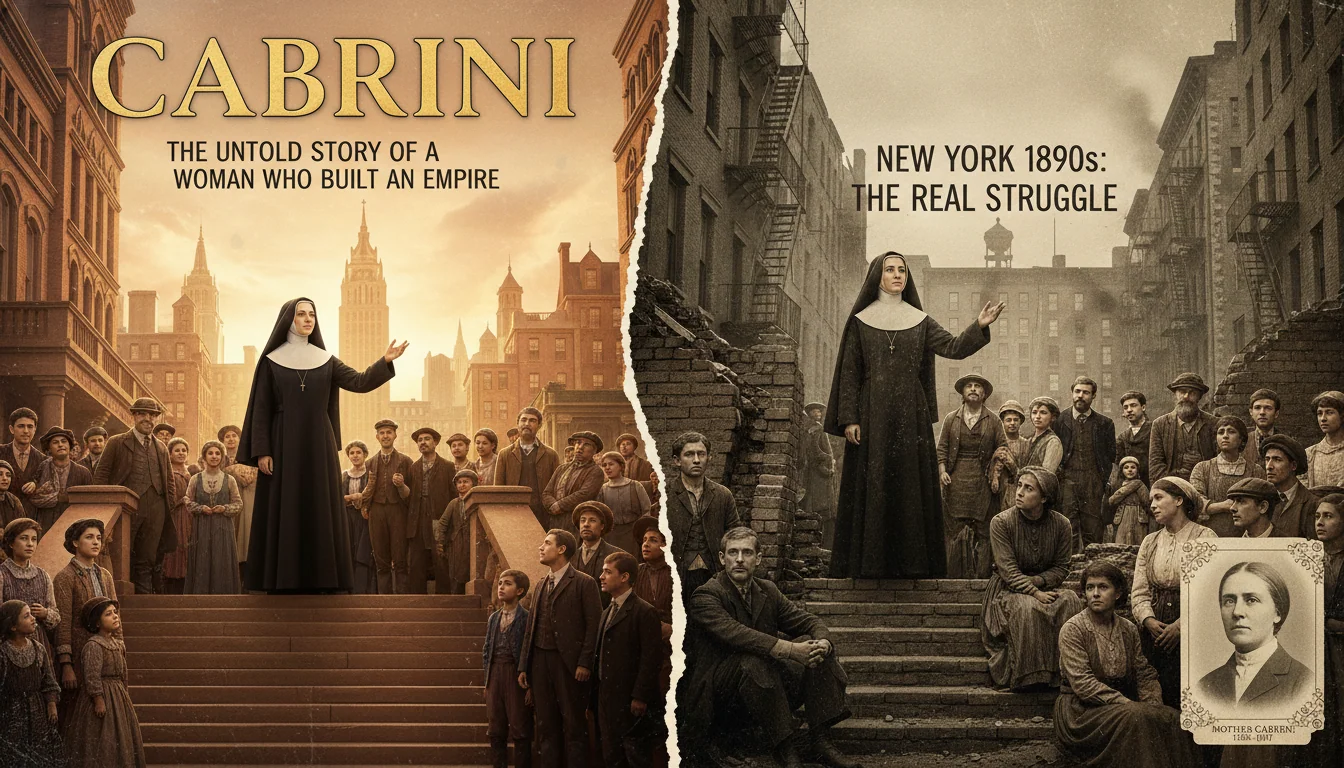
When the 2024 film Cabrini opened in theaters in March, it arrived with a marketing campaign aimed squarely at Catholic and faith-based audiences. The pitch was a figure most Americans had never heard of despite her status as the first American citizen to be canonized by the Catholic Church. That obscurity is itself historically interesting. Frances Xavier Cabrini spent nearly three decades transforming the lives of Italian immigrants in New York's most dangerous neighborhoods, and most people who have walked past the hospital named after her do not know who she was.
The film, directed by Alejandro Gomez Monteverde and starring Cristiana Dell'Anna, is essentially a conversion story: not of faith, but of a city. It follows Cabrini's arrival in New York in 1889 through the early years of building what would become Columbus Hospital. How faithful is it to the woman and the moment? Fairly faithful in its broad framework, more theatrical in its specifics, and occasionally guilty of constructing villains with more cinematic clarity than the historical record provides.
What Hollywood Got RIGHT
Her physical fragility and iron will
Frances Cabrini was born prematurely in 1850 and was considered physically delicate throughout her life. She suffered from recurring illness and was initially rejected by the religious orders she tried to join. The film's emphasis on her small frame and the constant underestimation she faced from officials, church hierarchs, and city politicians is historically grounded.
What the historical record makes clear is that Cabrini traveled continuously despite this frailty - crossing the Atlantic more than 25 times, visiting missions in Central and South America, managing an organization that eventually employed hundreds of nuns. Dell'Anna captures something real: the gap between how Cabrini appeared and what she actually accomplished is a genuine feature of the historical account.
Archbishop Corrigan's opposition
The film's conflict with Archbishop Michael Corrigan of New York is the most dramatically important historical relationship, and it is accurately handled in its essentials. When Cabrini arrived in 1889 at Pope Leo XIII's direction - the pope had told her "not to the East, but to the West" when she wanted to go to China - Corrigan was unprepared and unwelcoming. He told her the housing he had arranged was gone, that the orphanage project was not viable, and that she should return to Italy.
Corrigan's resistance was not simply personal animus. He was managing a complicated archdiocese with limited resources and found himself presented with a determined foreign nun who had the pope's letter and none of the institutional infrastructure Corrigan expected. Cabrini refused to leave, found her own accommodations, and proceeded to build. Corrigan eventually became a supporter. The film compresses this relationship and sharpens the conflict into something more adversarial than the historical record strictly supports, but the initial friction was real.
The poverty of the Italian immigrant community
The film's depiction of the Five Points and Lower East Side neighborhoods where Italian immigrants crowded in the 1880s and 1890s is accurate in atmosphere if not always in specific detail. The block-level density, the industrial labor, the disease, the criminal networks that preyed on newly arrived immigrants - all of this was documented by contemporary journalists, reformers, and the immigrants themselves.
Cabrini's work was directed at this specific population. The Italians arriving in New York in the 1880s faced discrimination from the existing Catholic establishment, which was predominantly Irish, as well as from Protestant charities that attached conditions to their assistance. Cabrini built institutions controlled by Italians and run for Italians, a deliberately political as well as charitable choice that the film handles correctly.
Columbus Hospital
The founding of Columbus Hospital in New York, which the film depicts as a centerpiece of Cabrini's New York mission, happened essentially as shown. The first hospital opened in 1892 in a building on 12th Street, converted from an existing structure with limited funds and considerable improvisation. It served Italian immigrants who were otherwise poorly served by the city's existing medical infrastructure. The hospital expanded over subsequent years and became a major medical institution.
What Hollywood Got WRONG
The invented political villain
The film constructs a composite antagonist in the form of a corrupt New York politician who controls city resources and actively works to block Cabrini's mission. This figure allows the screenplay to give Cabrini a human obstacle with clear motivation and a final scene of defeat. It works dramatically. It is not drawn from a single documented historical figure.
New York city politics of the 1890s were genuinely corrupt - Tammany Hall ran a machine that controlled municipal contracts, police, and charity certification - but the specific scenes of political confrontation in the film are largely invented or reconstructed from general patterns rather than specific documented episodes. The obstructions Cabrini faced were real; the individuals shown obstructing her are theatrical constructions.
The compression of decades
The film suggests a relatively rapid arc from arrival to triumph. The actual history is slower and more incremental. Cabrini worked in New York and across the Americas from 1889 until her death in 1917, nearly three decades of patient institutional building, not a dramatic climactic moment. The screenplay necessarily condenses this into something more filmable, but viewers may come away with the impression that Cabrini's New York mission was resolved in a few intense years rather than across a lifetime.
Cabrini's political sophistication
The film renders Cabrini primarily as a woman of faith overcoming institutional resistance through conviction. The historical figure was also a skilled political operator who understood how to use the patronage networks she nominally opposed, how to cultivate wealthy donors, and how to navigate competing factions within the American Catholic Church. She was not naive about power; she was sophisticated about it. This dimension is underplayed in favor of the more cinematic portrait of the determined saint.
The absence of her Latin American work
The New York focus of the film means that Cabrini's extensive network of schools and hospitals in Argentina, Brazil, Nicaragua, and Chile - a significant portion of her 67 institutions - is entirely absent. For a figure whose mission was explicitly to Italian emigrants worldwide, the exclusively American frame flattens her scope.
The historical score
Cabrini is more faithful to its subject than most faith-based films manage to be. The central facts of her mission, her conflicts with church authorities, and the scale of what she built are all correctly rendered. The emotional core - the determination of a physically frail woman who simply refused to accept the answers she was given - is accurate.
What the film trades in for drama is nuance: the political villain who is too conveniently villainous, the compressed timeline that suggests faster success than the decades actually required, and the relative absence of the institutional complexity that Cabrini actually navigated. These are acceptable distortions for a dramatic biography. They do not make the film dishonest; they make it more like a film.
Historical accuracy score: 7/10. The biography is sound, the setting is genuine, and the spirit of the enterprise is right. The political plotting is invented, and the real scope of the woman's work extends far beyond what two hours can show. For other biopics that face similar tradeoffs between fidelity and drama, see Selma vs. History and 12 Years a Slave vs. History.
Quick Answers
Common questions about this topic
Who was Frances Cabrini?
Frances Xavier Cabrini (1850-1917) was an Italian-born nun who emigrated to the United States in 1889 at the urging of Pope Leo XIII and spent nearly three decades building a network of hospitals, orphanages, and schools for Italian immigrants. She founded the Missionary Sisters of the Sacred Heart of Jesus and established more than 60 institutions across North and South America and Europe. She was canonized in 1946 as the first American citizen recognized as a saint.
Is the Cabrini movie based on a true story?
Yes. The 2024 film, directed by Alejandro Gomez Monteverde and starring Cristiana Dell'Anna, is a dramatized biography of Frances Cabrini's work in New York beginning in 1889. The core facts - her mission to Italian immigrants, her conflicts with church authorities, her founding of Columbus Hospital - are rooted in documented history, though individual scenes, dialogue, and some composite characters are invented.
Did Archbishop Corrigan really try to send Cabrini back to Italy?
Yes. Archbishop Michael Corrigan of New York was initially opposed to her staying and told her to return to Italy. He had expected nuns with more experience and financial backing and was skeptical that Cabrini's small group could sustain the ambitious work she was proposing. Cabrini refused to leave and eventually won him over through sheer results. The film depicts this conflict accurately in its broad strokes.
How many institutions did Frances Cabrini actually found?
By the time of her death in 1917, Cabrini had founded 67 institutions across the Americas, Europe, and beyond, including hospitals, orphanages, schools, and a settlement house in New York City. Columbus Hospital in New York, opened in 1892, became one of the most important medical facilities serving the immigrant community on the East Side.

Debate the Accuracy with the Real Figures
Ask the real people what Hollywood got wrong about their lives.
Create your free account →No card required. Some figures and features require a paid plan.
Join the HistorIQly Club
Get smarter about the past.
Weekly stories, deep dives, and exclusive content straight to your inbox.