Maestro vs. History: How Accurate Is the Leonard Bernstein Biopic?
Maestro 2023 accuracy: Bradley Cooper's Netflix biopic traces Bernstein's marriage to Felicia Montealegre. The emotional core is real; the omissions are considerable.
Read Wikipedia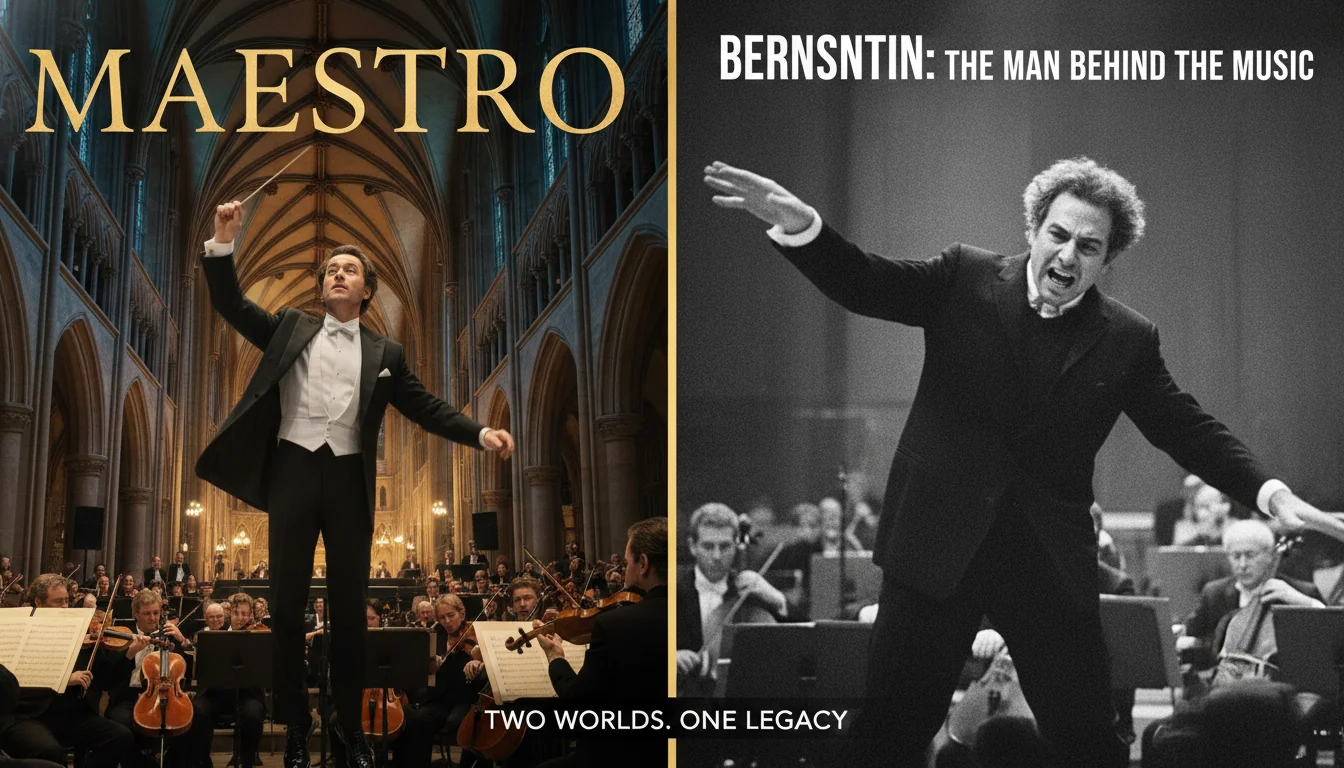
Bradley Cooper's Maestro had two arguments to make simultaneously. The first was that Leonard Bernstein was worth a serious biopic. The second was that Cooper was the person to make it. The controversy over the prosthetic nose Cooper wore to resemble Bernstein ate more column inches than anything else about the film before its November 2023 release - a strange distortion of priorities, since the nose is the least interesting thing about the movie or about the man it portrays.
When Maestro arrived on Netflix, Bernstein's children - Jamie, Alexander, and Nina - said publicly that it captured something truthful about their father. The criticism from music historians was not that the film was factually wrong. It was that the film's choices about what to show and what to omit left Bernstein looking smaller than he actually was.
What Hollywood Got RIGHT
The marriage and Felicia's knowledge
Felicia Montealegre was a Chilean-American actress and pianist of considerable accomplishment in her own right. She and Bernstein married in September 1951. The film is correct that she knew, from early in the relationship, that Bernstein was attracted to men, and that their marriage was built around a mutual decision to make it work anyway. This arrangement, common in mid-20th-century professional life where open homosexuality carried serious career and social costs, is depicted in the film without apology or sentimentality.
Their marriage lasted nearly 27 years. In 1976, Bernstein did briefly separate from Felicia to live with a male companion. When Felicia was diagnosed with lung cancer, he returned to care for her. She died on June 16, 1978. These facts are correctly rendered.
The 1943 debut
The film opens with a pivotal moment: the November 14, 1943 performance at Carnegie Hall in which a 25-year-old Bernstein substituted on a few hours' notice for Bruno Walter, who had fallen ill, and conducted the New York Philharmonic to enormous acclaim. The concert was nationally broadcast on radio. The next morning the New York Times ran the story on its front page. This event is accurately depicted as the launching pad for Bernstein's public career.
Tanglewood and Koussevitzky
The film correctly places Bernstein's study under Serge Koussevitzky at the Berkshire Music Center at Tanglewood as formative. Koussevitzky was the Boston Symphony Orchestra's music director and one of the most important conducting teachers of the 20th century. His influence on Bernstein's conducting style - the expressiveness, the physicality, the willingness to convey emotion through the whole body - is genuine and documentable.
Felicia's death and Bernstein's grief
The film does not romanticize Felicia's final illness. She died of lung cancer at 56. Bernstein's devastation is accurately captured. By multiple accounts from people close to him, her death left a wound he never healed from. His final decade - marked by conducting work, heavy smoking, and creative restlessness - followed from that loss in ways the film's brief epilogue correctly implies.
West Side Story's place in his career
The film treats West Side Story, which opened on Broadway in September 1957, as a genuine artistic landmark rather than just a popular success. This is accurate. Bernstein poured enormous effort into the score, which drew on jazz, Latin rhythms, and classical composition in ways that had not been done before in the American musical theatre. The show's run on its first Broadway staging changed the form of the American musical.
What Hollywood Got WRONG
The omission of Bernstein as a public intellectual
The most significant gap in Maestro is everything Bernstein did as a broadcaster, educator, and political figure. His Young People's Concerts for CBS, which ran from 1958 to 1972, introduced classical music to a television generation with an intimacy and intelligence no conductor had previously achieved on screen. His 1973 Norton Lectures at Harvard, published as The Unanswered Question, were a serious and admired attempt to apply structural linguistics to musical analysis. His conducting of Beethoven's Ninth at the Berlin Wall celebration in December 1989 - a performance watched by millions across Europe - is absent from the film entirely.
The film's Bernstein is a husband, a conductor, and an agonized artist. The Bernstein who was a public intellectual, who used his celebrity for political causes ranging from civil rights to nuclear disarmament, is mostly missing.
Radical Chic
One of the most famous episodes in Bernstein's life does not appear in the film. In January 1970, he and Felicia hosted a fundraiser at their Park Avenue apartment for the Black Panther defense fund. Tom Wolfe's account of the evening, published in New York Magazine under the title "Radical Chic: That Party at Lenny's," became one of the defining pieces of cultural journalism of the decade. The combination of Upper East Side luxury and revolutionary politics made the Bernsteins the target of sustained mockery and genuine social fallout. Omitting this episode means omitting a significant part of how the Bernsteins actually lived their political convictions, and also a significant part of why 1970 marked a turning point in their public standing.
Bernstein as a composer
The film's Bernstein is primarily a conductor who also composes. The real Bernstein spent much of his adult life in genuine anguish over the fact that the musical establishment did not take his compositions as seriously as he did. West Side Story was a popular success but treated by some critics as Broadway work rather than serious composition. His later pieces, including MASS (1971) and A Quiet Place (1983), were ambitious attempts to be recognized as a serious composer on the level of his conducting reputation. That tension - the gap between what the public celebrated and what he most wanted to achieve - is the most interesting thing about Bernstein's psychology, and the film does not fully engage it.
Scope of the New York Philharmonic years
Bernstein served as music director of the New York Philharmonic from 1958 to 1969 - the longest tenure of any American-born conductor at a major American orchestra. During those years he transformed the orchestra's recording output, expanded its repertoire, and made it one of the most recorded ensembles in the world. The film handles these years episodically. Viewers unfamiliar with the history will not come away with a clear sense of what that decade meant either for Bernstein or for American classical music.
Timeline compression
The film's structure is episodic and occasionally compresses events in ways that distort sequence. Some scenes set in specific periods use visual cues that are not entirely consistent with their supposed dates. These are minor irritants rather than meaningful historical errors, but they matter in a film that is otherwise so careful about period production design.
Historical Accuracy Score: 7.5/10
Maestro is a faithful portrait of the marriage at its center. The facts about Bernstein and Felicia - the timeline, the tensions, the genuine love, the difficult final years - are drawn from documented reality. Cooper and his team worked with Bernstein's family and had access to materials that produced a credible account of the private relationship.
What the film gets most right: the emotional texture of the Bernstein-Montealegre marriage, the accuracy of the 1943 debut, and the physical reality of Bernstein's conducting presence.
What it gets most wrong: shrinking Bernstein's public intellectual life to almost nothing, omitting the Radical Chic controversy entirely, and underplaying his long frustration at not being recognized as a serious composer.
The film is an intimate portrait of a private man inside a celebrated life. That makes it a fine piece of filmmaking and an incomplete piece of biography. For the full Bernstein - the Young People's Concerts, the Harvard lectures, the political activism, the composer's frustrations - viewers will need to look beyond its running time.
For other music biopics fact-checked against the record, Bohemian Rhapsody vs. History covers the Queen film, and Argo vs. History shows how another Best Picture winner handled a true story.
Quick Answers
Common questions about this topic
Was Bernstein really bisexual?
Yes. Bernstein had relationships with men before and during his marriage to Felicia Montealegre. This was widely known within the music world during his lifetime. His daughter Jamie Bernstein has spoken publicly about her father's sexuality since his death in 1990.
Did Bernstein and Felicia really stay married despite everything?
Yes. Bernstein and Felicia Montealegre married in September 1951 and remained married until her death from lung cancer in June 1978. Their relationship endured significant tension over the decades. In 1976, Bernstein briefly separated from Felicia to live openly with a male companion, but returned to care for her when she was diagnosed with cancer.
How accurate is Bradley Cooper's conducting in the film?
Cooper studied conducting for approximately six years before filming. Music professionals praised his physical performance. The film's most celebrated scene, recreating a 1976 concert at Ely Cathedral with the London Symphony Orchestra, was filmed with Cooper conducting the actual orchestra in real time.
When did Leonard Bernstein die?
Bernstein died on October 14, 1990, five days after publicly announcing his retirement from conducting. The cause was pleural mesothelioma. He was 72. The film does not depict his death directly but covers his life through the 1980s in its final section.

Debate the Accuracy with the Real Figures
Ask the real people what Hollywood got wrong about their lives.
Create your free account →No card required. Some figures and features require a paid plan.
Join the HistorIQly Club
Get smarter about the past.
Weekly stories, deep dives, and exclusive content straight to your inbox.