Operation Mincemeat vs. History: How Accurate Is the WWII Spy Movie?
Operation Mincemeat accuracy: the 2021 film dramatized how a corpse with planted documents fooled Nazi intelligence and helped secure the Allied invasion of Sicily.
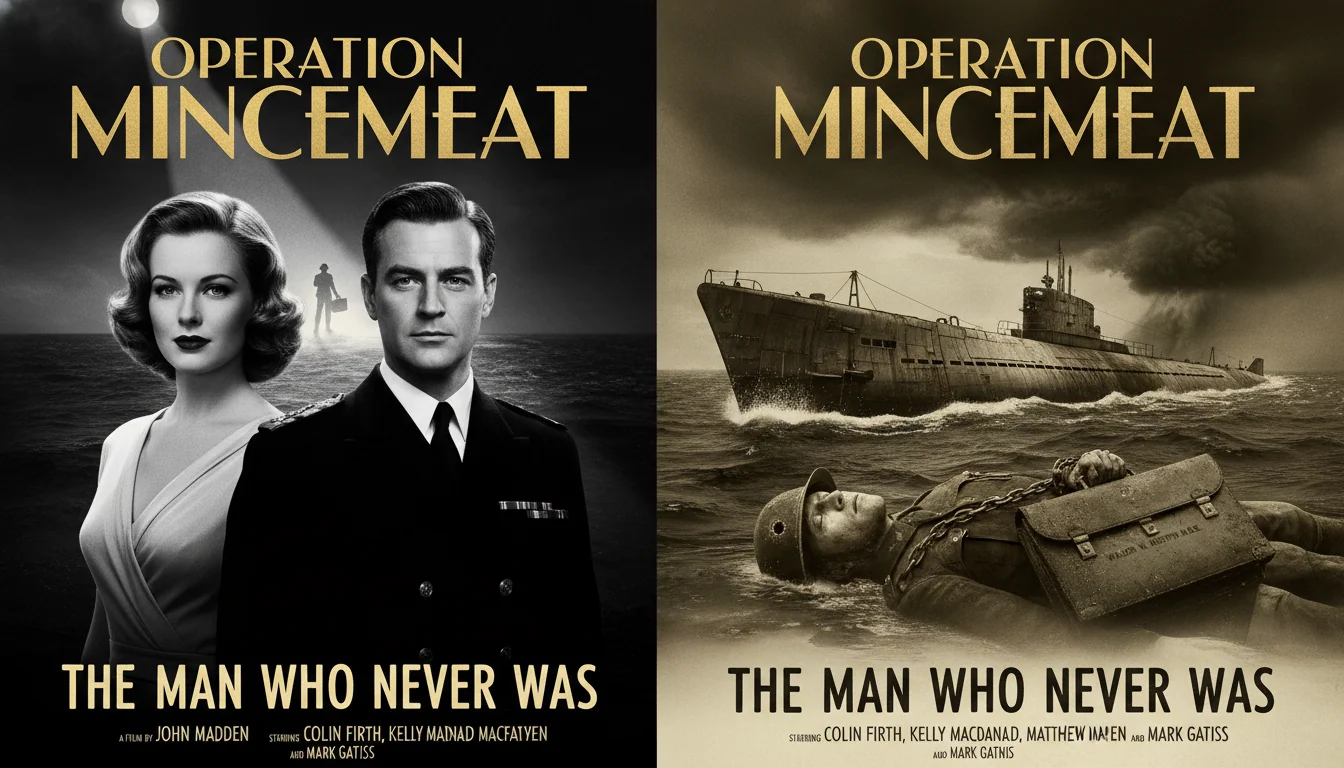
When Operation Mincemeat was released in 2021, it brought to a wider audience one of the most peculiar success stories of British wartime intelligence: a 1943 deception operation in which a corpse, dressed as a Royal Marines major and equipped with fabricated documents, was floated off the Spanish coast in the hope that German intelligence would recover the body and accept the fake papers as genuine.
The operation worked. The Germans accepted the deception. Hitler diverted reinforcements toward Sardinia and Greece. The Allied invasion of Sicily, when it began in July 1943, faced significantly weaker defenses than would otherwise have been the case.
So how close to the historical record does the film stay? Closer than most viewers realize. The operation's actual details, recovered after decades of postwar archive declassification and reconstructed by historian Ben Macintyre in his 2010 book, are most of what the film shows. The film adds emotional drama and a partly invented romantic subplot, but the operation itself is preserved with care.
What Hollywood Got RIGHT
The basic operation
In April 1943, a body was placed in the sea off Huelva, Spain, by the British submarine HMS Seraph. The body was wearing the uniform of a Royal Marines officer named Major William Martin. Chained to its wrist was a briefcase containing letters that referred, casually but specifically, to upcoming Allied operations in Sardinia and Greece, suggesting that the planned invasion of Italy through Sicily was a cover story.
The body was recovered by Spanish fishermen, taken to local authorities, and eventually examined by a German military attaché. Photographs of the documents were taken and forwarded to Berlin. The Germans accepted the documents as genuine.
The film's depiction of the operation is faithful to all of these basic facts. The submarine, the body, the briefcase, the recovery in Huelva, and the German interception are all real and largely accurate.
Glyndwr Michael, the man who never was
The corpse used was that of Glyndwr Michael, a 34-year-old homeless Welsh laborer who had died on January 28, 1943 from accidental ingestion of rat poison containing phosphorus. His body was preserved at St. Pancras Coroner's Court in London while planners arranged the operation.
The film depicts Michael's death and the careful selection of his body for the operation. The decision to use his body was made because phosphorus poisoning produces lung damage that mimics drowning, making it harder for a forensic examiner to detect the deception.
The film is broadly accurate about Michael's identity, his death, and the moral complications the planners faced in using his body without consent. Michael's name was kept secret for decades. It was not officially confirmed until the 1990s, partly through research by Ben Macintyre and others.
Ewen Montagu and Charles Cholmondeley
Lieutenant Commander Ewen Montagu, played by Colin Firth, was a real Royal Navy intelligence officer assigned to the Twenty Committee, the inter-service deception coordinating body. Flight Lieutenant Charles Cholmondeley, played by Matthew Macfadyen, was an MI5 officer who initially developed the concept.
The film's depiction of their working relationship is broadly accurate. Cholmondeley was an awkward, intellectually intense officer who came up with the idea. Montagu was the more polished, well-connected figure who took over the political and operational management. Their dynamic, with mutual respect undercut by occasional friction, is captured well.
Montagu wrote a 1953 memoir, The Man Who Never Was, that was made into a 1956 film of the same name. Macintyre's 2010 book added substantial new material from declassified archives.
The forged identity
The fictional Major William Martin was constructed in painstaking detail. He had a fiancée named Pam (in the film, real name in the operation was Pam, played by a young woman in the planning section), a domineering father, theater ticket stubs, an overdrawn bank account, a love letter, and a photograph. Many of these documents and props were created from real-life templates, in some cases involving the lives of real people who served as models.
The film's depiction of this forgery process is accurate to the source material. The Twenty Committee invested extraordinary effort in making Major Martin a person, knowing that German intelligence would scrutinize every detail.
Hitler's diversion of forces
The operational outcome is also well-documented. German intelligence accepted the documents. Hitler personally directed reinforcements toward Sardinia and Greece. When the Allied invasion of Sicily began on July 10, 1943, the German and Italian defenders had been significantly under-prepared. The operation is regarded by intelligence historians as one of the most successful strategic deceptions in modern military history.
What Hollywood Got WRONG
The romantic subplot
The film introduces a romantic tension between Montagu, Cholmondeley, and Jean Leslie, a young woman in MI5 whose photograph was used as the fictional fiancée's. The historical record does not support the depth of the romantic triangle the film depicts.
Montagu and Leslie did know each other through the operation. They appear to have had a friendship and possibly some flirtation. The historical record does not indicate that Cholmondeley was involved in any meaningful romantic competition. The film exaggerates this dynamic for dramatic structure.
Ian Fleming's role
The film prominently features Ian Fleming, then a young naval intelligence officer who would later create James Bond, as a witty, sharp-eyed observer of the operation. Fleming was indeed involved in the early conception phase of similar deception operations and contributed to the so-called "Trout Memo" of 1939, which proposed various deception techniques.
His direct involvement in Mincemeat itself was peripheral. The film slightly overstates his role, partly to give audiences a recognizable name and to lean into the implicit Bond aesthetic. He is not, for example, the operational architect the film occasionally implies.
The Spanish handling of the body
The film telescopes some of the actual Spanish handling of Major Martin's body. The Spanish authorities did examine the body and the briefcase, allowed German agents access to the documents, and subsequently returned the corpse to British representatives. The film's compression of this multi-day process makes it look faster and more dramatic than it actually was.
The film also makes the British anxiety about whether the deception had succeeded more cinematic than the historical record supports. In reality, British intelligence had multiple sources, including Ultra signals intercepts, that confirmed the Germans had accepted the documents within days of their planting.
Glyndwr Michael's family
The film implies more direct anguish over the use of Michael's body than the actual operation involved. Michael was an isolated figure with no immediate family who would have been notified of his death or the use of his body. The Twenty Committee did consider the ethical issues but did so in a context of wartime urgency that did not include external moral oversight.
His name and the use of his body were not made public until decades later. Michael was eventually identified on the headstone of the Huelva grave in 1998, after years of research by various historians.
The internal British politics
The film simplifies the bureaucratic politics surrounding the operation. The Twenty Committee, the various branches of military intelligence, and the political leadership above them were involved in continuous internal arguments about deception strategy. The film's depiction of these arguments as dramatic personality clashes is partly accurate but compresses what was actually a complex multi-departmental coordination.
What the film captures even when it bends facts
Operation Mincemeat gets one specific thing exactly right: the strange professionalism of British wartime intelligence. The men and women involved in the operation worked in cramped offices, drank too much tea, swapped morbid jokes about corpses, and produced one of the most sophisticated pieces of deception in the history of modern warfare. The film captures this texture, the mixture of seriousness and absurdity, with unusual fidelity.
It also captures the operation's underlying moral strangeness. A homeless Welsh laborer, who died alone of rat-poison ingestion in a London room, became, in death, the fictional Royal Marines officer whose forged life saved an estimated thousands of Allied soldiers' lives during the Sicily invasion. The film treats this moral knot with appropriate weight.
Historical Accuracy Score: 8/10
Operation Mincemeat is one of the most accurate spy-history films ever made. The operation itself, the documents, the corpse, the German interception, and the strategic outcome are preserved with care. The film embellishes the romantic triangle, slightly overstates Fleming's role, and compresses the bureaucratic politics, but it does not invent the basic facts.
What the film gets most right: the operation's mechanics and the moral complexity of using Glyndwr Michael's body.
What it gets most wrong: the romantic subplot and Fleming's elevated role.
For more WWII spy and military film fact-checks, see our breakdowns of Valkyrie and Darkest Hour.
The bottom line is that Operation Mincemeat is a well-made film about a remarkable operation. The actual story is, if anything, more impressive than what the film depicts, and Macintyre's book remains the best single source on what really happened in those London offices and that Spanish coastal town in early 1943.
Quick Answers
Common questions about this topic
Is Operation Mincemeat based on a true story?
Yes. The 2021 film, directed by John Madden and based on Ben Macintyre's 2010 nonfiction book of the same name, dramatizes a real British military deception operation conducted in April 1943 by the Twenty Committee. The operation used a corpse with planted documents to mislead German intelligence about the Allied invasion of Sicily.
Who was 'the man who never was'?
The corpse used in the operation belonged to Glyndwr Michael, a 34-year-old homeless Welsh laborer who died from accidental ingestion of rat poison in January 1943. His body was preserved, dressed as a fictional Major William Martin of the Royal Marines, and eventually released into the sea off the coast of Spain.
Did the deception actually work?
Yes. German intelligence accepted the planted documents as genuine. Hitler personally signed off on diverting reinforcements toward Sardinia and Greece in expectation of an Allied invasion in those regions. When the actual Allied invasion of Sicily began on July 10, 1943, the Italian and German defenders were significantly under-prepared. The operation is considered one of the most successful military deceptions in history.
Were Ewen Montagu and Charles Cholmondeley real?
Yes. Lieutenant Commander Ewen Montagu, played by Colin Firth in the film, was a Royal Navy intelligence officer and a real co-architect of the operation. Flight Lieutenant Charles Cholmondeley, played by Matthew Macfadyen, was an MI5 officer who developed the original concept. Both went on to long postwar careers.

Debate the Accuracy with the Real Figures
Ask the real people what Hollywood got wrong about their lives.
Chat with HistoryJoin the HistorIQly Club
Get smarter about the past.
Weekly stories, deep dives, and exclusive content straight to your inbox.