Bonnie and Clyde vs. History: How Accurate Is the 1967 Movie?
A Bonnie and Clyde accuracy check on Arthur Penn's 1967 film: the Depression setting holds up, but the real Barrow Gang was meaner and their body count far higher.
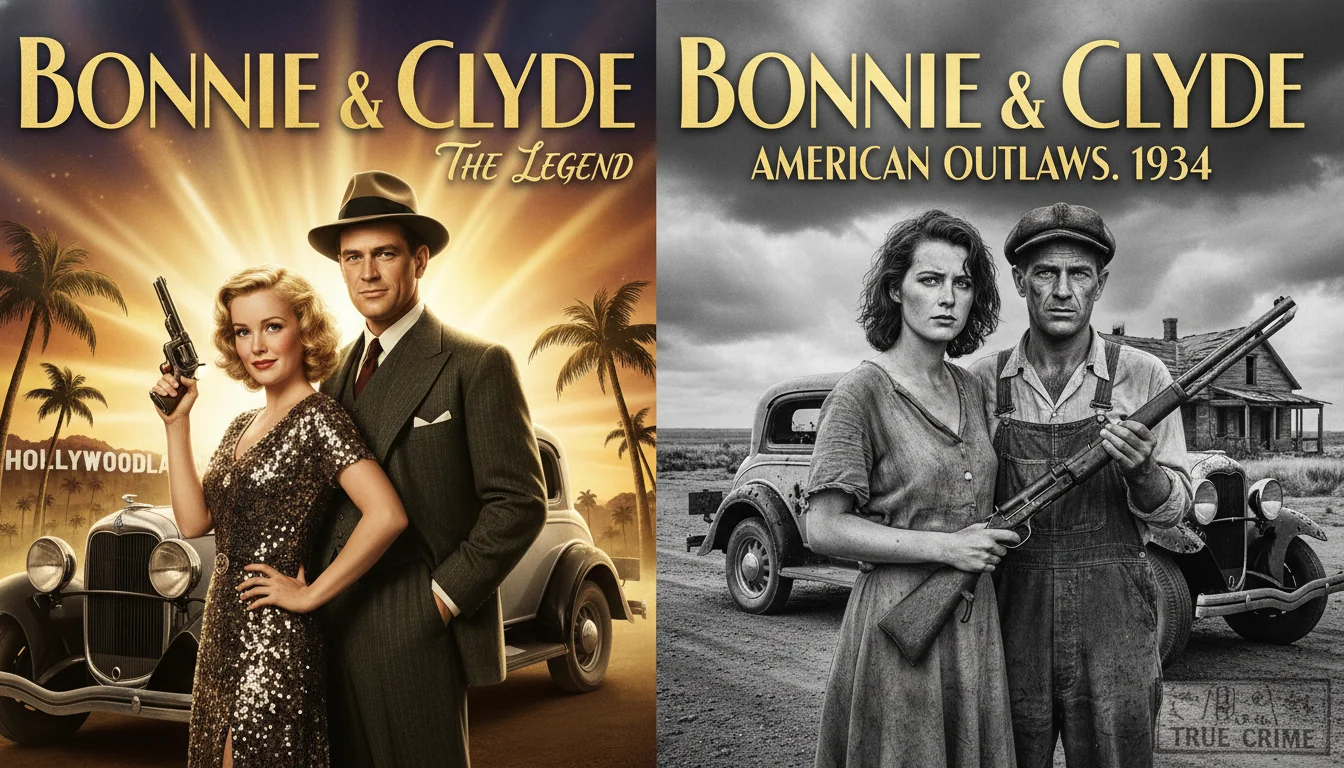
When Arthur Penn's Bonnie and Clyde premiered in August 1967, audiences had never seen anything like it. Stylish, sexy, witty, and shockingly violent, it turned two small-time Depression-era robbers into the patron saints of New Hollywood. Warren Beatty's swaggering Clyde and Faye Dunaway's beret-wearing Bonnie became instant pop icons, and the film helped end the era of sanitized studio Westerns.
But how much of Bonnie and Clyde is the real Barrow Gang, and how much is mythmaking?
The honest answer is that the movie captures the legend better than the history. The basic shape of events is intact, but the tone, the moral weight, and most of the texture have been smoothed into a counterculture parable. The real Bonnie and Clyde were poorer, meaner, and far less glamorous than the people on screen.
What Hollywood Got RIGHT
The Depression-era setting
The film's evocation of dust-bowl Texas, broken-down farms, and small-town banks is genuinely accurate. The Barrow Gang really did emerge from the rural underclass of the early 1930s, where banks were closing on families daily and police were stretched thin across enormous jurisdictions. Their robberies played differently in that climate than they would today, and the film is right that ordinary people sometimes cheered for them.
The famous moment when Clyde lets a dispossessed farmer fire a few bullets at the bank that took his home reflects the populist mood the real gang occasionally exploited. Clyde Barrow did sometimes hand cash to bystanders, and the press did occasionally treat the gang as folk heroes.
The role of the Barrow family and friends
The film accurately shows that Bonnie and Clyde were not lone wolves. They moved with a rotating cast of family and accomplices, including Clyde's brother Buck Barrow, Buck's wife Blanche, and the young driver C.W. Moss (a composite of real gang members W.D. Jones and Henry Methvin).
Buck's death from a head wound after a shootout in Iowa, and Blanche's capture and partial blinding, are essentially correct. The chaotic, family-style structure of the gang and the sheer number of relatives who paid for their crimes is one of the historically truer aspects of the film.
Bonnie's poetry and press obsession
The movie's portrayal of Bonnie as a writer obsessed with how the gang would be remembered is grounded in fact. The real Bonnie Parker wrote poetry, sent verses and photographs to newspapers, and was deeply aware of her growing fame. Her poem "The Trail's End," predicting their deaths, was published shortly before they were killed. The film's use of her self-mythologizing is one of its strongest historical instincts.
The final ambush
The death scene, though stylized in slow motion, is broadly accurate in its key facts. On May 23, 1934, a posse of six officers led by former Texas Ranger Frank Hamer ambushed the couple on a rural road in Bienville Parish, Louisiana. They fired well over 130 rounds into the stolen Ford V8. Bonnie and Clyde never returned fire. They were dead within seconds.
The film's choice to drag this moment into balletic slow motion was revolutionary in 1967, but the underlying horror, the overwhelming, lopsided violence, is real.
What Hollywood Got WRONG
Clyde Barrow was not a romantic outlaw
The film's Clyde is a charming, slightly impotent dreamer who only kills when cornered. The real Clyde Barrow was a hardened, abused ex-convict who emerged from the brutal Eastham Prison Farm in Texas with one consuming mission: to take revenge on the Texas prison system that had nearly destroyed him.
Eastham was notorious for its violence, and according to historians, Clyde killed his first man inside its walls, a fellow inmate who had been raping him. He left prison vowing he would never go back, and his subsequent crime spree was driven less by social rebellion than by personal terror and rage.
The body count is sanitized
The 1967 film makes the gang's killings feel almost incidental, the tragic cost of being trapped. The reality is grimmer. The Barrow Gang is credited with at least nine police killings and several civilian deaths over its 21-month run. They robbed grocery stores and gas stations far more often than banks, and the violence was frequently casual rather than reluctant.
By turning the gang into reactive victims of a hostile system, the film softens what was, by contemporary accounts, a pattern of cold and sometimes opportunistic killing.
Clyde's sexuality is invented
One of the film's most discussed choices is making Clyde sexually impotent. There is no historical evidence for this. Clyde and Bonnie's relationship was, by all surviving accounts, intense and physical. Some historians have suggested Clyde may have been bisexual, based on prison records and certain associates, but the impotence storyline appears to be a screenwriter's invention designed to add psychological tension.
The change matters because it reframes the entire relationship. The film's Clyde is a wounded, almost childlike figure. The historical Clyde was a violent, sexually active young man whose connection to Bonnie was less innocent than the film suggests.
Frank Hamer is libelously misrepresented
The film portrays Texas Ranger Frank Hamer as a vain, vengeful captive who is humiliated by the gang and then hunts them down out of personal grudge. None of this is true. Hamer never met Bonnie and Clyde before the ambush, was never captured or photographed with them, and was a respected lawman with a long career.
His widow successfully sued the filmmakers for defamation in the early 1970s. It remains one of the most factually indefensible portrayals in any major Hollywood biographical film.
The romance of poverty
The movie makes the gang's life look like a sun-drenched road trip with occasional gunfire. The reality, as documented by their accomplices and surviving victims, was filthy, exhausting, and usually terrifying. They slept in stolen cars, suffered serious injuries that went untreated, ate poorly, and lived in constant fear of capture.
After a June 1933 car crash in Texas, Bonnie sustained third-degree burns from battery acid that left her partly disabled and in chronic pain for the last year of her life. The glamorous beret-and-cigar imagery from the famous photographs comes from a brief, staged moment. It is not how they spent most of their final months.
Historical Accuracy Score: 5/10
Bonnie and Clyde is a great film, but it is a stylized myth more than a documentary. It correctly captures the Depression-era backdrop, the involvement of family, Bonnie's writerly self-fashioning, and the savagery of the final ambush. It also softens the gang's body count, romanticizes Clyde, invents an impotence storyline, and outright libels Frank Hamer.
What the film gets most right: the cultural mood that turned two killers into folk heroes.
What it gets most wrong: the moral weight of what they actually did.
The bottom line is that Bonnie and Clyde is a near-perfect example of how Hollywood transforms criminals into icons. If you want to feel the legend, watch the movie. If you want to know what really happened on those Texas back roads in 1933 and 1934, you need to read past the credits.
For other crime-era Hollywood treatments, see Public Enemies vs. History and Casino (1995) vs. History.
Quick Answers
Common questions about this topic
Is Bonnie and Clyde based on a true story?
Yes. The film is based on the real Barrow Gang, led by Clyde Barrow and Bonnie Parker, who carried out robberies and killings across the central United States from 1932 until they were ambushed by police in May 1934.
How accurate is the 1967 Bonnie and Clyde movie?
The film captures the duo's outlaw celebrity, the involvement of family, and the brutal final ambush, but it sanitizes their violence, mischaracterizes Clyde's motivations, and invents key emotional beats. Historians estimate the real gang killed at least nine police officers and several civilians, far more than the movie suggests.
Did Bonnie really write poetry?
Yes. Bonnie Parker wrote poems including 'The Story of Suicide Sal' and 'The Trail's End,' the latter sent to newspapers shortly before her death. The film's use of her writing to humanize her is one of its more historically grounded touches.
How did the real Bonnie and Clyde die?
On May 23, 1934, a posse of six lawmen led by former Texas Ranger Frank Hamer ambushed Bonnie and Clyde on a rural road in Bienville Parish, Louisiana. Officers fired more than 130 rounds into their stolen Ford V8. Both were killed instantly.

Debate the Accuracy with the Real Figures
Ask the real people what Hollywood got wrong about their lives.
Chat with HistoryJoin the HistorIQly Club
Get smarter about the past.
Weekly stories, deep dives, and exclusive content straight to your inbox.