The Boy in the Box: America's Unknown Child Who Finally Got His Name
The Boy in the Box: for 65 years no one knew his name. Found in a Philadelphia field in 1957, the cold case waited until DNA finally identified him in 2022.
Read Wikipedia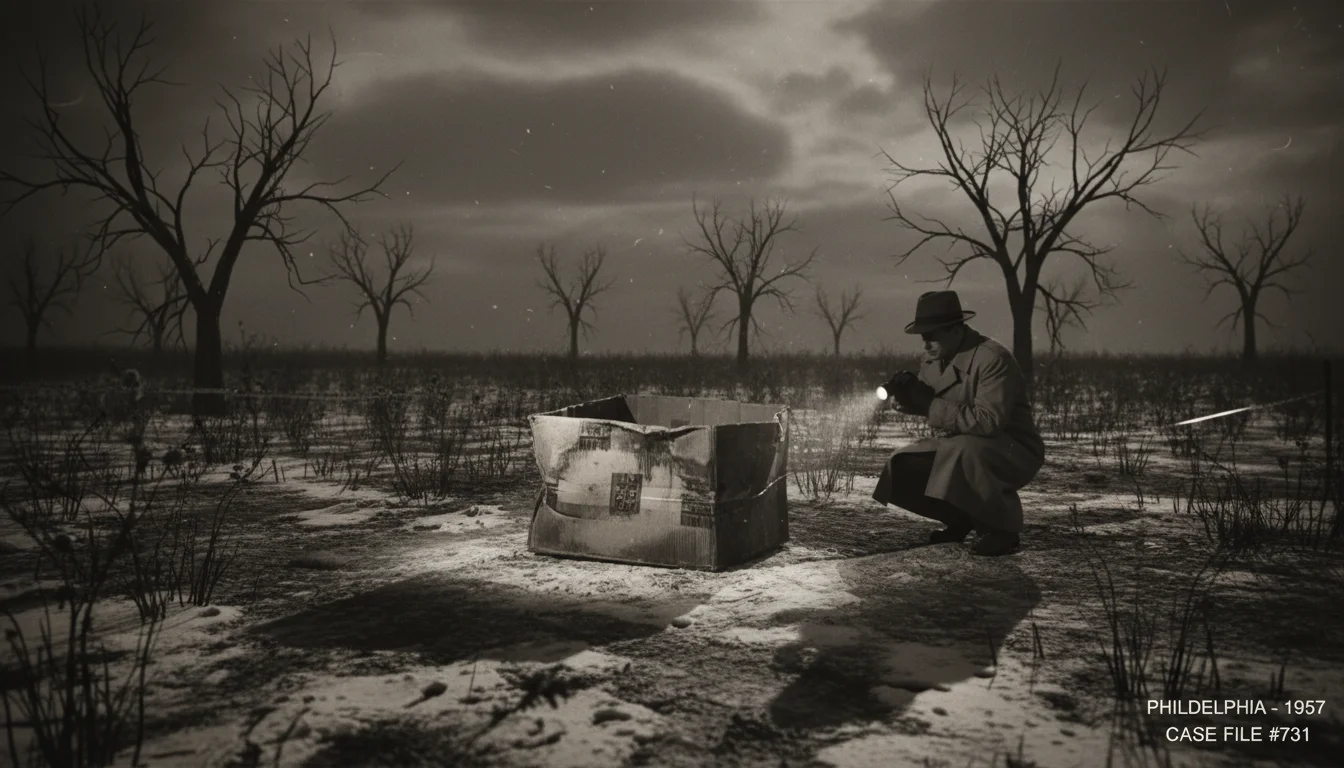
On February 25, 1957, a college student cutting through a desolate stretch of Susquehanna Road in Northeast Philadelphia noticed something in the brush. A large cardboard box - a bassinet box from J.C. Penney - sat among the bare winter trees. Curiosity drew him closer. What he found inside would haunt an entire city for decades.
Wrapped in a cheap plaid blanket lay the body of a small boy, roughly four to six years old. He was naked, malnourished, and covered in bruises. His hair had been crudely cut - recently, it seemed, as clippings still clung to his body. His fingernails and toenails were neatly trimmed, a strange contrast to the obvious neglect. Whoever this child was, someone had tried to clean him up before discarding him like trash.
The college student, afraid of drawing police attention to his own reason for being in the area - he was checking on muskrat traps - didn't report it right away. Days passed before another witness finally called it in. (For other long-cold American cases involving missing children, see the Charley Ross kidnapping and the Bobby Dunbar identity mystery.)
A City Mobilizes
The Philadelphia Police Department threw everything they had at the case. They distributed 400,000 flyers featuring the boy's photograph across the greater Philadelphia area. The image showed a child with light brown hair and blue eyes, his face eerily peaceful in death. Officers went door to door in surrounding neighborhoods. They checked every school, every hospital, every orphanage. They cross-referenced missing children reports from across the country.
Nothing.
No one claimed him. No one recognized him. In a city of two million people, not a single person came forward to say they knew this child.
The boy's body showed signs of chronic abuse. He had sustained multiple injuries over time, some old enough to have partially healed. The immediate cause of death was blunt force trauma to the head. He had been fed shortly before death - his stomach contained baked beans. But he was significantly underweight, his body telling a story of prolonged neglect.
Investigators traced the blanket to a nearby store, which had sold twelve of that pattern. They tracked down eleven buyers. The twelfth was never found. The J.C. Penney box was traced to a store that had sold it with a bassinet, but the buyer paid cash. Dead ends multiplied.
The Theories
Over the decades, several theories emerged, each more disturbing than the last.
The Foster Home Theory: In 2002, a woman identified only as "Martha" came forward to the Vidocq Society, a group of forensic professionals who had taken on the case. Martha claimed the boy was the illegally purchased son of her abusive mother. She said his name was Jonathan and that her mother had killed him in a fit of rage after he vomited his dinner - baked beans. She described her mother cutting the boy's hair in the bathtub before disposing of the body. Several details matched, but investigators couldn't fully corroborate her account, and Martha had a history of mental health issues that complicated her credibility.
The Hungarian Connection: Some investigators explored whether the boy might have been brought from Europe. In the 1950s, informal adoptions and child trafficking were more common than anyone wanted to admit. The boy's features and the lack of any American records pointing to his identity fueled speculation that he had come from overseas.
The Hospital Theory: A medical examiner noted that the boy's body had been professionally washed and his nails carefully maintained, suggesting someone with medical knowledge had prepared the body. A nearby children's home and several foster residences drew investigative attention, but no solid connection was ever established.
Decades of Devotion
What makes this case remarkable isn't just the mystery - it's the people who refused to let the boy be forgotten.
Philadelphia police detective Remington Bristow dedicated nearly his entire career to the case. From the moment he first saw the boy's body in 1957 until his death in 1993, Bristow spent his own money, his own time, and ultimately his own health pursuing leads. He bought a gravestone for the boy, who had been buried in a potter's field marked only as "America's Unknown Child." He kept files in his home, visiting the grave regularly, and once flew to California on his own dime to chase a tip. The case consumed him.
The Vidocq Society took up the investigation in 1998, bringing modern forensic techniques to bear. They exhumed the body in 2019 for advanced DNA testing, and a genealogical team began the painstaking process of building a family tree from genetic markers.
Local citizens formed volunteer groups. Someone always made sure flowers were on the grave. The boy who had no one in life had thousands of people who cared in death.
A Name at Last
On December 8, 2022 - sixty-five years after he was found - the Philadelphia Police Department announced they had finally identified the boy.
His name was Joseph Augustus Zarelli.
Using advanced DNA analysis and genetic genealogy - the same techniques that caught the Golden State Killer - investigators had traced the boy's family tree and confirmed his identity. Born on January 13, 1953, Joseph was the son of a couple in Philadelphia. The details of his family circumstances remain partially sealed, as the investigation into his murder technically remains open.
The identification confirmed what investigators had long suspected: this was a local boy, hidden in plain sight, failed by every system meant to protect children. He hadn't come from overseas. He hadn't been smuggled across state lines. He was a Philadelphia kid whose absence no one in authority ever noticed - or reported.
His gravestone was updated. The words "America's Unknown Child" were replaced with his name. For the first time in sixty-five years, Joseph Augustus Zarelli existed as more than a question mark.
What Remains Unanswered
Even with a name, the central question persists: who killed Joseph Zarelli?
His parents are both deceased, making criminal prosecution impossible. The precise chain of events that led to a small boy ending up beaten to death and stuffed in a cardboard box may never be fully reconstructed. Police have said they know more than they've publicly revealed, but with the primary suspects dead, the case exists in a painful limbo - solved enough to give a boy his name, but not enough to give him justice.
The Boy in the Box is no longer unknown. But his story remains a testament to how easily a child can fall through every crack in society. In 1957, a little boy disappeared from the world, and the world didn't notice. It took sixty-five years and revolutionary science to speak his name.
Joseph Augustus Zarelli. Born January 13, 1953. Died sometime before February 25, 1957. Finally remembered.

Want to Interrogate the Suspects?
Chat with historical figures and uncover the truth behind history's greatest mysteries.
Create your free account →No card required. Some figures and features require a paid plan.
Join the HistorIQly Club
Get smarter about the past.
Weekly stories, deep dives, and exclusive content straight to your inbox.