The Disappearance of Etan Patz: The Case That Changed America
Six-year-old Etan Patz vanished on a two-block New York walk in 1979. His disappearance launched the missing children movement and ended with a contested conviction that many investigators still question.
Read Wikipedia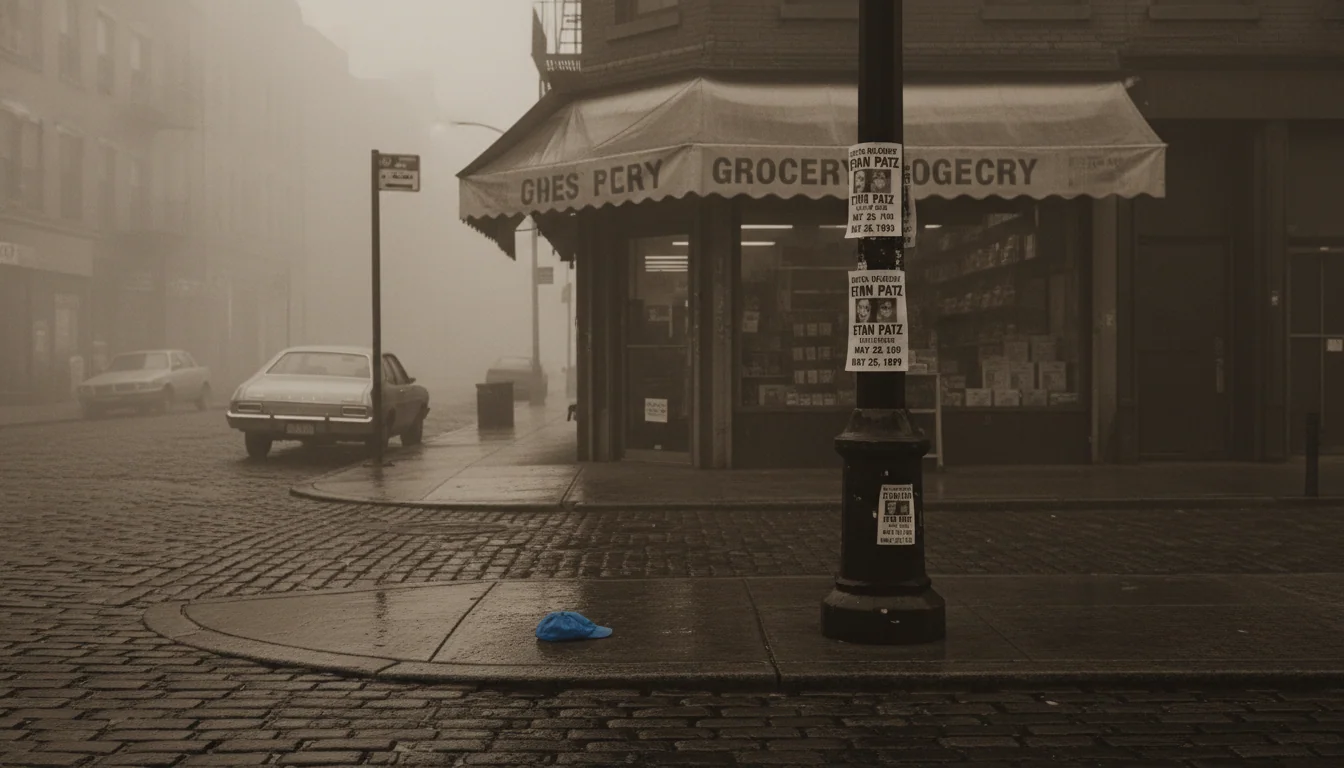
On the morning of May 25, 1979, six-year-old Etan Stanley Patz asked his parents for something most children want: to walk to the school bus stop alone. Two blocks. A route he had practiced with his parents. He was six years old and had been asking for weeks. His parents, Stan and Julie Patz, said yes. It was the first time.
Stan Patz watched from the doorway of their Prince Street apartment in SoHo as Etan, blond-haired and wearing a blue corduroy cap and a blue elephant-print shirt, walked down the block and turned the corner. He never came home.
The disappearance of Etan Patz became one of the most consequential unsolved cases in American history. Not because the circumstances were extraordinary. Because they were completely ordinary. A six-year-old. A walk to the school bus. Two blocks on a well-traveled street in a major American city. In a country where the safety of children had barely been thought about as a systemic policy problem, Etan's case tore open an awareness that permanently changed how America sees its youngest citizens.
The first hours
The Patz family waited before calling the police. Children come home late. Buses run slow. By the time the call went in, hours had passed, and any chance of a clean crime-scene investigation along the two-block route was compromised.
SoHo in 1979 was not the gallery-and-boutique neighborhood it would later become. It was a mixed commercial and residential district on the edges of gentrification, full of warehouses, small businesses, street vendors, and irregular foot traffic. Anyone could interact with a child there without drawing attention.
Police found nothing conclusive. No witnesses. No physical evidence. No body. Etan was simply gone, and no one along his walk could say with certainty they had seen him.
The FBI joined the investigation. Press coverage was immediate and intense. Etan's face, round-cheeked and blond, appeared on posters and in newspapers. His father was a freelance photographer and had taken hundreds of pictures of his children; the images were plentiful and arresting. The city was saturated with Etan's face, and he did not turn up.
Thirty years of Jose Ramos
For more than three decades, investigators circled a single name: Jose Antonio Ramos, a convicted pedophile from New York who had been a companion - and by some accounts more than that - of Sandy Harmon, a woman who had sometimes walked Etan to the bus stop and who knew the family's routines. Ramos had a documented history of luring children, and a former cellmate reported that Ramos had confided to him that he had taken a child he later identified as Etan, had sexually assaulted the boy, and had left him alive somewhere.
Ramos denied killing Etan. He maintained the child he encountered had been released unharmed. No physical evidence linked him conclusively to Etan's death. He was never charged with the crime.
In 2001, more than two decades after the disappearance, the Patz family sued Ramos in civil court. A judge found Ramos liable for Etan's death in a default civil judgment after Ramos refused to testify. The judgment carried no criminal weight and could not send him to prison. Ramos served out a separate child molestation sentence and was released in 2012.
The case had by then produced changes that outlasted the investigation. Etan's image became one of the first to appear on a milk carton, a nationwide program that launched in 1984 and placed missing children's photos in millions of refrigerators. The Missing Children Act of 1982 created the first national database for missing children's reports, mandating that the FBI enter missing children into its crime database upon request. The National Center for Missing and Exploited Children was founded in 1984, funded partly by federal money and partly by private donations catalyzed by the Patz case and others like it. President Ronald Reagan declared May 25 - the date of Etan's disappearance - as National Missing Children's Day in 1983.
The confession of Pedro Hernandez
In spring 2012, New York City police received a tip. A man in Maple Shade, New Jersey, had allegedly told members of his church group years earlier that he had once harmed a child in New York. The man was Pedro Hernandez, then fifty-one years old, who in 1979 had been eighteen and working in a basement grocery store at the corner of Prince Street and West Broadway - one block from the Patz apartment, directly on Etan's route to the bus stop.
Police brought Hernandez in for questioning. He confessed. He told detectives that he had lured Etan into the store's basement with the offer of a soda, choked him, placed his body in a garbage bag, and left it in the trash two blocks away. Etan's body has never been recovered. No physical evidence corroborated the confession.
The first trial began in 2015. It ended in a hung jury. One juror, who believed Hernandez's intellectual and mental health limitations made his confession inherently unreliable, refused to convict regardless of the other eleven jurors' votes.
The retrial in 2017 produced a different outcome. The jury convicted Hernandez of second-degree murder. He was sentenced to 25 years to life in prison.
Why the conviction has not ended the debate
The Hernandez conviction closed the case in official terms. It has not resolved it in the minds of many investigators and legal observers who have studied it closely.
Defense attorneys, including Barry Scheck of the Innocence Project, argued from the outset that the confession was unreliable. Hernandez was interrogated for hours without an attorney present. His description of the crime changed across multiple accounts - the location where he disposed of the body, the route he took, the details of the store. He could not accurately identify the specific building or describe Etan's clothing. He had a documented history of mental health problems and what defense experts characterized as a susceptibility to false confession under prolonged questioning.
Critics of the prosecution also noted the timing. Hernandez confessed in 2012, just months after Jose Ramos was released from prison and the investigation appeared to be at a dead end. The confession allowed authorities to close a case that had defined American child-safety policy for three decades. Some of the FBI agents who had spent years investigating Ramos remained skeptical of Hernandez even after the conviction.
The physical evidence connecting Hernandez to Etan's death amounts to nothing beyond his own statements. No forensic trace. No corroborating witness. No body.
In 2024, Hernandez's appeals remained active. The legal challenge centered on the admissibility of his confession and whether he received adequate representation. The outcome of those proceedings was not yet final at the time of writing.
The family that stayed
The most quietly devastating detail of the Etan Patz case is what his parents did in the years after his disappearance. They did not move. They stayed in the same Prince Street apartment where Etan had slept, where his room remained essentially unchanged for years, where Stan Patz had watched his son walk to the corner for the last time.
Stan Patz photographed, searched, appeared in interviews, and became a quiet and permanent figure in the missing children movement - defined by a grief that had no resolution and no body to bury. Etan was officially declared dead in 2001, which permitted the civil judgment against Ramos to proceed. The declaration did not make anything easier.
What remains unresolved
Whether Pedro Hernandez actually killed Etan Patz is a question the physical record cannot definitively answer. There is no body, no forensic trace linking Hernandez to the crime, no corroborating witness, and no account that remained consistent across multiple retellings.
Whether Jose Ramos killed Etan Patz is equally open - supported by somewhat stronger circumstantial evidence but equally free of physical proof. He was found civilly liable in 2001. He was never criminally charged.
The honest accounting, forty-seven years after May 25, 1979, is that the case remains genuinely contested at the evidentiary level, even as it is officially closed.
What is not contested is the legacy. Etan Patz is one of the reasons American children today grow up in a country with federal missing children databases, milk-carton campaigns, mandatory reporting systems, and a declared national day of awareness. He changed how a society thinks about the safety of the very young. And nobody who was changed by that can say with certainty what actually happened to him on a two-block walk on a spring morning in lower Manhattan. For other child disappearance cases that reshaped public awareness, see the Beaumont children disappearance in Australia and Asha Degree's disappearance in the United States.
Quick Answers
Common questions about this topic
Was anyone convicted of Etan Patz's murder?
Pedro Hernandez, who worked in a SoHo grocery store near the Patz apartment in 1979, confessed to police in 2012 and was convicted of second-degree murder in 2017 after a first trial ended in a hung jury. His conviction has been appealed, and as of 2024 his case remained in ongoing legal proceedings.
Who was the original suspect in the Etan Patz case?
For more than three decades investigators focused on Jose Antonio Ramos, a convicted pedophile who had been a companion of Etan's babysitter. In 2001 a civil court found Ramos liable for Etan's death, but he was never criminally charged. After Pedro Hernandez confessed in 2012, Ramos ceased to be the primary focus of the investigation.
Why is May 25 recognized as National Missing Children's Day?
President Ronald Reagan declared May 25 - the date of Etan Patz's disappearance in 1979 - as National Missing Children's Day in 1983, honoring the Patz family and drawing national attention to the problem of missing and exploited children.
What lasting changes did the Etan Patz case produce?
The case was a turning point for child safety policy. Etan was among the first missing children to appear on a milk carton, a practice that spread nationwide after 1984. The case contributed to the Missing Children Act of 1982, which created the first national database for missing children, and helped establish the National Center for Missing and Exploited Children in 1984.

Want to Interrogate the Suspects?
Chat with historical figures and uncover the truth behind history's greatest mysteries.
Create your free account →No card required. Some figures and features require a paid plan.
Join the HistorIQly Club
Get smarter about the past.
Weekly stories, deep dives, and exclusive content straight to your inbox.