The Bridge on the River Kwai vs. History: What Really Happened on the Death Railway
Bridge on the River Kwai historical accuracy: David Lean's Oscar-winning epic is brilliant cinema but poor history. Here's what really happened on the Death Railway.
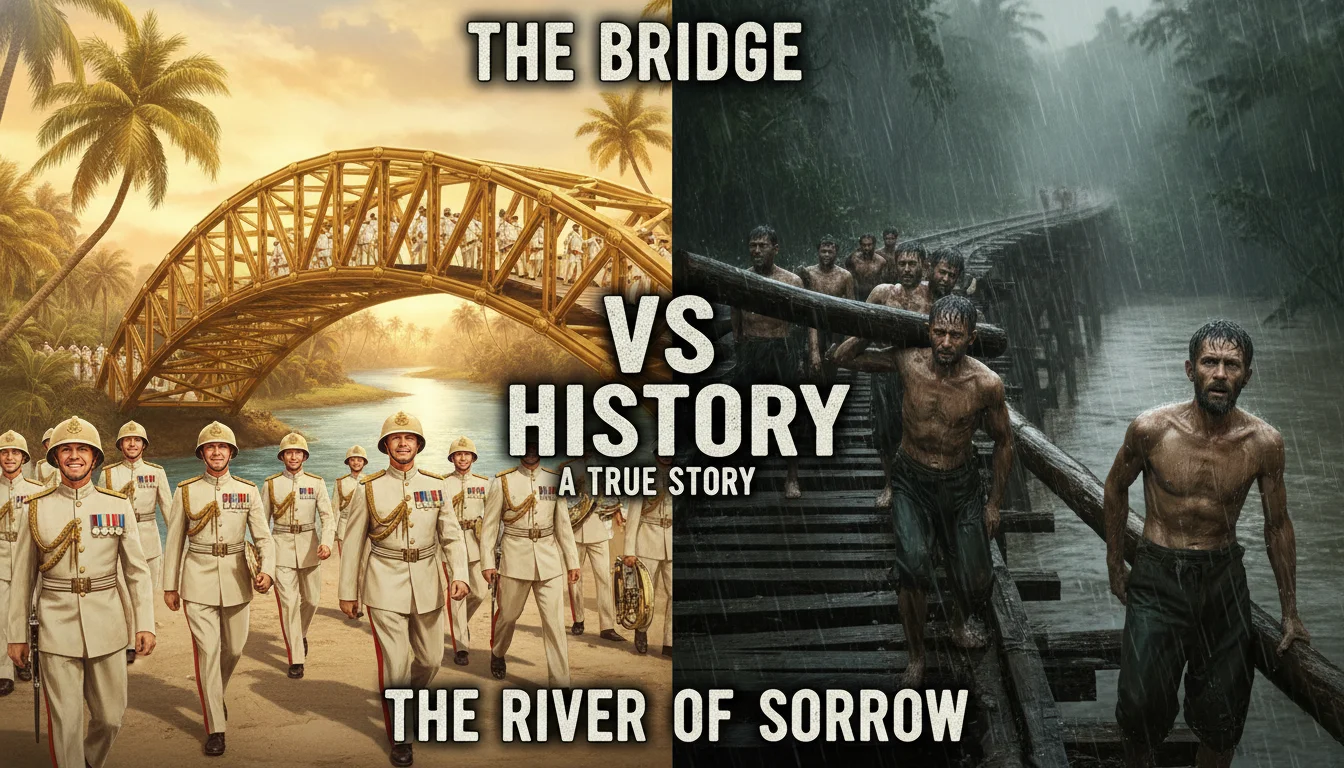
David Lean's 1957 epic The Bridge on the River Kwai remains one of cinema's greatest war films. Alec Guinness delivered an Oscar-winning performance as Colonel Nicholson, the stubbornly principled British officer who builds a bridge for his Japanese captors. William Holden played the cynical American who returns to destroy it. The film swept seven Academy Awards and permanently lodged itself in popular memory.
But the real story of the Burma-Siam Death Railway is far darker, more complex, and more harrowing than anything Hollywood showed.
What Hollywood Got Right
The Death Railway Was Real
The Japanese Imperial Army did force Allied prisoners of war and Asian laborers to build a 415-kilometer railway connecting Thailand (then Siam) to Burma between 1942 and 1943. The strategic goal was accurate: Japan needed a supply route to bypass the sea lanes around the Malay Peninsula, which were vulnerable to Allied submarines.
Brutal Conditions
The film hints at harsh conditions, but the reality exceeded anything shown on screen. Prisoners worked in tropical heat, monsoon rains, and dense jungle. Tropical diseases like cholera, dysentery, and malaria were rampant. Food was desperately insufficient. The film's depiction of sick prisoners being forced to work has a solid basis in fact.
Japanese Disregard for POW Rights
Colonel Saito's insistence that officers perform manual labor reflects a genuine cultural and military clash. The Japanese military code considered surrender dishonorable, and Japanese commanders genuinely viewed POWs with contempt. The Geneva Convention meant nothing to the Imperial Japanese Army, which had never ratified the 1929 treaty on prisoners of war.
There Were Real Bridges
Two bridges were indeed built over the Mae Klong River (later renamed the Kwae Yai) near Kanchanaburi, Thailand. A temporary wooden bridge was completed in February 1943, followed by a steel and concrete bridge in April 1943. Both were real, and both were targeted by Allied bombing.
What Hollywood Got Wrong
Colonel Nicholson Never Existed
The film's central character, the proud British colonel who collaborates with his captors to build a superior bridge as a monument to British engineering, is entirely fictional. The real senior British officer at the Kanchanaburi camp was Lieutenant Colonel Philip Toosey, and he was nothing like Nicholson. Toosey actually sabotaged construction efforts, organized secret resistance, protected his men from punishment, and smuggled medicine into the camp. He was furious about the film's portrayal and spent the rest of his life correcting the record.
The Bridge Was Never Blown Up in a Commando Raid
The film's dramatic climax, with commandos destroying the bridge in a daring raid, never happened. The real bridges were damaged by Allied bombing raids in 1944 and 1945, carried out by B-24 Liberators of the Royal Air Force and United States Army Air Forces. There was no special forces mission, no dramatic detonation, and no confrontation between a conflicted colonel and a demolition team.
The American Hero Was Invented
William Holden's character, Commander Shears, the escaped American POW who returns on the commando mission, is pure Hollywood invention. There were very few American POWs on the Death Railway. The workforce consisted primarily of British, Australian, and Dutch prisoners, along with an estimated 200,000 to 300,000 Asian forced laborers from Malaya, Burma, Java, and other occupied territories.
The Death Toll Was Massively Understated
The film suggests the bridge project was costly but focuses almost entirely on European POWs. In reality, approximately 12,000 Allied prisoners died during construction, a staggering number. But the forgotten tragedy is the Asian laborers: an estimated 90,000 to 100,000 Southeast Asian civilians perished. The film completely ignores their existence. They had no officers to advocate for them, no Geneva Convention protections, and received even less food and medical care than the POWs.
The Timeline Was Compressed
The film implies the bridge was built relatively quickly under one commander's watch. The actual railway took 16 months to complete, involved dozens of camps stretched along 415 kilometers, and required the labor of approximately 60,000 Allied POWs and up to 300,000 Asian workers. It was an industrial-scale atrocity, not a single-camp drama.
The Tone Missed the Horror
Perhaps the most significant distortion is tonal. The film, while tense and dramatic, feels like an adventure story about duty, honor, and conflicting principles. The real Death Railway was one of the worst war crimes of the 20th century. Survivors described conditions comparable to Nazi concentration camps. Men were beaten to death for minor infractions. Cholera victims were left to die in open pits. The "Speedo" period of 1943, when Japan demanded the railway be completed ahead of schedule, saw death rates spike catastrophically.
The Verdict
Historical Accuracy Score: 4/10
The Bridge on the River Kwai is a brilliant film that tells an almost entirely fictional story. The Death Railway was real, the bridges were real, and the suffering was real, but practically every character, plot point, and dramatic event was invented. Most critically, the film transforms a story of mass suffering and war crimes into a philosophical drama about one officer's misplaced pride. The real Colonel Toosey was a hero who fought for his men, not a deluded collaborator. And the 90,000 dead Asian laborers deserve more than total invisibility.
The film remains a masterpiece of cinema. It just happens to be terrible history.
For more WWII film fact-checks, see our breakdowns of The Great Escape and U-571.

Debate the Accuracy with the Real Figures
Ask the real people what Hollywood got wrong about their lives.
Chat with HistoryJoin the HistorIQly Club
Get smarter about the past.
Weekly stories, deep dives, and exclusive content straight to your inbox.