The Death of Stalin vs. History: How Accurate Is Armando Iannucci's Savage Soviet Satire?
The Death of Stalin historical accuracy: Iannucci's dark comedy captures the real paranoia, fear, and power struggle that followed Stalin's death in March 1953.
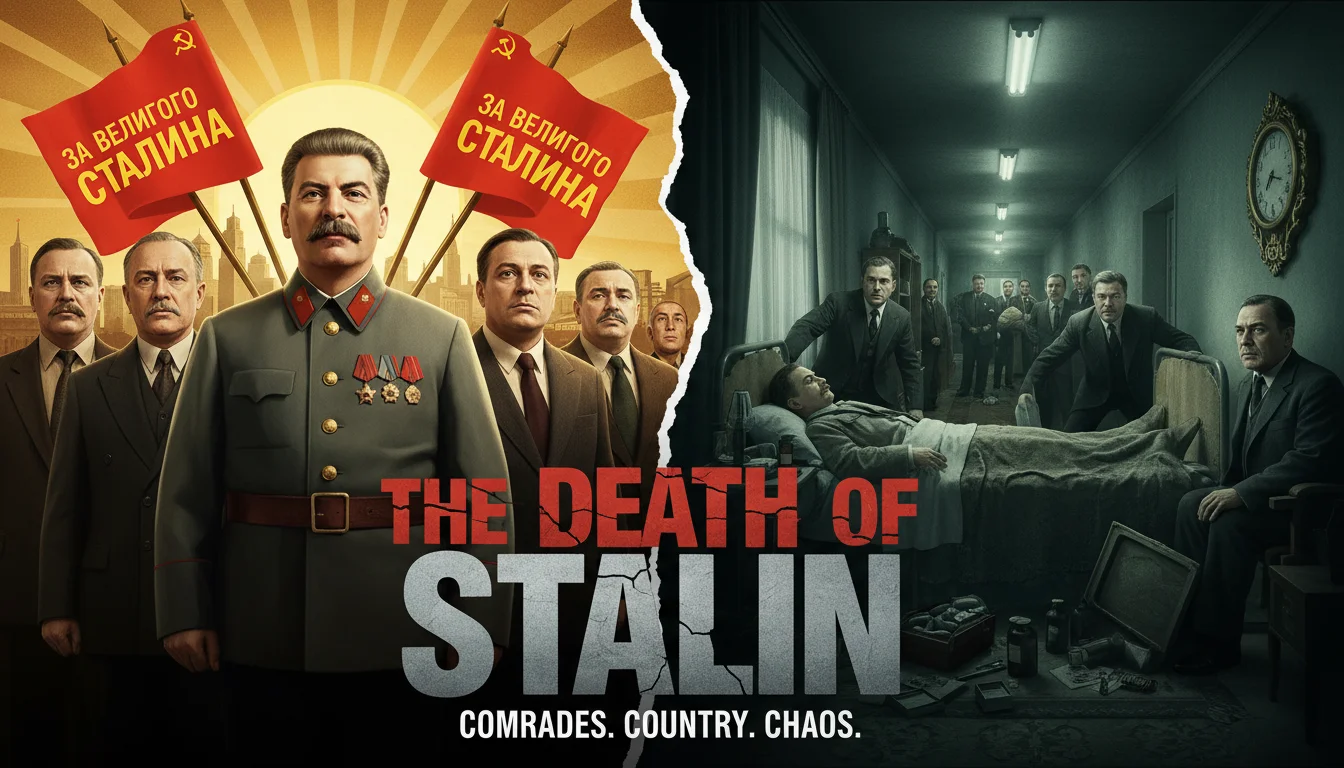
Armando Iannucci's The Death of Stalin (2017) has one huge advantage over most historical dramas: it understands that dictatorships are often ridiculous right up until they become murderous.
That is why the movie works so well. It is hilarious, fast, and vicious, but it is not just making things up for laughs. Beneath the farce is a very real story about a regime built on fear, a ruling elite terrified of one dying old man, and a scramble for power that could have reshaped the Cold War.
So how accurate is it?
More accurate than many solemn prestige dramas, honestly. The film compresses timelines, exaggerates personalities, and invents some scenes outright, but it gets the core reality of Stalin's final days and the struggle after his death remarkably well.
What Hollywood Got RIGHT
1. The atmosphere of fear is dead on
The single most accurate thing in the film is the mood.
When Stalin collapses, nobody knows what to do. Guards are afraid to enter his room. officials stall, whisper, and wait for someone else to take responsibility. That sounds absurd until you remember how Stalin ruled. He had spent decades purging real and imagined enemies, arresting loyal subordinates, and teaching everyone around him that initiative could be fatal.
That paralysis was real. Stalin's inner circle had been conditioned to fear him even when he was unconscious on the floor.
2. The doctors problem is based on reality
The film shows the leadership panicking because competent Moscow doctors are unavailable, in part because many had already been arrested.
That is rooted in the real "Doctors' Plot" of 1952-53, Stalin's final anti-Semitic purge campaign. Several prominent physicians had indeed been accused of conspiring to kill Soviet leaders. So when Stalin suffered his stroke on March 1, 1953, the regime had partly sabotaged its own medical system.
The movie turns this into dark comedy, but the underlying fact is true and grim.
3. Beria really was terrifying, and everyone knew it
Simon Russell Beale's Beria is the movie's real monster. That is not exaggeration.
Lavrentiy Beria had run the Soviet security apparatus, overseen arrests, deportations, torture, executions, and the wider machinery of terror. He also had a reputation for sexual predation that the film references only briefly. After Stalin's death, Beria really did look like one of the most dangerous men in the Soviet Union, and many of his colleagues genuinely feared he might seize total control.
The movie gets that balance right: Beria is efficient, politically agile, and so frightening that even hardened Soviet elites want him removed.
4. Khrushchev did outmaneuver stronger rivals
Steve Buscemi's Khrushchev seems almost too scrappy and unserious to win, which is precisely why the portrayal works.
In 1953, Nikita Khrushchev was not the obvious successor. Georgy Malenkov initially looked stronger on paper, and Beria looked more dangerous in practice. Yet Khrushchev proved to be the best political operator in the room. He built alliances, presented himself as less threatening than he was, and gradually emerged on top.
The film simplifies the process, but the broad arc is correct. Khrushchev was underestimated, and that helped him win.
5. Beria was really arrested by his colleagues with military backing
The movie's coup sequence, with Marshal Zhukov and armed officers moving against Beria, is dramatized but fundamentally true.
Beria was arrested in June 1953 through a conspiracy involving Khrushchev, Malenkov, and other Presidium members, backed by the military. Zhukov did play a major role. That part was not invented for cinematic excitement. Stalin's would-be heirs really did decide that if they did not eliminate Beria first, he might eliminate them.
What Hollywood Got WRONG
1. Maria Yudina probably did not kill Stalin with a note
The movie opens with a wonderful sequence involving pianist Maria Yudina, a rushed recording, and a note denouncing Stalin that seemingly shocks him into a stroke.
It is brilliant satire, but as history it is shaky.
Yudina was real, she did have a reputation for moral courage, and a famous story says Stalin admired her recording of Mozart. But the specific chain of events in the film is more legend than solid fact. Historians doubt the dramatic note-to-stroke sequence happened as shown.
It is the movie announcing its method early: emotionally true, factually slippery.
2. The timeline is heavily compressed
The film makes Stalin's death, funeral chaos, Beria's rise, and Beria's fall feel like one continuous fever dream.
In reality, Stalin died on March 5, 1953. Beria was not arrested at the funeral or the next day. He remained powerful for months and was only arrested in late June. He was later tried and executed in December.
This compression is understandable because the real sequence would have been harder to dramatize cleanly, but it matters. The film makes Beria's fall look almost immediate when in fact the post-Stalin struggle was longer and more uncertain.
3. The funeral crush is exaggerated in scale and certainty
The movie depicts a horrifying disaster outside Stalin's funeral, with huge numbers of civilians crushed or trampled.
There really were deadly crowd incidents during the mourning period. Large numbers of people converged on Moscow, and chaos around the funeral caused casualties. But the exact numbers remain disputed, and the film stages it with a kind of apocalyptic immediacy that goes beyond what historians can firmly document.
So the event is grounded in truth, but the presentation is heightened.
4. Some personalities are turned into comic archetypes
Malenkov as a vain, helpless dandy. Molotov as a baffled loyalist. Khrushchev as the guy quietly taking notes while everyone else self-destructs.
There is truth in all of these portrayals, but Iannucci pushes each figure toward caricature. Real Soviet leaders were often absurd, but they were also experienced, ruthless, and politically skilled. Malenkov, for example, was not just a nervous fool. He briefly became the Soviet premier because he was a serious power broker.
The film sacrifices nuance for speed and bite.
5. Beria's end is cleaner than the history
In the film, Beria is seized, denounced, and swiftly shot. Reality was messier.
After his arrest, Beria was secretly imprisoned, interrogated, tried by a special tribunal, and executed in December 1953. The charges mixed real crimes, political accusations, and staged legal theater. The movie prefers immediate moral closure. History, as usual, was slower and murkier.
What the Film Understands Better Than Most History Movies
What makes The Death of Stalin special is not that every detail is perfect. It is that the film understands the logic of a terror state.
Dictatorships are not efficient machines run by icy masterminds. They are often dysfunctional systems full of cowardice, vanity, guessing games, personal rivalries, and sudden violence. Stalin's USSR was all of that. The men around him were not cartoon idiots, but they were trapped inside a structure so paranoid that even basic decisions became dangerous.
That is why the movie's comedy lands. It is not laughing at history from a safe distance. It is showing how horror and absurdity can occupy the same room.
Historical Accuracy Score: 8/10
What it gets right:
- The climate of terror after decades of Stalinist purges
- The real importance of the Doctors' Plot context
- Beria's menace and political ambition
- Khrushchev's underdog rise
- The broad outline of Beria's military-backed removal
What it gets wrong or compresses:
- The Maria Yudina opening is more myth than fact
- The timeline is drastically compressed
- Several figures are caricatured for comic effect
- Funeral casualties are dramatized beyond the firm evidence
- Beria's arrest and execution are simplified
The verdict:
The Death of Stalin is not a documentary, but it is one of the sharpest historical films of the last decade because it gets the essential truth right. Stalin's court really was full of frightened schemers. Beria really was a menace. Khrushchev really did survive by being shrewder than he looked.
If you want a perfect chronology, this is not it. If you want a movie that captures the insanity of power in the Soviet Union's most dangerous transition, it is uncomfortably close.
That is what makes it so funny, and so chilling.
Further Reading:
- Stalin: The Court of the Red Tsar by Simon Sebag Montefiore
- Khrushchev: The Man and His Era by William Taubman
- Beria: Stalin's First Lieutenant by Amy Knight
Watch Next: For more power, paranoia, and historical mythmaking, see our breakdowns of Downfall, Oppenheimer, and The Iron Lady.

Debate the Accuracy with the Real Figures
Ask the real people what Hollywood got wrong about their lives.
Chat with HistoryJoin the HistorIQly Club
Get smarter about the past.
Weekly stories, deep dives, and exclusive content straight to your inbox.