Reagan vs. History: How Accurate Is the Dennis Quaid Biopic?
Reagan 2024 movie accuracy reviewed: the Dennis Quaid biopic gets the biography broadly right but invents its Soviet narrator and skips Iran-Contra almost entirely.
Read Wikipedia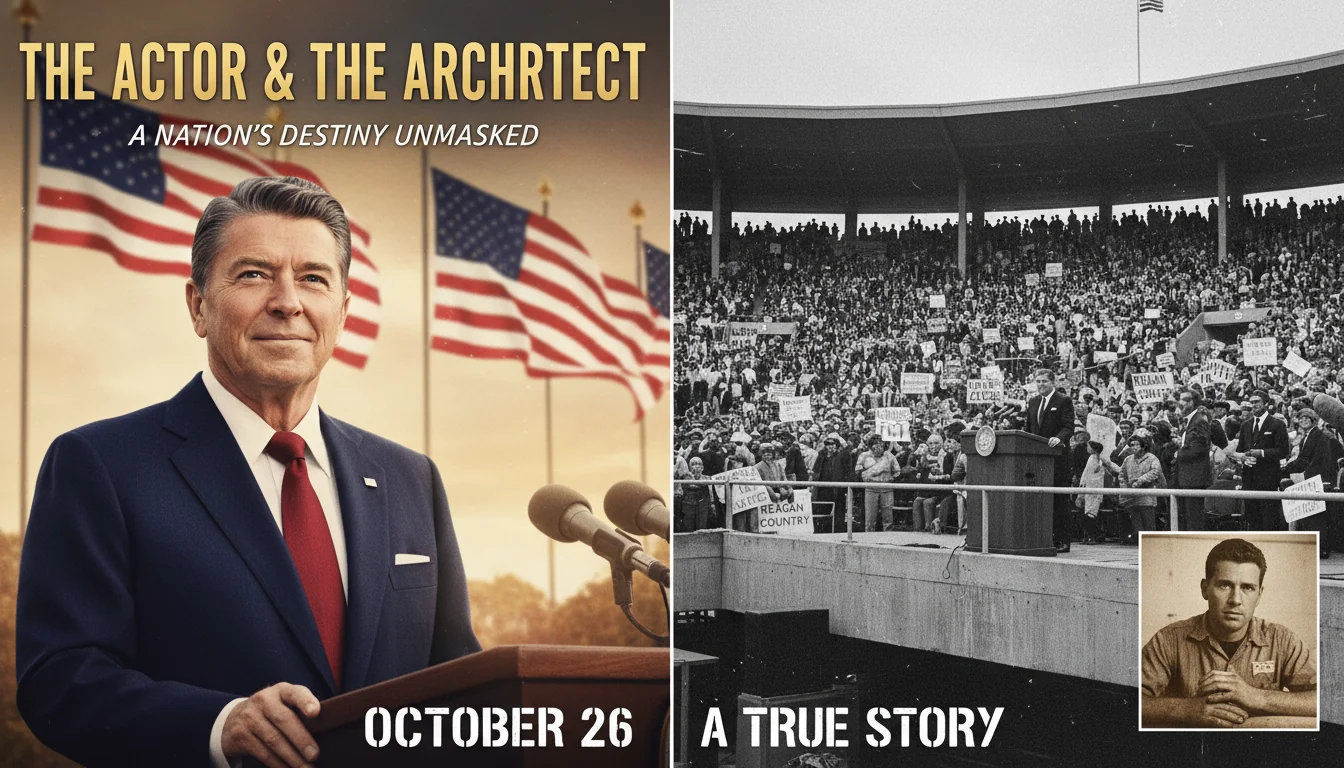
The 2024 film Reagan arrives with a clear purpose. It is not primarily a historical document. It is a memorial project - a formal tribute to the 40th president made by people who admire him, using the biographical form as a delivery vehicle for a political argument. That does not automatically make it inaccurate, but it does mean the film's accuracy has a ceiling built in. Uncomfortable facts that complicate the portrait are not welcome, and several of them were left out.
Knowing that, the question becomes: on the events and people it does choose to show, how well does the film hold up?
The answer is mixed. The broad strokes of Reagan's biography are depicted with reasonable faithfulness. The invented framing device is pure fiction. The Cold War section is dramatically compressed. And the film's silence on several major episodes of the Reagan presidency is a distortion by omission as significant as any factual error.
What Hollywood Got RIGHT
Reagan's origins and political evolution
The film correctly establishes that Ronald Reagan was not born a conservative. He grew up in a Depression-era Democratic family in Dixon, Illinois, admired Franklin Roosevelt, and entered Hollywood as a New Deal liberal. His presidency of the Screen Actors Guild during the early Cold War years, his cooperation with FBI investigations of Hollywood communism, and his slow drift toward Republican politics through his work as a corporate spokesman for General Electric during the 1950s - all of this is broadly accurate.
The film captures the GE years correctly: Reagan spent eight years touring factories and speaking to workers for General Electric Theater, developing the smooth populist conservatism that would define his career. By the time he delivered his famous 1964 televised speech, "A Time for Choosing," in support of Barry Goldwater's presidential campaign, the transformation was complete. The film depicts this correctly as a watershed moment.
The 1966 and 1980 campaigns
Reagan's career as California governor from 1967 to 1975 is covered quickly but not inaccurately. The film gives appropriate weight to his successful 1980 presidential campaign against Jimmy Carter, including the famous debate moment ("There you go again") and the sense of a country looking for relief after a decade of stagflation, Vietnam, Iran, and Watergate.
The economic context of the 1980 election is sketched faithfully: double-digit inflation, an energy crisis, 52 American hostages in Tehran. Reagan's election-night victory and the simultaneous release of the Iranian hostages (a timing that has been the subject of conspiracy theories the film wisely avoids speculating on) are handled straightforwardly.
The assassination attempt
The March 30, 1981 assassination attempt by John Hinckley Jr. is depicted with basic accuracy. Reagan was shot outside the Washington Hilton Hotel after a speaking engagement. The bullet entered under his arm, deflected off a rib, and lodged near his heart. He was far more gravely wounded than initially reported to the public. His recovery and his reported quip to surgeons - "I hope you're all Republicans" - are genuine. The film gives this section appropriate weight.
SDI and the Soviet pressure
The film's argument that Reagan's Strategic Defense Initiative (SDI), the so-called "Star Wars" missile defense proposal, placed unsustainable economic and psychological pressure on the Soviet Union is a legitimate historical position, though not one that all scholars share. The Soviet leadership's alarm about SDI - particularly evident in the 1986 Reykjavik summit negotiations with Mikhail Gorbachev - is documented.
What Hollywood Got WRONG
The Viktor Petrovich framing device
The most fundamental problem in the film is its structure. The entire story is narrated by a fictional KGB officer named Viktor Petrovich, played by Jon Voight, who claims to have tracked Reagan from his Hollywood years through the end of the Cold War as an assigned intelligence subject. This framing is complete invention.
No such figure existed. No known Soviet intelligence file on Reagan in his Hollywood years has been documented as the product of ongoing surveillance by a single named officer. The device is used to let the film tell the audience what to think about Reagan by having his "enemy" express reluctant admiration. It is a hagiographic technique, not a historical one.
Iran-Contra is barely acknowledged
The Iran-Contra affair - the secret sale of weapons to Iran and the diversion of proceeds to Nicaraguan rebels, both in violation of Congressional restrictions - was the most serious scandal of Reagan's presidency. It led to the conviction of multiple administration officials and raised genuine questions about whether Reagan knew more than he admitted.
The film skirts this almost entirely. A brief oblique reference does not begin to capture the complexity of what happened or the damage it did to Reagan's second term. For a film that presents itself as a serious biography, the near-omission of Iran-Contra is a significant choice.
The AIDS crisis
Between 1981 and the end of Reagan's presidency in 1989, tens of thousands of Americans died of AIDS. Reagan did not publicly mention the disease until 1987, six years into the epidemic. His response to the crisis, shaped partly by the social conservatism of his base, has been a subject of serious historical criticism. The film does not engage with it.
The Cold War's end is oversimplified
The film presents Reagan as the central figure in winning the Cold War. This is a defensible view with serious scholarly advocates. It is also a significant oversimplification. Mikhail Gorbachev's internal reforms - glasnost and perestroika - were independent decisions by a Soviet leader responding to the structural collapse of the Soviet economy and the political delegitimization of the Communist Party. Pope John Paul II, the Solidarity movement in Poland, dissidents throughout Eastern Europe, and decades of containment policy under multiple American presidents all played documented roles.
The film's Reagan is the decisive actor. History's Reagan was one important actor in a much larger drama.
The 1984 landslide and the "Morning in America" campaign
The film correctly establishes Reagan's reputation as "The Great Communicator," and this reputation is historically well-founded. His 1984 re-election campaign, with its famous "Morning in America" television advertisements, is depicted as the product of a genuinely skilled political communicator working with a favorable economic recovery. Reagan carried 49 states in 1984, the largest Electoral College margin in American history to that point. The film's portrayal of his rhetorical gifts is its most consistently accurate element.
Historical Accuracy Score: 5/10
Reagan gets the broad outline of its subject's life broadly right: the Illinois childhood, the Hollywood career, the political evolution, the communication gifts, the assassination attempt, and the Cold War policy framework. These are real events depicted without significant distortion.
What pulls the score down is the combination of a fictional framing device that is presented as if it illuminates truth, the strategic omission of Iran-Contra and the AIDS crisis, and the film's unwillingness to show Reagan making any significant mistake. Hagiography is not the same as history, and when a biographical film about a controversial president leaves out most of the controversy, it is telling a story - it is just not telling the whole one.
What the film gets most right: Reagan's biography from Dixon to the 1980 campaign and the assassination attempt.
What it gets most wrong: The fictional Soviet narrator is pure invention, and the silence on Iran-Contra and the AIDS response are distortions by omission.
Audiences who want to understand Ronald Reagan will learn something from this film and will need to read considerably more.
For other political and biographical films fact-checked against the record, see All the President's Men vs. History and Bohemian Rhapsody vs. History.
Quick Answers
Common questions about this topic
Is the 2024 Reagan film based on a true story?
It is based partly on the biography The Crusader: Ronald Reagan and the Fall of Communism by historian Paul Kengor. The film depicts broadly documented events from Reagan's life, from his Hollywood career through the presidency. However, its central framing device - a Soviet intelligence officer who has tracked Reagan for decades - is a fictional invention with no historical basis.
How accurate is Dennis Quaid's portrayal of Reagan?
Quaid captures Reagan's public mannerisms, his self-deprecating humor, and his optimistic delivery with reasonable accuracy. The film correctly depicts Reagan's background as a New Deal Democrat who moved steadily rightward through the 1950s and 1960s, his charismatic communication style, and his personal charm. Critics note that the film avoids Reagan's less flattering episodes almost entirely.
What does the Reagan biopic get wrong?
The most significant inaccuracy is structural: the entire framing through a fictional Soviet defector narrating Reagan's life is invented. The film also almost completely omits Iran-Contra, the AIDS crisis response, and the internal debates within his administration. It presents a simplified portrait of the Cold War's end that credits Reagan as its primary architect, which is a significant compression of complex history.
When was the Reagan biopic released?
The film was released in cinemas in August 2024, directed by Sean McNamara. Jon Voight played Viktor Petrovich, the fictional Soviet defector narrator. Penelope Ann Miller portrayed Nancy Reagan.

Debate the Accuracy with the Real Figures
Ask the real people what Hollywood got wrong about their lives.
Create your free account →No card required. Some figures and features require a paid plan.
Join the HistorIQly Club
Get smarter about the past.
Weekly stories, deep dives, and exclusive content straight to your inbox.