The Aviator vs. History: How Accurate Is Scorsese's Howard Hughes Epic?
The Aviator historical accuracy examined: what Scorsese's DiCaprio-led biopic got right about Howard Hughes's aviation records, OCD, and the Spruce Goose.
Read Wikipedia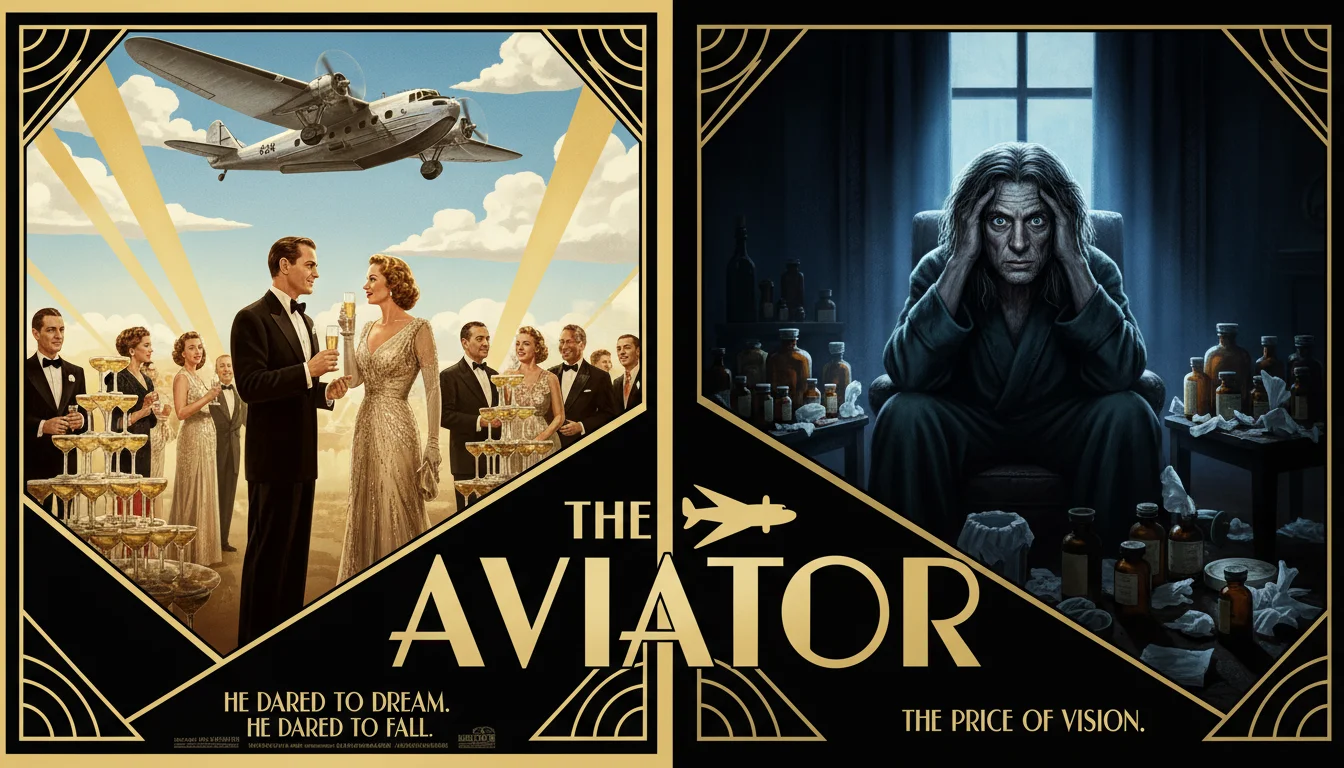
When Martin Scorsese released The Aviator in 2004, he delivered a sweeping portrait of one of America's most fascinating and troubled figures. Leonardo DiCaprio transformed into Howard Hughes, the aviation pioneer, filmmaker, and billionaire whose brilliance was matched only by his descent into mental illness. The film won five Academy Awards and earned DiCaprio his first Best Actor nomination.
But how much of this glamorous saga actually happened? Let's examine what Scorsese and screenwriter John Logan got right - and where they took creative liberties with one of the 20th century's most complex personalities.
What Hollywood Got RIGHT
Hughes's Aviation Achievements Were Real
The film accurately portrays Hughes as a genuine aviation visionary. He really did set the world airspeed record in 1935, flying 352 mph in a plane of his own design - the H-1 Racer. He did fly around the world in 1938 in just 91 hours, shattering the previous record. These weren't exaggerated Hollywood achievements; Hughes was genuinely one of the greatest pilots of his era.
The film's depiction of Hughes personally test-flying his aircraft is also accurate. He was a hands-on innovator who refused to let others take risks he wouldn't take himself. The near-fatal crash of the XF-11 reconnaissance plane in 1946, shown dramatically in the film, really happened. Hughes crashed into three houses in Beverly Hills, suffering severe injuries including a collapsed lung, multiple broken ribs, and third-degree burns.
The Hell's Angels Production Was Grueling
Hughes's obsessive production of Hell's Angels (1930) is portrayed accurately as one of the most expensive and troubled shoots in early Hollywood history. He really did reshoot the entire film when sound technology emerged, refusing to release a silent picture. He really did wait months for the right cloud formations for aerial sequences. And yes, three pilots died during filming - a detail the film handles with appropriate gravity.
His OCD Symptoms Were Documented
DiCaprio's portrayal of Hughes's obsessive-compulsive disorder remains one of the most clinically accurate depictions of mental illness in cinema. Hughes really did have elaborate rituals around cleanliness, fear of contamination, and repetitive behaviors. Contemporaries documented his habit of repeating phrases, his fear of germs, and his increasingly elaborate quarantine procedures. The scenes of Hughes isolating himself in darkened screening rooms, surrounded by tissue boxes and milk bottles, are based on documented behavior from his later years - though the film compresses the timeline.
Katharine Hepburn Confirmed the Relationship
The romance between Hughes and Katharine Hepburn, portrayed by Cate Blanchett in an Oscar-winning performance, was real. Hepburn herself confirmed the relationship in interviews and her autobiography. The basic dynamic - two strong-willed, unconventional people who both needed independence - rings true. Hepburn did bring Hughes home to meet her eccentric Connecticut family, and the relationship did end partly because neither would compromise their careers.
The TWA vs. Pan Am Battle Happened
Hughes's war with Juan Trippe and Pan American World Airways over international routes is based on fact. Hughes really did face congressional hearings where Senator Owen Brewster grilled him about defense contracts and his relationship with the government. Hughes's defiant testimony, portrayed in the film as a defining moment, was considered a triumph at the time. He successfully painted Brewster as a Pan Am stooge, and the investigation fizzled.
What Hollywood Got WRONG
The Hercules Timeline Is Compressed
The H-4 Hercules - the massive flying boat known derisively as the "Spruce Goose" - gets significant screen time, but the film compresses and alters the timeline. The Hercules was designed during World War II as a troop transport, but it wasn't completed until 1947, well after the war ended. The film suggests Hughes flew it to prove critics wrong during the Senate hearings, but in reality, the famous flight happened months after the hearings concluded.
Additionally, while the film implies the government wanted Hughes to testify about the Hercules specifically, the hearings were more broadly about his wartime contracts and alleged fraud. The Hercules was just one of several projects under scrutiny.
Katharine Hepburn's Portrayal Has Issues
While Cate Blanchett won an Oscar for her performance, many who knew Hepburn noted inaccuracies. Blanchett played Hepburn as extremely high-strung and affected; the real Hepburn, while theatrical, was also known for her earthiness and directness. Some critics felt the performance bordered on caricature.
More significantly, the timeline of Hughes's relationships is compressed. The film suggests Hughes moved directly from Hepburn to Ava Gardner; in reality, there were years and multiple other relationships in between.
The OCD Progression Is Simplified
While Hughes did suffer from severe OCD, the film's depiction suggests a relatively rapid decline during the 1940s. In reality, Hughes's mental health deteriorated more gradually over decades. The extreme behaviors shown in the film - complete isolation, fear of contamination, repeating phrases - became most severe in the 1950s and 1960s, well after the film's timeline ends.
The causes were also more complex than the film suggests. Hughes's crash injuries left him dependent on codeine, and his drug use likely accelerated his mental decline. The film hints at this but doesn't fully explore the role of addiction in his deterioration.
Noah Dietrich's Role Is Underplayed
John C. Reilly plays Noah Dietrich, Hughes's longtime business associate, but the film understates his importance. Dietrich effectively ran Hughes's business empire for 32 years and was far more central to Hughes's success than the film suggests. The real Dietrich wrote a revealing memoir about his time with Hughes that painted a more complicated picture of their relationship than the loyal subordinate shown on screen.
The Hollywood Glamour Is Exaggerated
The film portrays Hughes as the center of Hollywood's social universe, surrounded by stars and starlets. While Hughes did date famous actresses and was part of the Hollywood scene, he was also notoriously antisocial and awkward. Many contemporaries described him as uncomfortable at parties and prone to disappearing mid-conversation. The smooth, charming Hughes of the film's early scenes is partially a Hollywood invention.
Hughes's Darker Side Is Minimized
The film presents Hughes largely sympathetically - an innovative genius battling mental illness. It downplays some of his less admirable qualities. Hughes was known for his ruthless business tactics, his exploitation of employees, and his controlling behavior toward women he dated. He kept detailed files on people, had them followed, and used private investigators extensively.
His later treatment of actresses - including Ava Gardner - could be controlling and paranoid. The film hints at this jealousy but frames it primarily as a symptom of his illness rather than a character trait.
The Aviator Historical Accuracy Score: 7/10
The Aviator is among the more accurate Hollywood biopics, particularly in its depiction of Hughes's aviation achievements and the broad strokes of his life story. Scorsese clearly did his research, and DiCaprio's preparation for the role was extensive.
Where the film stumbles is in its compression of timelines (common in biopics), its tendency to soften Hughes's rougher edges, and its somewhat simplified view of his mental illness. The real Howard Hughes was more complicated than the romantic figure on screen - more brilliant, more disturbed, and ultimately more tragic.
The film wisely ends in 1947, before Hughes's most extreme decline. The Howard Hughes of the 1950s and 1960s - completely isolated, emaciated, addicted to drugs, watched by armed guards - would have made for a much darker film. By ending where it does, Scorsese captures Hughes at a triumphant moment while hinting at the darkness to come.
For viewers interested in the real Howard Hughes, The Aviator serves as an excellent introduction. Just remember that the man behind the legend was even more complex - and ultimately more troubled - than any film could fully capture.
Want to Know More?
For the full story of Howard Hughes, read Donald Barlett and James Steele's definitive biography Empire: The Life, Legend, and Madness of Howard Hughes. Noah Dietrich's memoir Howard: The Amazing Mr. Hughes provides an insider's perspective, though it should be read with awareness of Dietrich's complicated departure from Hughes's employ.
For another music biopic tested against the historical record, see our Bohemian Rhapsody vs. history breakdown. The Catch Me If You Can accuracy review examines another larger-than-life figure whose Hollywood story diverged from fact.

Debate the Accuracy with the Real Figures
Ask the real people what Hollywood got wrong about their lives.
Create your free account →No card required. Some figures and features require a paid plan.
Join the HistorIQly Club
Get smarter about the past.
Weekly stories, deep dives, and exclusive content straight to your inbox.