The Departed vs. History: How Accurate Is Scorsese's Boston Crime Epic?
The Departed historical accuracy: Scorsese drew from Whitey Bulger's real FBI corruption story. Here's what Hollywood got right - and what it left out.
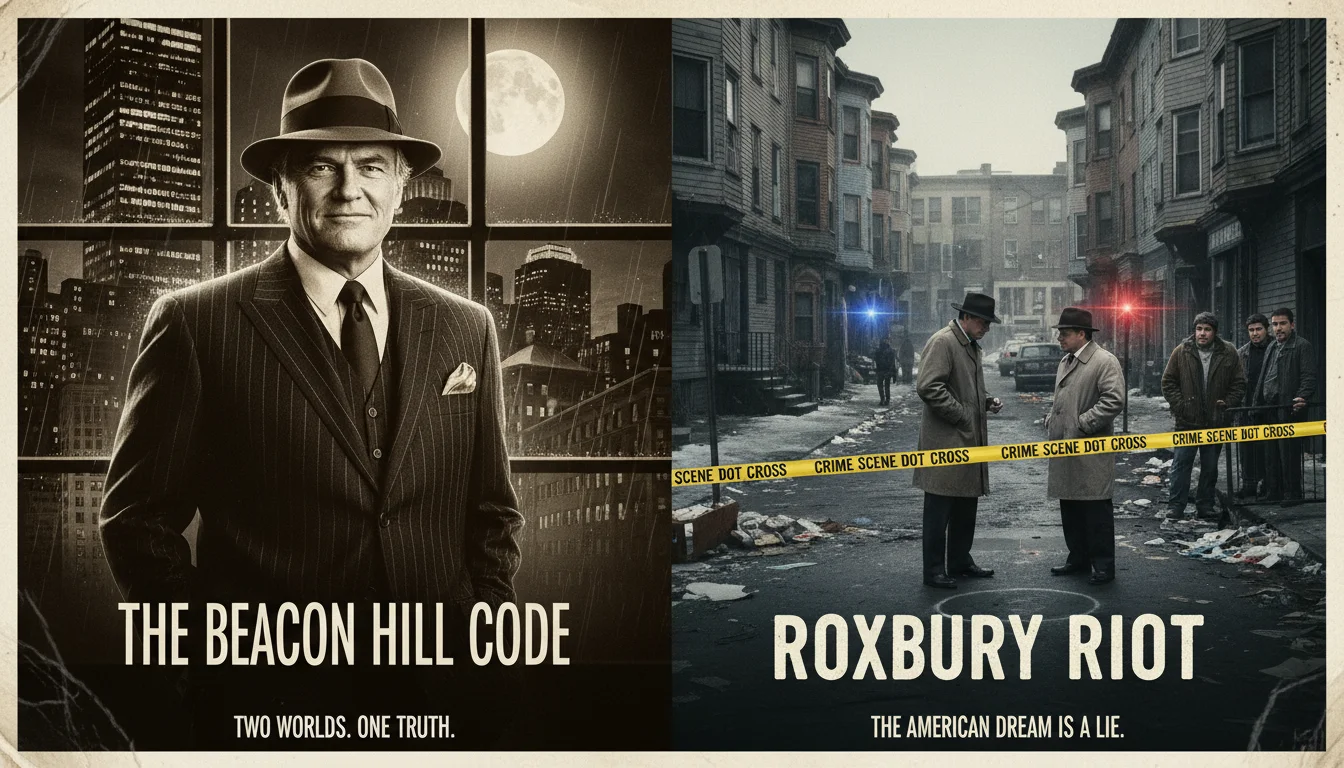
The Departed historical accuracy has long been debated, given how freely the film compressed a decades-long corruption scandal into a single taut thriller. In 2006, Martin Scorsese finally won his long-overdue Best Picture Oscar for The Departed, a tightly wound crime thriller about a Boston cop who infiltrates the Irish mob while a mob mole simultaneously infiltrates the police. The film was marketed as a remake of the Hong Kong thriller Infernal Affairs, but its real source material lay much closer to home - in the blood-soaked streets of South Boston and one of the most shameful chapters in FBI history.
The story of James "Whitey" Bulger, the brutal crime boss who spent decades as an FBI informant while running a criminal empire, is almost too audacious for fiction. And yet The Departed only scratched the surface.
What Hollywood Got RIGHT
The FBI Really Did Protect a Murderer for Decades
Jack Nicholson's Frank Costello is a composite character, but his central relationship with the FBI mirrors Bulger's arrangement with shocking accuracy. From 1975 to 1990, Whitey Bulger served as a "Top Echelon Informant" for the FBI, feeding them intelligence on the Italian Mafia while running his own criminal enterprise with near-complete immunity.
FBI agent John Connolly - the real-life inspiration for elements of the film - grew up in the same South Boston housing project as Bulger. Connolly recruited Whitey and then spent the next two decades protecting him, tipping him off to investigations, wiretaps, and even planned arrests. When Whitey was finally indicted in 1995, Connolly warned him in advance. Bulger fled and spent 16 years on the FBI's Most Wanted list.
The corruption was staggering. Connolly and his supervisor John Morris accepted cash, gifts, and cases of wine from Bulger. Morris even leaked the names of informants to Whitey - men who were subsequently murdered. The FBI didn't just look the other way; they actively enabled a serial killer.
The Mole Inside Law Enforcement
Matt Damon's Colin Sullivan, the mob mole who rises through the Massachusetts State Police, had multiple real-world counterparts. John Connolly himself functioned as an insider, but even more directly, several corrupt detectives and cops in Boston fed Bulger information for years.
State Police Colonel John O'Donovan was later convicted of tipping off bookmakers connected to Bulger's organization. Boston Police detective John Naimovich fed information to organized crime figures. The rot extended throughout Boston law enforcement.
The film's portrayal of a mole who appears competent and dedicated while secretly serving the mob accurately captures how these men operated. They didn't act suspicious. They built careers. They attended funerals for colleagues. And they got people killed.
The Brutal Violence
Some viewers found Frank Costello's casual sadism over-the-top. It wasn't. Whitey Bulger personally participated in at least 11 murders, possibly 19. He strangled women. He shot people in the head while they begged for their lives. He extracted teeth from victims' corpses to prevent identification.
In 1981, Bulger and his partner Steve Flemmi murdered Debra Davis, Flemmi's girlfriend, because she knew too much. They strangled her and buried her in a shallow grave. When Bulger's girlfriend Debbie Hussey became a liability in 1985, they killed her too - Bulger strangling her while Flemmi, her stepfather, held her down.
The matter-of-fact cruelty Nicholson brings to Costello? Bulger was worse.
The South Boston Setting
The Departed captures the insular, tribalistic nature of South Boston - a neighborhood where loyalty to your own was paramount and talking to law enforcement was the ultimate betrayal. Bulger exploited this culture brilliantly. He positioned himself as a Robin Hood figure who kept drugs out of Southie and protected the neighborhood from outsiders.
It was a lie. Bulger flooded South Boston with cocaine and used the proceeds to build his empire. But the myth persisted because Whitey understood his community's psychology. He attended wakes. He handed out turkeys at Thanksgiving. He remembered names. And anyone who threatened to expose him faced a stark choice: silence or death.
What Hollywood Got WRONG
The Timeline Compression
The Departed unfolds over what appears to be a few years at most. The real story stretched across decades. Bulger's relationship with the FBI began in 1975. John Connolly cultivated him for 15 years before the arrangement finally collapsed. The investigation that ultimately brought Bulger down took another decade.
The film necessarily compresses this into a manageable narrative, but it loses something important: just how long the FBI's complicity lasted. This wasn't a brief lapse in judgment. It was an institutional failure that spanned generations.
Bulger Wasn't a Mob Boss Like Costello
Frank Costello in the film leads a traditional organized crime family with clearly defined hierarchies. The real Whitey Bulger operated differently. He ran the Winter Hill Gang, which was more of a loose association of criminals than a structured mafia family. His power came not from being a don but from his FBI protection and his willingness to murder anyone who crossed him.
Bulger also wasn't primarily a hands-on operator in his later years. He collected tribute from other criminals, ran extortion schemes, and controlled drug trafficking through fear rather than direct management. The swaggering, quotable Costello is far more theatrical than the calculating, ice-cold Bulger.
The Ending Was Too Clean
Spoiler alert for a 20-year-old film: The Departed ends with almost everyone dead. Costello is killed by his own mole when the FBI relationship is exposed. The mole is eventually discovered and executed. Justice, of a sort, prevails.
Reality was messier and less satisfying. Whitey Bulger escaped in 1995 and lived freely in Santa Monica, California, for 16 years. He was finally captured in 2011 at age 81, living quietly with his longtime girlfriend. He was convicted of 11 murders in 2013 and sentenced to two consecutive life terms.
John Connolly was convicted of racketeering in 2002 and later convicted of second-degree murder for his role in a 1982 killing. He remains in prison. His supervisor John Morris received immunity in exchange for his testimony - a deal that infuriated many.
Several FBI officials who enabled Bulger faced no consequences at all. The institutional reckoning never fully happened.
The Romantic Subplot
Vera Farmiga's psychiatrist character, who becomes romantically involved with both the cop and the mole, is pure Hollywood invention. While the real figures had complicated personal lives - Connolly was a serial philanderer and Bulger had multiple girlfriends - there was no love triangle at the center of the story.
This addition serves the film's themes about identity and deception, but it has no historical basis.
Historical Accuracy Score: 6/10
The Departed is an excellent crime film that uses the Bulger story as a springboard rather than attempting documentary accuracy. The central concept - FBI protecting a murderous informant while moles infest law enforcement - is absolutely historical. The atmosphere, the violence, and the institutional corruption all ring true.
But the film is ultimately more interested in being a Greek tragedy about identity than in exploring the full scope of the Bulger scandal. It takes real outrage and channels it into a tight, satisfying genre piece. The actual story was slower, uglier, and involved far more people getting away with terrible things.
What the film gets most right is the bitter taste it leaves. The Departed suggests that the system cannot be trusted, that the people sworn to protect us might be the most dangerous of all. The Bulger case proved that beyond any doubt. The FBI's "Top Echelon Informant" program enabled a serial killer for 20 years, and the full accounting of that failure remains incomplete to this day.
Scorsese may have simplified the history, but he captured its essential horror: sometimes the rats really are in charge.
For more Scorsese crime fact-checks, see Casino (1995) vs. History on the mob's Las Vegas operation, and Gangs of New York vs. History on 19th-century Manhattan's underworld.

Debate the Accuracy with the Real Figures
Ask the real people what Hollywood got wrong about their lives.
Chat with HistoryJoin the HistorIQly Club
Get smarter about the past.
Weekly stories, deep dives, and exclusive content straight to your inbox.