Killers of the Flower Moon vs. History: How Accurate Is Scorsese's Epic?
Killers of the Flower Moon historical accuracy: Scorsese's epic depicts the Osage Nation murders in 1920s Oklahoma but underplays the full scale of the genocide.
Read Wikipedia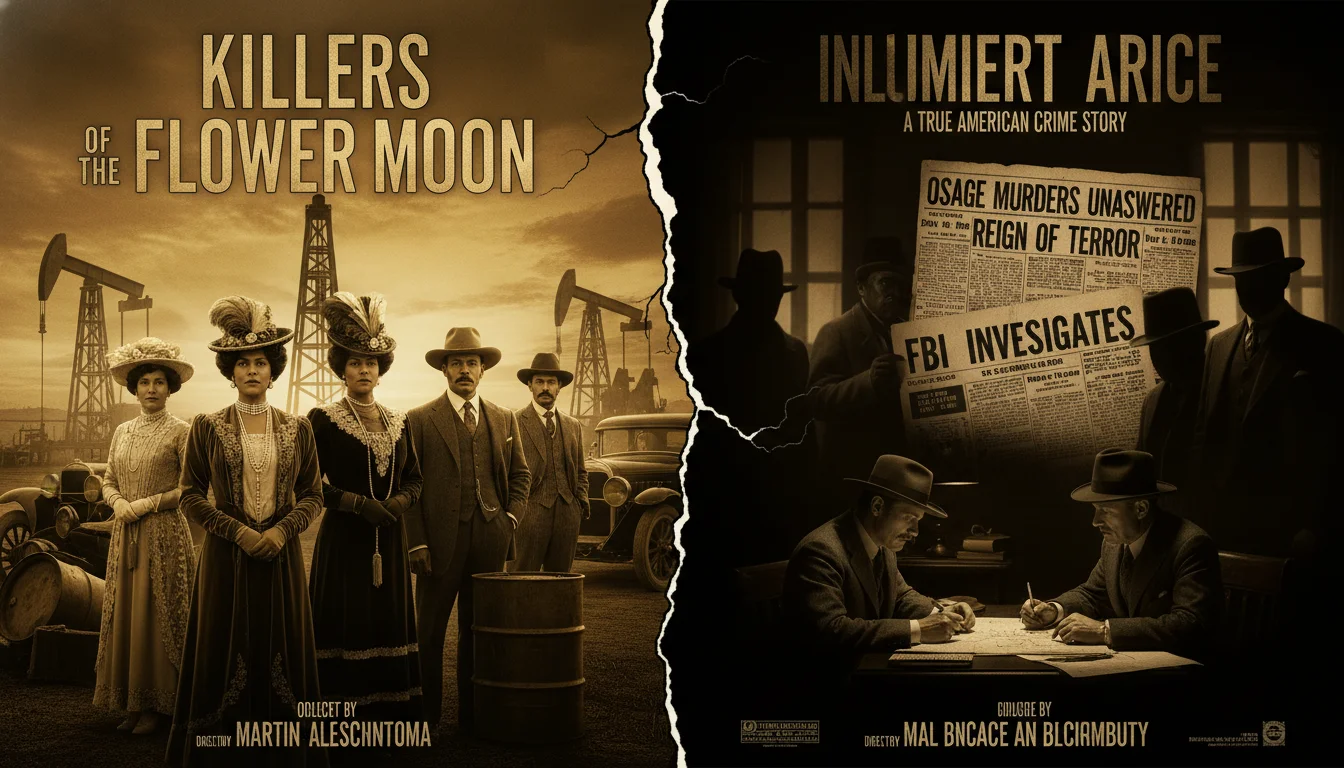
In 1920s Oklahoma, members of the Osage Nation were the richest people per capita in the world. Oil had been discovered beneath their reservation - land they had legally purchased from the Cherokee Nation specifically because it seemed worthless. By 1923, the Osage collectively received over $30 million in oil payments, equivalent to more than $400 million today.
Then they started dying. One by one, in ways that couldn't possibly all be coincidental - shootings, poisonings, explosions. The newspapers called it the "Reign of Terror."
Martin Scorsese's 2023 epic Killers of the Flower Moon, starring Leonardo DiCaprio, Robert De Niro, and Lily Gladstone, brings this largely forgotten chapter of American history to the screen. But how much of what we see is real, and where does Hollywood take creative liberties?
What Hollywood Got RIGHT
The Osage Were Systematically Targeted for Their Wealth
The film accurately depicts the historical reality that white settlers specifically targeted Osage individuals to steal their "headrights" - the legal certificates entitling them to oil royalties. The 2,229 mineral headrights allotted to enrolled Osage members became the focal point of a murder conspiracy that went far beyond what the film shows.
The movie correctly portrays how rancher William King Hale - who styled himself "King of the Osage Hills" - orchestrated a scheme to have his nephew Ernest Burkhart marry Mollie Kyle, whose family owned significant headrights. He then systematically eliminated her family members so those headrights would eventually flow to Ernest and, ultimately, to Hale himself.
The Murders Were Real - And Accurately Depicted
Anna Brown, shot and left in a ravine. Rita Smith, killed when her house was destroyed by five gallons of nitroglycerin. Lizzie Q. Kyle, slowly poisoned with a "peculiar wasting disease." Henry Roan, shot in the back of the head in his car after Hale fraudulently made himself the beneficiary of Roan's $25,000 life insurance policy.
All of these murders happened exactly as shown. The film even captures smaller details correctly - like how Mollie began to suspect she was being poisoned through her insulin injections (she was diabetic), and how she turned to her priest for help.
The FBI Investigation
The Bureau of Investigation (precursor to the FBI) did send former Texas Ranger Tom White, portrayed by Jesse Plemons, to investigate. White did assemble a team of undercover agents with fake identities - an insurance salesman, a cattleman, and an American Indian agent who could move undetected through the community. This was indeed one of the FBI's first major murder cases.
Ernest Burkhart's Complicity
The film shows Ernest helping to set up the explosion that killed his own sister-in-law Rita Smith. Historical records confirm this. More disturbing still: according to David Grann's book, Mollie and her children were supposed to be inside that house that night but stayed home because one child was sick. If true, Ernest may have been willing to murder his own wife and children.
Local Law Enforcement Was Corrupt and Useless
The movie accurately portrays local authorities as either corrupt or indifferent. The real sheriff reportedly ran a brothel out of his jail. This is why oilman Barney McBride - who had aligned himself with the Osage and earned their trust - traveled to Washington D.C. to urge federal intervention. He was murdered for it, stabbed more than 20 times after someone placed a burlap sack over his head.
What Hollywood Got WRONG
Robert De Niro Is 30+ Years Too Old
The most glaring visual inaccuracy: Robert De Niro was in his late 70s during filming, while the real William King Hale was in his 40s during the Reign of Terror. This dramatically changes our perception of the character, making him seem like a weathered patriarch rather than the cunning, middle-aged manipulator he actually was.
The Paddling Scene Never Happened
There's a dramatic scene where Hale paddles Ernest with a large wooden implement after a botched assassination plan. This is pure Hollywood invention - it doesn't appear in Grann's book. The film uses it to emphasize Ernest's subservience to his uncle, but there's no historical evidence it occurred.
Mollie Never Met President Coolidge
The film shows Mollie and a group of Osage traveling to Washington D.C. to plead for help, where she meets President Calvin Coolidge. This never happened. While Osage leaders did petition for federal assistance, there's no evidence Mollie personally met with the president.
The Jail Cell Confrontation Is Fictional
The intense scene where Ernest learns of his child's death and confronts his uncle through jail cell bars, declaring he's done being a patsy, never happened. In reality, the only place the two men encountered each other during the trial was in court.
The Film Dramatically Underplays the Scale
Here's the film's most significant distortion - not what it shows, but what it leaves out. By focusing on Hale's conspiracy against the Kyle family, the movie implies this was an isolated scheme by one evil mastermind.
The truth is far darker.
David Grann's research revealed evidence of a "vast criminal operation that was reaping millions and millions of dollars." Between 1921 and 1923, at least 13 other Osage died who had white guardians appointed by the courts - guardians who would inherit their land upon their deaths. By 1925, no fewer than 60 wealthy Osage had perished. The Bureau of Investigation discovered a "low-level market for contract killers" operating in the area.
The murders extended well beyond William Hale. There were possibly hundreds of unsolved killings. The film presents Hale as the villain; the truth is that Hale was just one particularly brazen perpetrator in a system designed to exploit and murder indigenous people with legal impunity.
The Question of Ernest's Knowledge
The film shows Ernest knowingly poisoning his wife. Historical evidence is less clear. Grann's book suggests Ernest may not have known what was in the vials he was giving Mollie - that Hale may have kept him in the dark, providing "plausible deniability." However, Ernest also reportedly gave Mollie whiskey laced with poison, which suggests deeper complicity.
The movie takes a definitive stance where history offers ambiguity.
The Uncomfortable Truth
Perhaps the film's most significant omission isn't a scene or a character but a systemic reality. The Osage murders happened because of the "guardianship" system - a racist legal framework that assumed Native Americans couldn't manage their own wealth and appointed white "guardians" to do it for them.
These guardians were local white lawyers and businessmen who would inherit the Osage's land and mineral headrights upon their death. It wasn't just murder - it was murder backed by legal infrastructure designed to facilitate theft from indigenous people.
As Osage language consultant Christopher Cote noted at the film's premiere: "When somebody conspires to murder your entire family, that's not love. That's beyond abuse." He expressed concern that the film, by focusing on the Ernest-Mollie relationship and suggesting Ernest genuinely loved his wife, obscured the fundamental nature of what happened: genocide in service of greed.
Historical Accuracy Score: 7/10
Killers of the Flower Moon is remarkably faithful to documented history in its major beats - the murders, the methods, the investigation, the perpetrators. Scorsese clearly did his homework, and the collaboration with Osage tribal members and historians shows in the cultural details.
Where it falters is in scope. By narrowing focus to create a coherent three-hour narrative, the film risks making the Reign of Terror seem like the work of one particularly evil family rather than a systemic campaign of genocide enabled by American legal and social structures. The fictional scenes - the paddling, the presidential meeting, the jail confrontation - serve dramatic purposes but muddy the historical record.
Still, for bringing this suppressed history to millions of viewers who had never heard of it, the film succeeds. The Osage trusted Scorsese to tell their story for a reason. For other Scorsese historical crime films put to the fact-check, see Gangs of New York vs. History; for another film handling indigenous American history, see Apocalypto vs. History.
As an elderly Osage woman quoted in Grann's book said: "The blood cries out from the ground. All these years later, perhaps those cries will finally be heard."
They're being heard now.

Debate the Accuracy with the Real Figures
Ask the real people what Hollywood got wrong about their lives.
Create your free account →No card required. Some figures and features require a paid plan.
Join the HistorIQly Club
Get smarter about the past.
Weekly stories, deep dives, and exclusive content straight to your inbox.