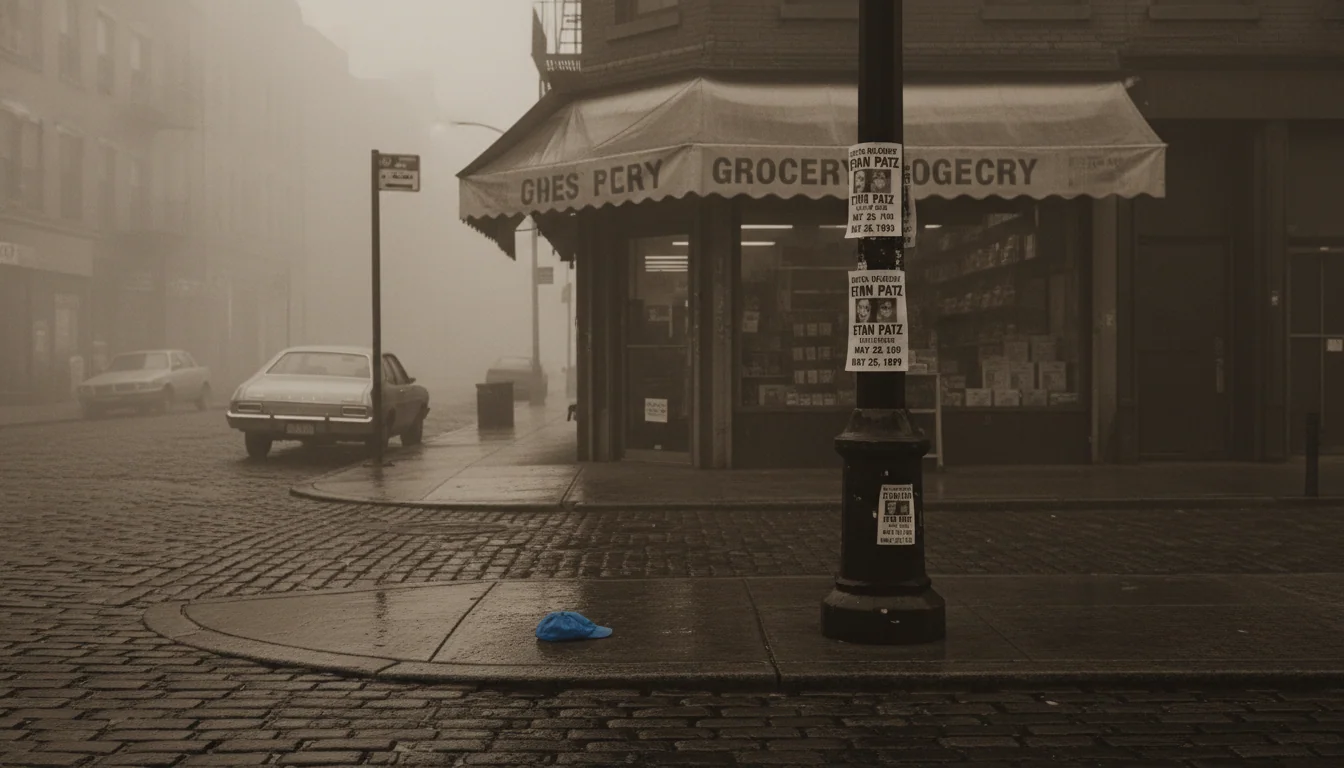
The Kidnapping of Charley Ross: America's First Ransom Case Changed Everything
Charley Ross, America's first ransom kidnapping victim, vanished in 1874 and was never found. His case gave America the warning parents still tell children today.
Read Wikipedia
The phrase has passed down through generations of American parents, so familiar it feels timeless: "Don't take candy from strangers."
Few people know that this warning has an origin story - and it begins with a four-year-old boy named Charley Ross, a hot summer day in Philadelphia, and a crime so shocking that it would haunt a nation for over a century.
The Men in the Carriage
July 1, 1874, was a typical summer afternoon in Germantown, a prosperous section of Philadelphia where tree-lined streets and stately homes suggested safety and permanence. Christian K. Ross, a dry goods merchant, lived with his wife Sarah and their children in one such home on East Washington Lane.
That afternoon, four-year-old Charley and his five-year-old brother Walter were playing in the front yard when a horse-drawn carriage pulled up. The two men inside were not strangers - not exactly. They had been visiting the neighborhood for several days, always with candy for the children, always friendly and familiar.
This time, they offered more: fireworks for the upcoming Independence Day celebration, if the boys would just take a short ride with them.
The boys climbed in.
The carriage wound through Philadelphia's streets until it stopped at a store. One of the men - later identified as Joe Douglas - handed Walter twenty-five cents and told him to go inside and buy some fireworks. Walter did as he was told.
When he came out, the carriage was gone. His brother Charley was inside it.
Walter Ross walked home alone, four miles through the city, and told his parents that Charley had driven away with the nice men.
He was telling the truth. And it was the last time anyone in the Ross family would ever see Charley.
The Ransom Notes
Christian Ross initially believed his son had simply gotten lost. He searched the neighborhood, contacted the police, and placed advertisements in local newspapers. But on July 3, two days after the disappearance, a letter arrived that shattered any hope this was a simple misunderstanding.
The letter was written in a semi-literate scrawl, words misspelled and grammar mangled in a way that seemed almost theatrical:
"yu wil have two pay us befor yu git him from us, and pay us big."
The kidnappers demanded $20,000 - approximately $500,000 in today's money. They warned against police involvement and threatened the child's life if Christian did not cooperate.
There was just one problem: Christian Ross was nearly bankrupt. The family lived in a large house that projected wealth they no longer had, having lost everything in the financial Panic of 1873. The kidnappers had assumed they were targeting a rich man. They were wrong.
Over the following months, more than twenty ransom notes arrived, each more threatening than the last. Christian contacted the police. The story exploded across American newspapers. The Pinkerton Detective Agency was hired. Millions of flyers were printed with Charley's likeness. A popular song, "Bring Back Our Darling," played in parlors across the nation.
Multiple attempts were made to deliver ransom money as instructed in the letters, but each time the kidnappers failed to appear. Eventually, the letters stopped coming entirely.
The nation watched. The nation waited. Charley Ross did not come home.
Death in Brooklyn
The break came five months later - and it came with blood.
On the night of December 13, 1874, two men broke into the home of Judge Charles Van Brunt in Bay Ridge, Brooklyn. The judge's brother Holmes, who lived next door, gathered armed members of his household and confronted the burglars inside the darkened house.
In the gunfight that followed, both intruders were shot. Bill Mosher died instantly. Joe Douglas, mortally wounded, lived another two hours.
In those final hours, Douglas made what appeared to be a deathbed confession. The exact words remain disputed - everyone present was shaken and their accounts varied. But the essence was clear: Douglas admitted that he and Mosher had kidnapped Charley Ross. He may have said Mosher knew where the boy was. He may have said the child was dead.
What he did not say was where Charley could be found.
When little Walter Ross was brought to view the bodies, he identified them immediately. Mosher, with his distinctively malformed nose - the "monkey nose" that Walter had described to police - was unmistakable.
The kidnappers were dead. But Charley was still missing.
The Accomplice
William Westervelt, a former Philadelphia policeman and Mosher's brother-in-law, was arrested as a suspected accomplice. The evidence against him was thin - Walter Ross insisted Westervelt was not one of the men in the carriage - but he had been close to Mosher and may have known the boy's location.
At trial in 1875, Westervelt was acquitted of kidnapping but convicted of conspiracy. He served six years in prison, maintaining his innocence to the end. He swore he did not know where Charley Ross was.
If he did know, he took the secret to his grave.
A Father's Search
Christian Ross spent the rest of his life looking for his son.
In 1876, he published a book, The Father's Story of Charley Ross, the Kidnapped Child, using the proceeds to fund his ongoing search. He and his wife interviewed over 570 people who claimed to be the missing child - boys, teenagers, and eventually grown men from around the world.
All were imposters.
The Rosses spent approximately $60,000 (over a million dollars today) searching for Charley. Christian died in 1897, still looking. His wife Sarah died in 1912, having never stopped hoping.
By 1924, the fiftieth anniversary of the kidnapping, Walter Ross was a middle-aged stockbroker still receiving letters from men claiming to be his long-lost brother. "We've long ago given up hope that Charles ever would be found alive," he told reporters.
The Man Who Said He Was Charley
In 1934, a 69-year-old carpenter named Gustave Blair petitioned an Arizona court to recognize him as the real Charley Ross. He claimed he had been held in a cave after his abduction and was eventually adopted by a man who told him his true identity.
Walter Ross dismissed Blair as "a crank." But when his claim went uncontested - the Ross family refused to participate in the proceedings - the court ruled in 1939 that Gustave Blair was legally "Charles Brewster Ross."
The Ross family never accepted him. They never gave him a penny.
Blair died in 1943, still claiming to be Charley. In 2011, DNA testing finally proved he was born into a family named Miller and could not possibly have been the kidnapped child.
The case remains officially unsolved.
The Legacy
The kidnapping of Charley Ross changed America in ways that persist to this day.
The expression "don't take candy from strangers" entered the national vocabulary because of what happened on East Washington Lane in 1874. The Charley Project, one of the nation's most comprehensive missing persons databases, is named in his honor.
Perhaps more significantly, the case served as a brutal warning to would-be kidnappers. The fate of Mosher and Douglas - shot dead during a burglary, unable to collect their ransom - combined with Westervelt's imprisonment, created a powerful deterrent. It was a quarter century before another high-profile ransom kidnapping made headlines, with the Edward Cudahy Jr. case in 1900.
As for what really happened to Charley Ross, we can only speculate. Did Mosher kill him to eliminate a witness? Was he sold to another party who raised him under a false name? Did he die of neglect while the kidnappers waited for a ransom that never came?
Joe Douglas might have known. Bill Mosher certainly did. But Douglas's confession was fragmentary and garbled, the last words of a dying man in a dark room full of people who had just shot him.
And Mosher - the one man who could have told the truth - died with a bullet in his heart and the secret locked forever behind his grotesque nose and his closed, dead eyes.
Charley Ross was four years old when he climbed into that carriage with the promise of candy and fireworks. He would be 155 years old today.
Somewhere, in some unmarked grave or forgotten place, the first child abducted for ransom in American history still waits to be found.
For more American cold cases that shaped the nation, see our investigations of the Colonial Parkway murders and the Burger Chef murders.

Want to Interrogate the Suspects?
Chat with historical figures and uncover the truth behind history's greatest mysteries.
Create your free account →No card required. Some figures and features require a paid plan.
Join the HistorIQly Club
Get smarter about the past.
Weekly stories, deep dives, and exclusive content straight to your inbox.