Cleopatra vs. History: Hollywood's Most Expensive Flop Gets the Queen Wrong
Cleopatra 1963 historical accuracy: Taylor's iconic epic got the queen's intelligence right but wrong on her appearance, the Egyptian language, and Antony's competence.
The 1963 epic Cleopatra starring Elizabeth Taylor remains one of the most infamous productions in Hollywood history. With a budget that ballooned to $44 million (over $400 million today), lavish sets, 65 costume changes for Taylor, and a scandalous on-set romance between Taylor and Richard Burton, the film became a legend before it even premiered.
But beyond the production drama and Taylor's iconic performance, how much of the actual history did they get right?
What Hollywood Got RIGHT
1. Cleopatra Was Politically Brilliant
The film correctly portrays Cleopatra VII as a shrewd political strategist, not just a seductress. She spoke nine languages, was educated in mathematics and philosophy, and ruled Egypt for 21 years - longer than many of her Roman contemporaries held power.
Historical accuracy: ✅ Spot on. Ancient sources describe her intelligence and political acumen, not just her beauty.
2. The Carpet/Rug Entrance to Caesar
One of cinema's most famous scenes shows Cleopatra rolled up in a carpet and delivered to Julius Caesar. This actually happened - though probably in a linen sack or bedroll, not an ornate Persian rug.
Historical accuracy: ✅ Based on Plutarch's account, though the "carpet" was likely more practical.
3. The Battle of Actium Was a Disaster
The film shows Cleopatra and Mark Antony's naval defeat at Actium (31 BC) as the beginning of the end. History agrees - Octavian's forces crushed their fleet, forcing them to flee back to Egypt.
Historical accuracy: ✅ The strategic outcome is correct, though the film simplifies the battle.
4. Cleopatra's Death by Asp
The iconic suicide scene with a venomous snake (asp) follows the ancient legend. While we'll never know for certain how she died, the asp story was widely believed in antiquity.
Historical accuracy: ✅ Historically plausible, though modern historians debate whether it was poison instead.
What Hollywood Got WRONG
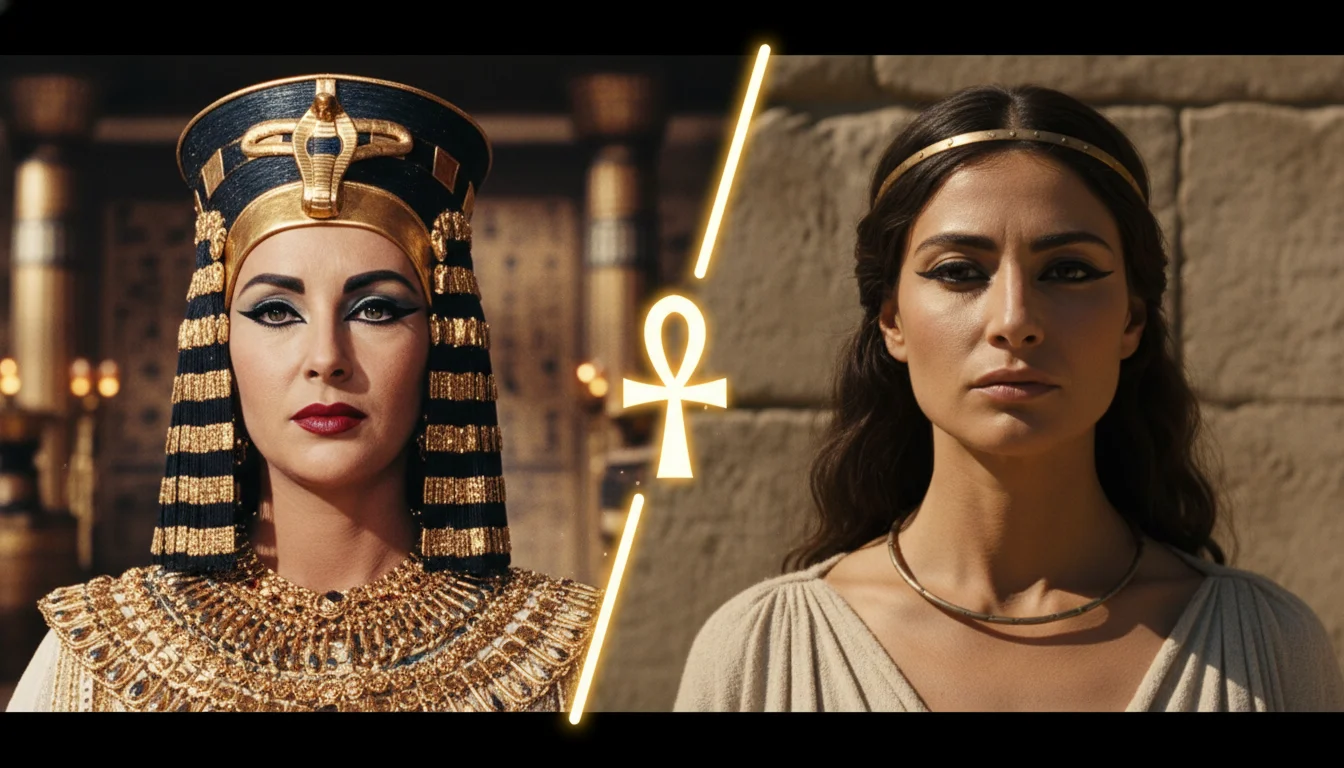
1. Elizabeth Taylor Looks Nothing Like the Real Cleopatra
Here's the uncomfortable truth: Cleopatra was Greek, not Egyptian. She was a descendant of Ptolemy I, one of Alexander the Great's generals. Coins and busts show a woman with a prominent nose, strong chin, and Mediterranean features - not Elizabeth Taylor's violet eyes and Hollywood glamour.
Historical accuracy: ❌ The casting prioritized star power over historical authenticity.
2. The Lavish Egyptian Aesthetic is Mostly Wrong
The film's over-the-top Egyptian sets, costumes, and Art Deco-meets-pharaonic design are pure Hollywood fantasy. By Cleopatra's time (1st century BC), Alexandria was a cosmopolitan Greco-Roman city, not an ancient pharaonic capital.
Historical accuracy: ❌ The visual style belongs to Egypt 1,000+ years earlier.
3. Cleopatra Wasn't a Tragic Romantic
While the film frames Cleopatra as a woman destroyed by love for Mark Antony, the reality was more pragmatic. Her relationships with Caesar and Antony were political alliances designed to preserve Egypt's independence and her dynasty's power.
Historical accuracy: ❌ She was a calculating politician, not a lovestruck romantic.
4. The Roman Senate Scenes are Pure Drama
The film depicts Caesar's assassination with Cleopatra present in Rome and emotionally involved. In reality, she was likely back in Egypt by the Ides of March (March 15, 44 BC), having left Rome after Caesar's legislative agenda stalled.
Historical accuracy: ❌ Cleopatra wasn't present for Caesar's murder.
5. Mark Antony's Character is Oversimplified
Richard Burton's Antony is portrayed as a simple soldier, a drunk, and a fool for love. The real Marcus Antonius was a skilled general, a powerful triumvir who controlled the Eastern Roman Empire, and a politician who nearly matched Octavian.
Historical accuracy: ❌ Antony was far more competent than the film suggests.
6. The Timeline is Compressed
The film condenses 13 years of history (48 BC to 30 BC) into a few dramatic sequences. Cleopatra's reign, her relationship with Caesar, the birth of Caesarion, Caesar's death, her alliance with Antony, and the final war with Octavian all blur together.
Historical accuracy: ❌ The pacing sacrifices historical depth for drama.
7. The "Egyptian" Language is Gibberish
When characters speak "Egyptian" in the film, it's a made-up language created for the production. The real Cleopatra spoke Greek (the official language of the Ptolemaic court) and possibly Demotic Egyptian, not hieroglyphic chants.
Historical accuracy: ❌ Pure invention.
The Biggest Missed Opportunity
What the film completely ignores: Cleopatra was the last pharaoh of Egypt and the end of a 3,000-year-old civilization. Her death in 30 BC marked Egypt's annexation by Rome and the extinction of the Ptolemaic dynasty. This epochal historical moment gets lost in the romance.
Historical Accuracy Score: 5/10
What works: The film captures Cleopatra's intelligence, political skill, and the broad strokes of her alliances with Caesar and Antony.
What doesn't: The visual aesthetic is wrong, the characterizations are oversimplified, and the love story overshadows the political tragedy.
The Verdict
Cleopatra (1963) is a Hollywood spectacle first, history second. Elizabeth Taylor's performance is iconic, the production is legendary, and the drama is timeless - but if you want to understand the real Cleopatra, you'll need to look beyond the eyeliner and asp.
The real queen was smarter, more Greek, and far more politically ruthless than Hollywood ever showed. For other ancient world epics graded for accuracy, compare Ben-Hur (1959) vs. history and Alexander vs. history.
Want the real story? Check out Stacy Schiff's Pulitzer Prize-winning biography "Cleopatra: A Life" or Mary Beard's "SPQR" for the Roman context.

Debate the Accuracy with the Real Figures
Ask the real people what Hollywood got wrong about their lives.
Chat with HistoryJoin the HistorIQly Club
Get smarter about the past.
Weekly stories, deep dives, and exclusive content straight to your inbox.